Chapter 2 section 3
 Call Kai
 Learn
Learn Practice Test
 Spaced Repetition
 Match
Match Flashcards
 Knowt Play
1/75

There's no tags or description
Looks like no tags are added yet.
Name | Mastery | Learn | Test | Matching | Spaced | Call with Kai | Chat |
|---|
No analytics yet
Send a link to your students to track their progress
76 Terms
the fucntion of the respiratory system is toe xhcange gases with the?
cardiovascular system
teh respiratory system involves both?
External respiration and internal respiration
what the diffrence between external and internal?
External is the excahnge of gases between the atmosphere and the blood
Internal its the exchnage of gases between the blood and the cells of the body
why do we need oxygen for energy?
We need oxygen to breakdown glucose and form atp
by which procces is glucose broken down?
Aerobic respiration
excees carbon dioxide produced by waste of aerobci respiration is toxic to cells and its removed from the cells by?
internal respiration
if body to atmosphere or atmosphere to body or blood its external. But when the name cell is mentioned ints?
internal
lung is the site of? so is it external or internal?
gas exchange between the atmosphere and blood, its external
the lungs are located insode which cavity? Bounded by the? And the>??
thoracic, rib cage diaphragm
the lungs are divided into right and left which lung has 3 diviisons or lobeS? Which one has 2 and which one is heavier?
right has 3 lobes and its slightly heavier
what lines the entire thoracic cavity? which means it also covers?
pleuara membrane, teh lungs
pleaue is contains how many membranes? Whatdoes it do?
2 membranes it secrets a slippery fluid that decreases friction from the movement of the lungs during breating
the path of air?
mouth/nose pharynx larynx trachea bronchus bronchioli alveoli blood stream or capilaries
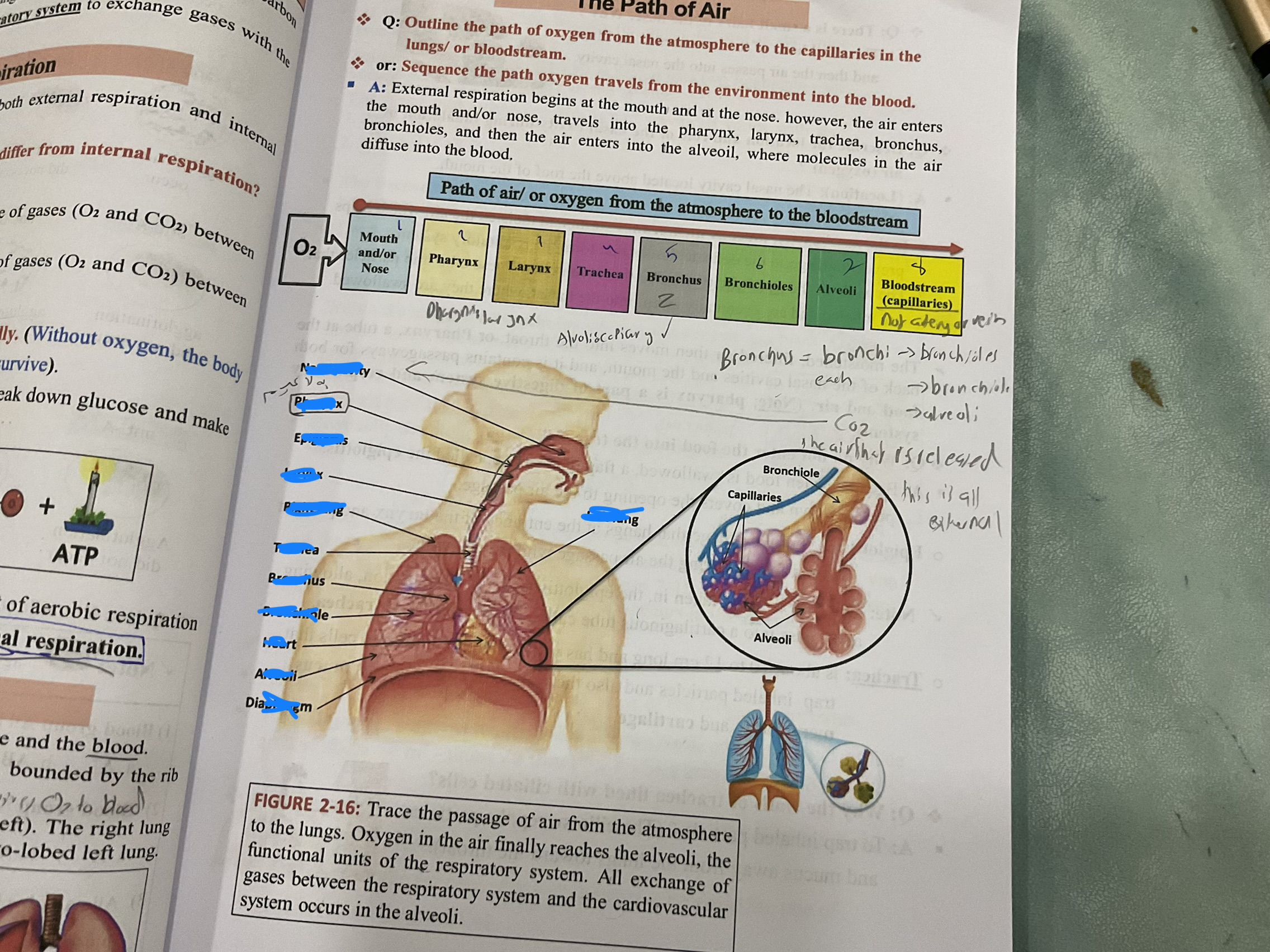
Al exchange of gases between respiratory system and cariovascular sytem occures in the?
alveoli
why are there small hair in the nose?
For filtering
what is the role of nasal cavity
First where is it located?
Functions?
roof of our mouth
1 warm and moisten the air which helps prevent damage to delicate tissues that form in the respiratory system
2 they are also line with cillia these cillia trap particlea that are inhaled and are evntaully swept into the throat where they are swalloed
pharynx is a tube at the back of nasal cavity and the mouth and it contains passage ways for both? Which means its the part of which two systems?
Food and air , respiratory and digestive
why doesnt food enter the treachea. Because when food is swalloed a flap of ….. called the ….. presses down and covers the opening to the air passage
Cartilage, epiglotis,
epiglotis is a flap of cartilage that hangs at the entrance of the ….. and prevent food from enetring the …. Pasage while swallowing
larynx, air
when air is taken in the epiglotis is in an ….... position allowing air to pass into ……… tube called the ……. Or …..
upright, windpipe and trachea
trachea is about .. to .. cm long and has walls lined with ….. cells that trap inhaled particles and also the wall of trachea contains ….. …. And ……
10-12 cilliated, muceous membrane, cartilage
Why do trachea wals have cillia it takes what and what to the throat?
mucus and trapinhaled particles to the thrroat
at the uppper end of trachea or upper larynx there is?
box/vocal cords
sounds are prodcued when air is forced past two …. Which those ligaments are they stretch across the …..
the vocal cords , larynx
the pitch and volume of the sound produced varies with the?
amount of tension on the vocal cords
Amount of air being forced past them
the trachea then branches into two …. each of which leads to a ….
bronchi , lung
the walls of bronchi consists of …. Muscke and …… and are lined with …. And ,…
smooth muscle, cartilage cillia and mucus
the bronchi turn into smaller tubes known as bronchioles they contain …. Muscle and also lined with …. And …. And what dont they have?
they dont have cartiligenous tissue
so which ones have cartligenous mucus and cilia?
The trachea and nasal cavity and the bronchi
which ones have smooth muscle cillia and mucus?
only bronchi and bronchioles
eventually the bronchiles end in clusters of tiny air sacs called? As singular its called? what is bronchus called singular?
Alveoli, alvelous, bronchi
alveoli are clusters of tiny air sacs of the lungs found at the ends of ……. A networkm oof …. Sorounds each alveolous all exchange of gases in the lungs occures in the …..
are clusters of tiny air sacs of teh lungs … bronchioles, capilaries, alveoli
to faciliate this excahnge the surfgace area of the lungs is?
enormous
One healthy lungs consists of nearly … million alveoli and has a totals urface area of about ..m² about .. times the surface area of skin
300, 70, 40
why is the surafce area of alveoli so great?
to faciliate the procces of gas exchange
explain the procces of gas excahnge in the lungs
When air enter sthe lungs oxygen in teh air crosses the thin albveolour membrane aswell as the capilary walls and ….. in the blood
Oxygen diffuses from an area of?
disolves. Higher concentration in albveoli to an area of lower concenteration in the blood
carbon dioixde moves oppositly it enters the …… through its thin membranes
alveoli
why oxygen diffuses into the blood and carbon dioixe ddiffuses out of the blood?
cuz of concenteration gradient
the air from the atmosphere does it contain a little carbon dioxide?
yes it does
When oxygen diffuse sinto teh blood only a small amount remains dissolved in the ….. most of the oxugen 95-98% moves into the?
plasma, red blood cells
where in the red blood cells it combines with the ….. which its an ….. containing ….., and produce fast soluble compound that is called …….
hb iron protein, oxyhemoglobvin
each hemoglobin can hold how many irons? And each iron can hold how many oxygen molecules?
4, 1
that reaction ocures where? Wreite the reaction down?
the capilaries that sorounds the alveoli
Hb+4o2 - hbo8
when oxygenated blood goes to body tissues becasue of concenteration?
that oxygenated blood diffuses into the tissues and co23 diffuses into the blood
so that reaction ocures in? Write the reaction down
the capilaries that sorounds the blood
Hbo8- hb+4o2
if oxygen number is given and tells us how many hb? If opposite?
we divide oxygen by 4, we multiply oxygen by 4
co2 and o2 when they enter and leave our body is energy used up? Which procces do they use?
Nope, simple diffusion
then how does co2 get out?
its concenteration is higher in the cells so it diffuses out of the cell into the blood
what are the shapes of carbon dioxide in the blood?
7% disolves in the plasma
23% binds to hemoglobin
And 70% is carried in the blod as bicarbonate ions
co2 reaqcts with water and forms? Then it dicosiaites and formes?
carbonic acid, bicarbonate
where does both of those reactions ocures?
in the plasma of teh capilaries sorounded body cells
write the reaction down?
h2o+co2-h2co3-hco3-h
So most co2 ions travels in the blood as? when the blood reaches the lungs the reactions are ……, right down the reversed reaction
So where dopes this reaction happen?
bicarbonate ions , revererd, hco3+h-h2co3-h2oco3
This reaction ocures in the capilaries located saround the alveoli in the lungs
oxygen is mainly transported by …… while carbon dioxide is mainly transported as
hemoglobin, bicarbonate
normally arterial blood is about 98% saturated with oxygen what are the two conditions that could reult in lower oxygen saturation?
Emphysema and bronchitis, accept any logical answer that could result in less o2 reaching the blood or less o2 being carried by the blood
breating is the moving of air into and out of the lungs depending on the?
inspiration and expiration procceses
inspiration and expiration ar ethe two mechanism of breating
its the procces of taking air into the lungs
Ur ribcage expands and your rib muscles contracts
(The other rib cae contracts while rib muscles relax)
The diaohraghm contracts and flattens and pushes down on the abdomen
The volume of the lunsg increases
when our diaphraghm contracts what does our abdomin do?
it relaxes so its easier for the diaphraghm
a diaphraghm ios a large …… muscle that seperates teh thoracic and teh abdominal cavity and the muscles between the ribs are also ….. muscles they control the movement of the ….. cavity during ….. if these muscles were paralyzed then ……… and ……. Would not ocure
skeletal, skeletal , tharocic breathing, expiration and inspiration
greater volume = lower pressure so expaning teh lungs means greater volume which means inside of the lungs have lower pressure which means air enters the body
And the opposite is possible during eexpiration we make the lungs smaller inside of the lungs more pressure so oxygen is releasde
what things had elastic tissue mentione din our book?
arteries and lungs
why does a single celled organism not need a resiratory systm?
cuz the entire surafce of the ceell is exposed to its external enviromental this exposure alows the difusion and osmosius toi supply o2 and nutrients and remove wates from the cell
muscular changes and skeletal changes that take place when a person inhales?
the rib muscles contracts expanding the rib cage and teh diaphragm moves down
How can we control teh movement of thoracic cavity during breathing?
through the diaphragm and the muscles between the ribs
what are the only two involunatry skeletals?
the diaphraghm and teh muscles between the ribs
what afctors regulate the rate of breathing when co2 increases in our blood?
An increased level of co2 increases the blood stimulate nerve cells in the brain tio stimulate the diaphraghm o increase the breathing rate
the more the body needs oxygen the …. We breath, it does both
faster , eliminating co2 faster and getting more oxygen
respiratory is involuntary but we can? How?
make it voluntary for a little bit , by not breathing
the rate of breathing is controlled by? what does both of them do?
the brain and brain stem monitor the concenteration of co2 in the blood
brain controls diaaphragm and rib muscle while brain stem only controls diaphragm
as activity increases and high levels of co2 nerve cells stimuklate the brain and the brain stem tells the diaphragm to do its job faster
But when its back to normal levels the brain sends a signal to the respiratory system and tells it to calm down
a person can temporarily stop the respiratory system until u pass out and ur brain takes control again this is good for when u go swimming and when u sleep
the lymphatic system retunrs fluid that has collected in the?
tissues
does the damaged tissue have any relation to the blood clot formed?
only warning chemicals THOSE CHEMICALS DO NOT FORM THE BLOD CLOR ONLY THE REACTIONS OF PLATELATES DO
rate of breathing= nerve centers