8.3 monohybrid test cross, 8.2 pedigree, 8.4 genetic outcomes
 Call Kai
 Learn
Learn Practice Test
 Spaced Repetition
 Match
Match Flashcards
 Knowt Play
1/38

There's no tags or description
Looks like no tags are added yet.
Name | Mastery | Learn | Test | Matching | Spaced | Call with Kai | Chat |
|---|
No analytics yet
Send a link to your students to track their progress
39 Terms
Predicted genetic outcomes for:
•A single autosomal dominant gene
•A monohybrid test cross
•Sex-linked inheritance
Predicted genetic outcomes for: A single autosomal dominant gene
•Autosomal genes are those located on the autosomes (non-sex chromosomes).
•Offspring inherit two alleles of a single autosomal gene, one from each parent.
Predicted genetic outcomes for: A single autosomal dominant gene
•A monohybrid cross is a cross between individuals that have different pairs of alleles of one gene at a specific location.
•We can predict the outcome of the next generation if the genotype of the parent generation is known.
•
Predicted genetic outcomes for: A monohybrid test cross
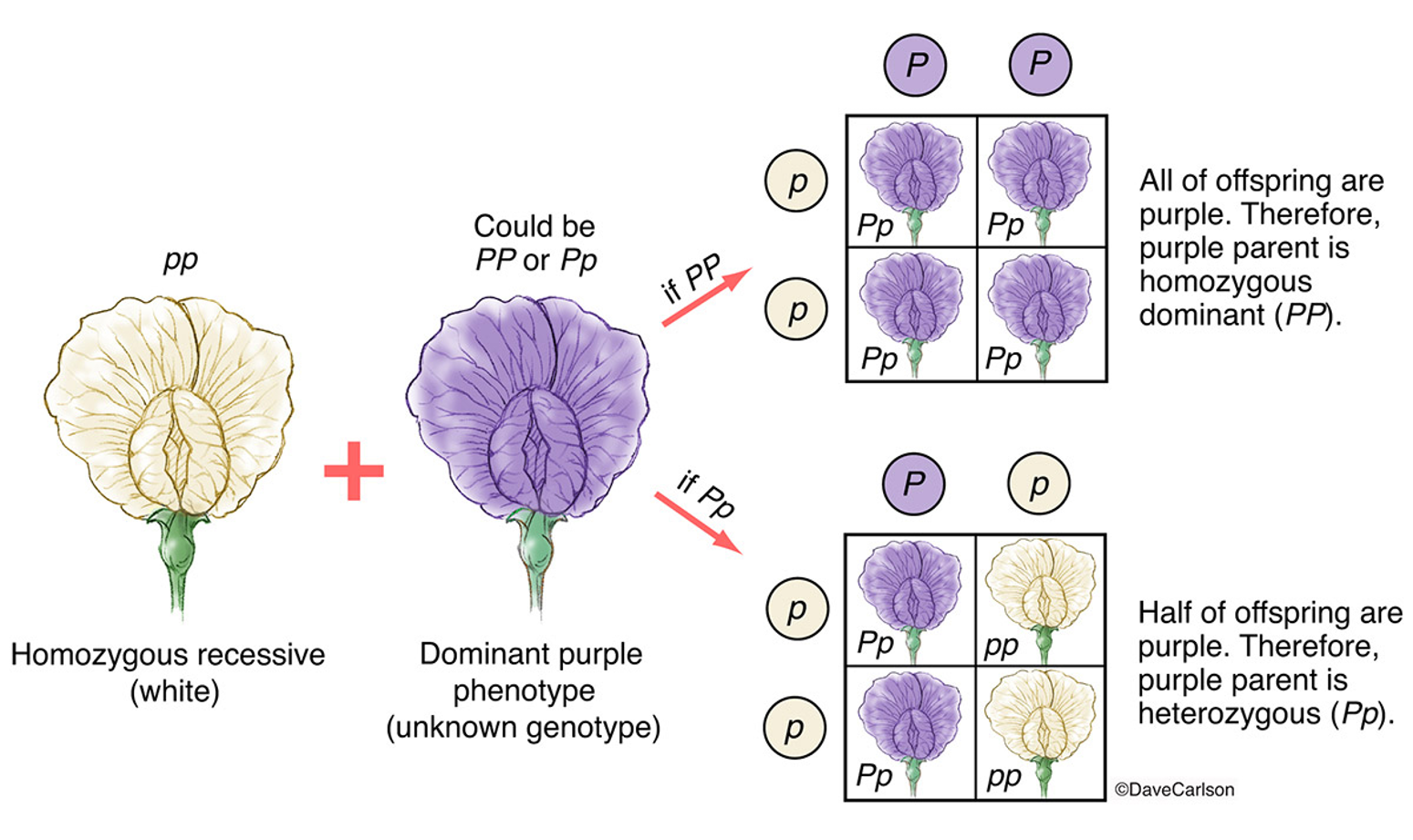
•How can we tell if an organism expressing a dominant trait is homozygous dominant or heterozygous?
•The individual expressing the dominant trait (with unknown genotype) is crossed with a homozygous recessive individual.
•Several offspring are bred and the phenotypic ratios will help determine the genotype of the origiginal individual.
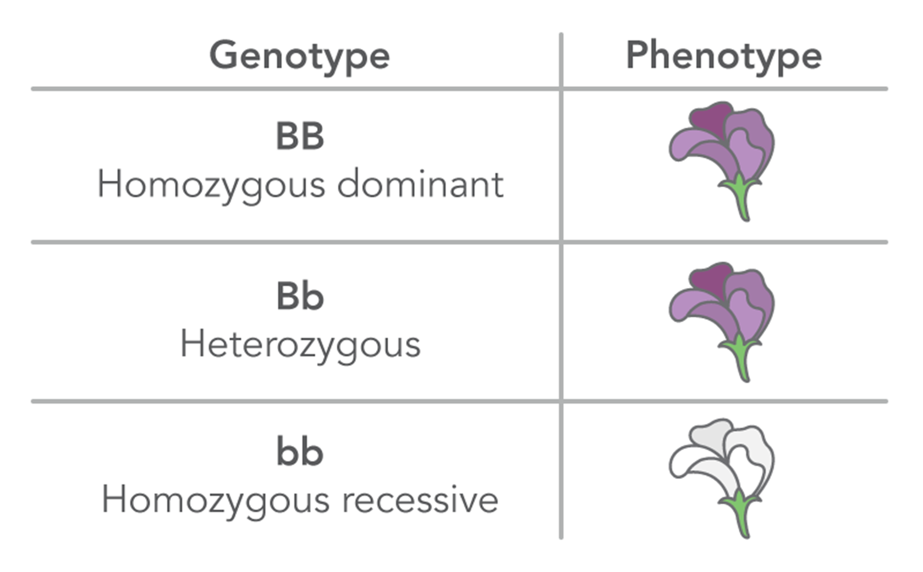
test cross
•Sex-linked inheritance
•X-linked recessive
•X-linked dominant
•Y-linked inheritance
Sex chromosomes
•The X chromosome has a region with genes that control female secondary sex characteristics and a region with genes that contain sex-linked genes.
•The Y chromosome contains some unique Y-linked genes that determine male secondary sex characteristics.
•
•Females will have two copies of each X-linked gene because they have two X chromosomes, whereas males will only have one copy of the X –linked gene on their one X chromosome.
•Inheritance involving genes on the X or Y chromosomes are described as sex-linked inheritance.
X-linked recessive inheritance
X-linked recessive inheritance occurs when a recessive allele is located on the X chromosome
•Red-green colour blindness and Haemophilia are examples of X-linked recessive conditions.
•Males are more likely to have these conditions as they only have one X chromosome – and therefore, only require one copy of the allele.
•
•Females on the other hand, will require two copies of the recessive Red-green colour blindness or Haemophilia alleles in order to have the condition…
X-linked dominant inheritance
•Heterozygous females will always show the phenotype.
•All affected individuals will have at least one parent with the phenotype.
•Males showing the phenotype will not pass the affected allele on to their sons (because sons inherit their father’s Y chromosome) but they will pass it on to all of their daughters.
X-linked dominant inheritance
Definition:
X-linked dominant inheritance occurs when a dominant allele is located on the X chromosome. Only one copy of the dominant allele is needed for a person to have the condition.
Key points
Males (XY): One dominant allele on the X chromosome → affected.
Females (XX): One dominant allele is enough to be affected.
Affected fathers pass the condition to all daughters but none of their sons.
Affected mothers have a 50% chance of passing the condition to each child, regardless of se
X-linked dominant inheritance
•Examples of X-linked dominant conditions:
•Vitamin D resistant rickets
•Bone deformity including short stature and bow-leggedness.
•Rett syndrome
•Impairments in language and coordination, slower growth, difficulty walking, and a smaller head size.
•Fragile-X Syndrome
•Mild-to-moderate intellectual disability. Physical features may include a long and narrow face, large ears and flexible fingers.
Y-linked inheritance
•Since Y-linked inheritance involves the Y chromosome, Y-linked inheritance is passed on from father to son.
•
•The most obvious phenotype associated with genes of the Y chromosome in male gender.
•‘Maleness’ in humans is determined by the SRY gene carried on the Y chromosome. Other Y linked genes are relevant to testis development and sperm production.
Y-linked inheritance
•Examples of Y-linked dominant conditions:
•Hypertrichosis of the ear
•A condition wherein there is a conspicuous growth of hair on the outside rim of the ear.
•Webbed toes
•A condition is characterized by having a web-like connection between second and third toes.
•PKU (phenylketonuria)
•A condition that causes an amino acid called phenylalanine to build up in the body. Untreated, it cann lead to brain damage, intellectual disabilities, behavioural symptoms or seizures.
•
Pedigrees
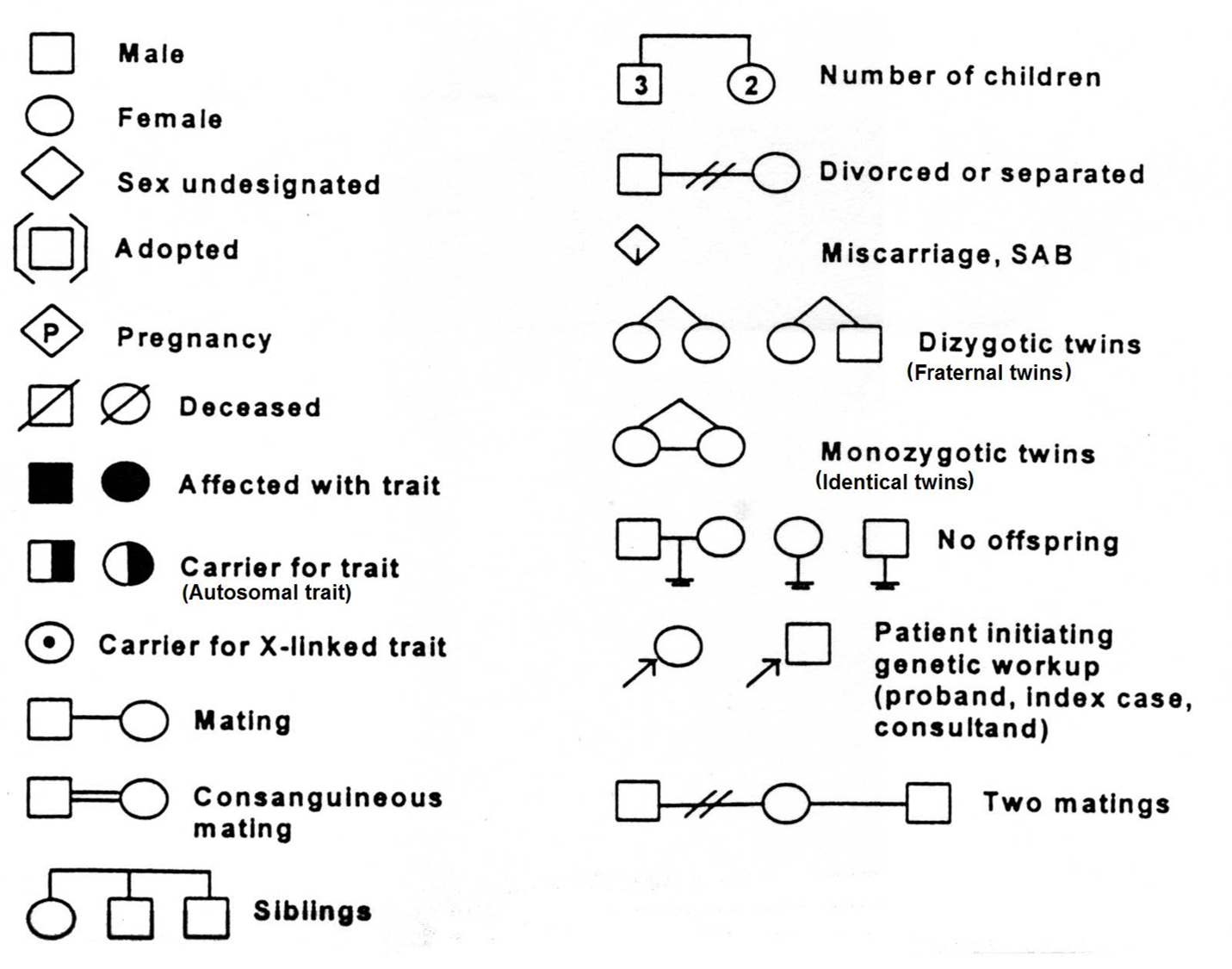
§A pedigree is a diagram of family relationships that uses symbols to represent people and lines to represent genetic relationships.
§Pedigrees are often used to determine the mode of inheritance (dominant, recessive, etc.) of genetic traits such as a disease or characteristic
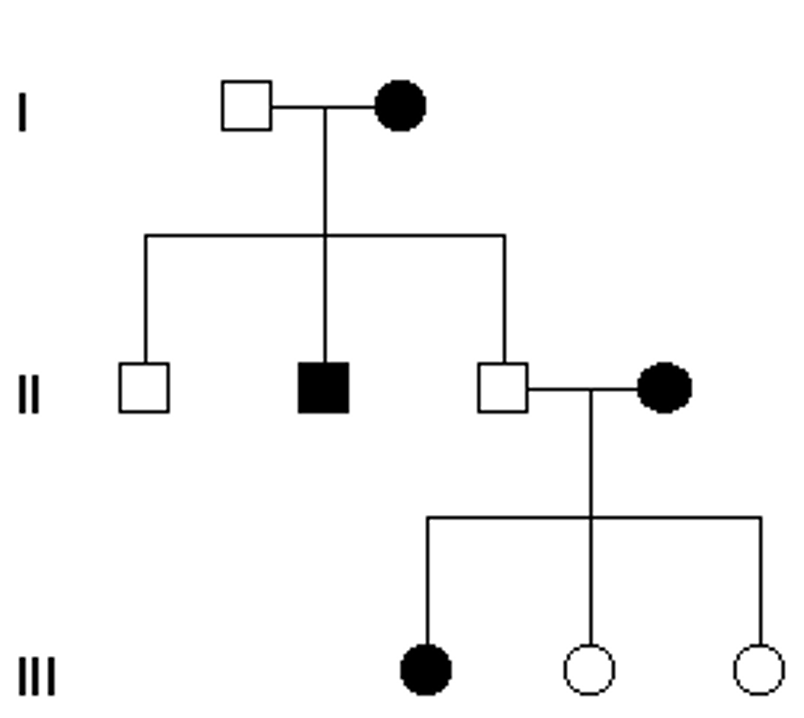
Pedigree symbols:

Pedigree lines:
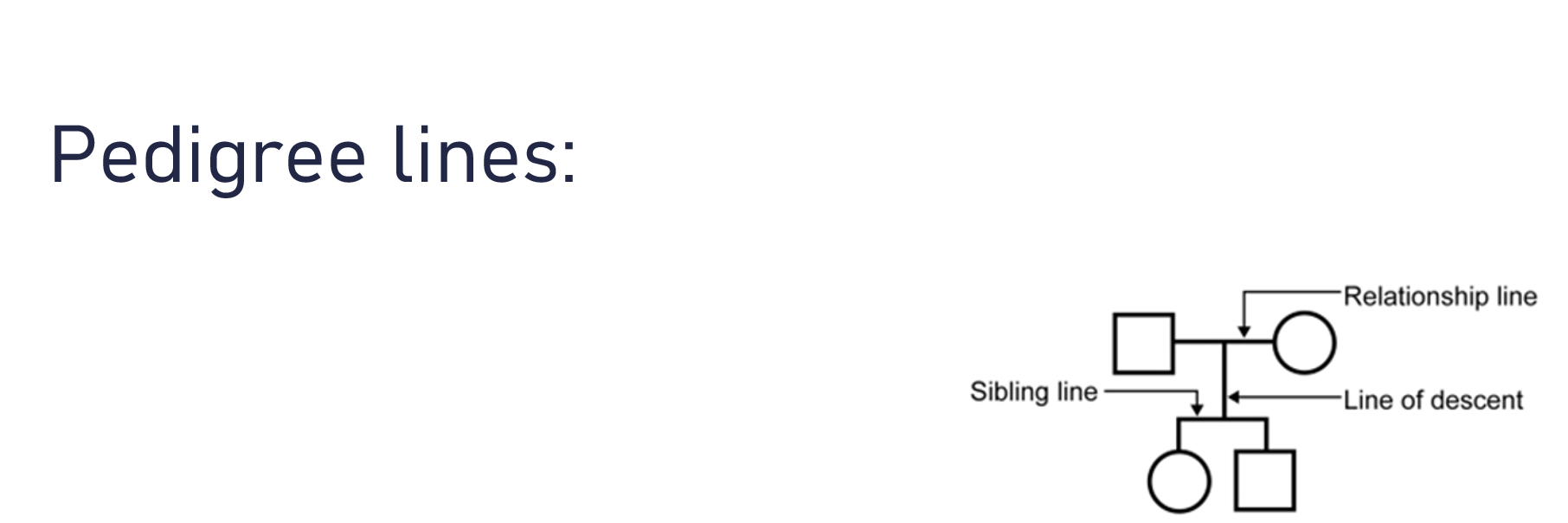
symbols
How to recognise: Autosomal recessive inheritance
•Likely if neither parent has the phenotype, but one of their offspring does.
•If both parents are affected, then all offspring are affected.
•Can also 'skip' generations i.e., it doesn't appear in every generation.
•However, it can still appear in every generation.
How to recognise autosomal recessive inheritance
Males and females are affected equally.
Can skip generations because parents may be unaffected carriers.
Affected children often have unaffected parents.
Two carrier parents have a:
25% chance of an affected child
50% chance of a carrier child
25% chance of an unaffected, non-carrier child
More common when parents are closely related (consanguinity).
Examples: Cystic fibrosis, Tay-Sachs disease, Fanconi anaemia.
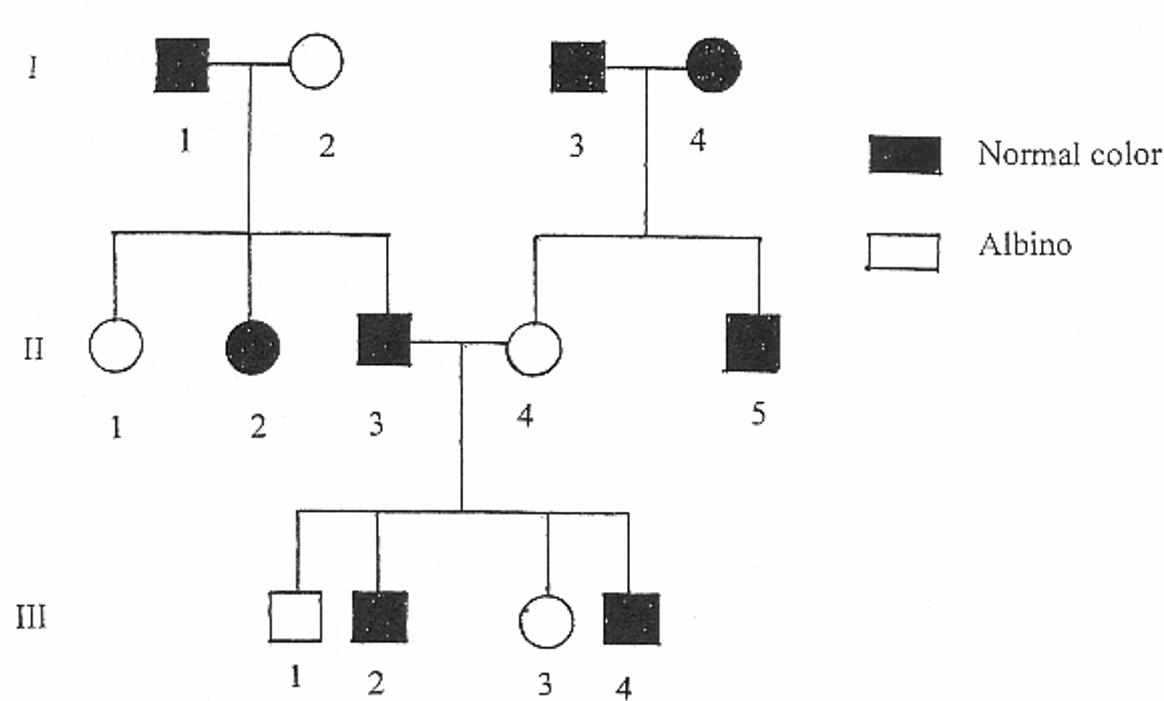
write the genotypes- •Use A for the dominant allele and a for recessive…
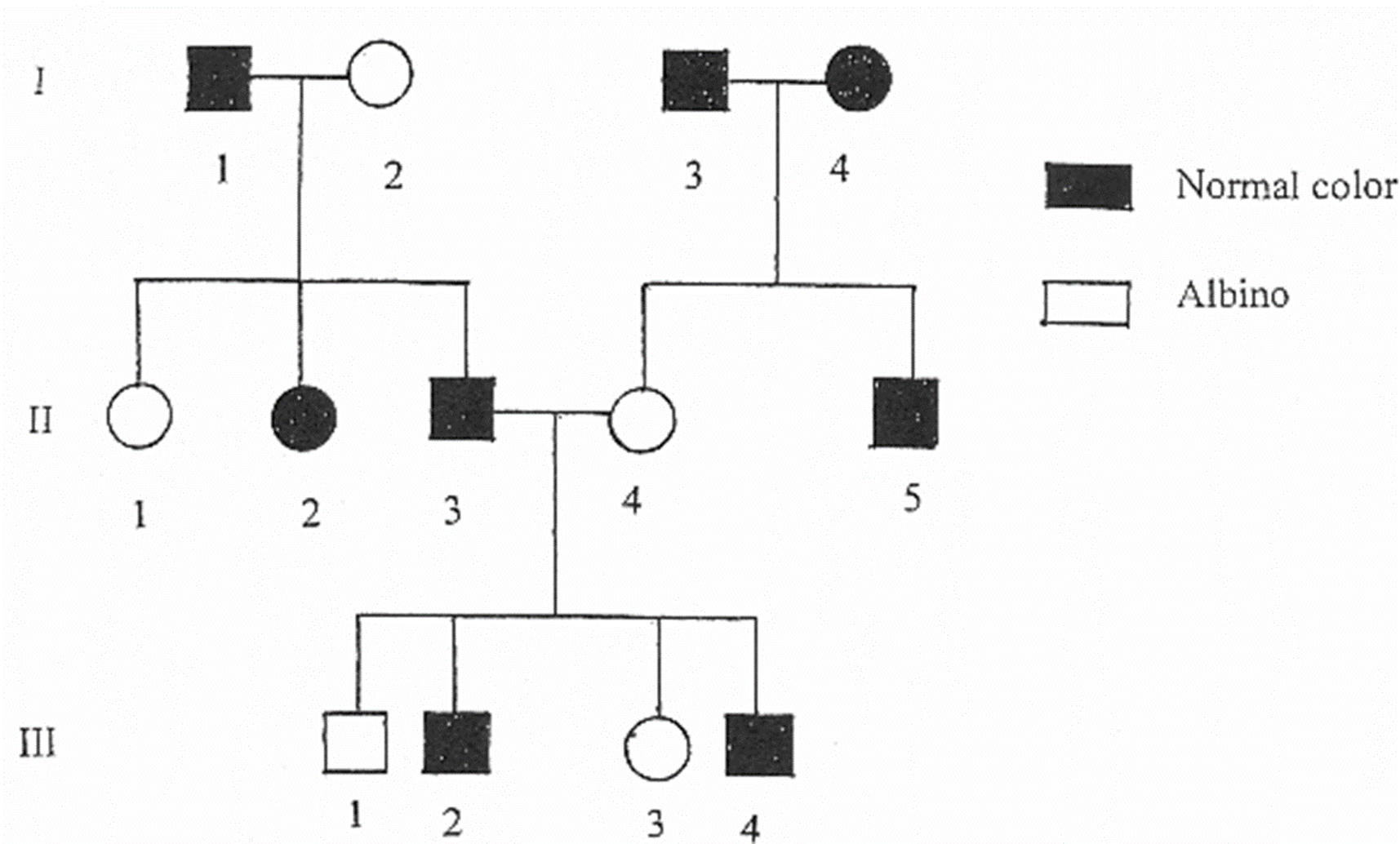
How to recognise: Autosomal dominant inheritance
•Likely if both parents display the phenotype, but their offspring don’t.
•Individuals with the trait will also have at least one parent with the trait.
•May also be seen in all generations.
How to recognise autosomal dominant inheritance
Males and females are affected equally.
Usually appears in every generation (does not skip generations).
An affected person usually has an affected parent.
An affected parent has a 50% chance of passing the condition to each child (if heterozygous).
Unaffected people do not pass on the condition (unless a new mutation occurs).
Examples: Huntington disease, Achondroplasia, Marfan syndrome.
How to recognise: X-linked recessive inheritance
•Affected mothers must have affected sons.
•Males are affected more than females because they only inherit one X chromosome.
•May not be seen in all generations.
How to recognise X-linked recessive inheritance
More males than females are affected.
Can skip generations because females can be unaffected carriers.
Affected males usually have carrier mothers.
No father-to-son transmission (fathers pass their Y chromosome to sons).
Affected fathers pass the allele to all daughters, who become carriers if the mother is unaffected.
Examples: Haemophilia, red-green colour blindness, Duchenne muscular dystrophy.
How to recognise: X-linked dominant inheritance
•The daughters of affected males will always be affected; however, their sons won't be.
•Affects more females than males (because female inherit two X chromosomes and therefore have twice the chance of inheriting the trait).
•The daughters of affected females will have a 50% chance of inheriting the trait.
How to recognise X-linked dominant inheritance
More females than males are usually affected.
Does not skip generations.
Affected fathers pass the condition to all daughters, but no sons.
Affected mothers have a 50% chance of passing the condition to each child.
Examples: Vitamin D-resistant rickets (X-linked hypophosphataemia), Rett syndrome.
How to recognise: Y-linked inheritance
•Will only affect males.
•All male offspring are affected,
•The trait is observed in every generation in which males are born.
question

Mendel further explained....
•Mendel also performed dihybrid crosses, where two characteristics were examined at a time.
•He knew that:
•Round seeds were dominant to wrinkled seeds
•Yellow seeds were dominant to green seeds
•Mendel crossed two pure bred plants
•Round, yellow seeds x wrinkled, green seeds
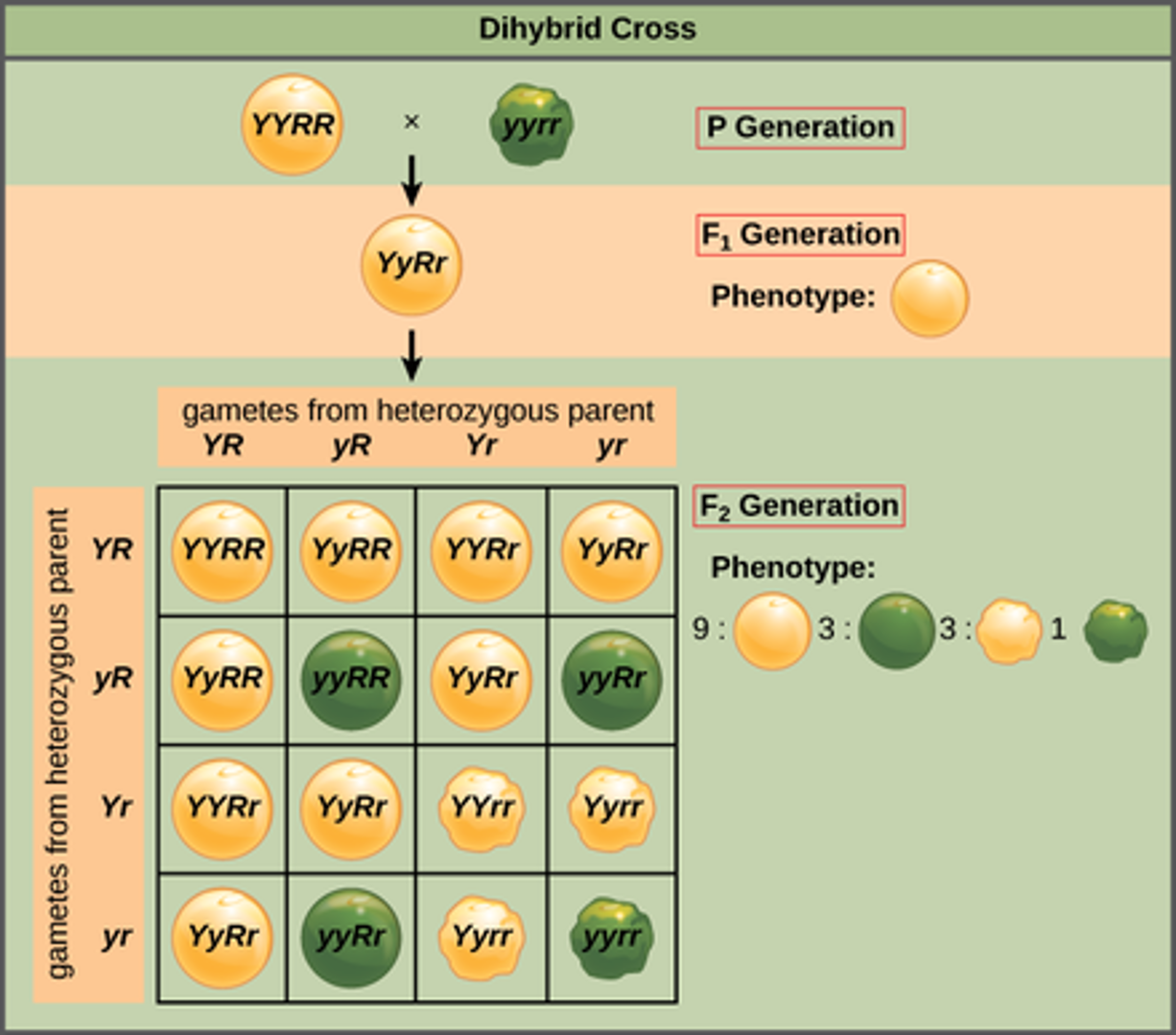
The ratio:
9:3:3:1
is called the dihybrid ratio…
Dihybrid crosses explained…
•Cross 1: Pure bred parents
•Phenotype: Round Yellow X Green Wrinkled
•Genotype: RRYY X rryy
•Gametes: RY x ry
•
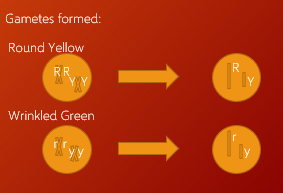
Results of cross 1:
•F1 Generation:
•Genotype: 100% RrYy
•Phenotype: 100% Round Yellow
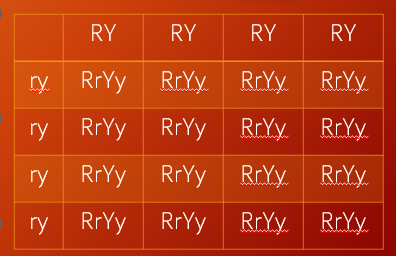
F1 Generation
•Possible gametes:

Dihybrid crosses continued…
•Cross 2: F1 Generation
•
•Phenotype: Round Yellow X Round Yellow
•Genotype: RrYy X RrYy
•Gametes: RY, Ry, rY, ry X RY, Ry, rY, ry
•
Results of cross 2:
•F2 Generation:
•Genotype:
•1 RRYY: 2 RRYy : 1 RRyy : 2 RrYY : 4 RrYy :1 rrYY : 2 rrYy : 1 rryy
•Phenotype:
•9 Round Yellow: 3 Round Green: 3 Wrinkled Yellow: 1 Wrinkled Green
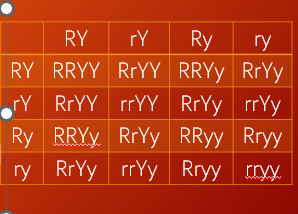
Significance of results
•Looking at each trait separately, Mendel’s ratio holds true:
•9:3:3:1
•This means that the two features behaved independently of each other.
•
•Mendel’s law of independent assortment.
•Each pair of factors can combine with either of another pair of factors…
•
Linked genes
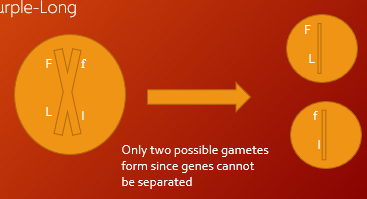
•Two genes are said to be linked if they are close together on the same chromosome.
•
•During meiosis, linked genes remain together in normal circumstances.
•Linked genes do NOT follow Mendel’s law of independent assortment.
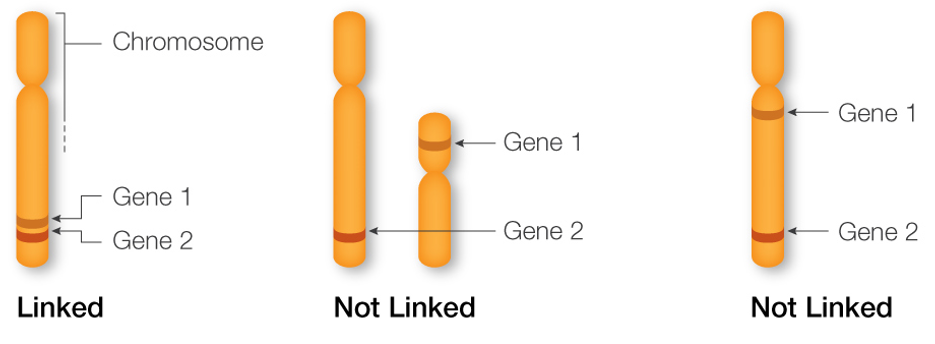
Dihybrid cross involving linked genes…
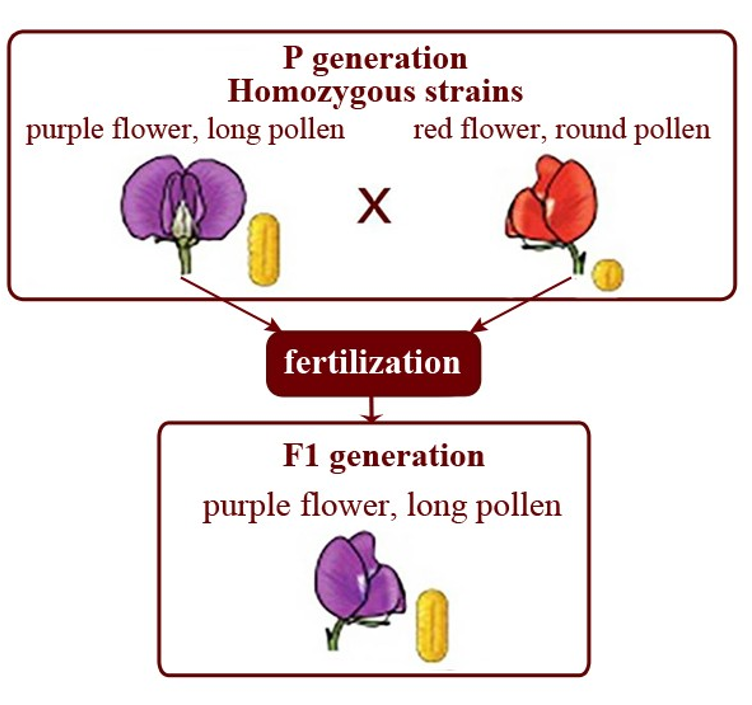
•In pea plants, flower colour and pollen shape are linked traits. Purple (F) is dominant to red (f) flower and long pollen (L) is dominant to round (l) pollen.
•
•Cross 1: Purebred parents
•
•Phenotype: Purple-Long X Red-Round
•Genotype: FFLL X ffll
•Gametes: FL X fl
•Results: All FfLl (Purple-Long)
•
•This result is no different to unlinked genes!
•
Dihybrid cross involving linked genes continued…
•Cross 2: F1 Generation
•Phenotype: Purple-Long X Purple-Long
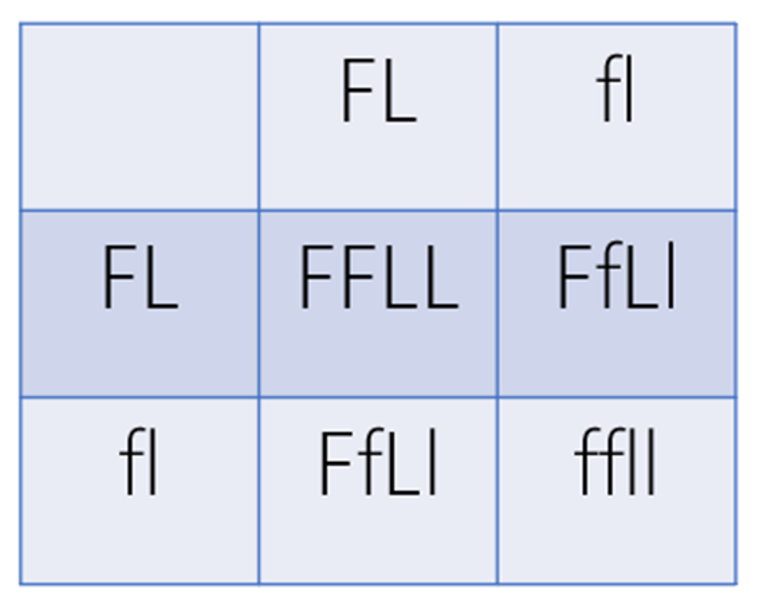
•Genotype: FfLl X FfLl
•Gametes: FL, fl
Results of cross 2:
•F2 Generation:
•Genotype:
•1 FFLL: 2 FfLl : 1 ffll
•Phenotype:
•3 Purple Long: 1: Red Round
•
However,
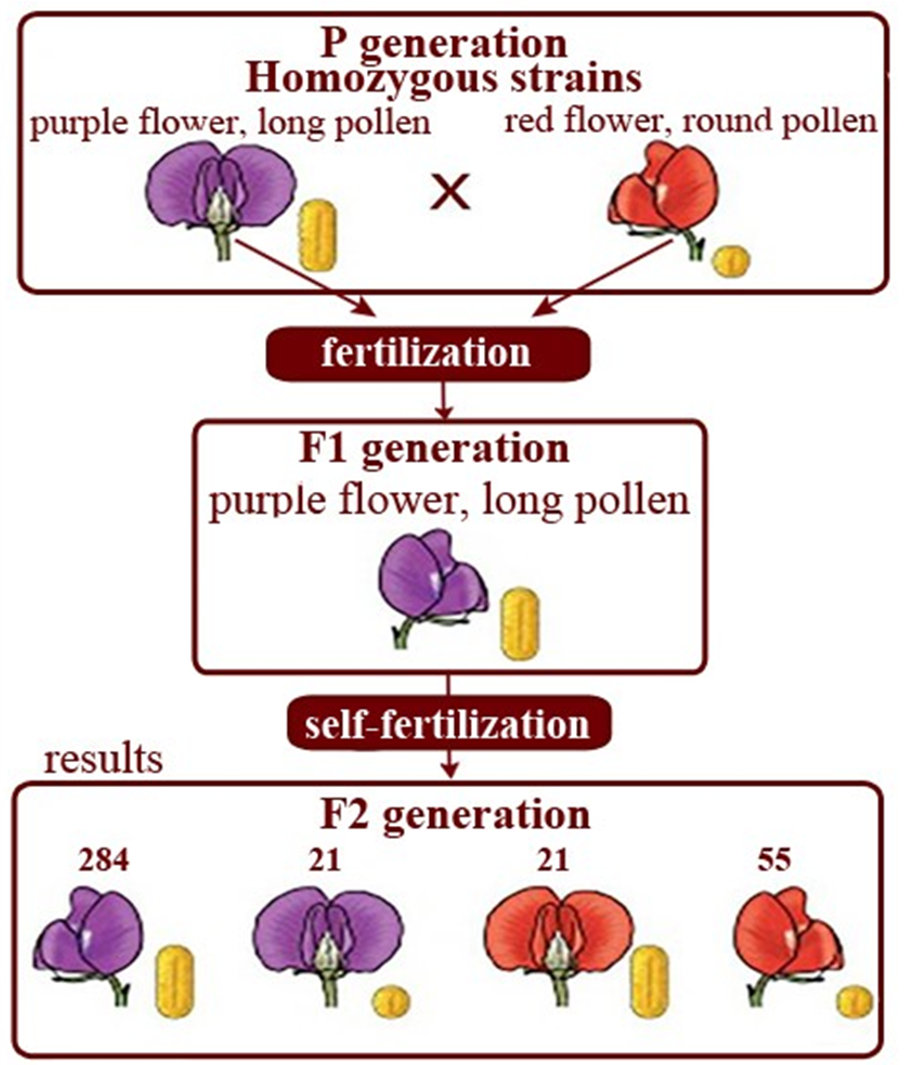
•When an actual cross is performed the following results are obtained:
•From 384 offspring:
•Purple flowers, long pollen: 284
•Red flowers, short pollen: 55
•Purple flowers, short pollen: 21
•Red flowers, long pollen: 21
Why do we get these results?
•The existence of purple-short and red-long combinations are shown in the previous cross…
•How is this possible?
•These are formed by crossing over!
•Crossing over produces the new gametes which are called recombinant gametes - the offspring are called recombinants
•The amount of crossing over is not the same for very pair of genes.
Position of genes
•The degree of crossing over is determined by the distance between the two genes on the same chromosome:
•The smaller the distance between the two genes on the chromosome, the less likely crossing over will occur, and the less recombinants there will be.
•
•The relative distance between genes on the chromosome can be determined by looking at the percentage of offspring that are recombinants.
•This is also called the crossover frequency.
•
Crossover frequency
•Example: using the following results:
•From 100 offspring
•Purple flowers, long pollen: 68
•Red flowers, short pollen: 18
•Purple flowers, short pollen: 7
•Red flowers, long pollen: 7
•There are 14 recombinants in a total of 100 offspring i.e., 14% are recombinants
•Crossover frequency is 14
•Therefore, the flower colour gene is 14 units away from the pollen shape gene on the same chromosome
•This technique can be used to map the genes on a chromosome and determine linkage groups.