Ch. 4 Atomic Structure and Periodic Trends
 Call Kai
 Learn
Learn Practice Test
 Spaced Repetition
 Match
Match Flashcards
 Knowt Play
1/42

There's no tags or description
Looks like no tags are added yet.
Name | Mastery | Learn | Test | Matching | Spaced | Call with Kai | Chat |
|---|
No analytics yet
Send a link to your students to track their progress
43 Terms
Take a picture of the periodic table of elements on page 50
Atoms
The smallest unit of any element is one atom of the element.
All atoms have a central nucleus, which contains protons and neutrons, known collectively as a nucleus.
Each proton has an electric charge of +1 elementary unit; neutrons have no charge. Outside the nucleus is the electrons, and each electron has a charge of -1 elementary unit.
In every neutral atom, the number of electrons outside the nucleus is equal to the number of protons inside the nucleus. The electrons are held in the atom by the electrostatic attraction of the positively charged nucleus.
The number of protons in the nucleus of an atom is called its atomic number, Z. The atomic number of an atom uniquely determines what element the atom is, and Z may be shown explicitly by a subscript before the symbol of the element. For example, every beryllium atom contains exactly four proteins, and we can write this as 4Be.
A proton and a neutron each have a mass slightly more than one atomic mass unit (1 amu= 1.66×10⁻²⁷ kg), and an electron has a mass that’s only about 0.05 percent of the mass of either a proton or a neutron. So, virtually all the mass of an atom is due to the mass of the nucleus.
The number of protons plus the number of neutrons in the nucleus of an atom gives the atom’s mass number, A. If we let N stand for the number of neutrons, then A=Z+N.
In designating a particular atom of an element, we refer to its mass number. One way to do this is to write A as a superscript. For example, if a beryllium atom contains 5 neutrons, then its mass number is 4=5=9, and we would write this as 49Be or simply as 9Be. Another way is simply to write the mass number after the name of the elements with a hyphen; 9Be is beryllium-9.

Isotopes
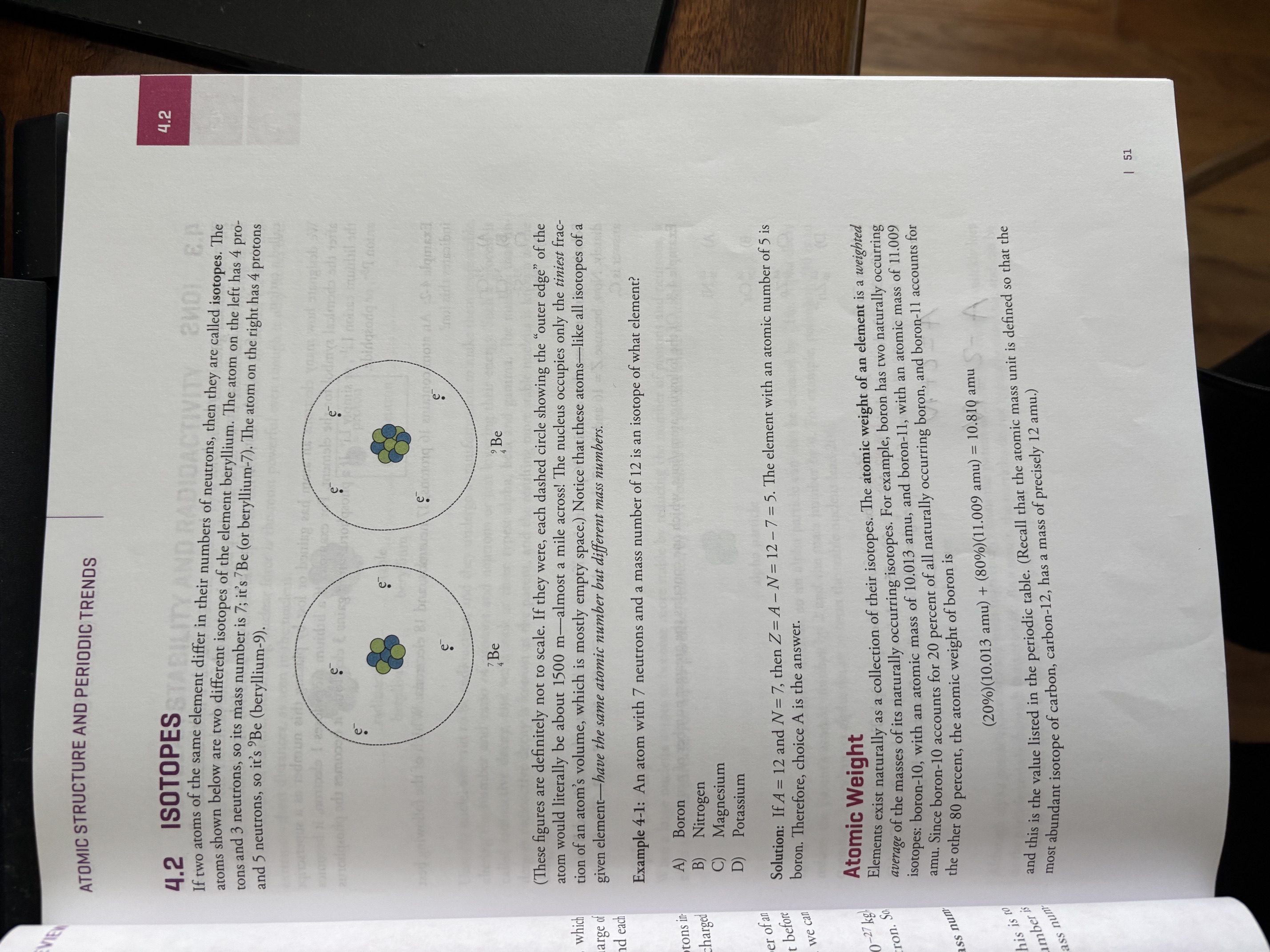
If two atoms of the same element differ in their numbers of neutrons, then they are called isotopes. The atoms shown below are two different isotopes of the element beryllium. The atom on the left has 4 protons and 3 neutrons, so its mass number is 7; it’s 7Be (or beryllium-7). The atom on the right has 4 protons and 5 neutrons, so it’s 9Be (beryllium-9).
look at the figures of Be on the page.
(These figures are definitely not to scale. If they were, each dashed circle showing the “outer edge” of the atom would literally be about 1500m-amost a mole across! the nucleus occupies only a the tiniest fraction of an atom’s volume, which is mostly empty space.) Notice that these atoms- like all isotopes of a given element—have the same atomic number but different mass numbers.
Example: 4-1: An atom with 7 neutrons and a mass number of 12 is an isotope of what element?
Boron, Nitrogen, Magnesium, Potassium
7 neutrons,
mass number of 12, that means 5 protons. The atomic number is 5. The element is boron.
Atomic Weight
Elements exist naturally as a collection of their isotopes. The atomic weight of an element is a weighted average of the masses of its naturally occurring isotopes. For example, boron has two naturally occurring isotopes: boron-10, with an atomic mass of 10.013 amu, and boron-11, with an atomic mass of 11.009 amu. Since boron-10 accounts for 20% of all naturally occurring boron, and boron-11 accounts for the other 80%, the atomic weight of boron is
(20%)(10.013 amu) + (80%)(11.009 amu)= 10.810 amu
and this is the value listed in the periodic table. (Recall that the atomic mass unit is defined so that the most abundant isotope of carbon, carbon-12, has a mass of precisely 12amu).
Ions
When a neutral atom gains or loses electrons, it becomes charged, and the resulting atom is called an ion.
For each electron it gains, an atom acquires a charge of -1 unit, and for each electron it loses, an atom acquires a charge of +1 unit. A negatively charged ion is called an anion, while a positively charged ion is called a cation.
We designate how many electrons an atom has gained or lost by placing this number as a superscript after the chemical symbol for the element. For example, if a lithium atom loses 1 electron it becomes the lithium cation Li1+, or simply Li+. If a phosphorous atom gains 3 electrons, it becomes the phosphorous anion P3-, or phosphide.
Example4-2: An atom contains 16 protons, 17 neutrons, and 18 electrons. Which of the following best indicates this ion?
C) 34 S2-

Nuclear Stability and radioactivity
The protons and neutrons in a nucleus are held together by a force called a strong nuclear force. It’s stronger than the electrical force between charged particles, since for all atoms besides hydrogen, the strong nuclear force must overcome the electrical repulsion between the protons. In fact, of the four fundamental forces of nature, the strong nuclear force is the most powerful even though it only works over extremely short distances, as seen in nucleus.
Unstable nuclei are said to be radioactive and they undergo a transformation to make them more stable, altering the number of and ratio of protons and neutrons or just lowering their energy. Such a process is called radioactive decay, and we’ll look at three types: alpha, beta, and gamma. The nucleus that undergoes radioactive decay is known as the parent, and the resulting more stable nucleus is known as the daughter.

Alpha decay
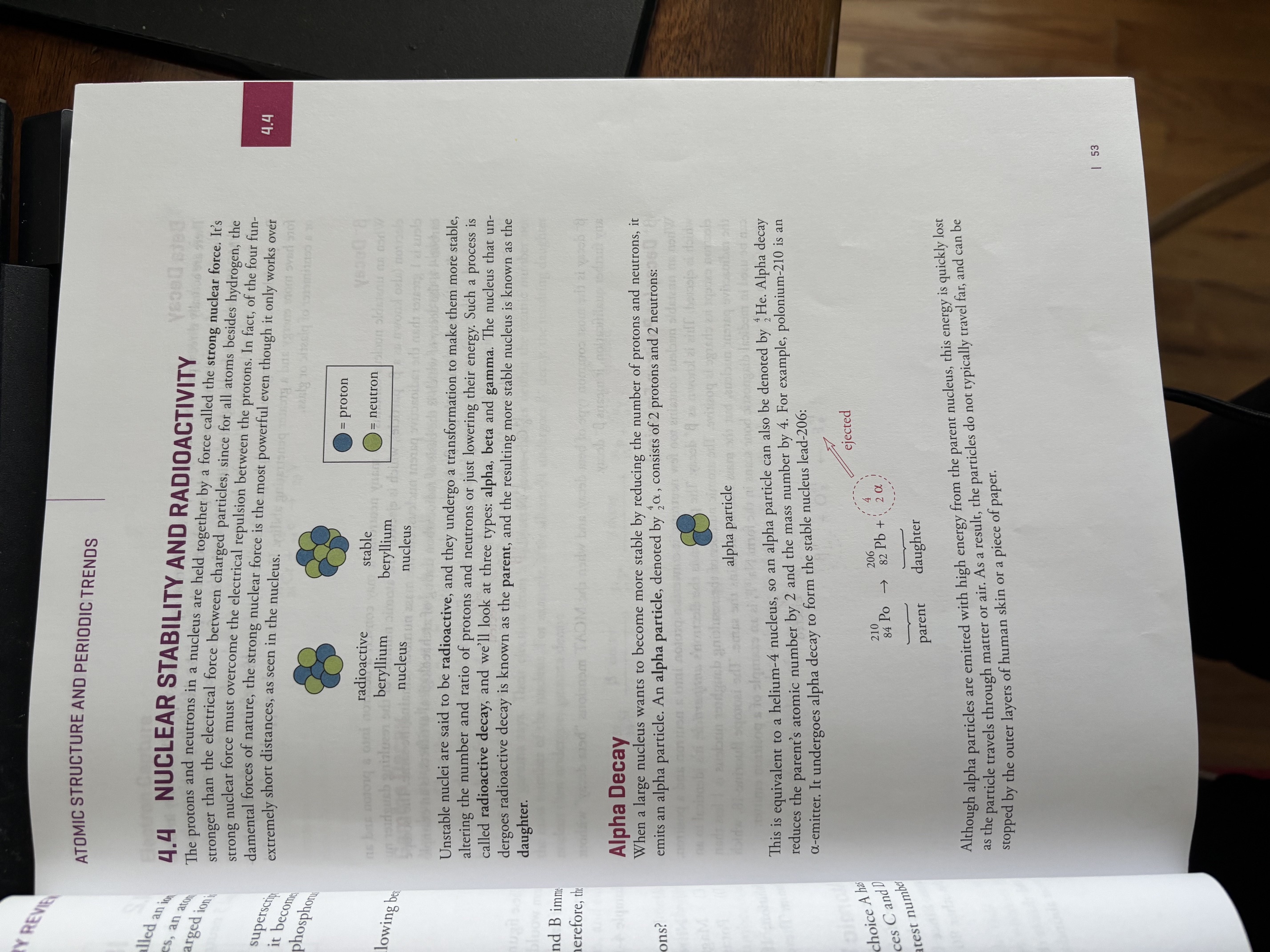
When a large nucleus wants to become more stable by reducing the number of protons and neutrons, it emits an alpha particle. An alpha particle, denoted by 42α, consists of 2 protons and 2 neutrons.
This is equivalent to a helium-4 nucleus, so an alpha particle can also be denoted by 42He. Alpha decay reduces the parent’s atomic number by 2 and the mass number by 4. For example, polonium-210 is an alpha-emitter. It undergoes alpha decay to form the stable nucleus lead-206:
put the put picture of the parent and the ejected on page 53 (put this picture on the next flashcard)
Although alpha particles are emitted with high energy from the parent nucleus, this energy is quickly lost as the particle travels through matter or air. As a result, the particles do not typically travel far, and can be stopped by the outer layers of human skin or a piece of paper.
Scientific Naming: In 1899, physicist Ernest Rutherford studied uranium radiation and found different types of rays. He labeled the first and least penetrating type alpha using the first letter of the Greek alphabet simply to categorize it sequentially, before knowing its actual physical structure.
Beta decay
There are three types of beta decay, B-, B+, and electron capture. Each type of beta decay involves the conversion of a neutron into a proton (along with some other particles that are beyond the scope of the MCAT), or vice versa, through the action of the weak nuclear force.
Beta particles are more dangerous than alpha particles since they are significantly less massive.
They therefore have more energy and a greater penetrating ability. However, they can be stopped by aluminum foil or a centimeter of plastic or glass.

B-decay
When an unstable nucleus contains too many neutrons, it may convert a neutron into a proton and electron (known as a B- particle), which is ejected. The atomic number of the resulting daughter is 1 greater than the radioactive parent nucleus, but the mass number remains the same.
Beta- decay changes the atomic number (increased by 1 proton) but leaves the mass number the same because one neutron transforms directly into one proton. (from 1 amu to 1 amu).
The isotope carbon-14, the decay of which is the basis of radiocarbon dating of archaeological artifacts, is an example of a radioactive nucleus that undergoes B- decay:
put the picture of the 14,6 C → 14,7 N + 0,1 B ejected
B- decay is the most common type of beta decay, and when the MCAT mentions “beta decay” without any further qualification, it means B- decay.

B+ Decay (or positron emission)
When an unstable nucleus contains too few neutrons, it converts a proton into a neutron and a positron, which is ejected. This is known as B+ decay. The positron is the electron’s antiparticle; it’s identical to an electron except its charge is positive. The atomic number of the resulting daughter nucleus is 1 less than the radioactive parent nucleus (proton converted into neutron), but the mass number remains the same (proton converted into neutron). The isotope fluorine -18, which can be used in medical diagnostic bone scans in the form Na18F, is an example of positron emitter:
attach picture of “18,9 F → 18,8 O + 0,1B → ejected” to this flashcard

Electron capture
nucleus is proton-rich
proton-rich nucleus attracts an inner shell electron
proton is converted into a neutron, an the electron is emitted.
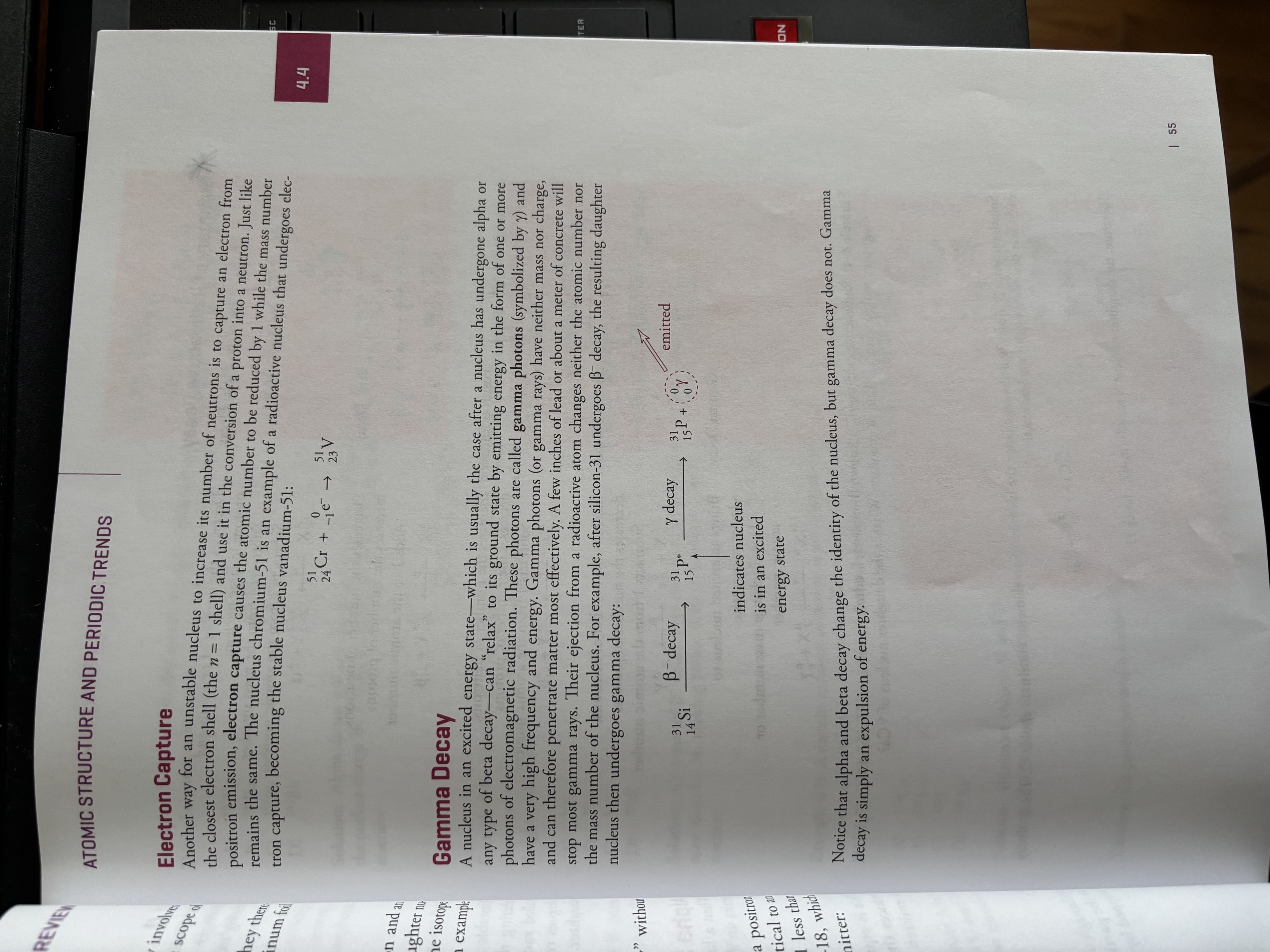
Electron capture is a type of radioactive decay where an unstable, proton-rich nucleus absorbs an inner-shell electron (the n=1 shell), converting a proton into a neutron and emitting an electron neutrino.
Just like positron emission, electron capture causes the atomic number to be reduced by 1 while the mass number remains the same. The nucleus chromium-51 is an example of a radioactive nucleus that undergoes electron capture, becoming the stable nucleus vanadium-51:
attach picture of 51,24Cr + 0,1 e- → 51, 23 V
Gamma decay
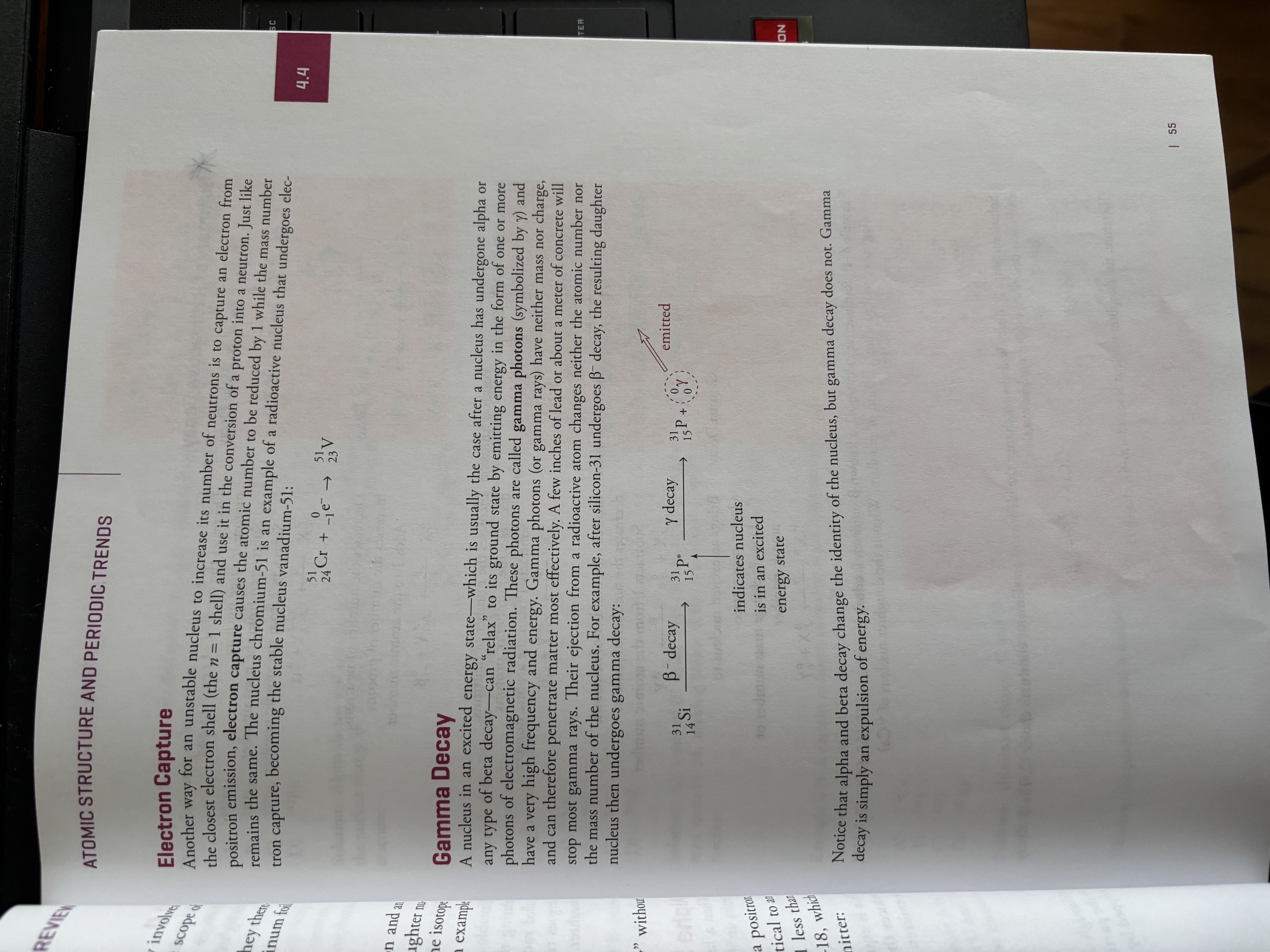
A nucleus is an excited energy state—which is usually the case after a nucleus has undergone alpha or any type of beta decay—-can “relax” to its ground state by emitting energy in the form of one or more photons of electromagnetic radiation. These photons are called gamma photons (symbolized by y, the sign for gamma) and have a very high frequency and energy. Gamma photons (or gamma rays) have neither mass nor charge, and can therefore penetrate matter most effectively. A few inches of lead or about a meter of concrete will stop most gamma rays. Their ejection from a radioactive atom changes neither the atomic number nor the mass number of the nucleus. For example, after silicon-31 undergoes B- decay, the resulting daughter nucleus then undergoes gamma decay:
put the picture 31,14 Si B- decay→ 31,15 P* y-decay→ 31,15P + 0,0gamma
Notice that alpha and beta decay change the identity of the nucleus, but gamma decay does not. Gamma decay is simply an expulsion of energy.
Summary of radioactive decay
take a picture of this

put examples 4-4,4-5,4-6,4-7,4-8,4-9

Half Life
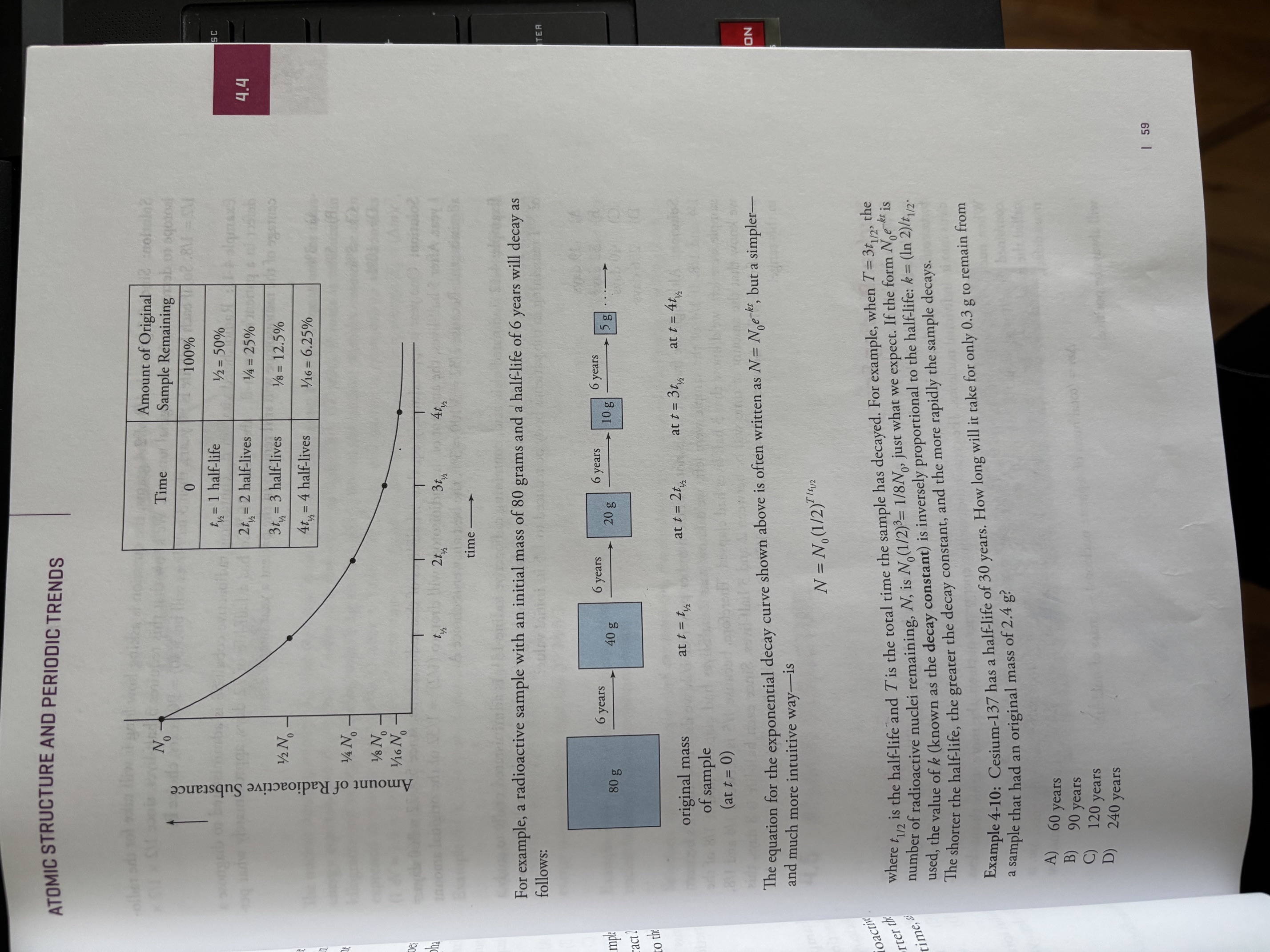
Different radioactive nuclei decay at different rates. The half-life, which is denoted by a t1/2, of a radioactive substance is the tie it takes for one-half of some sample of the substance to decay. Thus, the shorter the half-life, the faster the decay. The amount of radioactive substance decreases exponentially with time, as illustrated in the following graph.
insert the graph on page 59

Half Life cont
Fro example, a radioactive sample with an initial mass of 80 grams and a half-life of 6 years will decay as follows
attach the picture of the blue boxes onto this flashcard


Half life cont
The equation for exponential decay curve shown above (at the top of page 59, you can attach the same picture to this flashcard) is often written as N=N0e-kt, but a simpler and much more intuitive way is —-
N=N0(1/2)T/t1/2
where t1/2 is the half-life and T is the total time the sample has decayed. For example, when T=3t1/2, the number of radioactive nuclei remaining, N, is N0(1/2)3=1/8N0 , just what we expect. If the form N0e-kt is used, the value of k (known as the decay constant) is inversely proportional to the half life: k=(ln 2)/t1/2. The shorter the half life, the greater the decay constant, and the more rapidly the sample decays
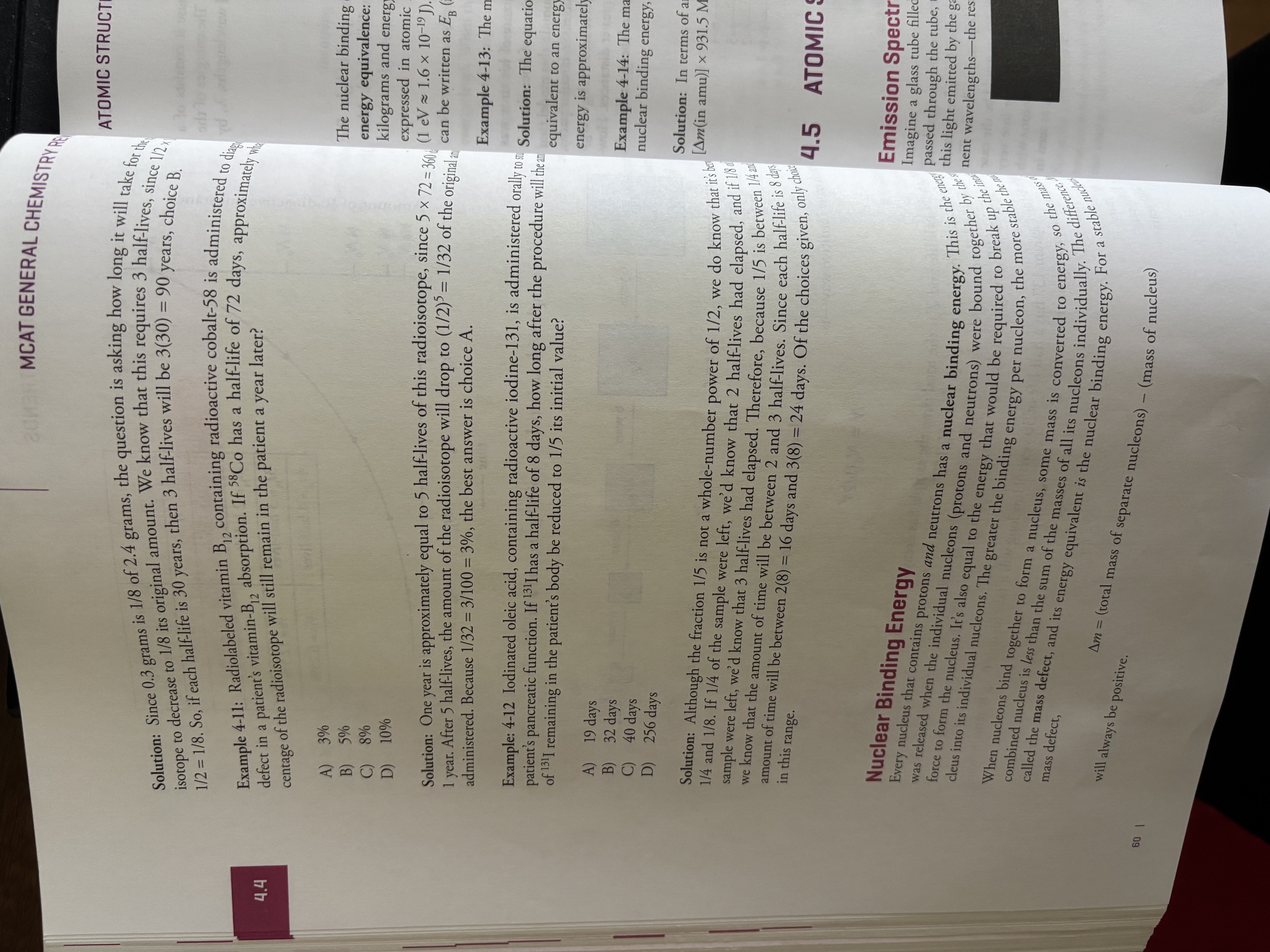
put example 4-10 on this flashcard
put example 4-11 on this flashcard
put example 4-12 on this flashcard
Nuclear Binding Energy
Every nucleus that contains protons and neutrons has a nuclear binding energy. This is the energy that was released when the individual nucleons (protons and neutrons) were bound together by the strong force to form the nucleus. It’s also equal to the energy that would be required to break up the intact nucleus into individual nucleons. The greater the binding energy per nucleon, the more stable the nucleus.
When nucleons bind together to form a nucleus, some mass is converted to energy, so the mass of the combined nucleus is less than the sum of the masses of all the nucleons individually. The difference, delta m, is called the mass defect, and its energy is the nuclear binding energy. For a stable nucleus, the mass defect:
delta m= (total mass of separate nucleons) - (mass of nucleus)
will always be positive.
attach the picture on page 61 to this flashcard.
The nuclear binding energy, EB, can be found from the mass defect using Einstein’s equations for mass-energy equivalence: EN = (delta m)c2, where c is the speed of light (3×10⁸ m/s). If mass is measured in kilograms and energy in Joules, then 1 kg ←> 9×10¹⁶ J. But in the nuclear domain, masses are often expressed in atomic mass units (1 amu= 1.66 × 10⁻²⁷ kg), and energy is exposed in electronvolts (1 eV=1.6×10⁻¹⁹ J). In terms of these units, the equations for the nuclear binding energy, EB=(deltam)c2, can be written as EB (in eV)=[deltam (in amu))] x 931.5 MeV.

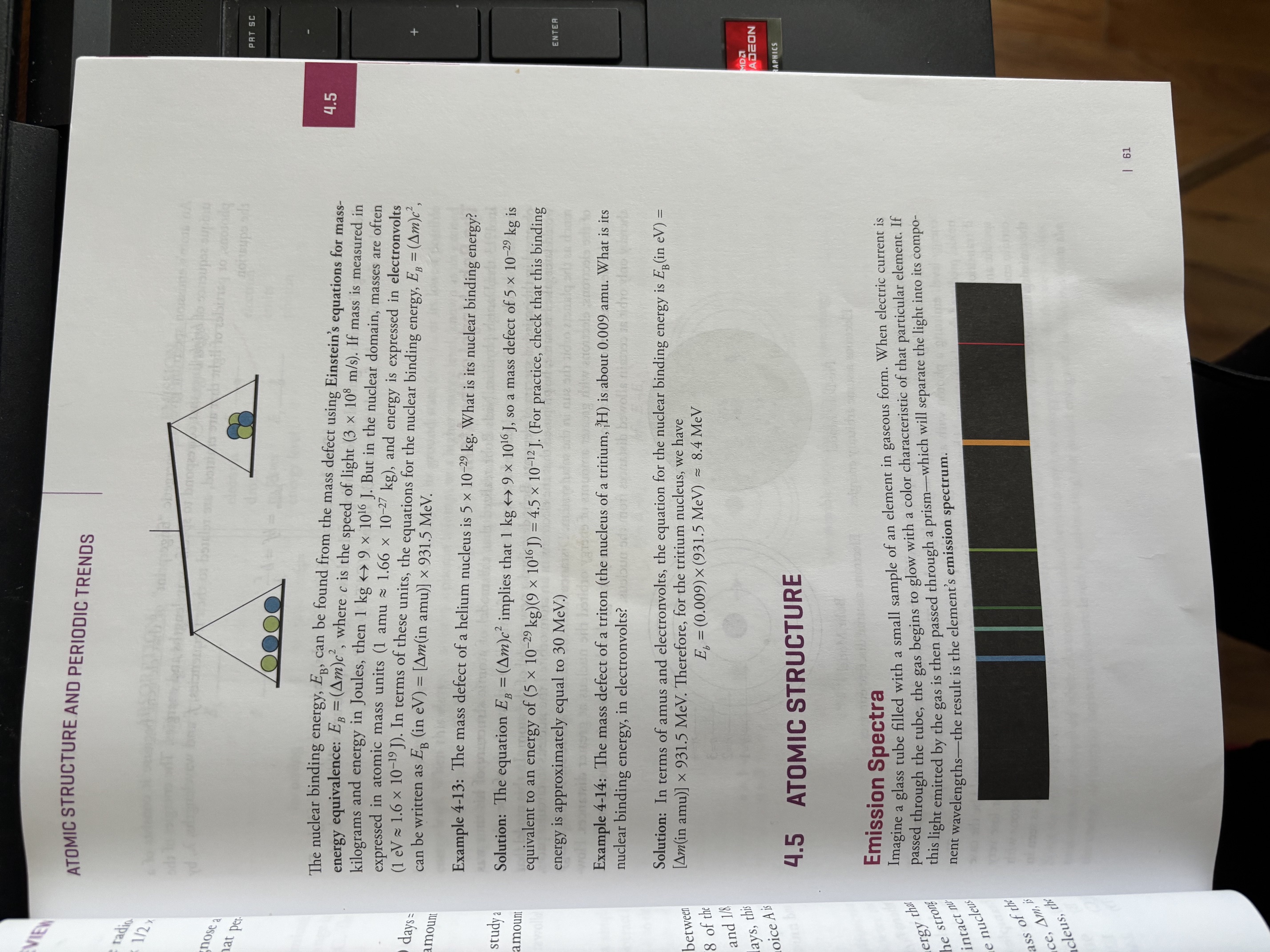
put example 4-13 on this flashcard
pu
put example 4-14 on this flashcard
atomic structure
Emission Spectra
Imagine a glass tube filled with a small sample of an element in gaseous form. When electric current is passed through the tube, the gas begins to flow with a color characteristic of that particular element. If this light emitted by the gas is then passed through a prism—which will separate the light into its component wavelengths—the result is the element’s emission spectrum.
attach a photo of the black emission spectrum with the different colors to this flashcard on page 61
An atom’s discussion spectrum gives an energetic “fingerprint” of that element because it consists of a unique sequence of bright lines that correspond to the specific wavelengths and energies. The energies of the photons, or particles of light that are emitted, are related to their frequencies, f, and wavelengths, lambda, by the equation
Equation: Ephoton =hf=h c/lambda
where h is a universal constant called Planck’s constant (6.63×10⁻³⁴ Jxs) and c is speed of light. For the following discussion, a general understanding of the electromagnetic spectrum will be useful.

The Bohr Model of the Atom
In 1913, the Danish physicist Niels Bohr realized that the model of the atomic structure of his time was inconsistent with emission spectral data. In order to account for the limited numbers of lines that are observed in the emission spectra of elements. Bohr described a new model of the atom. In this model that would later take his name, he proposed that the electrons in an atom orbited the nucleus in circular paths, much as the planets orbit the sun in the solar system. Distance from the nucleus was related to the energy of the electrons’ electrons with greater amounts of energy orbited the nucleus at greater distances. However, the electrons in the atom cannot assume an arbitrary energy, but have quantized energy states and thereby only orbit at certain allowed distances from the nucleus.
attach a photo of the “Pre-Bohr” model and the “Bohr Model” on page 62
If an electron absorbs energy that’s exactly equal to the difference in energy between its current level and that of an available higher lever, it “jumps” to that high level. The electron can then “drop” to a lower energy level, emitting a photon with an energy exactly equal to the distance between the levels. The model predicted that elements would have line spectra instead of continuous spectra, as would be the case if transitions between all possible energies due to the quantized nature of energy levels. Therefore, only photons with certain energies are observed. These specific energies corresponded to very specific wavelengths, as seen in the emission spectra.


The Bohr Model of the Atom con’t
attach the picture at the top of page 63 to this flashcard

In the transition depicted below, an electron is initially in its ground state (n=1), or its lowest possible energy level. When this electron absorbs a photon it jumps to a higher energy level, known as an excited state (in this case n=3). Electrons excited to high energy don’t always relax to the ground state in large jumps, rather they can relax in a series of smaller jumps, gradually coming back to the ground state. From this excited state, the electron can relax in one of two ways, either dropping into the n=2 level, or directly back to the n=1 ground state. In the latter case we’d detect a more energetic photon of energy corresponding to the difference between n=3 and n=1.
The Bohr Model of the Atom con’t
Note: Distances between energy levels are not drawn to scale

pleas attach the picture of “energy is absorbed, creating an excited state, two possible ways the electron can lose energy” on page 63 to this flashcard
The energies of these discrete energy levels are given by Bohr in the following equation, which only accurately predicted the behavior of atoms or ions containing one electron, now known as Bohr atoms. The value n in this case represents the energy level of the electron.
En= (-2.178×10⁻¹⁸J)/n2
Since we can calculate the energies of the levels of a Bohr atom, we can predict the wavelengths of photons emitted or absorbed when electrons transition between any two energy levels. To do this we calculate the energy differences between discrete levels by subtracting the initial energy of the electron from the final energy of the electron.

The Bohr Model of the Atom con’t
We can find the energies of the two possible emitted photons shown above as follows:
(take a picture of the math at the top of page 64 and attach it to this flashcard)
Notice that both energies calculated above are negative, indicating that energy is being released by the electron as it falls from its excited state to a lower energy level. For electron transitions from the ground state to an excited state, the deltaE values will be positive, indicating energy is absorbed by the electron.
Once the energy is calculated, the wavelength of the photon can be found by employing the relation deltaE=h c/lambda. Not all electron transitions produce photons we can see with the naked eye, but all transitions in an atom will produce photons either in the ultraviolet, visible, or infrared region of the electromagnetic spectrum.
put example 4-15 here
put example 4-16 here
put example 4-17 here
The Quantum Model of the Atom
While one-electron atoms produce easily predicted atomic spectra, the Bohr model does not do a good job of predicting the atomic spectra of many-electron atoms. This shows that the Bohr model cannot describe the electron-electron interactions that exist in many-electron atoms. The quantum model of the atom was developed to account for these differences. Bohr’s model suggested, and we still hold to be true, that electrons held by an atom can exist only at discrete energy levels-that is, electron energy levels are quantized. This quantization is described by a unique “address” for each electron, consisting of four quantum numbers designating the shell, subshell, orbital, and spin. While the details of quantum numbers are beyond the scope of the MCAT, it is still useful to understand the conceptual basis of the quantum model.

The Energy Shell
The energy shell (n) of an electron in the quantum model of the atom is analogous to the circular orbits in the Bohr model of the atom. An electron in a higher shell has a greater amount of energy and a greater average distance from the nucleus. For example, an electron in the 3rd shell (n=3) has higher energy than an electron in the 2nd shell (where n=2), which has more energy than an electron in the 1st shell (n=1).

The Energy Subshell
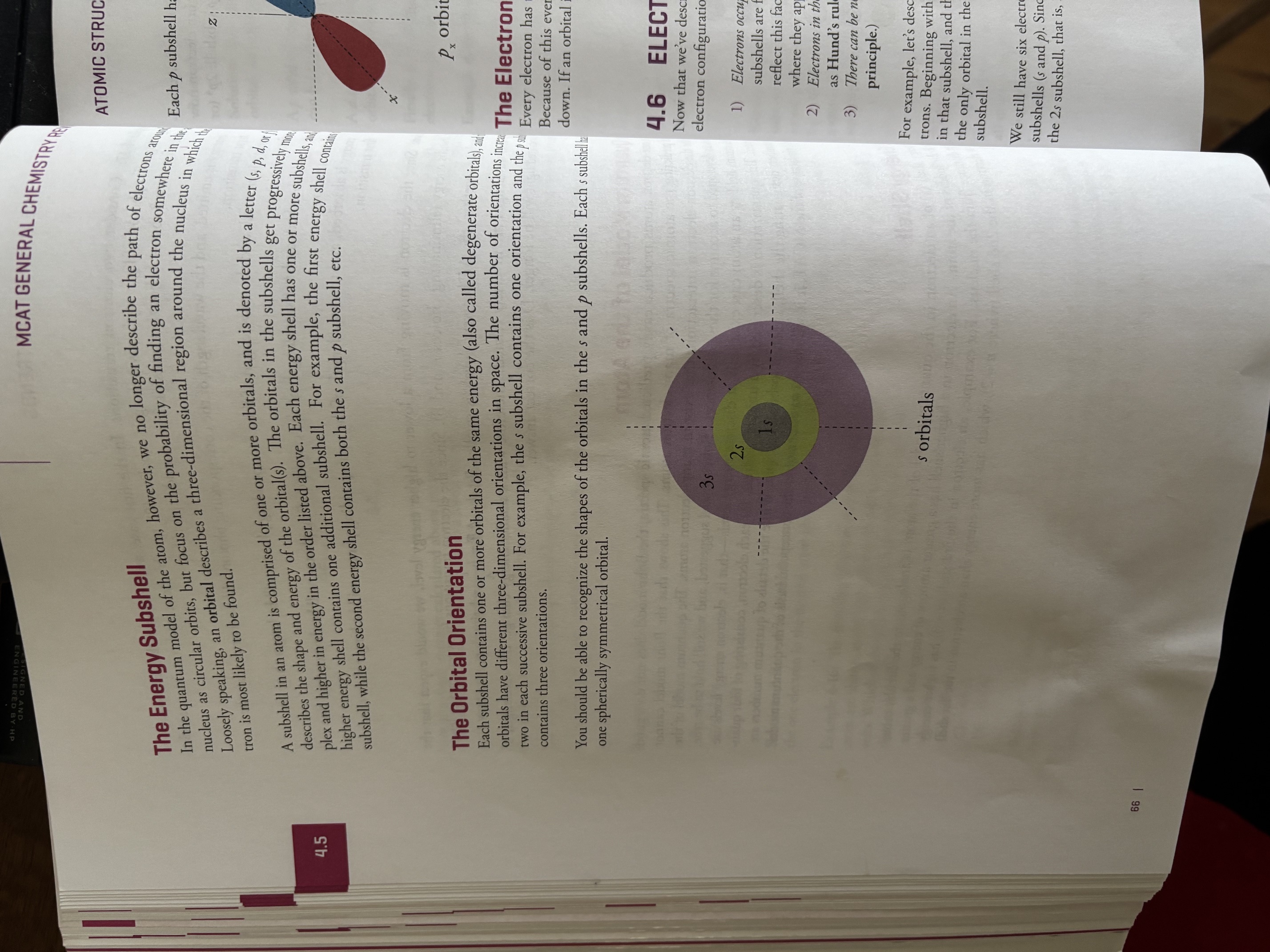
In the quantum model of the atom, however, we no longer describe the path of electrons around the nucleus as circular orbits, but focus on the probability of finding an electron somewhere in the atom. Loosely speaking, an orbital describes a three-dimensional region around the nucleus in which the electron is most likely to be found.
A subshell in an atom is comprised of one or more orbitals, and is denoted by a letter (s,p,d, or f) that describes the shape and energy of the orbital (s). The orbitals in the subshells get progressively more complex and higher in energy in the order listed above. Each energy shell has one of more subshells, and each higher energy shell contains one additional subshell. For example, the first energy shell contains the s subshell, while the second energy shell contains the s and p subshell, etc.

The orbital orientation
Each subshell contains one or more orbitals of the same energy (also called degenerate orbitals), and these orbitals have different three-dimensional orientations in space. The number of orientations increases by two in each successive subshell. For example, the s subshell contains one orientation and the p subshell contains three orientations.
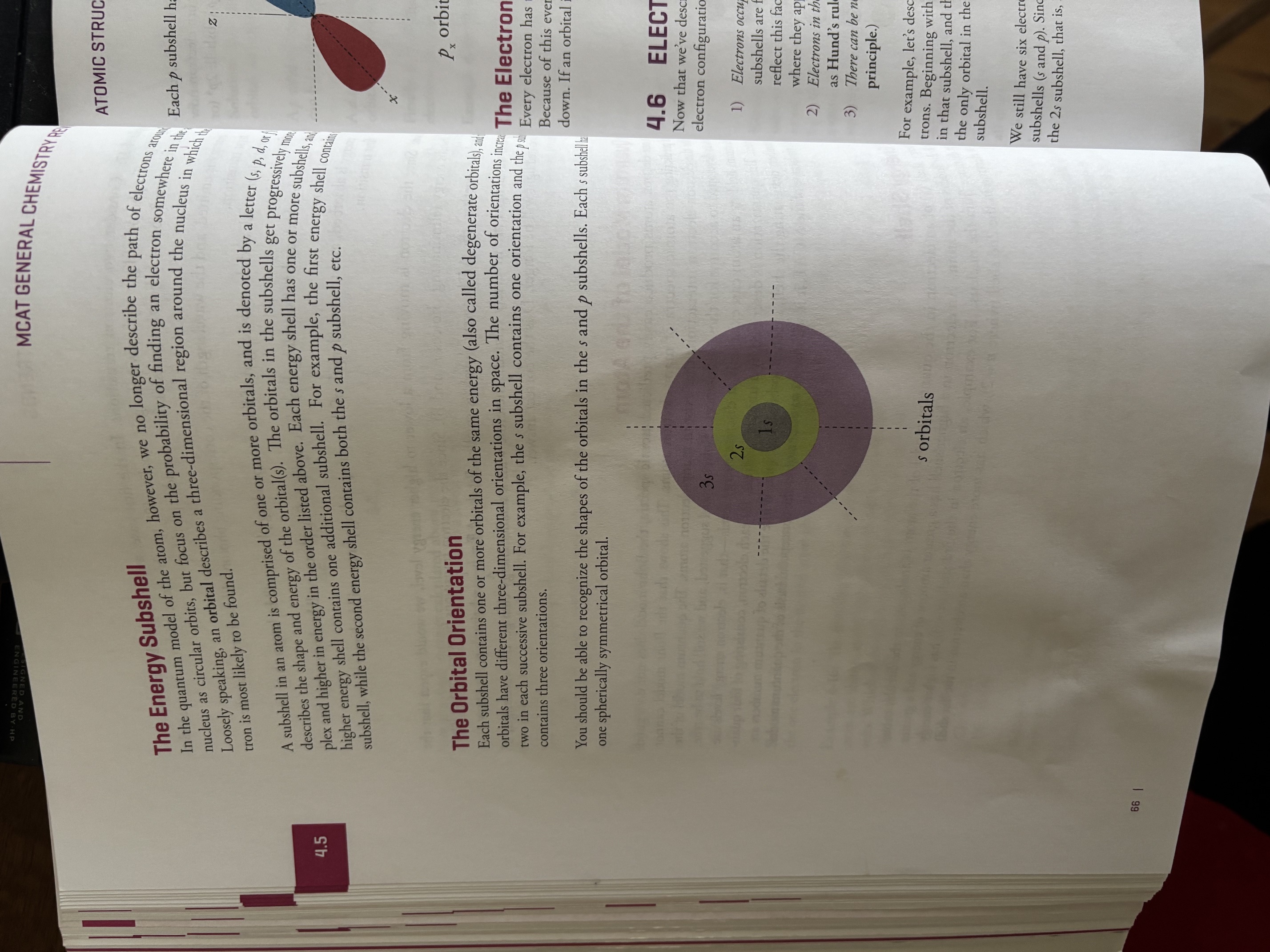
You should be able to recognize the shapes of the orbitals in the s and p subshells. Each s subshell has just one spherically symmetrical orbital.
attach a picture of the s orbital on page 66 to this flashcard.

The orbital orientation
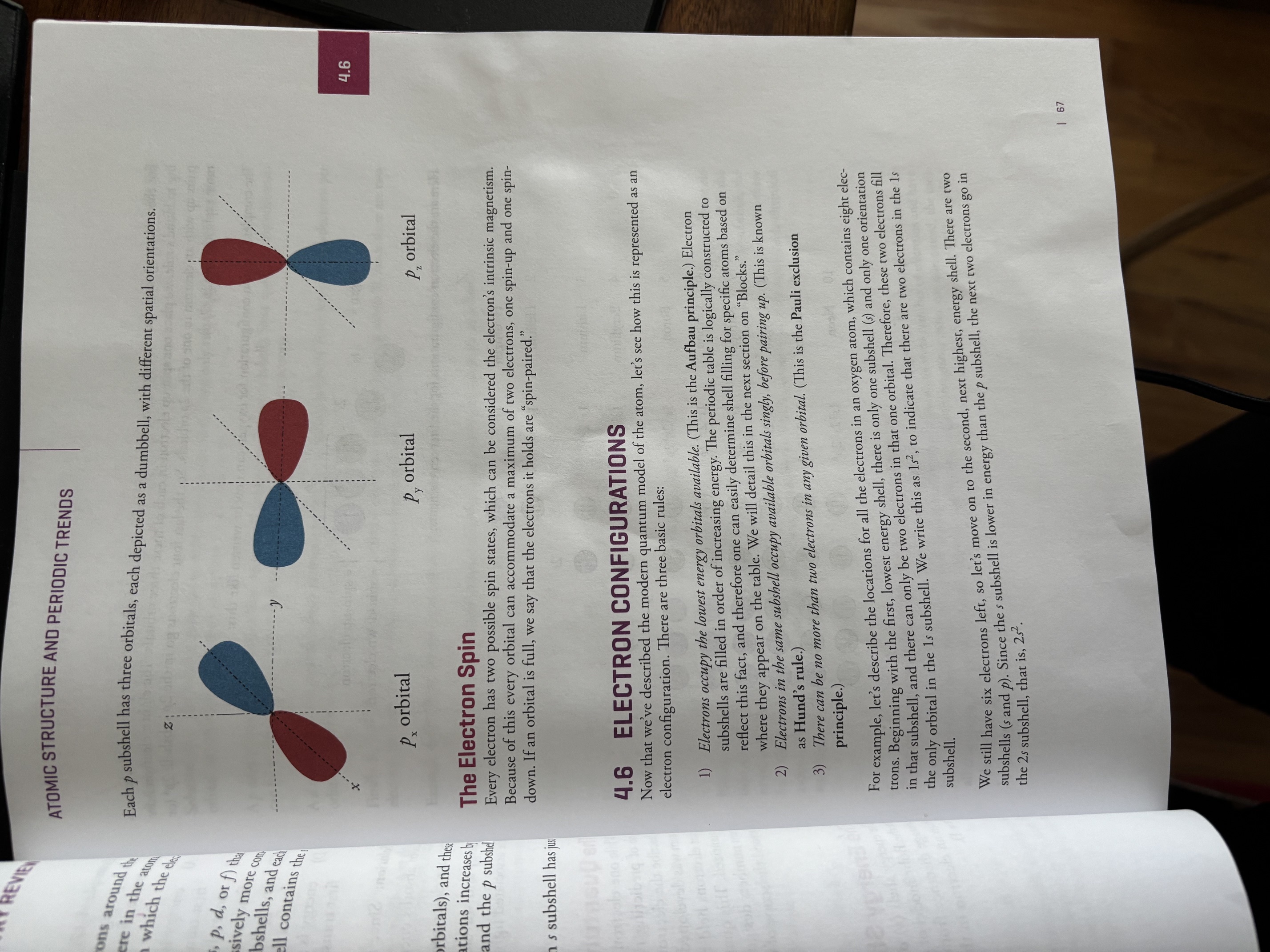
Each p subshell has three orbitals, each depicated as a dumbbell, with different spatial orientations
-attach picture of the Px, Py, and Ps orbital at the top of page 67 to this flashcard
The electron spin
Every electron has two possible spin states, which can be considered the electron’s intrinsic magnetism. Because of this every orbital can accmmodate a maximum number of two eletrons, one spin-up and one spin-down. If an orbital is full, we say that the electrons it holds are “spin-spaired”.

Electron configurations
now that we’ve described the modern quantum model of the atom, let’s see how this is represented as an electron configuration. There are three basic rules:
1) Electrons occupy the lowest energy orbitals available. (This is the Aufbau principle). Electron subshells are filled in order of increasing energy. The periodic table is logifally constructed to reflect this fact, and therefore one can easily determine shell filling for specific atoms based on where they appear on the table. We will detail this in the next section on “Blocks”
2) Electrons in the same subshell copy occupy available orbitals singly, before pairing up (This is known as Hund’s rule).
3) There can be no more than two electrons in any given orbital. (This is the Pauli exclusion principle).
For example, let’s describe the locations for all the electrons in an oxygen atom, which contains eight electrons. Beginning with the first, lowest energy shell, there is only one subshell (s) and only one orientation in that subshell, and there can be only two electrons in that one orbital. Therefore, these two electrons fill the only orbital in the 1s subshell. We write this as 1s2, to indicate that there are two electrons in the 1s subshell.
We will have six electrons left, so let’s move on to the second, next highest, energy shell. There are two subshells (s and p). Since the s subshell is lower in energy than the p subshell, the next to two electrons go in the 2s subshell, that is 2s2.
If an atoms electrons are not all spin-paired, it is said to be paramagnetic. Paramagnetic atoms are attracted into externally produced magnetic fields.
attach the picture on top of page 70 to this flashcard


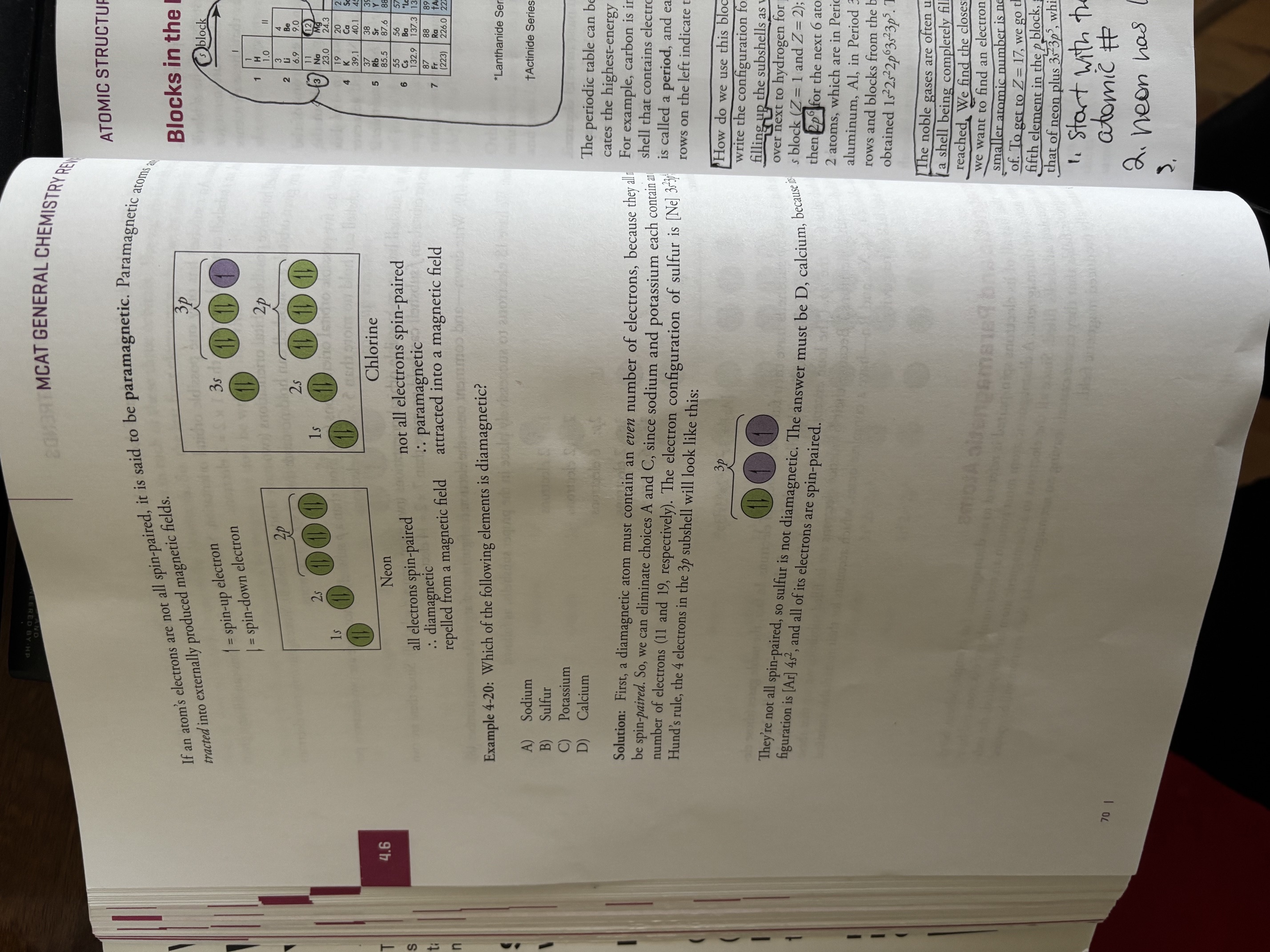
put example 4-20 here
Blocks in the periodic table
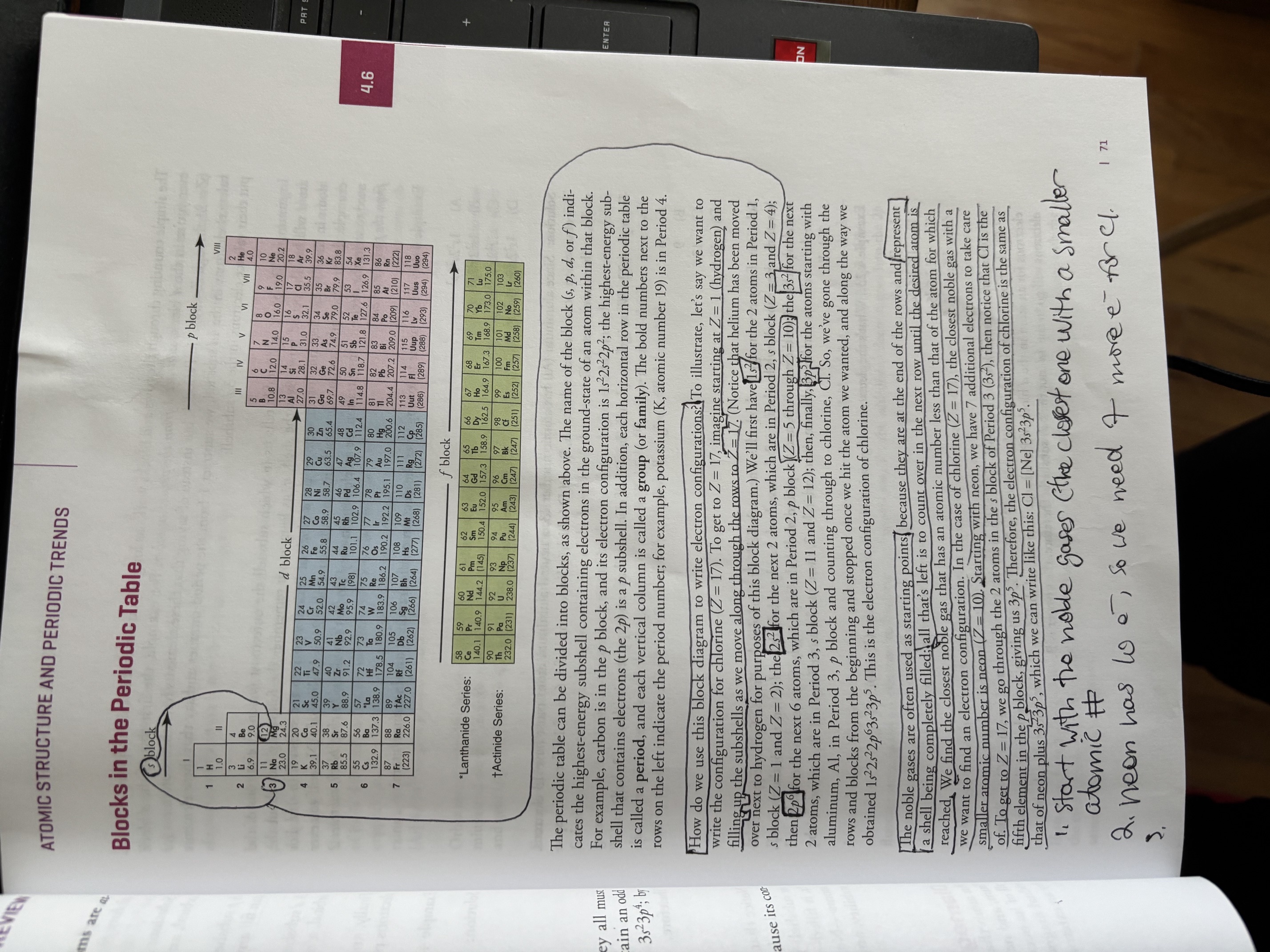
Put a picture of the periodic table at the top of page 71 here
The periodic table can be divided into blocks. The name of the block (s, p, d, or f) indicates the highest-energy subshell containing electrons in the ground-state of an atom within that block. For example, carbon is the in the p block, and its electron configuration is 1s2 2s22p2; the highest energy subshell that contains electrons (the 2p) is a p subshell. In addition, each horizontal row in the periodic table is called a period, and each vertical column is called a group (or family). The bold numbers next to the rows on the left indicate the period number; for example, potassium (K, atomic number 19) is in period 4.
How do we use this block diagram to write electron configurations? To illustrate, let’s say we want to write the configuration for chlorine (Z=17). To get to Z=17, imagine starting at Z=1 (hydrogen) and filling up the subshells as we move along through the rows to Z=17. (Notice that helium has been moved over next to hydrogen for purposes of this block diagram.) We’ll first have 1s2 for the 2 atoms in Period 1, s block (Z=1 and Z=2); the 2s2 for the next 2 atoms, which are in Period 2, s block (Z=3 and Z=4); then 2p6 for the next 6 atoms, which are in Period 2, p block (Z=5 through Z=10); the 3s2 for the next 2 atoms, which are in Period 3, s block (Z=11 and Z=12); then finally 3p5 for the atoms starting with aluminum, Al, in Period 3, p block and counting through chlorine, Cl. So, we’ve gone through the rows and blocks from the beginning and stopped once we hit the atom we wanted, and along the way we obtained 1s22s22p63s23p5. This is the electron configuration of chlorine.
this was on page 71 by the way
The noble gases are often used as starting points, because they are at the end of the rows and represent a shell being completely filled; all that’s left is to count over in the next row until the desired atom is reached. We find the closest noble gas that has an atomic number less than that of the atom for which we want to find an electron configuration. In the case of chlorine (Z=17), the closest of noble gas with a small atomic number if neon (Z=10). Starting with neon, we have 7 additional electrons to take care of. To get to Z=17, we go through the 2 atoms in the s block of Period 3 (3s2), then notice that Cl is the fifth element in the p block, giving us 3p5. Therefore, the electron configuration of chlorine is the same as that of neon plus 3s23p5, which we can write like this: Cl= [Ne] 3s23p5.
The simple counting through the rows and blocks works as long as you remember this simple rule: Whenever you’re in the d block, subtract 1 from the period number. For example, the first row of the d block (Z=21 through Z=30) is in Period 4, but instead of saying that these elements have their outermost (or valence) electrons in the 4d subshell, we subtract 1 from the period number and say that these elements put their valence electrons in the 3d subshell.
In summary: The block in the table tells us in which subshell the outermost (valence) electrons of the atom will be. The period (row) gives the shell, n, as long as we remember the following fact about the atoms in the d block: electrons for an atom in the d block of Period n go into the subshell (n-1)d. For example, the electron configuration for scadium (Sc, atomic number 21) is [Ar]4s23d1. (Note: if you ever need to write the electron configuration for an element in the f block, the rule is: In the f block, subtract 2 from the period number.)
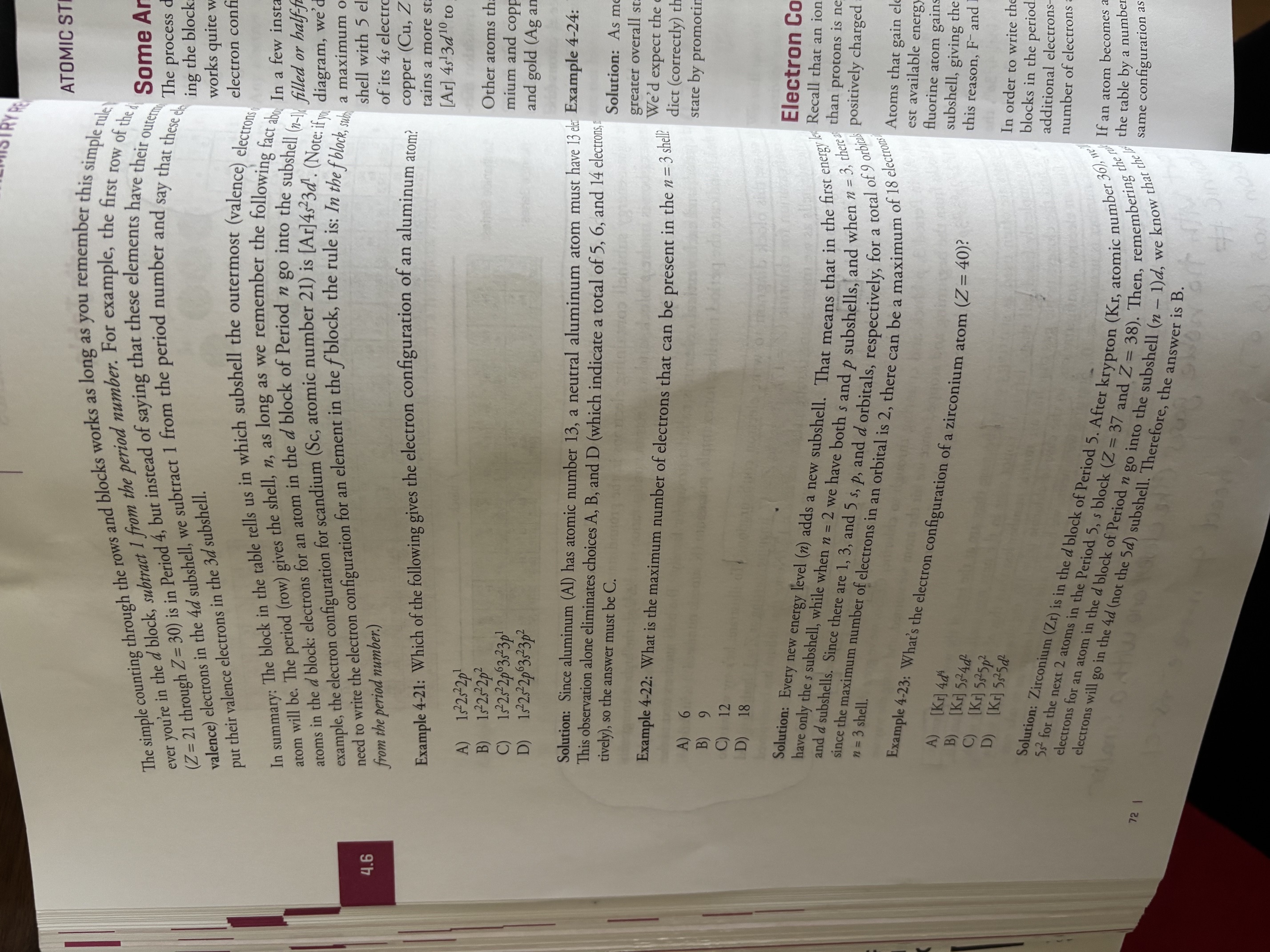

example 4-21
example 4-22
example 4-23
Some anomalous electron configurations
The process described above (reading across the periodic table, from top to bottom and left to right, using the blocks as a tool for the order of filling of subshells) to determine an atom’s electron configuration works quite well for a large percentage of the elements, but there are a few atoms for which the anticipated electron configuration is not the actual configuration observed).
In a few instances, atoms can achieve a lower energy state (or a higher degree of stability) by having a filled or half-filled, d subshell. For example, consider chromium (Cr, Z=24). On the basis of the block diagram, we’d expect its electron configuration to be [Ar]4s23d4. Recalling that a d subshell can hold a maximum of 10 electrons, it turns out that chromium achieves a more stable state by filling its d subshell with 5 electrons (half-filled) rather than leaving it with 4. This is accomplished by promoting one it’s 4s electrons to the 3d subshell, yielding the electron configuration [Ar]4s13d5. As another example, copper (Cu, Z=29) has an expected electron configuration of [Ar]4s23d9. However, a copper atom obtains a more stable, lower-energy state by promoting one of its 4s electrons into the 3d subshell, yielding [Ar]4s13d10 to give a filled d subshell.
Other atoms that display the same type of behavior with regard to their electron configuration as do chromium and copper include molybdenum (Mo, Z=42, in the same family as chromium), as well as silver and gold (Ag and Au, Z=47 and Z=79).

Put example 4-24 on this flashcard
Electron Configurations of Ions
Recall that an ion is an atom that has acquired a nonzero electric charge. An atom with more electrons than protons is negatively charged and is called an anion; an atom with fewer electrons than protons is positively charged and is called a cation.
Atoms that gain electrons (anions) accommodate them in the first available orbital, the one with the lowest available energy. For example, fluorine (F,Z=9) has the electron configuration 1s22s22p5. When a fluorine atom gains an electron to become a fluoride ion, F-, the additional electron goes into the 2p subshell, giving the electron configuration 1s22s22p6, which is the same as the configuration of neon. For this reason, F- and Ne are said to be isoelectric.
In order to write the electron configuration of an ion for an element in the s or p blocks, we can use the blocks in the periodic table as follows. If an atom becomes an anion—that is, if it acquires one or more additional electrons—then we move to the right within the table by a number of squares equal to the number of electrons added in order to find the atom with the same configuration as the ion.
If an atom becomes a cation—that is, if it loses one or more electrons—then we move to the left within the table by a number of squares equal to the number of electrons lost in order to find the atom with the same configuration as the ion.


Put example 4-25 here
Put example 4-26 here
put example 4-27 here
Excited state vs Ground state
Assigning electron configurations as we’ve just discussed is aimed at constructing the most probable location of electrons, following the Aufbau principle. These configurations are the most probable because they are the lowest in energy, or as they are often termed, the ground state.
Any electron configuration of an atom is not as we would assign it, provided it doesn’t break any physical rules (no more than 2e- per orbital, no assigning non existent shells such as 2d, etc…) is an excited state. The atom has absorbed energy, so the electrons now inhabit states we wouldn’t predict as the most probable ones.
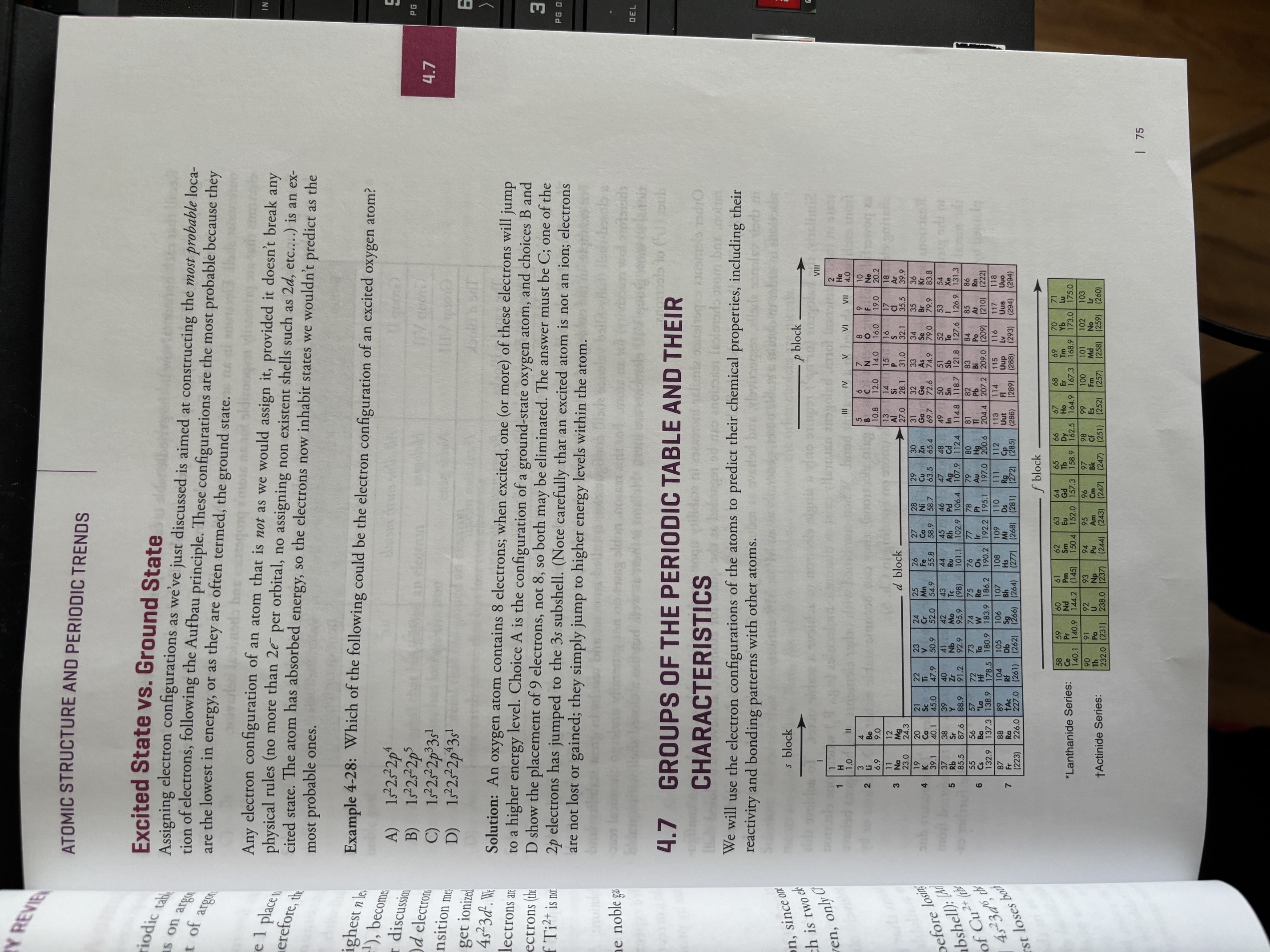

put example 4-28 here
4.7 Groups of the Periodic Table and their characteristics
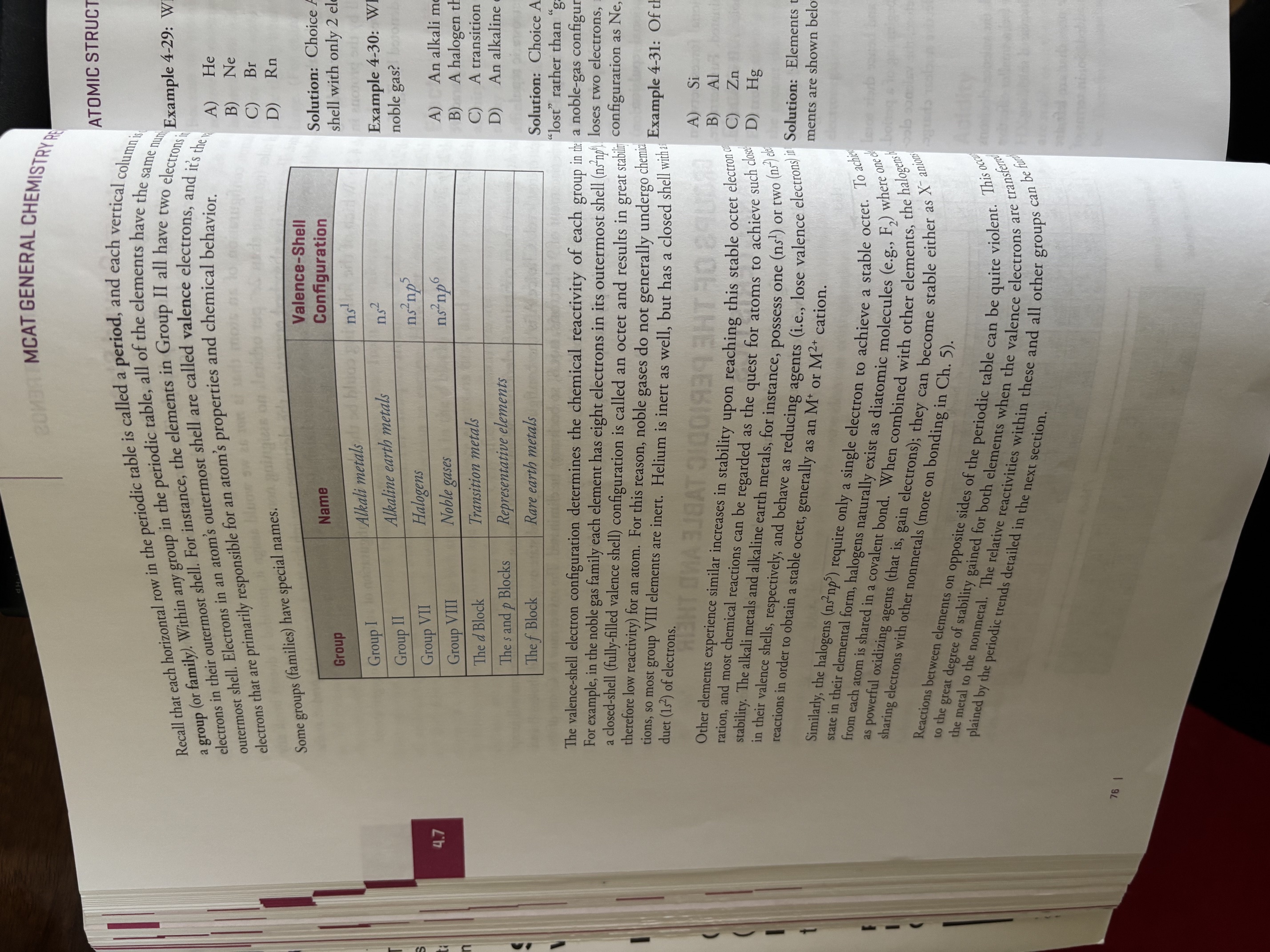
We will use the electron configurations of the atoms to predict their chemical properties, including their reactivity and bonding patterns with other atoms.
take a picture of the periodic table at the bottom of page 75 and attach it to this flashcard
Recall that each horizontal row in the periodic table is called a period, and each vertical column is called a group (or family). Within any group in the periodic table, all of the elements have the same number of electrons in their outermost shell are called valence electrons, and it’s the valence electrons that are primarily responsible for an atom’s properties and chemical behavior.
4.7 Groups of the Periodic Table and their characteristics cont’d
Some groups (families) have special names.
insert the table on page 76 here
The valence-shell electron configuration determines the chemical reactivity of each group in the table. For example, in the noble gas family each element has eight electrons in its outermost shell (ns2np6). Such a closed-shell (fully-filled valence shell) configuration is called an octet and results in great stability (and therefore low reactivity) for an atom. For this reason, noble gases do not generally undergo chemical reactions, so most group VIII elements are inert. Helium is inert as well,, but has a closed shell with a stable duet (1s2) of electrons.
Other elements experience similar increases in stability upon reaching this stable octet electron configuration, and most chemical reactions can be regarded as the quest for atoms to achieve such closed-shell stability. The alkali metals and alkaline earth metals, for instance, possess one (ns1) or two (ns2) electrons in their valence shells, respectively, and behave as reducing agents (ex: lose valence electrons) in redox reactions in order to obtain a stable octet, generally as an M+ or M2+ cation.
Similarly, the halogens (ns2np5) require only a single electron to achieve a stable octet. To achieve this state in their elemental form, halogens naturally exist as diatomic molecules (ex: F2) where one electron from each atom is shared in a covalent bond. When combined with other elements, the halogens behave as powerful oxidizing agents (that is, gain electrons); they can be stable either as X- anions or by sharing electrons with other nonmetals (more on bonding in Ch.5).
Reactions between elements on opposite sides of the periodic table can be quite violent. This occurs to a great degree of stability gained for both elements when the valence electrons are transferred from the metal to the nonmetal. The relative reactivities within these and all other groups can be further explained by the periodic trends detailed in the next section.
Example 4-29
Example 4-30
Example 4-31
Periodic Trends
Shielding
Each filled shell between the nucleus and the valence electrons shields—or “protects”— the valence electrons from the full effect of the positively charged protons in the nucleus. This is called nuclear shielding or the shielding effect. As far as the valence electrons are concerned, the electrical pull by the protons in the nucleus is reduced by the negative charges of the electrons in the filled shells in between; the result is an effect reduction in the positive elementary charge, from Z to a smaller amount denoted by Zeff (for effective nuclear charge).

put example 4-32 here
Atomic and Ionic Radius
With progression across any period in the table, the number of protons increases, and hence their total pull on the outermost electrons increases, too. New shells are initiated only at the beginning of a period. So, as we go across a period, electrons are being added, but new shells are not; therefore, the valence electrons are more and more tightly bound to the atom because they feel a greater effective nuclear charge. Therefore as we move from left to right across a period, atomic radius decreases.
However, with progression down a group, as new shells are added with each period, the valence electrons experience increased shielding. The valence electrons are less tightly bound since they feed a smaller effective nuclear charge. Therefore, as we go down a group, atomic radius increases due to the increased shielding.
If we form an ion, the radius will decrease as electrons are removed (because the ones that are left are drawn in more closely to the nucleus), and the radius will increase as electrons are added. So, in terms of radius, we have X+< X<X-; that is , cation radius < neutral-atom radius < anion radius.

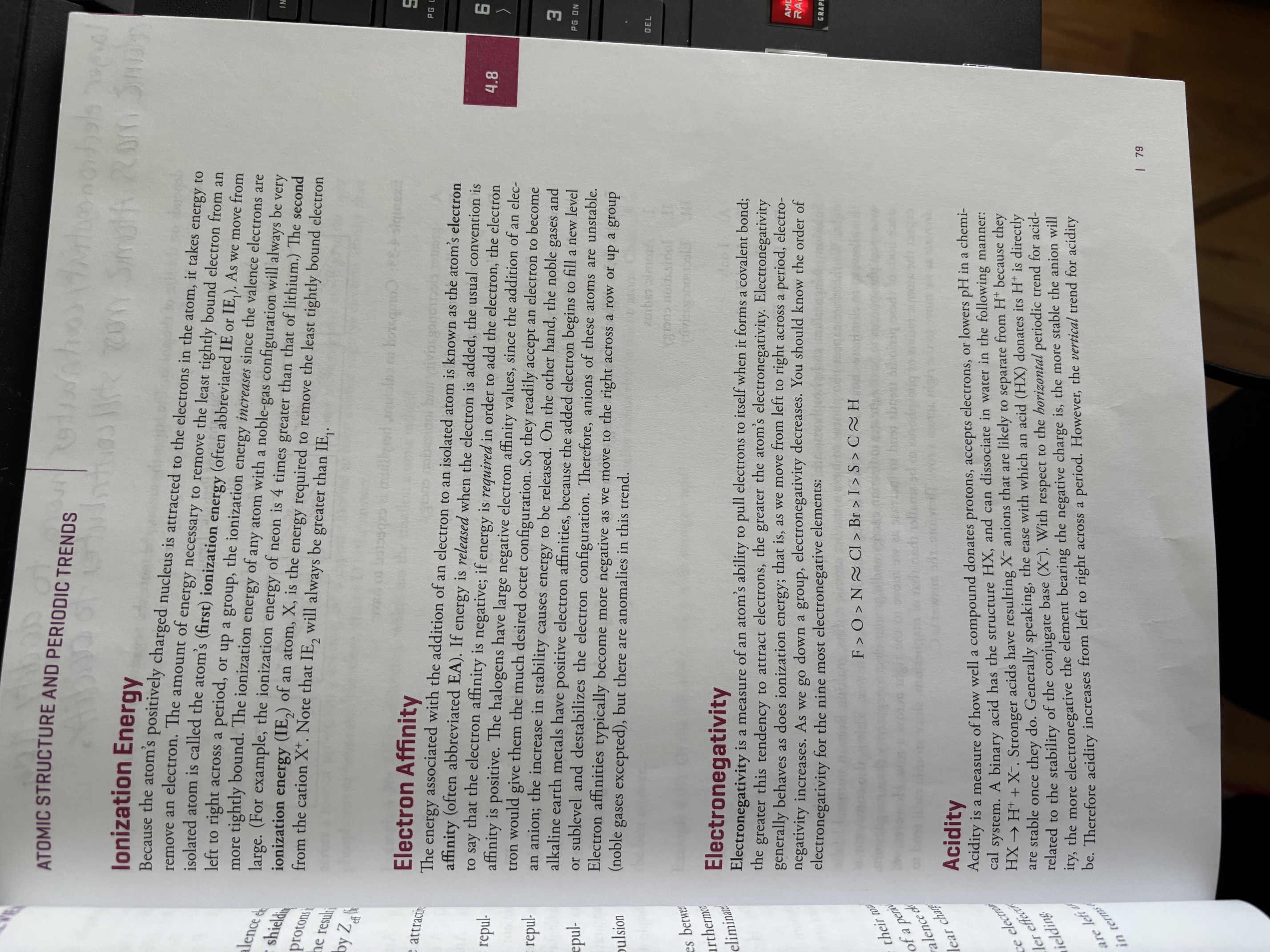
Ionization Energy
Because the atom’s positively charged nucleus is attracted to the electrons in the atom, it takes energy to move an electron. The amount of energy necessary to remove the least tightly bound electron from an isolated atom is called the atom’s first (first) ionization energy. (often abbreviated IE or IE1). As we move from left to right across a period, or up a group, the ionization energy increases since the valence electrons are more tightly bound. The ionization energy of any atom with a noble-gas configuration will always be very large. (For example, the ionization energy of neon is 4x greater than that of lithium.) The second ionization energy (IE2) of an atom, X, is the energy required to remove the least tightly bound electron from the cation X+. Note that IE2 will always be greater than IE1.

Electron Affinity
The energy associated with the addition of an electron to an isolated atom is known as the atom’s electron affinity (often abbreviated EA). If energy is released when the electron is added, the usual convention is to say that the electron affinity is negative; if energy is required in order to add the electron, the electron affinity is positive. The halogens have the large negative electron affinity values, since the addition of an electron would give them the much desired octet configuration. So they readily accept an electron to become an anion; the increase in stability causes energy to be released. On the other hand, the noble gases and alkaline earth metals have positive electron affinities, because the added electron begins to fill a new level of sublevel and destabilized the electron configuration. Therefore, anions of these atoms are unstable. Electron affinities typically become more negative as we move to the right across a row or up a group (noble gases excepted), but there anomalies in this trend.

Electronegativity
Electronegativity is a measure of an atom’s ability to pull electrons to itself when it forms a covalent bond; the greater this tendency to attract electrons, the greater the atom’s electronegativity. Electronegativity generally behaves as does ionization energy; that is; as we move from left to right across a period, electronegativity increases. As we go down a group, electronegativity decreases. You should know the order of electronegativity for the nine most electronegative elements:
F>O>N = Cl>Br>I>S>C=H

Acidity
Acidity is a measure of how well a compound donates protons, accepts electrons, or lowers pH in a chemical system. A binary acid has the structure HX, and can dissociate in water in the following manner: HX → H+ + X-. Stronger acids have resulting X- anions that are likely to separate from H+ because they are stable once they do. Generally speaking, the ease with which an acid (HX) donates its H+is directly related to the stability of the conjugate base (X-). With respect to the horizontal periodic trend for acidity, the more electronegative the element bearing the negative charge is, the more stable the anion will be. Therefore acidity increase from left to right across a period. However, the vertical trend for acidity depends on the size of the anion. The larger the anion, the more the negative charge can be delocalized and stabilized. Therefore, acidity increases down a group or family in the periodic table.
take a picture of the “summary of periodic trends” on page 80 and attach it to this flashcard
ex
example 4-33
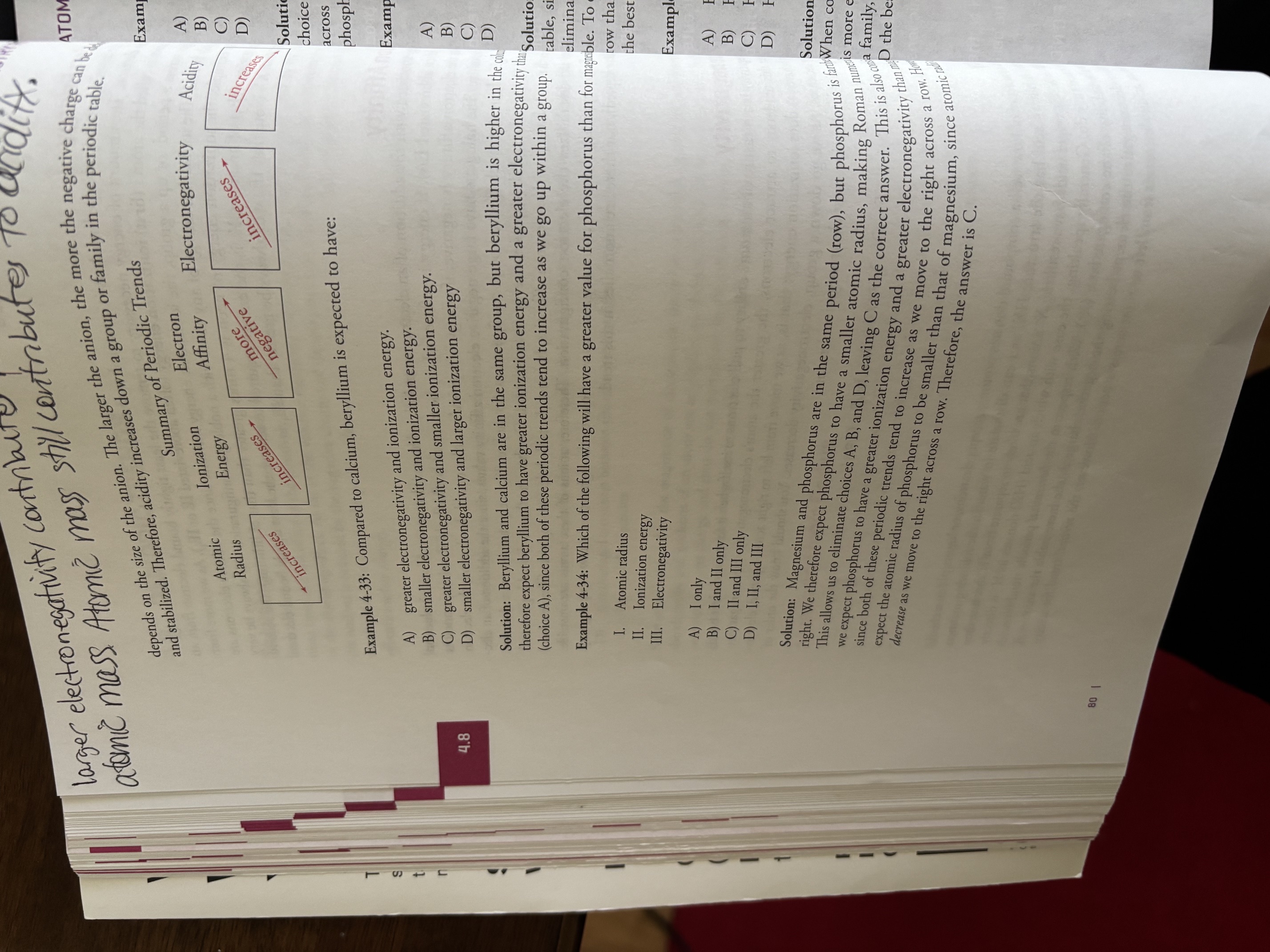
example 4-34

example 4-35

example 4-36

example 4-37
