CH 1: Introduction to Financial Statements
 Call Kai
 Learn
Learn Practice Test
 Spaced Repetition
 Match
Match Flashcards
 Knowt Play
1/77

There's no tags or description
Looks like no tags are added yet.
Name | Mastery | Learn | Test | Matching | Spaced | Call with Kai | Chat |
|---|
No analytics yet
Send a link to your students to track their progress
78 Terms

Personal Balance Sheet formula
What you own (Assets) minus What you owe (Liabilities) equals Your net worth (Equity).
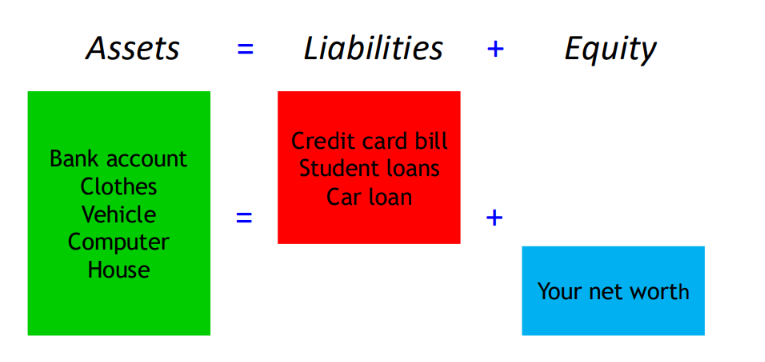
The Accounting Equation
Assets = Liabilities + Stockholders' Equity (A = L + SE).

Personal Income Statement formula
What you earn (Revenue) minus What you spend (Expenses) equals Change in net worth (Net Income).

Personal Equity Statement formula
Net worth on Jan 1 + Net income (or − net loss) = Net worth on Dec 31.
Which statement reflects the change in net worth (equity) over a period?
The Statement of Equity (Statement of Stockholders' Equity).

Personal Cash Flow Statement formula
Total cash on Jan 1 + Cash receipts for the year − Cash payments for the year = Total cash on Dec 31.
Which statement summarizes the cash effects of transactions?
The Statement of Cash Flows (Cash Flow Statement).
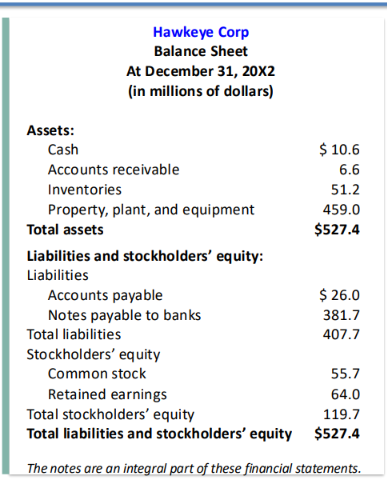
What does the Balance Sheet (The Statement of Financial Position) report?
Dollar amounts for assets, liabilities, and shareholders' equity.
What does the Balance Sheet provide?
A snapshot of financial position at a particular point in time (usually quarter-end or year-end).

What four items must appear at the top of every financial statement?
1) Name of the entity, 2) Title of the statement, 3) Specific date of the statement, 4) Unit of measure.
Definition of Assets
Economic resources owned or controlled by the company.
What do Liabilities and Stockholders' Equity represent on the balance sheet?
Sources of financing for the company's resources.

Order of items typically listed under Assets on a balance sheet
Cash → Other Current Assets → Total Current Assets → Non-current Assets → Total Assets.

Order of items typically listed under Liabilities & Equity on a balance sheet
Current Liabilities → Non-current Liabilities → Total Liabilities → Stockholders' Equity → Total Stockholders' Equity → Total Liabilities and Stockholders' Equity.

Lawn Care Kid Example: At the start of operations, what are Evelyn's assets and their total?
Lawnmower $150 + Trimmer $100 + Cash $100 = Total $350.

Lawn Care Kid Example: At the start of operations, who has claims to Evelyn's assets?
Mom and Dad loaned her $150 (Liability) + Evelyn contributed $200 (Equity) = Total $350.

What does the Income Statement (The Statement of Operations) report?
Revenues, expenses, and net income.
What period does the Income Statement cover?
Performance for a period of time (usually a quarter or a year).
Definition of Revenues
Increases in assets or decreases in liabilities from ongoing operations.
Definition of Expenses
Decreases in assets or increases in liabilities from ongoing operations, incurred to generate revenues during the period.

The Income Statement Equation
Revenue − Expenses = Net Income.

Lawn Care Kid Example: First year revenue and expenses
Customers paid Evelyn $300 (Revenue); Evelyn paid $75 for fuel and $25 for other expenses ($100 total Expenses).
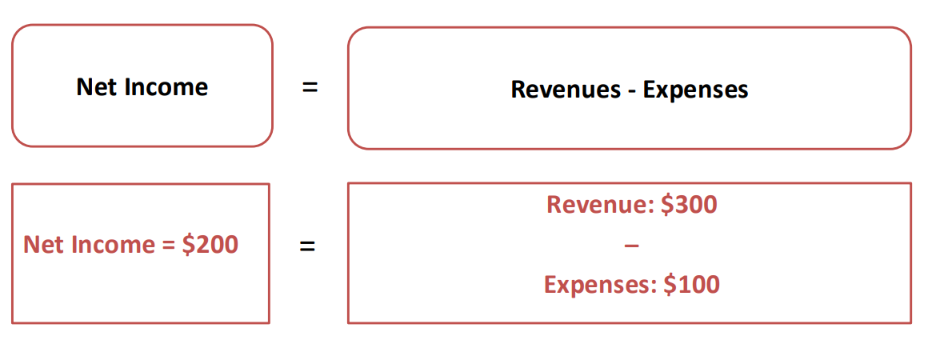
Lawn Care Kid Example: What is Lawn Care Kid's Net Income for the first year?
Revenue $300 − Expenses $100 = Net Income $200.
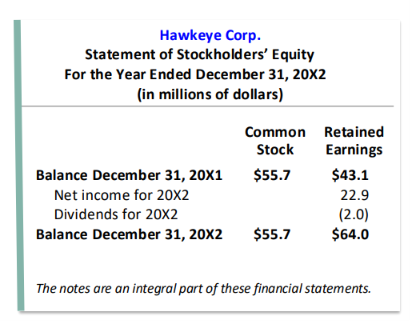
What does the Statement of Stockholders' Equity (The Statement of Retained Earnings) report?
The cumulative earnings reinvested in the business (changes in equity accounts over a period of time).

Definition of Common Stock (on the Statement of Stockholders' Equity)
Amounts invested in the business by stockholders.

Common Stock formula
Beginning Common Stock + Stock Issuance = Ending Common Stock.
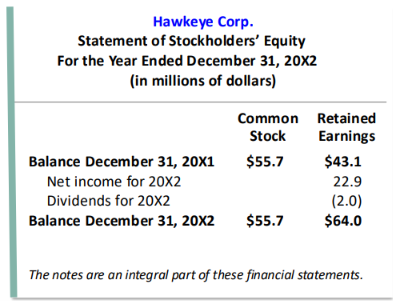
Definition of Retained Earnings
Past earnings not distributed to stockholders.

Retained Earnings formula
Beginning Retained Earnings + Net Income − Dividends Declared = Ending Retained Earnings.

Overall flow from Income Statement to Statement of Stockholders' Equity
Revenue − Expenses = Net Income (or Loss); Beginning Retained Earnings + Net Income − Dividends = Ending Retained Earnings.

Lawn Care Kid Example: Retained earnings at the end of year 1
Beginning RE $0 + Net Income $200 − Dividends $0 = Ending RE $200.
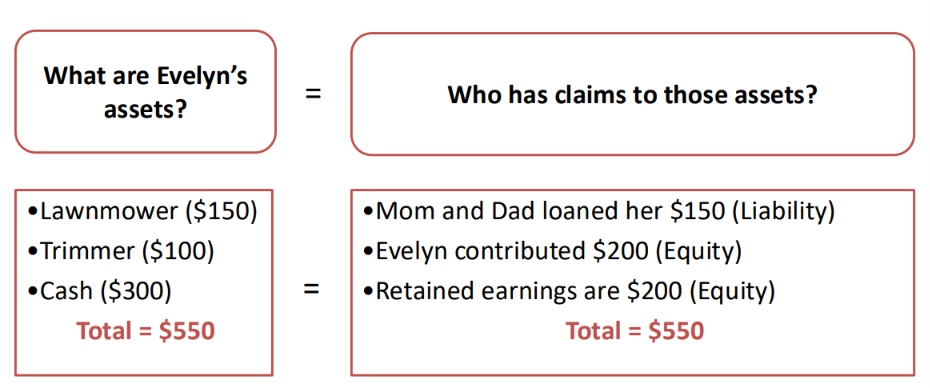
Lawn Care Kid Example: Assets and claims at the end of year 1
Assets: Lawnmower $150 + Trimmer $100 + Cash $300 = $550. Claims: Loan $150 (Liability) + Evelyn's contribution $200 (Equity) + Retained Earnings $200 (Equity) = $550.

What does the Statement of Cash Flows report?
Changes in cash resulting from operating, investing, and financing activities.
What period does the Statement of Cash Flows cover?
Changes in cash over a period of time (usually a quarter or a year).

Definition of Operating Cash Flows
Cash collected from customers less cash paid for operating expenses such as cash paid to suppliers and employees.

Definition of Investing Cash Flows
Cash flows related to the acquisition or sale of the company's plant, equipment, and investments.

Definition of Financing Cash Flows
Cash flows from the receipt or payment of money to investors and creditors (except suppliers).

Statement of Cash Flows formula
+/− Cash Flows from Operating Activities (CFO) +/− Cash Flows from Investing Activities (CFI) +/− Cash Flows from Financing Activities (CFF) = Change in Cash; + Beginning Cash Balance = Ending Cash Balance.

Can each cash flow category (operating, investing, financing) be positive or negative?
Yes — each can be a net cash inflow (positive) or net cash outflow (negative).
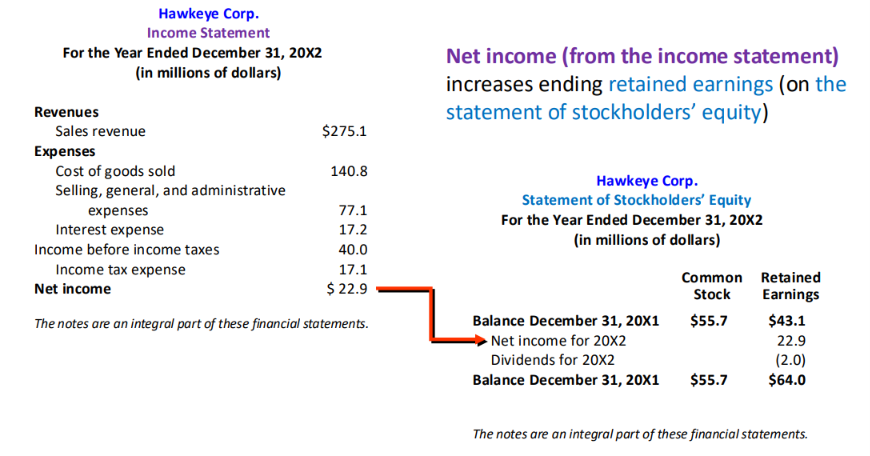
How does Net Income connect the Income Statement and Statement of Stockholders' Equity?
Net income (from the income statement) increases ending retained earnings on the statement of stockholders' equity.

How does Retained Earnings connect the Statement of Stockholders' Equity and the Balance Sheet?
Ending retained earnings is one component of stockholders' equity reported on the balance sheet.

How does Cash connect the Statement of Cash Flows and the Balance Sheet?
The ending cash balance from the statement of cash flows is reported as the Cash line item on the balance sheet.
What is the key takeaway about how the four financial statements relate?
The financial statements are interrelated — net income flows into equity, ending equity and ending cash flow into the balance sheet.
What three things do the Notes to the Financial Statements provide?
1) Describe the accounting rules applied, 2) Present additional detail about items included in the financial statements, 3) Provide information about items not included in the financial statements.
Balance Sheet: Purpose
Reports the financial position (economic resources and sources of financing) of an accounting entity at a point in time.
Balance Sheet: Structure
Assets = Liabilities + Stockholders' Equity.
Balance Sheet: Example content
Cash, accounts receivable, plant and equipment, long-term debt, common stock.
Income Statement: Purpose
Reports the accountant's primary measure of economic performance during the accounting period.
Income Statement: Structure
Revenues + Increases − Expenses = Net Income.
Income Statement: Example content
Sales revenue, cost of goods sold, selling expense, interest expense.
Statement of Stockholders' Equity: Purpose
Reports changes in the company's common stock and retained earnings during the accounting period.
Statement of Stockholders' Equity: Structure
Beginning balance + Increases − Decreases = Ending balance.
Statement of Stockholders' Equity: Example content
Beginning and ending stockholders' equity balances, stock issuances, net income, dividends.
Statement of Cash Flows: Purpose
Reports inflows (receipts) and outflows (payments) of cash during the accounting period in the categories operating, investing, and financing.
Statement of Cash Flows: Structure
+/− CFO, +/− CFI, +/− CFF = Change in Cash.
Statement of Cash Flows: Example content
Cash collected from customers, cash paid to suppliers, cash paid to purchase equipment, cash borrowed from banks.
How many basic financial statements are there, and what are they?
Four: the Balance Sheet, the Income Statement, the Statement of Stockholders' Equity, and the Statement of Cash Flows.
What is a fiscal year?
A 12-month accounting period, which may not begin on January 1.
How are fiscal years referenced?
By their ending date or year — for example, "FY 2025" refers to the fiscal year ending in 2025.
Definition: Accounting
A system that collects and processes (analyzes, measures, and records) financial information about an organization and reports that information to decision makers.
Definition: Accounting Entity
The organization for which financial data are to be collected.
Definition: Accounting Period
The time period covered by the financial statements.
Definition: Audit
An examination of the financial reports to ensure that they represent what they claim and conform with generally accepted accounting principles.
Definition: Balance Sheet (formal glossary version)
Reports the amount of assets, liabilities, and stockholders' equity of an accounting entity at a point in time. Also called the Statement of Financial Position.
Definition: Basic Accounting Equation (Balance Sheet Equation)
Assets = Liabilities + Stockholders' Equity.
Definition: Faithful Representation
Requires that financial information be complete, neutral, and free from error.
Definition: Generally Accepted Accounting Principles (GAAP)
The measurement and disclosure rules used to develop the information in financial statements.
Definition: Income Statement (formal glossary version)
Reports the revenues less the expenses of the accounting period. Also called the Statement of Income, Statement of Earnings, or Statement of Operations.
Definition: Internal Controls
Processes by which a company provides reasonable assurance regarding the reliability of its financial reporting, the effectiveness and efficiency of its operations, and its compliance with applicable laws and regulations.
Definition: Notes (Footnotes) (formal glossary version)
Provide supplemental information about the financial condition of a company, without which the financial statements cannot be fully understood.
Definition: Primary Objective of Financial Reporting to External Users
To provide financial information about the reporting entity that is useful to existing and potential investors, lenders, and other creditors in making decisions about providing resources to the entity.
Definition: Relevant Information
Information that can influence a decision; it has predictive and/or feedback value.
Definition: Statement of Cash Flows (formal glossary version)
Reports inflows and outflows of cash during the accounting period in the categories of operating, investing, and financing. Also called the Cash Flow Statement.
Definition: Statement of Stockholders' Equity (formal glossary version)
Reports the changes in each of the company's stockholders' equity accounts during the period.
What role does GAAP play in financial statements?
GAAP refers to the measurement rules used to develop the information in financial statements; knowledge of GAAP is necessary to accurately interpret the numbers.
Who has primary responsibility for the accuracy of a company's financial information?
Management.
What is an auditor's responsibility regarding financial statements?
Auditors are responsible for expressing an opinion on the fairness of the financial statement presentations, based on their examination of the company's reports and records.
What must be true for users to have confidence in the accuracy of financial statement numbers?
The people associated with preparing and auditing the statements must have reputations for ethical behavior and competence.
Can management and auditors be held legally liable for fraudulent financial statements?
Yes — both management and auditors can be held legally liable for fraudulent financial statements.