Anatomy exam 1
 Call Kai
 Learn
Learn Practice Test
 Spaced Repetition
 Match
Match Flashcards
 Knowt Play
1/222

There's no tags or description
Looks like no tags are added yet.
Name | Mastery | Learn | Test | Matching | Spaced | Call with Kai | Chat |
|---|
No analytics yet
Send a link to your students to track their progress
223 Terms
microscopic anatomy
Structures too small to see with eyes, includes cytology (cells) and histology (tissues)
Gross anatomy
structures seen with naked eye, has subdisciplines
Comparative anatomy
similarities and differences across species. EX: human vs monkey
Developmental anatomy
structural changes from conception through maturity
embryology
developmental changes occurring prior to birth. EX: conception through birth
Regional anatomy
study of all structures in that single region. EX: upper limbs, trunk, lower limbs
surface anatomy
superficial and internal surfaces as they relate to their location on the body surface. Directly can touch without cutting open.
Systemic anatomy
studies structures involved with a specific body activity. EX: nervous system
Increasing complexity of anatomy
chemical (atoms and molecules), cellular (cells), tissue, organ level, organ system level, organismal level
Integummentary system
provides protection, regulates body temp, site of cutaneous receptors, synthesizes vitamin D, prevents water loss
Skeletal system
Provides support and protection, site of hemopoiesis (blood cell production), stores calcium and phosphorus, provides sites for muscle attatchments
muscular system
provides body movement, generates heat when muscles contract
Nervous system
A regulatory system that controls body movement, responds to any sensory stimuli, and helps control all other systems of the body. Also responsible for conciousness, intelligence, and memory.
Endocrine system
Consists of glands and cell clusters that secrete hormones, some of which regulate body and cellular growth, chemical levels in the body, and reproductive functions
cardiovascular system
Consists of the heart (a pump), blood, and blood vessels; the heart moves blood through blood vessels to distribute hormones, nutrients, and gases, and pick up wase products
Respiratory system
Responsible for exchange of gases (oxygen and carbon dioxide) between blood and the air in the lungs
Digestive system
Mechanically and chemically digests food materials, absorbs nutrients, and expels waste products.
Urinary system
Filters the blood and removes waste products from the blood, concentrates waste products in the form of urine, and expels urine from the body.
axial region
vertical axis, head, neck, trunk
appendicular region
upper and lower limbs
Cephalic region
head
otic region
ear
frontal region
forehead
occipital region
back of head
oral region
mouth
buccal region
cheek
mental region
chin
nasal region
nose
ophthalmic region
eye
cervical region
neck
pectoral region
chest
umbilical region
naval
abdominal region
mid-torso
axillary region
armpit
vertebral region
midline of back
costal region
ribs
pelvic
hips
gluteal region
buttocks
inguinal region
groin
lumbar region
lower back
perineal region
between anus and external genetalia
brachial region
arm
antebrachial region
forearm
carpal region
wrist
cubital region
elbow
antecubital region
front of elbow
palmar region
palm of hand
femoral region
thigh
crural region
lower leg
popliteal region
back of knee
patellar region
front of knee
pedal region
foot
plantar region
sole of foot
cutaneous region
everywhere (skin)
anterior/ventral (ventral only used when referring to AXIAL region)
toward the front
posterior/dorsal (dorsal only used when referring to AXIAL region)
toward the back
Superior/cranial (cranial only used when referring to AXIAL region)
above/toward head
inferior/caudal ( caudal only used when referring to AXIAL region)
below/ toward tail
medial
towards midline
lateral
away from midline
intermediate
in between (get as close as possible when using)
Proximal
(appendicular only) toward attachment point
Distal
(appendicular only) away from attatchment
superficial
towards the surface of the skin
deep
away from the skin surface
ipsilateral
same side
contralateral
opposite sides
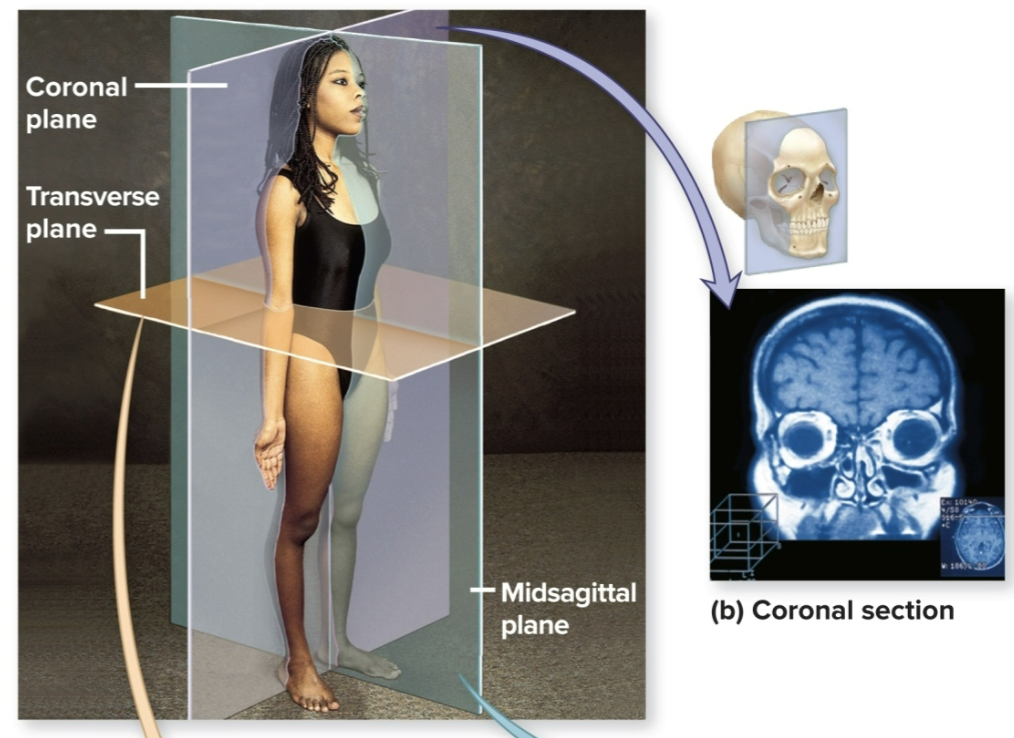
coronal (frontal plane)
divides body into anterior and posterior sections.
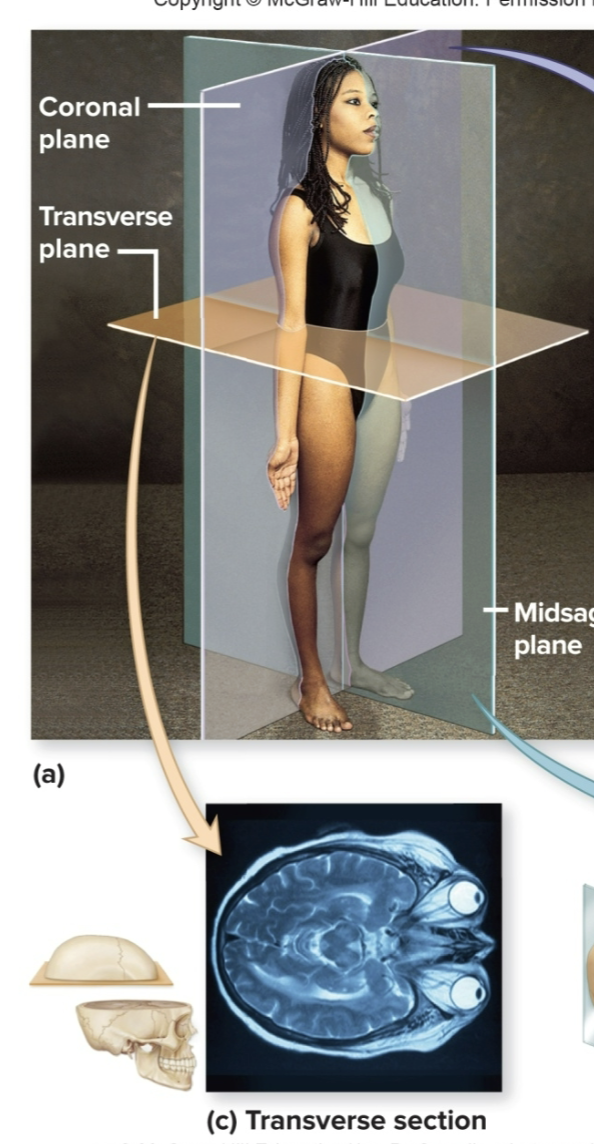
transverse (horizontal plane)
divides body into superior/inferior sections
sagittal plane
divides body into left and right sections (unequal)
midsaggital plane
divides body into EQUAL left and right halves
oblique plane
passes through specimen at an angle, diagnal
plasma membrane (cell membrane or plasmalemma)
Extremely thin, outer border of cell that seperates the intracellular and extracellular fluid compartments. Phospholipid bilayer with proteins interspersed within
passive transport
materials move down concentration gradient-high to low. Requires no energy
active transport
materials move against concentration gradient- low to high. large in size or quantity, needs energy
simple diffusion
small, nonpolar molecules move from high to low concentration, crowded, wants to move to low concentration. Passive transport
osmosis
diffusion of water, passive transport
facilitated diffusion
transport proteins help move molecules across membrane. Large molecules move down/with concentration gradient. Passive transport
bulk transport
moves large molecules or bulk structures across the plasma membrane. Exocytosis and endocytosis
exocytosis
materials packed into vesicles and secreted out of the cell when vesicles fuse w the plasma membrane
endocytosis
materials taken in to the cell, packaged in vesicles
phagocytosis
nonspecific uptake of particles by formation of membrane extensions that surround.
pinocytosis
nonspecific uptake of cellular fluid
Cytoplasm
includes all materials between plasma membrane and nucleus
cytosol
a well flowing fluid containing water and many dissolved substances, such as ions, nutrients, proteins, carbohydrates, lipids, SMALL MOLECULES. Some cells store inclusions here including pigments, nutrient stores, and protein crystals.
membrane bound organelles
contents are separate from cytosol. Endoplasmic reticulum, golgi app, lysosomes, peroxisomes, mitochondria. membrane wrapped around
non-membrane-bound organelles
contents are in direct contact with cytosol. ribosomes, cutoskeleton, centrosomes, centrioles, cilia, flagella, microvilli. not surrounded, in direct contact
cisternae
gap inside fluids
smooth ER
lack of ribosomes, continuous with the rough ER, synthesis, transport, and storage of lipids including steroid hormones, metabolism of carbohydrates, detoxification of drugs, alcohol, and poisons
rough ER
Attatchment of ribosomes outside membrane. Recieves newly synthesized proteins from ribosomes. Proteins will be secreted, inserted into plasma membrane or included in a lysosome. RER modifies the proteins and package them into transport vesicle. DOES NOT produce ribosomes itself, ribosomes do, and RER decides what to do with it.
golgi apparatus
receive material from the ER for modification, sorting, and packaging. Gets production from others and distributes it
Lysosomes
Vesicles generated by Golgi Apparatus, contains enzymes used to digest and remove waste products and damaged organelles within the cell, when a cell is dying it releases lysosomal enzymes that digest the cell. Find damaged molecule, engulf it, and break it down, then releases enzymes to recycle.
Peroxisomes
Sacs formed by pinching off from RER, smaller than lysosomes, detoxify harmful molecules in cell, abundant in liver cells
cristae
organelles with double membranes, produce ATP, cells that require more energy have more mitochondria
ribosomes
responsible for protein synthesis, free ribosomes float in the cytosol, fixed ribosomes are attatched to RER
Cytoskeleton
Proteins organized in the cytosol as solid filaments or hollow tubes, gives structure. Has 3 components: microfilaments, intermediate filaments, and microtubules
centrosomes
nonmembranous, spherical structure adjacent to nucleus, contains pair of centrioles at right angles to each other
centriole
attatched to chromosomes during cell division causing chromosomal migration
cilia
on exposed surfaces of certain cells move objects across their surface. EX: cells of resp. system move mucus
flagella
longer than cilia usually singular whiplike tails ex: sperm