Cell Biology
 Call Kai
 Learn
Learn Practice Test
 Spaced Repetition
 Match
Match Flashcards
 Knowt Play
1/82

There's no tags or description
Looks like no tags are added yet.
Name | Mastery | Learn | Test | Matching | Spaced | Call with Kai | Chat |
|---|
No analytics yet
Send a link to your students to track their progress
83 Terms
ATP is composed of…
nucleotides and phosphate groups
monosaccharides are…
simple sugars
individual building blocks
examples of monosaccharides:
glucose, fructose, galactose
how are monosaccharides obtained in the body?
through digestion of more complex carbs that are consumed
examples of disaccharides:
sucrose, lactose, maltose
examples of polysaccharides:
starch, glycogen, cellulos
what is glycogen?
the primary storage form of carbs in animal cells
where is glycogen typically found?
glycogen is typically stored in skeletal muscle and in the liver
what is the primary storage form of carbs in plant cells?
cellulose and starch
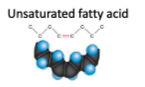
how many doubles bonds do saturated fatty acids have?
0

how many doubles bonds do unsaturated fatty acids have?
1

how many doubles bonds do polsaturated fatty acids have?
>1
what is the primary storage form of lipid in animals?
triglycerides
how are triglycerides composed?
3 fatty acids esterified to a glycerol back bone

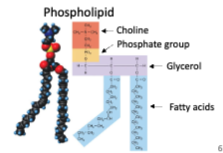
how are phospholipids composed?
2 fatty acids esterified to a glycerold and phosphate head
where are phospholipids used?
in the cell membrane
what type of organic molecule is cholesterol?
lipid
why is cholesterol imporant?
it is a precursor to steroid hormones like testosterone, estrogen, and cortisol
what are proteins composed of?
proteins are composed of folded polypeptide chains
polypeptides = peptides = chains of amino acids linked by peptide bonds
how are primary structure of proteins determined?
type, number, and order of amino acids in the polypeptide chain
dictated by genetic code and gene expression

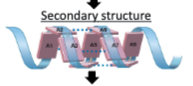
how are secondary structure of proteins determined?
hydrogen bondings
common structures include alpha helices or beta sheets
how are tertiary structures formed?
coiling and folding of polypeptide to form a 3D globular protein

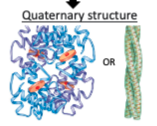
how are quaternary structures formed?
multiple separate polypeptide subunits interact to form a larger functional molecular
examples include hemoglobin or structural collagen
what is cell theory?
cells are the smallest basic unit of life of which all organisms are composed
cells are autonomous and self replicating
what are the 3 basic components of a cell?
nucleus
cell membrane/plasma membrane
cytoplasm
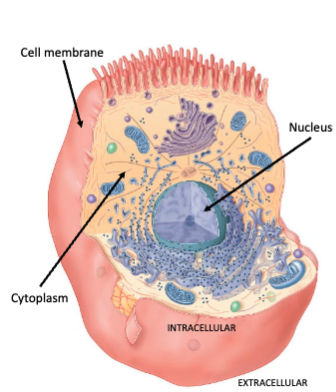
what is the cytoplasm?
the space between the nucleus and cell membrane
what is the cytoplasm composed of?
cytosol (actual name of the fluid) & organelles
what is the extracellular space and what does it contain?
extracellular space is everything outside the cell membrane
it contains interstitial fluid or blood plasma
what is the intracellular space and what does it contain?
intracellular space is inside the cell membrane
contains intracellular fluid, cytosol
what is the function of the smooth endoplasmic reticulum?
it synthesizes lipids and carbs
what is the function of the rough endoplasmic reticulum?
it modifies and packages proteins that are synthesized by the attached ribosomes
what is the function of the golgi apparatus?
it stores, modifies, and packges the secretory products from the ER
what is the function of peroxisomes
metabolism of fatty acids
what is the function of lysomes?
removal of damaged organelles
“garbage can”
what is the function of mitochrondria?
produces 95% of ATP required by the cell
list the membranous organelles:
smooth ER
rough ER
golgi apparatus
peroxisomes
lysosomes
mitochondria

list the non-membranous organelles:
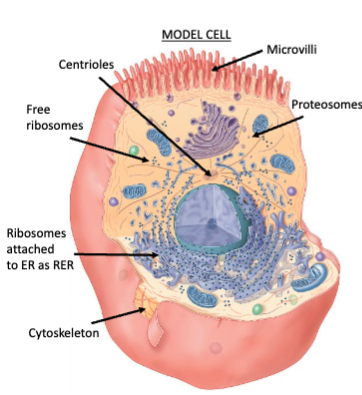
ribosomes
cytoskeleton
microvilli
centrioles
proteosomes
what is the function of ribosomes?
site of protein synthesis
can be free in cytoplasm of bound to the ER
why is the rough ER “rough”?
b/c of the ribosomes that are attach to it
what is the function of the cytoskeleton?
cellular shape, support, and strength
what is the function of microvilli?
increase cell surface area to aid with absorption of extracellular material
unlike cilia, microvilli are…
passive
where else can microvilli be found?
in the small intestines
what is the function of centrioles?
to arrange chromosomes during cell division (mitosis)
what is the function of proteasomes?
site of protein degradation
what is the function of the cell nucleus?
control center of the cell
site of gene expression
transcription specifically, DNA → mRNA
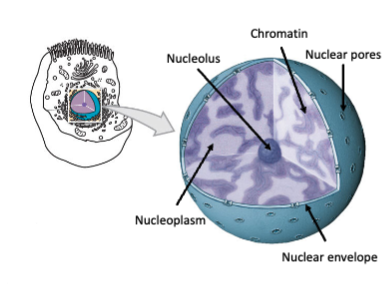
what is inside the cell nucleus?
nucleoplasm
chromatin
nucleolus

what is the function of the nuclear envelope?
barrier of the nucleus
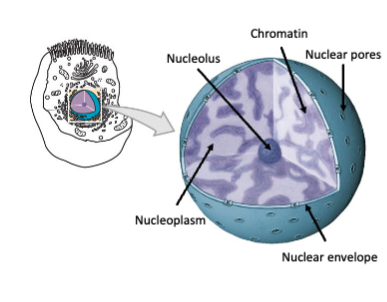
what is the function of nuclear pores?
allow passage mRNA and proteins out of the nucleus

what is the function of the nucleolus?
site of ribosomal RNA (rRNA) production

what is the function of the cell membrane?
physically separates the intracellular and extracellular space
what is the cell membrane composed of?
phospholipid bilayer
hydrophobic fatty acid tails of phospholipids face the core of bilayer
hydrophilic phospholipid heads face outward towards the extracellular and intracellular spaces
what does “selectively-permeable” mean for the phospholipid bilayer?
lipid-soluble molecules pass freely via passive diffusion from region of high-to-low concentration
ex: O2, CO2, steroid hormones
H2O diffuses freely through protein channels via osmosis (a special form of passive transport)
what is osmosis?
the passive transport of water through a selectively permeable membrane where H2O moves from a region of less solute concentration toward a region of higher solute concentration
“water follows salt”
☆ does not require energy
osmosis results in…
equilization of solute concentration via movement of H2O molecules
what is an isotonic solution?
no osmotic flow occurs
solute concentration is equal inside and outside cell
what is a hypotonic solution?
lower solute concentration outside the cell than inside
water flows into the cell
☆ swelling may continue until the plasma membrane reputes, or lyses
what is a hypertonic solution?
higher solute concentration outside the cell than inside
water flows from the cell, outside
☆ the cell shrivels and becomes crenated
what is facilitated diffusion?
the molecule doesn’t need energy to permeate the cell membrane, but needs a channel
the molecule finds the receptor site and is transported into the cell via a carrier protein
occurs from a region of high-to-low concentration
facilitated diffusion - glucose:
glucose is too large to permeate the cell membrane
glucose → receptor site
a protein called GLU4 transports glucose into muscle and fat cells (adipocytes) in response to the hormone insulin
what is active transport?
movement of molecules from a region of low-to-high concentration
↪ against the concentration gradient
requires energy
ATP + H2O → ADP + Pi
☆ maintains resting cell membrane
example of active transport
the sodium (Na+) - potassium(K+) ATPase pump
moves 3x Na+ ions out of the cells and 2x K+ ions in for each single molecule of ATP broken down
what are the factors that affect rate of diffusion?
steepness of concentration gradient
molecular size
electric charge
lipid solubility
temperature
presence of channel proteins
factors affecting rate of osmosis?
concentration gradient
opposing osmotic or hydrostatic pressure
substance involved in diffusion?
small inorganic ions
most gases and lipid-soluble materials (all cells)
substances involved in osmosis?
water only (all cells)
factors affecting rate of facilitated diffusions?
steepness of gradient
temperature
availability of carrier proteins
factors affecting rate of active transport?
availability of:
carrier proteins
substrate
ATP
subtances involved in facilitated diffusion?
glucose
amino acids
(all cells)
substances involved in active transport?
Na+, K+, Ca2+, Mg2+ (all cells)
other solutes by specialized cells
what is the function of DNA?
encodes instructions for all cell processes
where is DNA found>
in the cell nucleus
what is DNA composed of?
2 polynucleotide chains in the form of a double helix
DNA backbone is made of sugar (deoxyribose) and phosphate groups
what is chromatin?
DNA wrapped around histone proteins
list the nitrogenous bases (DNA & RNA):
adenine
thymine
guanine
cytosine
uracil
list the complimentary pairs (for both DNA & RNA)
DNA:
adenine & thiamine
guanine & cytosine
RNA:
adenine & uracil
guanine & cytosine
what is RNA’s backbone
ribose backbone instead of deoxyribose
what is transcription?
the initial step in protein synthesis that begins in the nucleus of the cell
creates a single stranded molecule of messenger RNA (mRNA)
↪ carries the genetic code of proteins to produce
the mRNA sequence is __ to the encoding DNA sequence
complimentary with replacement of thiamine with uracil
how does mRNA leave the nucleus?
via pores in the nuclear envelope → moves to cytosol
what is the process of translation?
mRNA binds to a ribosome in the cytoplasm
↪ either free in cytosol or attached to the RER
tRNA reads the mRNA sequence and now has the complimentary anticodon nucleotide sequence
tRNA transfer the appropriate amino acid to the ribosome
↪ mRNA start codon = AUG, tRNA anticodon = UAC
the ribosome moves along the mRNA with additional tRNAs adding further amino acids until a stop codon is read
the completed polypeptide is released
mRNA is complimentary to
DNA
tRNA is complimentary to
mRNA