Miftaah Summer Immersion: The Battlefields of Faith: Session 1
 Call Kai
 Learn
Learn Practice Test
 Spaced Repetition
 Match
Match Flashcards
 Knowt Play
1/32

Earn XP
Description and Tags
The Rightly Guided Caliphs, Political Landscape in era of the Prophet PBUH, Prophethood, Battle of Khandaq, Prophet PBUH's vision for the ummah, Battle of Muttah
Name | Mastery | Learn | Test | Matching | Spaced | Call with Kai | Chat |
|---|
No analytics yet
Send a link to your students to track their progress
33 Terms
The Prophet advised Muslims to hold onto the teachings and traditions of the ____ ________ _______ during times of religious and social conflict.
Rightly guided Caliphs (Khulafa ar-Rashideen)
The 4 Rightly Guided Caliphs were within the time period of
632-661 CE
The Rightly Guided Caliphs were the first four leaders chosen after the Prophet and they are in order:
Abu Bakr as Siddiq, Umar ibn al Khattab, Uthman ibn Affan, and Ali ibn Abi Talib
The Hereditary Empires are between the time period of:
661-1258 CE
The Prophet PBUH foretells the Caliphate after him will last for ____ ____, then there will be monarchies and empires.
30 years
The Ottoman Empire was between the time period of:
1517-1924 CE
The Prophet PBUH predicted that the ____ would become a formidable and powerful force.
The Prophet PBUH said “Leave the ___ alone as long as they leave you alone” (Sunan Abu Dawud)
Turks
Under ____ ____ ___ _____, the Ottoman Empire (the descendants of the Turks) was a superpower that spanned across 3 continents.
Sultan Suleiman the Magnificient
What 3 continents does the Ottoman Empire span across?
Europe, Asia, and Africa
What does the early 1900s signify for the Caliphate?
the end of the caliphate as there was no single internationally recognized caliph for the global Muslim community.
There were ___ dominant global superpowers during the era of the Prophet PBUH.
2
What were the dominant global superpowers during the era of the Prophet PBUH?
The Byzantine (Roman) Empire & The Sasanian (Persian) Empire
Where is the Byzantine (Roman) Empire located?
based in the Levant (Ash-Sham) and Anatolia
What is the official religion of the Byzantine (Roman) empire?
Christianity, but it wasn’t very unified
What was a recurring issue due to the Byzantine Church being a department of state administration?
clerical corruption (priests and ministers)
Where was the Sasanian (Persian) empire located?
based in Iraq and Iran
What was the official religion of the Sasanian (Persian) Empire?
Zoroastrianism and heavy involvement of astrology
The 12 descendants of _______ are the 12 tribes that spread across the Arabian Peninsula
Ismail (AS)
The shift to idolatry among the descendants of Ismail (AS) was introduced by ____ ___ ______. He traveled to 'Ash-Sham and, upon seeing the people there worshiping idols, he thought to himself that this was something beneficial.
'Amr ibn Luhay
____ brought home several statues and placed them around the Ka'bah in Makkah. He successfully convinced the tribes of the Arabian Peninsula to accept these idols as mediators to Allah, shifting them away from the original monotheism they inherited. Along with idolatry, these tribes began relying on fortunetellers to make decisions. These fortune-tellers obtain their information through contact with evil jinn.
Amr
A Christian scholar and the cousin of the Prophet PBUH’s wife Khadija, _____ __ ______, confirmed that Muhammad PHUH was a prophet but warned him that like the stories of the messengers before, his own people will drive him out.
Waraqah ibn Nawfal
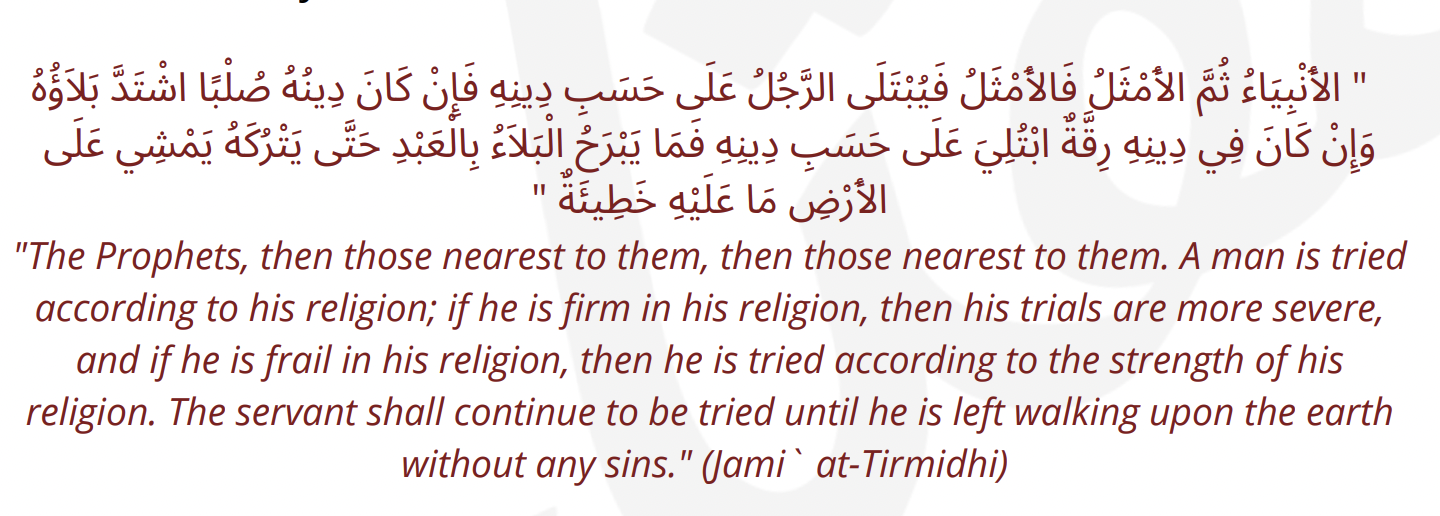
Mus'ab bin Sa'd narrated from his father that a man said: "O Messenger of Allah (صلى الله عليه وسلم)! Which of the people is tried most severely?" He said:
"The Prophets, then those nearest to them, then those nearest to them. A man is tried according to his religion; if he is firm in his religion, then his trials are more severe, and if he is frail in his religion, then he is tried according to the strength of his religion. The servant shall continue to be tried until he is left walking upon the earth without any sins." (Jami` at-Tirmidhi)
Who was the first ambassador of Islam?
Musab ibn Umair, who helped the Prophet PBUH settle smoothly in Madinah
What was the name of the man who was going to crowned the sole King of Madinah, but then the migration of the Prophet Muhammad PBUH to Madinah and many individuals conversion to Islam derailed that plan?
Abdullah ibn Ubayy
During the Battle of _____ (The _____), the Companions had been digging the ____ in freezing weather and were starving. The Prophet (صلى الله عليه وسلم) had a stone tied to his stomach to suppress the intense hunger pains.
Khandaq, Trench, trench
The Companions encountered a massive, unbreakable boulder. The Prophet (صلى الله عليه وسلم) stepped down into the trench and struck the rock ___ times, reducing it to sand. With each strike, a bright flash of light appeared, and the Prophet (صلى الله عليه وسلم) prophesied the future Islamic conquests of _______, ______, and ______ lands.
3, Byzantine, Persian, Yemeni
The Prophet PBUH prophesied that _______ (modern-day Istanbul) would be conquered by the Muslims.
Constantinople
The Prophet (صلى الله عليه وسلم) foresaw his nation (who was an inland civilization) undertaking a naval expedition decades before they took place during the caliphate of _______ ___ ______.
Uthman ibn Affan
Who was the muslim envoy that was sent by the Prophet PBUH to deliver a letter to the Byzantine governor of Busra (Shurahbil ibn Amr al-Ghassani) and ended up being assassinated by the governor?
Al-Harith ibn Umayr
The assassination of this muslim envoy led to what battle?
Battle of Mutah
The Prophet (صلى الله عليه وسلم) sent a force of roughly 3,000 men to seek justice, and ultimately in this expedition, all three commanders were martyred. What were their names?
Zayd ibn Harithah (the beloved adopted son of the Prophet PBUH), Jafar ibn Abi Talib, and Abdullah ibn Rawahah
Before the Prophet (صلى الله عليه وسلم) passed away, he mobilized the army led by ______ ___ _____ to confront Byzantine forces and avenge the losses at the Battle of Mu'tah, where Usama's father (Zayd ibn Harithah) was killed.
Usama ibn Zayd
After the Prophet (صلى الله عليه وسلم) passed, Caliph ____ ____ prioritized executing this final command and insisted the army depart without delay. The departing army was not kept in Madinah to mourn.
Abu Bakr