Stuff for Exam 1
 Call Kai
 Learn
Learn Practice Test
 Spaced Repetition
 Match
Match Flashcards
 Knowt Play
1/225

There's no tags or description
Looks like no tags are added yet.
Name | Mastery | Learn | Test | Matching | Spaced | Call with Kai | Chat |
|---|
No analytics yet
Send a link to your students to track their progress
226 Terms
santiago ramon y cajal contributions
revealed most of CNS structure using silver nitrate stain, correct idea of neuron theory
camillo golgi contributions
invented golgi (silver nitrate) stain and was really the first to use histology to study neuroscience; incorrect idea of reticular theory
reticular theory
neurons are continuous with one another, the nervous system is an uninterrupted network (reticulum)
neuron theory & its elements
neurons are individual units that communicate across intercellular gaps - proven with electron microscopes definitively in 1950 when you could observe synapses/gap junction
brain made of individual units = cells = neurons
units/cells may differ in size, shape, structure
center of cells is nucleus, nerve fibers built from outgrowth/processes
cells connected via contact and synapses allow transmission
there is a preferred direction of transmission bw cells = polarization
transmission is excitatory or inhibitory, not both
Dale’s law → each terminal releases single type of transmittor
main parts, functions of neurons
dendrites receive info, directed to soma/cell body (has nucleus and organelles), axon propagates electrical signals via action potentials, axon terminals send out chemical signals/release neurotransmittors
plasticity
idea that experience can modify neuronal activity
unipolar neurons
one process

pseudounipolar neurons
typically have continuous axon with central (CNS) and peripheral (PNS) axon that goes into skin/muscle → often sensory

bipolar neurons, common location, what its structure tells us
axon and one main dendrite stem; ex: in retina, limited inputs and low surface area therefore each input contributes more to firing action potential or not
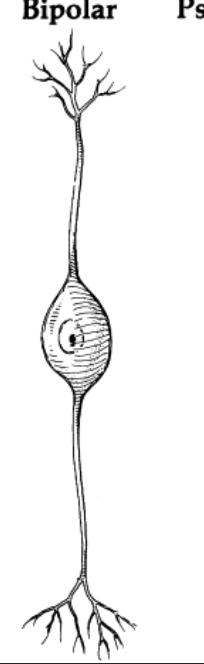
multipolar neurons, what its structure tells us
several processes - large surface area and multiple inputs so can be involved in many neural networks, each input contributes less to ap or not

polarity of axon proceedings
primarily in one direction: axon → dendrite → soma (back propagation does exist though)
nucleus in soma contains…
lots of euchromatin → loosely packaged DNA that is accessible and active in transcription
what is present in soma/functions
rough er with ribosomes to form proteins
golgi apparatus to modify and package proteins
neuronal structures most relevant to axon
myelin sheath (typically present) allows faster ap conductance
nodes of ranvier = gaps in myelin sheath
axon hillock/axon initial segment is where aps originate from
major components of cytoskeleton/structure
microtubules
neurofilaments
microfilaments
microtubules’ function
carry info, bases for protein transport (‘walked’ along them)
neurofilaments’ function
primarily make up axon’s structure
microfilaments’ function
responsible for cell shape and movement
axon means of communication, morphology
fairly uniform with branches at axon terminal, uses neurotransmitters within synaptic vesicles to send signals
dendrite means of communication, morphology
variety of branched patterns, diameter decreases towards end, receives/propagates info via postsynaptic receptors (have varying densities)
segments of neuron & what’s in them
somatodendritic - dendrites, soma
axonal -axon
terminal - axon terminal
where are action potentials initiated and why
at the AIS, because there is a high density of low voltage-activated channels there, allowing the depolarization required for AP firing
how was action potentials originating at AIS experimentally confirmed
electrodes were placed in various neuronal regions (axon, soma, dendrites) and mv was recorded in electrodes when ap was fired; increase in mv was first seen in axon, then soma, then dendrites
major proteins at AIS are…, allow…
ankyrin-G proteins, visualization of multiple types of channels and locations via fluorescence
types of channels around AIS, visualized with ankyrin-G proteins
Nav1.2 channels → clustered closer to soma, promotes its own back propagation to soma (proximal)
Nav1.6 channels → clustered farther from soma (distal)
general structure and elements of microtubules
tube-like structure made of 13 protofilaments; each protofilament is a heterodimer of alpha tubulin and beta tubulin, slightly slanted
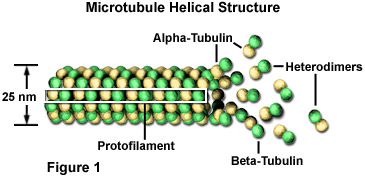
microtubules are associated with…
unique microtubule-associated proteins (MAPs) - MAP2 is a dendritic marker, and Tau is associated with alzheimer’s
microtubule-disrupting agents (for exps)
nocodazole
colchicine
microtubule-stabilizing agent (for exps)
paclitaxel (AKA taxol)
actin general structure, made of
contains many genes that remain conserved, gamma and beta actin
has globular subunits made of G-actin and filament subunits made of F-actin
G v. F actin
F-actin is a double-helixed filament made of G-actin subunits
proteins associated with microfilaments
spectrin, ankyrins, dystrophin
F-actin disrupting agents
latrunculin A
cytochalasin D
microfilaments associated with what protein family?
Myosin family of motor proteins
general steps of axonal transport
1) proteins synthesized in rough ER in soma
2) nascent proteins transferred to Golgi apparatus, packaged into membrane-bound organelles or integrated into membrance
3) proteins slowly move down membrane (100-400 mm/day)
4) proteins specially localized → reach final location and stay there to carry out a specific function in that specific location
5) proteins recycled via endocytosis
6) proteins sorted for recycling or retrograde transport, occurs at cell body
(also vesicle trafficking in dendrites)
what is epifluorescence
uses fluorophores to visualize phenomena → one of the most important and common modern molecular biology techniques
requirements for epifluorescence
contrast agent (fluorescent molecule = fluorophore)
light source (for excitation)
optics for imagine
emission detector
most common fluorophore
green fluorescent protein, GFP (from jellyfish)
generally how epifluorescence works, machinery
only things with GFP (or whatever fluorophore) will show up

lambda emission
energy change from molecule’s excited state to its spontaneously reduced almost ground state
lambda absorption
change in energy from ground to excited state from light source
GFP lambda a, lambda e
absorption: 490 nm
emission: 509 nm
what is stokes shift
lambda emission - lambda absorption
how to calculate energy from epifluorescence
E = hc (plank’s constant * speed of light) / stokes shift
stochastic expression
3+ fluorescent proteins are expressed in an image to visualize multiple types of cellss/interactions, sometimes called brainbow
FRAP means…
fluorescence recovery after photobleaching
what is FRAP
a small section of fluorescently labeled cells is photobleached with lasers which removes their fluorescence, and it is then tracked how quickly/if at all surrounding fluorescent cells will infiltrate that bleached section - helps track cell spread/growth
‘filter’ at AIS
experimental evidence suggests this ‘filter’ restricts diffusion of certain proteins and may play a role in neuronal polarization
experimental evidence for AIS ‘filter’
FRAP bleached area in axon showed greater movement of small proteins than large ones to come replace area, suggesting that small proteins may have more success travelling through a ‘filter’ at the AIS than large ones
action potentials occur when? what does this rely on?
when membrane potential reaches threshold → mv relies on ions, channels, pumps
extracellular fluid is…
the same for all neurons
typical ion concentrations in/out of neurons, mV
high Na+ outside, high K+
cytoplasm. is relatively negative compared to extracellular fluid
type of transport through ion channels
passive → along concentration or voltage gradients, but various factors will cause these channels to open/close (ex, voltage gated or leak channels)
sodium potassium pump
3 Na+ out
2 K+ in
require ATP → active transport, against concentration gradients
general info about ion pumps
are active and require ATP, create concentration gradients againt electrochemical gradient by allowing ion movement across membrane → this causes mV
membrane potential definition and equation
comparison of intra v. extracellular voltage
mV = Vin - Vout
neuron RMP
-60 - -80 mV
4 ions that determine RMP of neuron
Na+, K+, Ca2+, Cl-
what causes hyperpolarization
- ion into cell, + ion out of cell
what causes depolarization
+ ion into cell, - ion out of cell
types of potentials
graded → voltage remains subthreshold, no AP
AP → triggers neurotransmitter release
ionic movement is determined by…
permeability, concentration gradient, electrical potental across membrance
permeability?
if ion channels are open for ions to travel through
concentration gradient?
an ion will try to flow to the side of membrane with a lower concentration of that type of ion
ex, Na+ prevalent outside cell so wants to come in
electrical potential across membrane?
an ion will try to flow to the side of membrane with the opposite charge as itself
ex, negative inside cell so positive ions want to go in, positive ones want to go out
ATPase cycle for sodium-potassium pump is important because…?
about 2/3 of neuron energy expenditure is due to this, generates outward current
ATPase cycle for sodium-potassium pump inhibited by?
Oubain
Digoxin
ATPase cycle for sodium-potassium pump looks like/steps

where is equilibrium potential
where opposing forces of concentration gradient and voltage gradients are balanced
concentration gradient equation
RT * ln ([ion outside]/[ion inside]
R is gas constant 8.314 J/kmol
T is temp (K)
voltage gradient equation
ZFV
Z is valence/charge of ion
F is faraday const 96485 C/mol
equation for equilbrium potential
ZFV = RT * ln ([ion outside]/[ion inside])
Veq will be reached for an ion if…
the ion channel remains open and the ion’s effect is unimpeded
what does Nernst eq potential tell us
Ek, reversal potential, tells us ion’s movement/direction (in or out)
generally if Vm < Ek, inwards net ion flow
Vm > Ek, outwards net ion flow
what is nernst equation
Ek = V = RT/ZF * ln ([ion outside]/[ion inside])
Veq of Na+
+56 mV
Veq of K+
-100 mV
Veq of Cl-
-76 mV
Veq Ca2+
+125 mV
typical mV for neuron
-60 → -75 mV
Goldman equation for overall membrane potential

P is…
permeability of membrane for each ion
permeability ratio of ions in squid giant axon
-Pk:PNa:PCl → 1.0 : 0.04 : 0.45
Ohm’s law, general
delta V = IR = I/G
Ohm’s law for neurons
Ix = G * (Vm - Ex)
Ix = current
G = conductance
Vm = membrane potential
Ex = Ek = reversal potential
general parts of RC circuit, neuron equivalents, values
capacitor (membrane capacitance → capacitative current)
resistor (membrane resistance → due to leak channels)
battery (membrane potential → potential to generate current)
membrane time constant eq
tau = R * Cm
membrane current eq
= Ic + I ionic
general characteristics of Na+ channels
transient, persistent, resurgent
Ca2+ and K+ channel types, general characteristics
can be high-voltage activated (HVA → L, N, P/Q channels)
can be low-voltage activated (LVA → T)
can be intermediate-voltage activated (R)
What are L, N, P, T, R channels
L: long-lasting
N: neural
P: purkinje
T: transient
R: residual
some nonselective cation channels
TRP
mGluR
photoreceptor
possibly hair cells
some cyclic nucleotide-gated channels
HCN (Ih or If)
Cl- channels
H+ channels
variation involtage-gated potassium channels due to
over 80 mammalian genes encode K+ channel alpha subunits that form conductance pore, and can see more variability with alternative splicing; most diverse ion channel family
general parts and their purpose in v-gated K+ channels
various alpha subunits, form conductance pore
beta subunits → auxiliary proteins that associate with alpha subunits and modulate Kv channel activity
similarity in v-gated K+ channels
similar mechanism of hyperpolarization/decreasing cell excitability; kinetics is what mainly varies between channels
generally what a v-gated K+ channel looks like

step currents
channels gradually open, causing a slight inc/dec in mV until certain mV met and suddenly many channels open at once → sudden inc/dec in mV
sub v suprathreshold depolarization
subthreshold under threshold, no AP
suprathreshold meets threshold, AP fired