PSYCH 275 Chapter 2 -Communication Within the Nervous System (Questions)
 Call Kai
 Learn
Learn Practice Test
 Spaced Repetition
 Match
Match Flashcards
 Knowt Play
1/12

There's no tags or description
Looks like no tags are added yet.
Name | Mastery | Learn | Test | Matching | Spaced | Call with Kai | Chat |
|---|
No analytics yet
Send a link to your students to track their progress
13 Terms
What are the different components of neuron structure?
Cell body, nucleus, dendrites, axon, axon terminals
Describe the structure and function of the cell membrane. What allows movement through it?
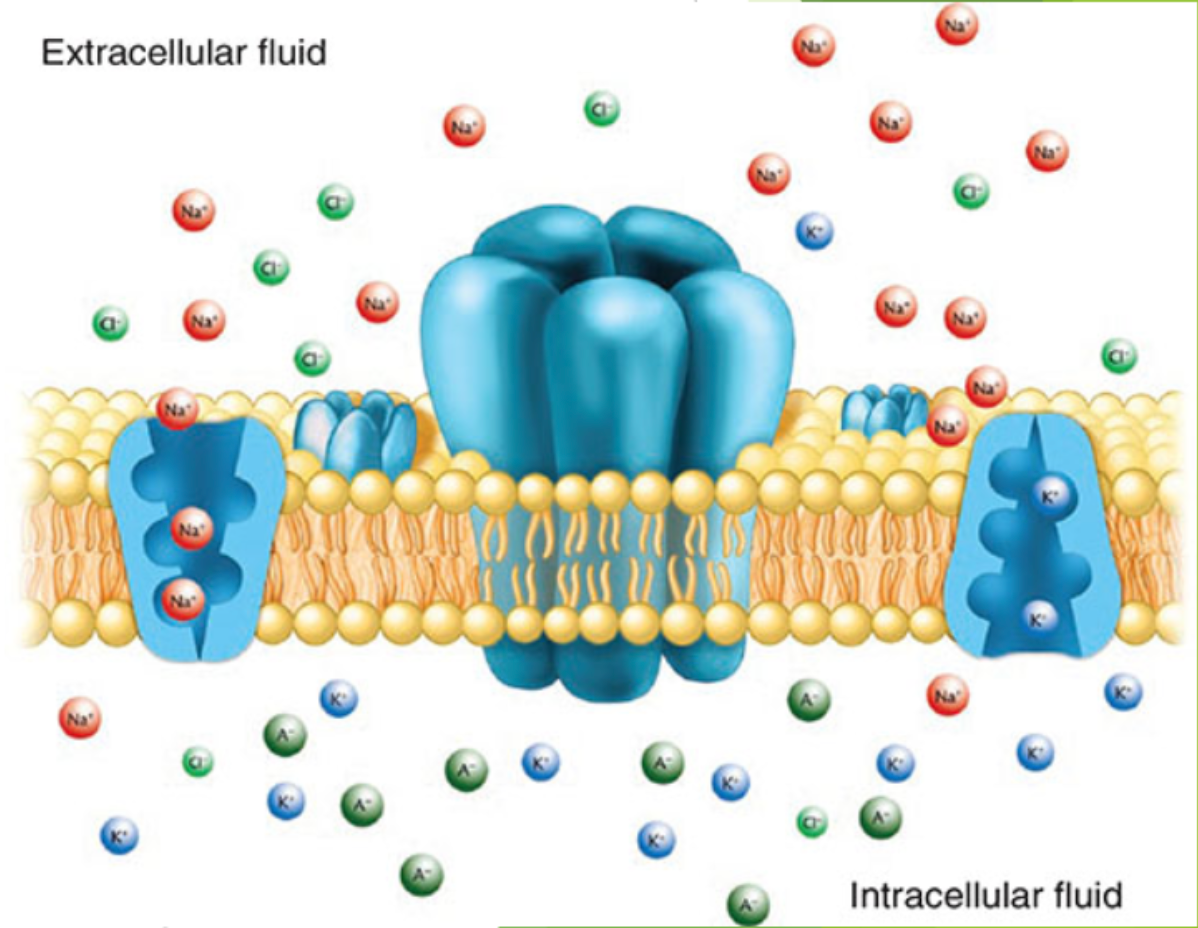
Phospholipid bilayer: hydrophillic heads on the outside and hydrophobic tails on the inside of the membrane, keeping the inside of the cell separate from the outside. Protein channels embedded into the membrane allow movement in and out

What is a neuron’s resting potential?
-70 mV: inside is more negative than inside
Which ions are responsible for maintaining the positive and negative charge difference that allows for the resting potential of the neuron? Name them and state their direction of movement/location and how this results in a difference of charge.
Na+ and K+: more Na+ resides outside the cell than K+ inside the cell, causing a difference of charge where the outside is more positive than the inside
A- (anion) and Cl-: more anions reside outside the cell than Cl- inside the cell, causing a difference of charge where the inside is more negative than the outside
Overall: outside is more positive, inside is more negative.
In what ways can an ion channel be regulated?
Chemically gated: chemicals (neurotransmitters or hormones) open/close channel
Electrically gated: change in electrical potential of the membrane opens/closes channel
What are the natural forces that will move ions across a membrane?
Force of diffusion to less concentrated areas, electrostatic attraction to opposite charges.
In a neuron, how are ions moved once the ion channels are open? When closed?
Open: natural forces (diffusion, electrostatic attraction) causes ions to move with concentration gradient
Closed: sodium potassium pump maintains voltage
Compare the properties of a local potential and an action potential.
Local potential is graded: size (magnitude) differs depending on the strength of the stimulus that produced it. Action potential is ungraded: stays the same size no matter the strength of the stimulus
Local potential starts at one portion of the neuron and will shift towards zero. Action potential is nondecremental: never decreases in size as it travels
Can a new action potential be stimulated during the absolute refractory period and/or relative refractory period? Why or why not?
Action potential stimulation requires the sodium channels to be able to open and respond to stimuli
Absolute refractory period: no action potential can be stimulated
Relative refractory period: action potential can be stimulated, but it is more difficult because the charge of hyperpolarization must be overcome
Describe the stimulation of an action potential, including all relevant steps (local potential, action potential, threshold, refractory periods, etc.) and ions.
Local potential partially depolarizes until it reaches the electrical ion channel threshold of potassium and sodium
Once local potential reaches threshold, sodium channel opens the quickest (rushes in) → membrane depolarizes, becomes positive; action potential occurs
Potassium channels open slow (fully open when sodium starts to close) → repolarizes the membrane back to negativity. Because the potassium pump closes slow, excess potassium ions enter and polarizes it past resting potential
Once potassium channels close, hyperpolarized ions are returned via sodium potassium pump and sodium channel gates return to their original resting potential

Why does saltatory conduction occur? What are the benefits of this?
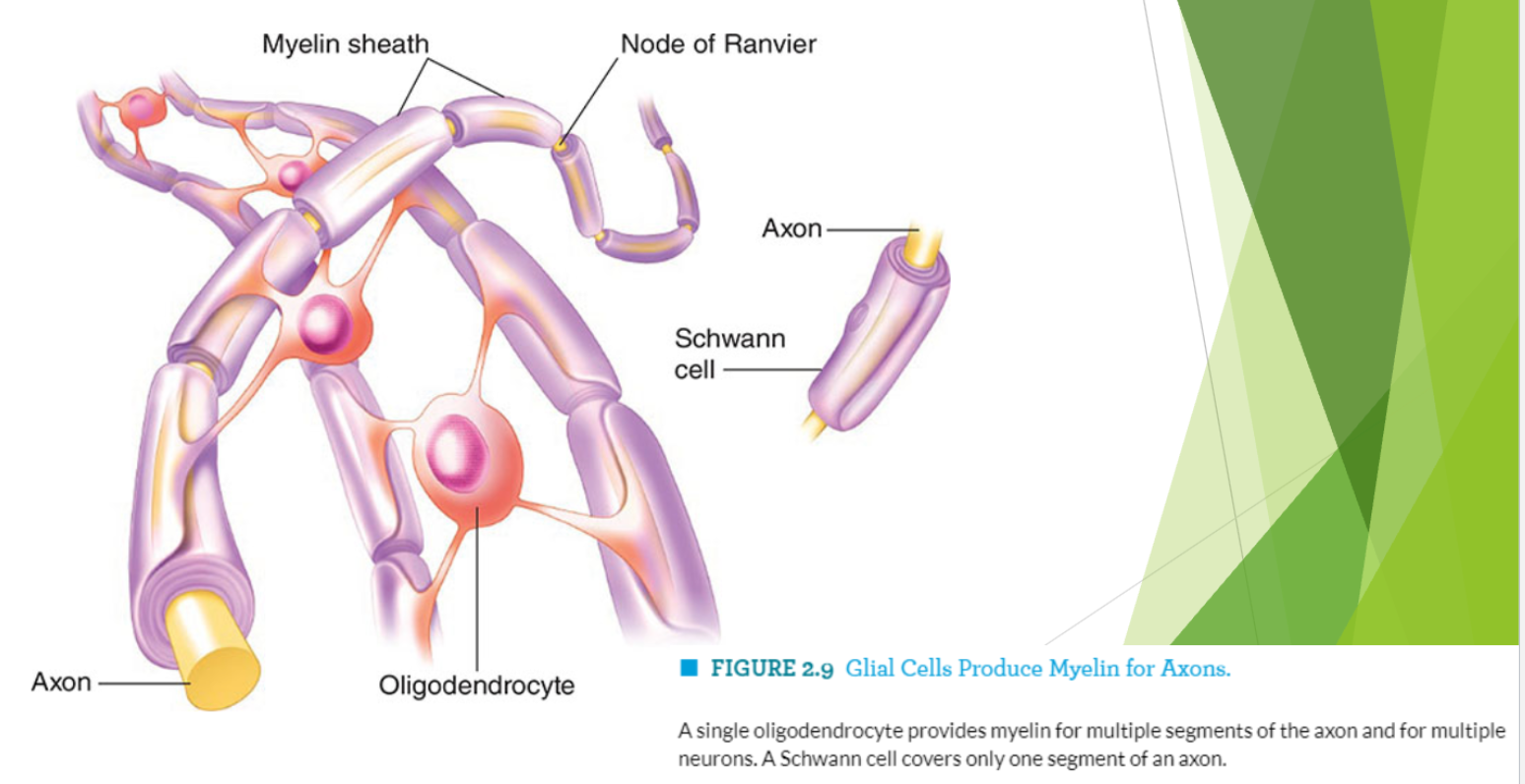
Action potential appears to “jump” to the nodes of ranvier because it cannot be conducted through the fatty myelin sheath
Allows action potentials to transmit faster and saves energy
What are the benefits of the myelin sheath?
Reduces capacitance, regenerates signals at nodes of Ranvier to maintain strength, uses less energy due to less distance spanned
How do oligodendrocytes and Schwann cells differ in their method of creating myelin?
Oligodendrocytes have multiple arms that each create myelin for multiple segments of the axon, while Schwann cells have one arm that will only cover one segment of the axon