UARK Dental Science Unit 1
 Call Kai
 Learn
Learn Practice Test
 Spaced Repetition
 Match
Match Flashcards
 Knowt Play
1/111

There's no tags or description
Looks like no tags are added yet.
Name | Mastery | Learn | Test | Matching | Spaced | Call with Kai | Chat |
|---|
No analytics yet
Send a link to your students to track their progress
112 Terms
Odontology is:
the study of structure and form of teeth/dentition
Anterior dentition includes:
the incisor and canine teeth
Postcanine dentition includes:
the premolar and molar teeth
Labial direction means
relating to/towards the lips
Lingual direction means
relating to/towards the tongue
Buccal direction means
relating to/towards the cheek
Labial and buccal directions/surfaces can also be referred to as
facial
Incisal means
the biting surface of a tooth (canines and incisors)
Occlusal means
the chewing surface of a tooth (premolars and molars)
The apical part of a tooth refers to
the apex, AKA root of the tooth
Oral version of anterior/towards the midline:
mesial
Oral version of posterior/away from midline:
distal
Interproximal means
between adjoining teeth
The bones of the oral cavity are the:
Maxillae, Palatines, and Mandible
The maxillary arcade/arch is the
maxilla; top bone; roof of mouth
The mandibular arcade/arch is the
mandible; bottom bone; jaw
The two dental antimeres are the
left side and right side
When looking at dentition, left and right from OUR pov is
SWITCHED. (right side is on left hand/left side is on right hand)
The four dental quadrants are
upper right, upper left, lower left, and lower right.
Humans are diphyodonts, which means
we have two sets of teeth
Deciduous dentition is also known as:
baby teeth, primary teeth
Permanent dentition is also known as:
adult teeth, secondary/succedaneous teeth
How many teeth are in deciduous dentition?
20 teeth
How many teeth are in permanent dentition?
32 teeth
Mixed dentition refers to
A dentition that contains both deciduous and permanent teeth
What are the four kinds/fields of teeth?
incisors, canines, premolars, and molars
Canines and premolars can also be called __________ and __________
cuspids, bicuspids
Molars can also be called __________, including M3s (wisdom teeth).
cheek teeth
In deciduous dentition, only _________, __________, and __________ are found.
incisors, canines, molars
The permanent dental formula is
2.1.2.3 / 2.1.2.3
The deciduous dental formula is
2.1.2 / 2.1.2
The following graphic shows what system?

Permanent Universal Numbering System
The following graphic shows what system?

Deciduous Universal System
In the permanent universal system, what tooth represents #1?
upper right third molar (wisdom tooth)
In the permanent universal system, what tooth represents #17?
lower left third molar (wisdom tooth)
Using the deciduous universal system, if A represents the upper right second molar, what tooth does N represent?
lower left second incisor
The following graphic shows what notation system?

Palmer/Zsigmondy Permanent System
The following graphic shows what notation system?

Palmer/Zsigmondy Deciduous System
The following graphic shows what notation system?

Permanent FDI System
The following graphic shows what notation system?

Deciduous FDI System

The red line is called the ________ of the tooth
crown
The line is pointing to the ________ of the tooth

neck/cervix
The area with red is the ________ of the tooth
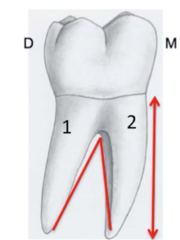
root
Area E is known as the:

enamel
Area F is known as the:

dentine
Area D is known as the:

pulp chamber/cavity
Area G is known as the:

gums/gingiva
Area J is known as the:

root canal
Area K is known as the:
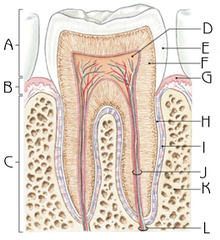
alveolar bone
Area H is known as the:

cementum
Area L is known as the:
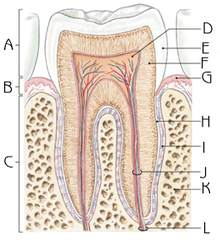
nerves and blood vessels
Area I is known as the:

periodontal ligament
The dietary/manipulation function of incisors helps with
cutting, scraping, and peeling.
The social function of incisors helps with
esthetics, signaling/display, and phonetics/speech.
The universal notations for upper incisors are __, __, | __, __, and the notations for lower incisors are __, __, | __, __.
(7, 8, | 9, 10) ; (26, 25, | 24, 23)
The zsigmondy notations for upper incisors are __ __ | __ __, and the notations for the lower incisors are __ __ | __ __ .
(2 1 | 1 2) ; (2 1 | 1 2)
The FDI notations for upper incisors are __ __ | __ __, and the notations for the lower incisors are __ __ | __ __ .
(12 11 | 21 22) ; (42 41 | 31 32)
What type of tooth has these specific traits?
- 2/3 crown flat and spatulate
- 2+ mammelons
- strong marginal ridges
- single root (typically)
incisors
incisors have __ labial lobe(s), and __ lingual lobe(s)
3; 1
___ is the key tooth of the maxillary incisor field because it is more stable (less variable in size and form) than ___.
I^1 ; I^2
The key tooth of the mandibular dentition is ___.
I^2
compared to the maxillary lateral, the maxillary central (I^1) is
- larger, wider, mesial incisal angle almost 90 degrees, less variable
- marginal ridges and cingulum less prominent, lingual fossa shallower
compared to the maxillary central, the maxillary lateral (I^2) is
- smaller, narrower, sloped, asymmetrical, rounded distoincisal angle, more variable
- marginal ridges and cingulum more prominent, lingual fossa deeper

This image shows what kind of incisor morphological variant?
Shoveling; an elaboration of the mesial and distal marginal ridges.

This image shows what kind of incisor morphological variant?
Double shoveling; the manifestation of mesial and distal marginal ridges on the labial surface.
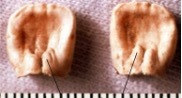
This image shows what kind of incisor morphological variant?
Tuberculum dentale; cingular projections on lingual aspect; ridges or tubercles.
This image shows what kind of incisor morphological variant?

Winging; I^1s rotated distolabially (unilaterally or bilaterally); if rotated mesiolabially - counterwinging.
This image shows what kind of incisor morphological variant?

Labial convexity; level of convexity of the I1 labial surface.
This image shows what kind of incisor morphological variant?

Interruption grooves; depressions or grooves interrupting marginal ridges or cingulum; highly variable.
Compared to mandibular incisors, maxillary incisors are
- larger, broad and convex labial surfaces, more asymmetrical, sharp mesioincisal angle and rounded distolingual angle
- strong cingulum and marginal ridges, stout and rounded-triangular roots
Compared to maxillary incisors, mandibular incisors are
- smaller, more chisel-shaped, flatter labial surface, more symmetrical, parallel margins
- narrow cingulum and weak marginal ridges, mesio-distally compressed roots
Mandibular incisors are
mobile cutting edges that slide behind maxillary incisors.
The mandibular central incisor is ______________ compared to the mandibular lateral incisor.
symmetrical, narrower, incisal edge straight, roots have a weaker distal curve
The mandibular lateral incisor is ______________ compared to the mandibular central incisor.
asymmetrical, wider, incisal edge rotated, roots have a stronger distal curve
The dietary/manipulation function of canines are
piercing, gripping, and tearing.
The canines' function as tools/weapons helps with
hunting, defense, and digging.
The canines' function as a social signaling tool manifests through
intimidation and threat.
Canines can also be called
cuspids.
The universal notation for upper canines is __ | __ , and the notation for lower canines is __ | __ .
(6 | 11) ; (27 | 22)
The zsigmondy notation for upper canines is __ | __ , and the notation for lower canines is __ | __ .
(3 | 3) ; (3 | 3)
The FDI notation for upper canines is __ | __ , and the notation for lower canines is __ | __ .
(13 | 23) ; (43 | 33)
The following traits belong to which tooth?
- sole member of tooth class/field (key tooth)
- longest roots
- simplest morphology
- single root (typically)
Canines.
True or False? Just like incisors, canines have three labial lobes and one lingual lobe.
True
What is the canine mesial ridge?
Morphological variant unique to canines; mesial marginal ridge larger than distal marginal ridge with distal reflection 2/3 way down crown and attachment to tuberculum dentale.
What is the canine distal accessory ridge?
Morphological variant unique to canines; small elevation in distolingual fossa between cusp apex and distal marginal ridge.
Compared to mandibular canines, the maxillary canines are
- stouter, broader, bulge mesiodistal, more lingually concave
- lingual ridge, marginal ridges, and cingulum more defined
Compared to maxillary canines, the mandibular canines:
- mesial crown margin upright, root more compressed, sometimes accessory rootlet
- less topography on lingual crown surface
What are premolars?
Premolars are the most anteriorly placed teeth to bear occlusal forces.
Premolars' esthetic function is to
maintain the vertical dimension of the face.
Premolars may also be called
Bicuspids
The universal notation for upper premolars is __ __ | __ __ , and the notation for lower premolars is __ __ | __ __ .
(4 5 | 12 13) ; (29 28 | 21 20)
The zsigmondy notation for upper premolars is __ __ | __ __ , and the notation for lower premolars is __ __ | __ __ .
(5 4 | 4 5) ; (5 4 | 4 5)
The FDI notation for upper premolars is __ __ | __ __ , and the notation for lower premolars is __ __ | __ __ .
(15 14 | 24 25) ; (45 44 | 34 35)
What tooth do the following traits belong to?
- at least two cusps
- one large buccal cusp
- one or more smaller lingual cusps
- only in the permanent dentition
Premolars
How many lobes do premolars have?
4; 3 buccal and 1 lingual.
P1 (premolar) traits
- occlusal outline more circular/triangular, buccal cusp much bigger than lingual, *KEY TOOTH (more stable)***
- central groove longer, fossae more marked, mesial concavity or "canine fossa" present, typically 2 root
- typically 1-2 lingual cusps
- marginal ridges run steeply down to the lingual cusp, prominent mesiolingual groove, divided roots more common
P2 (premolar) traits
- occlusal outline more rectangular/oval, buccal and lingual cusps more similar in size
- marginal ridges bulkier, typically 1 root
- typically 2-3 lingual cusps, square occlusal outline
- bulkier crown with a central pit
What are odontomes?
A morphological variant unique to premolars; central enamel projection, often have a dentine component.
What are accessory cusps?
A morphological variant unique to premolars; small accessory cusps at either end of the central groove.
What is a distosagittal ridge?
A morphological variant unique to premolars; rare variant of P1; distal margin of buccal cusp rotates away from the central groove.