Chemical Bonding 1-3
 Call Kai
 Learn
Learn Practice Test
 Spaced Repetition
 Match
Match Flashcards
 Knowt Play
1/9

There's no tags or description
Looks like no tags are added yet.
Name | Mastery | Learn | Test | Matching | Spaced | Call with Kai | Chat |
|---|
No analytics yet
Send a link to your students to track their progress
10 Terms
Metallic bonds
electrostatic forces of attraction between a lattice of metal cations and sea of delocalised electrons
giant metallic structure
factors affecting strength of metallic bonds
number of valence electrons contributed to the sea of delocalised electrons
greater the number of valence electrons contributed, stronger the metallic bonds
radius of metal cation
larger the radius, weaker the metallic bonds — delocalised electrons are further away from the positive nuclei, causing the electrostatic forces of attraction between the electrons and positive nuclei to be weaker
physical properties of metals
high melting and boiling points
good electrical conductivity
delocalised electrons function as charge carriers to conduct electricity
good thermal conductivity
when heat is applied to one end of a piece of metal, kinetic energy of the electrons at that end increases, energy is transferred by the delocalised electrons to other parts of the metal
malleable and ductile
when a force is applied, layers of metal atoms can easily slide over each other without breaking the metallic bond
metallic bonds are easily reformed, and the crystal lattice is restored
form alloys - much harder
atoms of other metal have different sizes and disrupt the orderly arrangement of the main metal in the lattice so that the layers of atoms do not slide over each other easily
ionic bonds
electrostatic forces of attraction between the oppositely charged ions
formation of ionic bonds
between elements with large electronegativity difference
when metal atoms lose electrons to form cations while non-metal atoms gain electrons to form anions to achieve a stable noble gas configuration
structure of ionic compounds
giant ionic lattice structures
cations and anions arranged alternatingly to maximise attractive forces between oppositely charged ions and minimise repulsive forces between similarly charged ions
factors affecting strength of ionic bonds
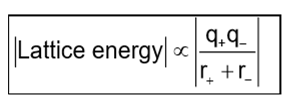
strength of ionic bonds is indicated by the lattice energy. magnitude of lattice energy is dependent on
charges of the ions
radii of the ions
coordination number of an ion
determined by total number of ions of opposite charge that surrounds it
depends on the relative charges and relative sizes of the ions
physical properties of ionic compounds
high melting and boiling points
solid in room temperature
good electrical conductivity
only in aqueous and molten states
there are free mobile ions acting as charge carriers to conduct electricity
in solid state, ions can only vibrate about their fixed positions, no free mobile ions to conduct electricity
hard but brittle
brittle - stress applied causes the sliding of the layers of ions, ions of similar charges come together, and the repulsion shatters the ionic structure
generally soluble in polar solvents and insoluble in non-polar solvents
ion-dipole interactions formed between ions and water molecules releases sufficient energy to overcome the ionic bonds between the oppositely charged ions as well as the hydrogen bonds between water molecules,
releases insufficient energy to overcome the ionic bonds between oppositely charged ions and the attractions between solvent molecules
ionic bonds with covalent character
due to the distortion of the anion electron cloud by the cation in an ionic compound
extent of polarisation depends on
polarising power of cation
polarisability of anion
cation has high polarising power if it’s small and highly charged — high charge density and anion has higher polarisability if it’s large
greater extent of polarisation, greater the covalent character in the ionic bond