Operative I: 2.1 and 2.2 Principles of Preparations and Preparation Classifications
 Call Kai
 Learn
Learn Practice Test
 Spaced Repetition
 Match
Match Flashcards
 Knowt Play
1/83

There's no tags or description
Looks like no tags are added yet.
Name | Mastery | Learn | Test | Matching | Spaced | Call with Kai | Chat |
|---|
No analytics yet
Send a link to your students to track their progress
84 Terms
What are the two defects in teeth caused by?
1. Non-caries defects
2. Carious defects
What are the 4 categories of non-carious defects?
1. Abrasion
2. Erosion
3. Attrition
4. Fractures
What is abrasion?
Abrasion is tooth structure loss from direct friction between tooth and external forces
What are some examples that cause abrasion?
toothbrush, toothpick, pen, etc.
What is chemical erosion?
Chemical erosion is the loss of tooth structure through chemical-mechanical action
What are some examples of chemical erosion?
acid reflux, lemon juice, acidic colas, bulimic habits
What does idiopathic mean?
unknown cause
What is idiopathic erosion?
Idiopathic erosion: tooth loss due to unknown cause
What is abfraction and NCCL?
Abfraction: biomechanical loading forces, like those caused by teeth grinding (bruxism) or an improper bite (malocclusion). These forces create stress and flexion at the tooth's cervical (gumline) area, leading to small, V-shaped notches
NCCL (new-term): broader term encompassing any loss of tooth structure at the cementoenamel junction that is not caused by tooth decay. NCCLs can be caused by a variety of factors including abrasion (mechanical wear), attrition (tooth-to-tooth contact), erosion (chemical dissolution), and abfraction (biomechanical forces)
What is the predominant theory of abfraction?
caused by the flecture at gingival margin due to excess occlusal force leading to micro fractures and tooth structure loss when combined with abrasion
What is attrition?
Attrition: abnormal wear on incisal and occlusal surfaces of teeth
What is a prevention of attrition?
wearing a night guard
What are fractures caused by?
trauma, excessive use (ice chewing), and weakened tooth structure
longitudinal definiton
vertical (down the tooth)
transverse definiton
horizontal (through the tooth)
apical definition
the root tip or apex of a tooth
What is a simple cavity preparation?
only one tooth surface involved
What is the compound cavity preparation?
two tooth surfaces are involved
What is the complex cavity preparation?
three or more surfaces involved
What is the internal wall?
Internal wall: the prepared surfaces of a tooth within a cavity that do not extend to the external tooth surface. They are named based on their orientation relative to the tooth's long axis and the pulp
Types of Internal Walls:
Axial Wall: This wall runs parallel to the long axis of the tooth.
Pulpal Wall: This wall is perpendicular to the long axis of the tooth and is closest to the pulp
*Walls that are entirely within the tooth preparation
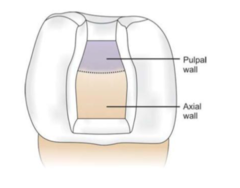
What is the axial wall?
Axial Wall: wall runs parallel to the long axis of the tooth.
*oriented in the longitudinal plane
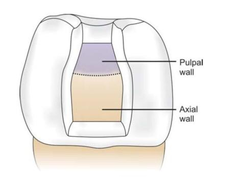
What is the pulpal floor?
Pulpal Floor: perpendicular to the long axis of the tooth and is closest to the pulp
*oriented in the transverse plane
What is the external wall?
External wall: prepared cavity wall that extends to the outside of the tooth (cavosurface margin)

What is the gingival floor?
Gingival Floor: refers to the base of a cavity preparation that lies adjacent to the gingiva (gums). It's a horizontally oriented surface within the prepared cavity, specifically designed to accommodate the restorative material

What is the buccal wall?
Buccal Wall: the prepared cavity wall that faces the buccal surface (cheek surface).
What is the lingual wall?
Lingual Wall: refers to the inner surface of a tooth that faces the tongue. It's the side of the tooth that's closest to the tongue and is also known as the palatal surface for upper teeth.

What is the distal wall?
Distal wall: refers to the wall of a tooth cavity that is closest to the distal surface of the tooth. The distal surface is the side of the tooth that is farthest from the midline of the mouth.

What is the facial wall?
Facial wall: the surface that faces the cheeks and lips. It's also sometimes referred to as the labial wall for the front teeth (incisors and canines) and the buccal wall for the back teeth (premolars and molars).

Buccal pulpal line angle

Mesio-buccal pulpal point angle
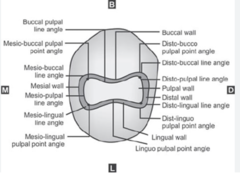
Mesio-buccal line angle
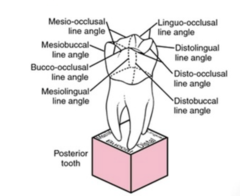
Mesial wall
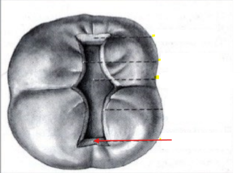
Mesio-pulpal line angle
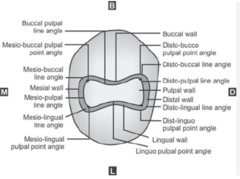
Mesio-lingual line angle
45

Mesio-lingual pulpal point angle
MLP
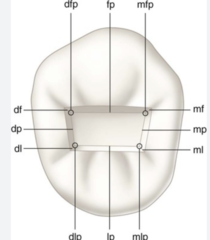
Disto-bucco pulpal point angle
DFP
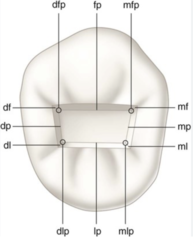
Disto-buccal line angle
DF
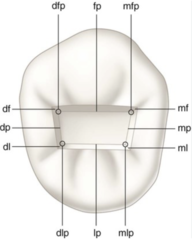
Disto-pulpal line angle
DP

Disto-lingual line angle
DL
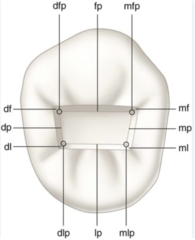
Disto-lingual pulpal point angle
DLP

Linguo pulpal point angle
LP
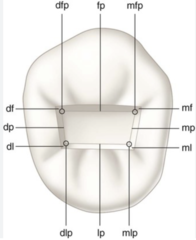
Buccal occlusal wall

Pulpal-axial line angle
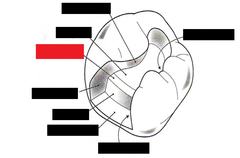
Buccal proximal wall
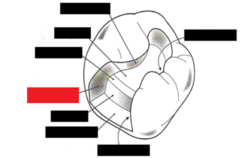
Gingical cavosurface margin
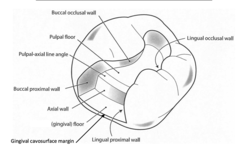
Lingual proximal wall
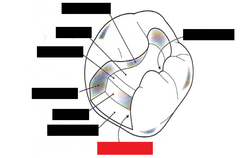
Lingual occlusal wall
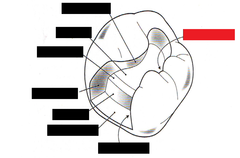
What is the cavosurface margin?
Cavosurface Margin: line angle formed by the function of the external surface of the tooth and a prepared external wall
What is Intracoronal preparation?
Intracoronal preparation: preparation that are within that tooth
ex.) operative preparations
What is extracoronal preparation?
Extracoronal preparation: preparation that remove the external surfaces of the tooth
ex.) fixed prosthodontic preparation...crown preparation
What are the types of carious lesions?
1. Pits and fissures: begins in development grooves and pits
2. Smooth surface: caries that begin on any smooth surface of a tooth
What is the definition of cavity preparation?
The mechanical alteration of a defective, injured or diseased tooth in order to best receive a restorative material which will reestablish a healthy state for the tooth, including proper form, function and esthetics
What are the objectives of a cavity preparation?
1. Remove all defects
2. Protect the pulp
3. Be as conservative as possible
4. Retention and resistance form
5. Esthetics
6. Function
What is a class I cavity?
Class I: pits and fissure defects
*Any surface that has a pit or fissure, typically occlusal but can be buccal or lingual
*clinically defined as occlusal, buccal, or lingual
What is a class II cavity?
Class II: includes interproximal lesions on posterior teeth (premolar and molars)
*mesio-occlusal (MO), disto-occlusal (DO), or messy-occluso-distal (MOD)
What is a class III cavity?
Class III: interproximal lesions on anterior teeth (incisors and canine)
*mesio-lingual (ML), disto-lingual (DL), medio-facial (MF), or disto-facial (DF)
What is a class IV cavity?
Class IV: involves the incisal corner of anterior teeth
*mesio-incio-facio-lingual (MIFL) or disto-inciso-facio-lingual (DIFL)
What is a class V cavity?
Class V: involves the gingival 1/3 of the lingual or buccal surface of any tetth
*bucco-gingival or lingua-gingival
What is a class VI cavity?
Class VI: involves the cusp tips of posterior teeth plus the incisal edges of anterior teeth
*occlusal or incisal
What are the 7 Principles of Preparation?
1. Outline form
2. Retention form
3. Resistance
4. Convenience form
5. Decay Removal
6. Finishing of cavity walls
7. Cleaning of the cavity preparation
What is the outline form principle?
1. Extension for prevention
2. All enamel is supported by dentin
3. Smooth/flowing curves on the preparation cacosurface margin
What is extension for prevention and which principle of preparation does it fall under?
1. Extension for prevention: extend the boundaries of the cavity preparation (cavosurface margin) into areas of the tooth that are self-cleansing
*Outline form principle
What does all enamel needs supported by dentin, and which principle of preparation does it fall under?
2. All enamel is supported by dentin: enamel is brittle and will fracture if not supported by sound (non-carious) dentin; therefore, it is removed if unsupported
*Outline form principle
Why do you need a smooth and flowing cavosurface margin , and which principle of preparation does it fall under?
3. Smooth/flowing curves on the preparation cacosurface margin: allows for better adaptation of the restorative materials, no sharp angles
*sharp angles are difficult to restore and encourage stress fracture/crack propagation
*Outline form principle
What is the retention form principle?
Retention Form Principle: steps taken to prevent loss of restoration
What are the two main forms of retention form principles?
Macro-mechanical retention
Micro-mechanical retention
What are the components of macro-mechanical retention?
1. Relationship of the cavity walls
2. Retention grooves
3. Retention pins
What are the components of micro-mechanical retention?
1. Acid-etched enamel bond
2. Dentin hybrid layer bond
Why does the relationship of the cavity walls matter and what category does it fall under?
Depending on the relationship of the cavity wall, it can create a "lock" that physically restricts the restoration from lifting out of the cavity
*macro-mechanical retention
Why do retention grooves/retention pits matter and what category do they fall under?
Retention grooves (or pits) are a type of mechanical retention feature created in tooth preparations or within restorations to improve their stability and resistance to dislodgement
*macro-mechanical retention
Which is the best cavity wall relationship: parallel, converging, or diverging?
converging > parallel > diverging
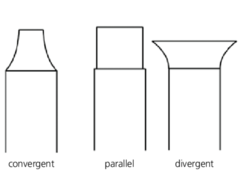
How does acid etch enamel and dentin bonding help retention form and what category does it fall under?
Acid etching roughens enamel and dentin surfaces, creating microscopic porosities that allow resin-based materials to penetrate and create a strong, long-term bond
*micro-mechanical retention
What is the resistance form principle?
The steps taken to prevent fractures of the tooth or restoration
What are the components of the preparation-resistant form?
1. Flat floors that are perpendicular to the forces of mastication
2. Restrict the occlusal width of preparation to provide sufficient strength of remaining tooth structure
3. Remove weak/unsupported enamel
What are the components of the restoration-resistant form?
1. Must have sufficient depth and width in the amalgam preparation to reduce the chance of amalgam fracture (and must be in sound dentin)
2. 90-degree cavosurface margins (required for amalgam)
3. Materials with weak edge strength require bulk to avoid fracture (weak edge strength: amalgam, porcelain, ceramic)
Why are flat floors perpendicular to forces important and what principle does it fall under?
Flat floors ensure even distribution of biting forces
*Preparation Resistance
Why is conserving tooth structure important, and what principle does it fall under?
Minimizing the size of preparation allows strength to be maintained
*Preparation Resistance
Why is removing enamel that is unsupported important, and what principle does it fall under?
Enamel is brittle and will fracture if not supported by sound (non-carious) dentin; therefore, it is removed if unsupported
*Preparation Resistance
*Outline form
Why does the depth/width of the restoration matter and what principle does it fall under?
If the restoration is too narrow, it is more likely to fracture and if the restoration isn't deep enough, then it does not reach the dentin and is still in the enamel.
*Restoration Resistance
Why does a 90-degree cavosurface margin matter and what principle does it fall under?
This angle provides the maximum bulk of both the tooth and the restorative material at the margin, making it less prone to fracture
*90-degree margin prevents unsupported enamel
*Restoration Resistance
What is the convenience form principle?
The steps taken to ensure access to caries and proper preparation
*The shape and form of the cavity preparation, which allows for adequate observation and ease of operation in preparing the tooth for a restoration
*Justification of removing sound tooth structure for a restoration
What is the decay removal principle?
1. Removing all caries before restoration is placed
2. Caries exist in a variety of colors and consistencies
3. Remove all caries from the dent-enamel junction (DEJ) first
What is the finish the cavity wall principle?
1. 90 degree cavosurface margins for all amalgams, ceramics, and most posterior composites
2. Beveled (angled) cavosurface margins for retention and esthetics on anterior composites
3. Beveled (angled) for flared cavosurface margins for gold inlays or onlays
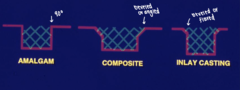
What is the cleaning the cavity preparation principle?
Making sure to remove all debris, salvia, blood, and water BEFORE restoring
*enhances bonding effectiveness
*reduces bacterial contamination