Astronomy Exam
 Call Kai
 Learn
Learn Practice Test
 Spaced Repetition
 Match
Match Flashcards
 Knowt Play
1/73

There's no tags or description
Looks like no tags are added yet.
Name | Mastery | Learn | Test | Matching | Spaced | Call with Kai |
|---|
No analytics yet
Send a link to your students to track their progress
74 Terms
Life Stages of a Low-Mass Star
protostar: gravitational contraction
nuclear fusion begins: gravity balances pressure
main sequence: H → fusion in core
end of main sequence: hydrogen runs out in core
red giant: H → He fusion in shell around contracting core (leading to He flash)
He fusion in core
double shell fusion: He → C; H → He
ejection of H and He in a planetary nebula
leaving behind an inert white dwarf (made of carbon just radiating remnant heat)
death of a low mass star
planetary nebula and white dwarf
are white dwarfs always left alone?
sometimes they can have a companion star
the white dwarf can steal mass from it
the stolen matter forms an external layer which can quickly ignite and shine brightly creating a nova
the small star sirius B is a white-dwarf companion of the much larger and brighter sirius A
whats a nova
a nova occurs in binary systems where a white dwarf is pulling mass from its companion
a nova is a relatively gentle explosion of hydrogen gas on the surface of a white dwarf in a binary star system
this process does not damage the white dwarf and it can repeat
supernova - type Ia
sometimes the mass transfer can be excessive, so excessive that the white dwarf will not be able to support the mass it gains
so, what would have been a nova becomes a supernova (Type Ia)
this results in the white dwarf star exploding and leaving no remnant
massive stars (>8M)
greater than 8 solar masses
begins life on main sequence as a blue star
follows the same path as a low-mass star but everything occurs faster
end stage is different than a low mass star
when hydrogen fusion in the core ends, the star leaves the main sequence
fusion in the core continues through many more stages than for low mass stars
heavier elements (and burning shells in the star) are produced (carbon, oxygen, neon, silicon, and so on up to iron)
super giants on the H-R diagram
as the shells of fusion around the core increase in number:
→ thermal pressure overbalances the lower gravity in the outer layers
→ the surface of the star expands
→ the surface of the star cools
the star moves toward the upper right of the H-R diagram
it becomes a red supergiant (example is beteleguese)
the iron (Fe) problem
the red supergiant has an inert iron (Fe) core
fusing iron does not release energy
so you keep making iron
it marks the end-point of nuclear fusion to give energy (i.e., iron needs energy to fuse)
supernova - type II
if fusion stops at the core, then:
gravity overcomes pressure
gravity even pulls electrons which are smashed into protons and form neutrons
no more atoms…
the neutron core collapses and inward falling material rebounds off the core
this only takes seconds
the core recoils and sends the rest of the star flying into space
this results in one of the biggest explosions in the entire universe
the light given off from supernova explosion can be brighter than the entire galaxy
many supernova type II occurred before we did
the amount of energy released was so great, that most of the elements heavier than iron are instantly created (like lead, copper, and gold)
the atoms that created our world and solar system came from nuclear fusion in stars and from supernova events
we are all made of star stuff
big bang gave is 70% H, 30% He, everything else is from stars
what happens to the core after a type II supernova
the whole story depends on mass
neutron star: the really big ones: remaining core mass of ~1.4M to 3M
black hole: the really really big one: remaining core mass greater than 3<
the end states of stars
white dwarf: remnants of low mass stars (<1.4M) - typical size 10 000km (size of earth)
neutron stars: core remnants of high mass stars - typical size 10 km (size of big city
black holes: core remnants of high mass stars - small size less then 10 km (about the size of a few city blocks)
white dwarfs
are remnants of low-mass main sequence stars, supported against gravity by electron degenerate pressure (electron-electron repulsion of carbon atoms)
the composition of the core is carbon
not hot enough to fuse carbon any further
small mass stars end life as white dwarfs
core becomes so dense can not contract and heat any more
star supported by pressure of degenerate
size about size of earth
star slowly cools
neutron stars
these are leftover cores from high mass star supernova (type II) explosions
pressure becomes so high that electrons and protons combine to form neutrons throughout the object
protons combine with electrons to make neutrons and neutrinos (really small particles)
properties of neutron stars
very dense and small
it will stop collapsing and be held up by neutron degeneracy pressure
they spin very rapidly: 0.03 to 4 sec
typical size: R= 3M
mass: 1.4M - 3M
density: 10^11 kg/cm³
piece of neutron star matter of the size of a sugar cube has a mass of ~100 billion pounds
why do neutron stars spin so fast
conversation of angular momentum: before collapsing, the stars core probably rotates once every few hours
collapse to a smaller radius, the rotation rate increases exponentially
consider figure skater performing a spin: to rotate faster, they pull their arms in
pulsars
in 1967, graduate student Jocelyn bell accidentally discovered a sharp pulse of light which recurred every 1.3 sec
she called it a pulsar
the pulsars observed were originally though to be a signal from extraterrestrials
this was later shown to be unlikely after many other pulsars were found all over the sky
the mystery was solved when another pulsar was discovered in the heart of the Crab Nebula
the crab pulsar pulses in visual light as well as radio
pulsars and neutron stars
all pulsars are neutron stars (but all neutron stars are not pulsars)
pulsars are rotating, magnetized neutron stars
emission (mostly radio) is concentrated at the magnetic poles and focused into a beam
pulsars - light house model
beams of radiation emanate from the magnetic poles
as the pulsar rotates, the beams sweep across the sky
if the earth happens to lie in the path of the beams, we see the pulsar
pulsars are the lighthouses of galaxies
the fates of neutron stars
like the white dwarfs, a neutron star slowly irradiate the thermal energy into surrounding space… and eventually come into thermal equilibrium with the cold universe
similar to an isolated white dwarf, the neutron star will eventually stop rotating, cool to the temperature of the surrounding universe, and becomes inert
similar to a white dwarf, in a close binary system, a neutron star in a close binary system would still have a life after death
black holes
if a type II supernova explosion leaves behind a core that is greater than 3M:
collapsing core passes though a neutron star stage
neutron star not stable
core shrinks even more and becomes a black hole
“black” because it neither emits nor reflects light
“hole” because nothing entering can ever escape
what did einstien say about gravity
mass distorts space - “curving it”
objects and light moving near the massive objects are forced to take a curved path around the object, just like the moon orbiting the earth
what is a black hole?
an unimaginably dense region of space where space is curved around it so completely and gravity becomes so strong that nothing, not even light, can escape
mass is so great in such a small volume that the velocity needed to escape is greater than the speed light travels
a black hole has only a “center” and a “surface”
the black hole is surrounded by an event horizon which is the sphere from which light cannot escape
the distance between the black hole and its even horizon is the Schwarzchild radius
the center of the black hole is a point of infinite density and zero volume, called a singularity (smaller than the size of an atom)
a black hole is 3-dimensional
the schwarzchild radius
the larger the mass of a black hole, the larger the schwarzchild radius
once light or any object has crossed the schwarzchild radius (or event radius), it can never escape the force of gravity of the black
this is the point of no return
the center of the milky way
the galactic center lies in the constellation of Sagittarius
a supermassive black hole exists in the center
probably a black hole 3 million times the mass of the sun → named Sagittarius A*
not much matter appears to be accreted by a black hole
falling into a black hole: tidal forces
falling toward a black hole wouldn’t be a pleasant experience
falling feet first, your body would be scrunched sideways and stretched along the length of your body by the tidal forces (spaghetti noodle)
stretching happens because your feet would be pulled much more strongly than your head
falling into a black hole: time dilation
a friend watching you as you enter a black hole, would see your clock run slower and slower than theirs as you approach the event horizon
your friend would see you brake an infinite amount of time to cross the event horizon → time would appear to stand still
however, in your time frame your clock would run forward normally and you would read the center very soon
falling into a black hole: redshifted
any light falling in will have its wavelength stretched
the light would be extremely red-shifted
more on astronaut falling into black hole
suppose he sends us a signal every second, according to his watch as he falls in space-time gets stretched more and more
the time between signals get stretched also
his signals appear to get further and further apart in time
his signals are red-shifted
any light reflected off him is red-shifted also, so he looks redder and redder
falling into a black hole - summary
object is stretched by tidal forces
time slows down as seen by outside observers
light gets extremely redshifted
wormholes and time machines
Einstein discovered that general relativity predicts the possibility that black holes could connect our universe to another ‘parallel’ universe via a bridge
such a bridge is called a wormhole
however theories suggest that these wormholes collapse as soon as they are formed
also, since traversing a wormhole means that you are emerging at a different space domain than the one you started with, you could star at present time and emerge at a time in the past (or future) - time travel!
intro to solar system
the solar system formed from a rotating cloud of cold gas and dust called the solar nebula about 4.6 billion years ago
birth of the solar system
collapse of a slow rotating cloud of interstellar gas and dust
cloud flattens and central region condenses
young sun shines with disk of gas and dust in which the planets are forming - random collision and sticking of particles
collisions dominated the early solar system
clump collapses
forms protoplanetary disk (planets form from the disk)
center collapses, heats up, forms sun
disk fragments forms planets
“debris” gets cleared
within the disk that surrounds the protosun, solid grains collide and clump together into planetesimals
our own solar system
nearly circular orbits
all going the same way around
all in nearly the same plane
8 planets in the solar system
planets are categorized according to composition and size, there are two main categories of planets
small rocky planets (terrestrial) → mercury, venus, earth, mars
gas giants → jupiter, saturn, uranus, and neptume
inner (terrestrial) planets
they are made mostly of rock and metal
they are relatively heavy
they are relatively small
they have no rings and few moons (if any)
mercury
a small, hot, rocky planet
1/3 of earths radius
no atmosphere → heavily cratered
temp: 430 degrees C to 180 degrees C
no moons
can be seen transiting the sun, it happened recently
venus
earths twin in size
brightest object in the sky … look west at sunset
no moons
carbon dioxide atmosphere (greenhouse effect)
very hot → 480 degrees C
venus transits the sun
most recent: 2012, next is 2117
the surface of venus is completely hidden beneath permanent cloud cover
our living earth and the atmosphere
earth is the only planet known to support living organisms
earths surface is composed of 71% water
water is necessary for life on earth and the oceans help maintain earths stable temperatyres
earth has one moon
conditions of life is not too hot not too cold
the greenhouse effect
visible light enters though glass
warms the ground and air
ground and air give off IR
IR cant exit through a glass
greenhouse gets warmer than outside
the greenhouse effect and earth
sunlight energy comes in mostly as visible light
warms atmosphere and ground which emit IR
IR light is absorbed by greenhouse gases (CO2) in the atmosphere
“recycles” some of the energy → warms earth
asteroids belt and ceres
asteroids are composed of carbon or iron and other rocky material
the asteroid belt is a group of ricks that appear to have never joined to make a planet
most asteroids remain in the asteroid belt between mars and jupiter but a few have orbits that cross earths path
many asteroids enter earths atmosphere
on average, 3 large asteroids hit the earth every 1 million years
shooting star
when a small asteroid enters earths atmosphere, it burns up as it encounters air friction at tremendous speeds
a shooting star is just a tiny grain/rock that has entered the earths atmosphere
air friction causes the rock to heat up so much it begins to burn across the sky
craters
hole in the ground caused by an asteroid hitting earth
daniel barringer purchased this land in 1904 to look for iron, there was no iron found in the depot was 174 meters
why are mercury and the moon heavily cratered
no atmosphere to cause asteroids to burn up, they always reach the surface
earths moon
it takes the moon approximately 29 days to complete one rotation around earth
the same side of the moon always faces us
the moons surface is covered in dust and rocky debris from meteor impacts
it has no water or atmosphere
the moon reflects light from sun onto the earths surface
how did we get our moon
according to one theory, 4.5 billion years ago a mars sized asteroid rock hit the earth at such a high speed that both liquified, debris created another large rock close to earth
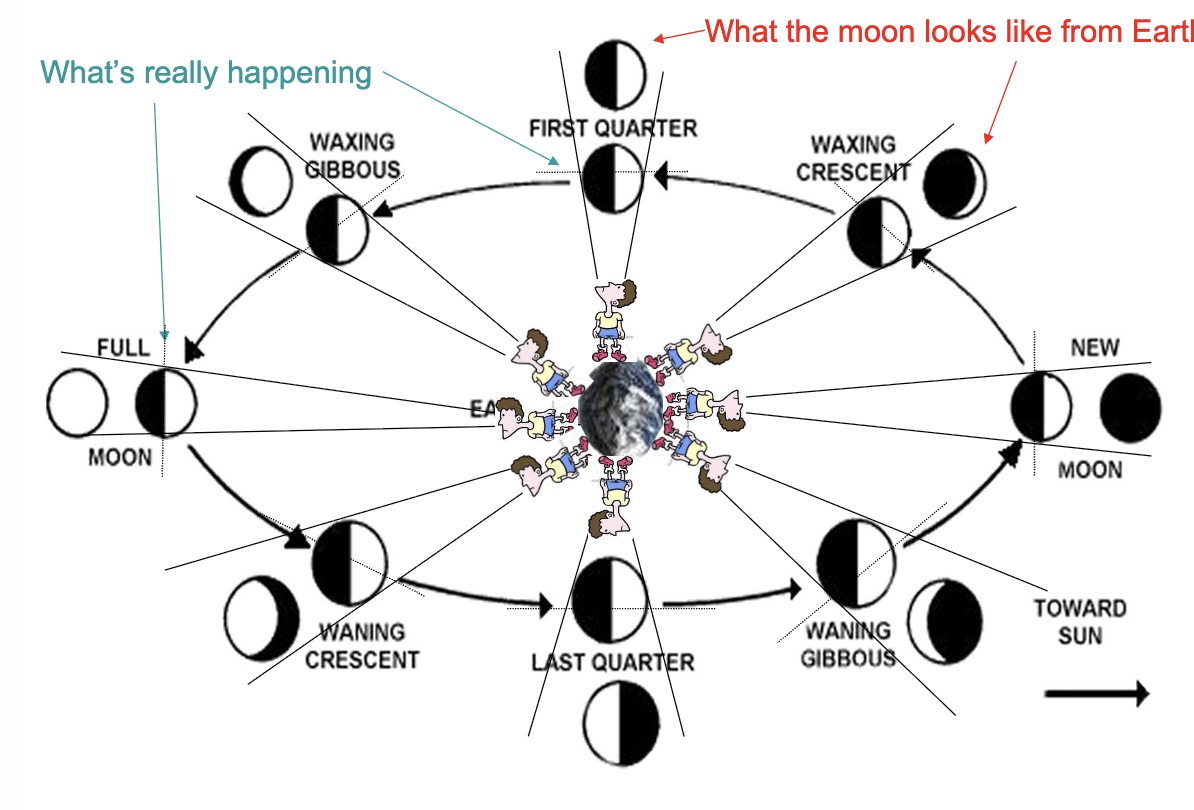
phases of the moon
moon appears different over the course of one month due to its orbit around the earth
we (from earth) only see certain parts of the moon lit up by the sun at different times
why do we have seasons
look at the earth-sun distance in july and january
when we are closest to sun, were 3% closer than the farthest point
the tilt of the earth causes seasons
since the earth is tilted, the sun strikes earth differently in various parts
the angle of sunlight affects heating
sunlight is spread over a larger area when the suns altitude is low, thus does not penetrate the ground as much
mars
smaller in size than earth
rusty red soil
temperature: -10 degrees to -120 degrees
atmosphere is mostly carbon dioxide
gravity is ~1/3 that of earth
2 moons (phobos and deimos)
contains water - both liquid and frozen
enormous volcanoes (valles marineris is as big as the entire united states)
olympus mons: the largest volcano in the solar system has a base larger than the state of arizona and is 25 km high
liquid water on mars?
today the surface temperature and pressure seem too low for liquid, but there is some debatable evidence that it happens
other sources of H2O, polar caps, under ground
outer (jovian) gas planets
jupiter, saturn, uranus, neptune
characteristics:
enormous
made mostly of hydrogen and helium
far from sun
separated by large distances
have ring systems
have many moons
jupiter
is the largest of the gas giant planets
79 moons
has faint rings
gravity is 2.5 times that of earths
great red spot → giant hurricane
four of jupiters biggest moons
Io
Europa
Ganeymede
Callisto
Saturn
saturn has the most extensive ring system in the solar system
rings are just ice/rocks orbiting saturn
less dense than water → would float in a bathtub big enough
82 moons
uranus
is tipped on its side about 98 degrees
27 moons
narrow faint rings
neptune
is the smallest of the gas giants
faint rings
great dark split is an occasional giant storm like the one on jupiter
13 moons
frost line
is the dividing line between where hydrogen compounds can and cannot condense out (forms ice)
the formation of jovian planets occurred outside the frost line, where ices could also form small particles
dwarf planets
orbits in a zone that has other objects in it
newtons law of gravity
newtons saw an apple falling
he though: if it is gravity that causes the apple to fall to earth, then it is probably gravity that holds the moon in orbit around the earth
gravity and acceleration
falling objects accelerate (due to gravity)
earth: g=10m/s²
mass is not weight
mass = the amount of matter in an object
measured in gram or kg
weight = a measure of force
weightlessness
gravity always still there
whats missing is a contact force (nothing is holding you up)
apparent weight is the strength of that contact force
so you fall with 10m/s² and feel weightless
newtons law of gravitation
says the strength of the force depends on the:
masses of the objects
distance between them
masses of the objects
gravitational force is small between objects that have small massive
it is large between objects that have large masses
If one object doubles in mass, then the gravitational force doubles
If both objects double in mass, then the force doubles twice, becoming four times as strong
distance between objects
gravitational force is strong when the distance between objects is small
if the distance between object increases, then gravity decreases
inverse square law
Gravitational force is inversely proportional to the square of the distance between objects
Doubling the separation distance produces one-fourth of the force
If the distance is reduced by one-half, force is four times as great
planets orbiting other stars
An extrasolar planet, or exoplanet is a planet beyond our solar system, orbiting a star other than our sun
Overview of Extrasolar Planets
First extrasolar planet found around a sun-like star: 1995
Number to date: over 4000 planets
Closest to parent star: 0.006 AU (compared with mercury 0.4 AU)
Furthest from parent star: 650 AU (compared with pluto 40 AU)
Detention methods: numerous, mostly indirect
Detecting Extrasolar Planets
Method 1: Direct Observation
The most obvious method of detecting a planet around another star is to directly image the planet, just as we image stars
Unlike stars, planets are both much smaller and observable only in reflected light, and so far fainter
The glare of their parent star makes it incredibly difficult to see them
Method 2: Transits
Planets observed at inclinations near 90 degrees will transit their host stars (pass in front of their stars relative to us)
We can determine orbital period and size of planet
Advantages: easy, can be done with small cheap telescopes, possible to detect low mass planets such as earths
Disadvantages: probability of seeing a transit is low, easy to confuse with star spots, binary systems, needs other measurements for confirmation and masses
Method 3: Doppler Planet Detection
In a stellar system with a planet, both the star and the planet revolve around the center-of-mass
Even if the planet is not directly visible (as is usual), the star can be observed to rotate around the center-of-mass of the combined system
Radial Velocity Technique (Doppler “Wobble”)
Star + planet orbit common centre of mass
As stars move towards observer, wavelength of light shortens (is blue-shifted)
Starlight red-shifted as stars moves away
Lets us determine mass of planet