CHM1030 Dr. Weaver Santa Fe College Final Exam Study Guide
 Call Kai
 Learn
Learn Practice Test
 Spaced Repetition
 Match
Match Flashcards
 Knowt Play
1/117

There's no tags or description
Looks like no tags are added yet.
Name | Mastery | Learn | Test | Matching | Spaced | Call with Kai | Chat |
|---|
No analytics yet
Send a link to your students to track their progress
118 Terms
Traits that describe how a substance reacts chemically (e.g., flammability, reactivity, acidity).
Chemical properties
Traits that can be observed/measured without changing the substance's identity (e.g., color, melting point, density).
Physical properties
Celsius (°C), Kelvin (K), Fahrenheit (°F). Kelvin is the SI unit; K = °C + 273.15.
Temperature scales in chemistry
starts at absolute zero, where all particle motion stops, making it ideal for gas laws.
Kelvin
Observation → Hypothesis → Experiment → Analyze Data → Conclusion → Communicate results.
Steps of the scientific method
What is density's formula and unit?
Density = mass ÷ volume; unit = g/mL or g/cm³.
The doubt about a measurement's exactness; comes from instrument limits and human error.
Uncertainty
Include all certain digits plus one estimated digit (last digit).
Writing a measurement with uncertainty
What are the rules for counting sig figs?
Non-zero digits = always sig; zeros between non-zeros = sig; leading zeros = not sig; trailing zeros after decimal = sig.
how close a measurement is to the true value
accuracy
how close repeated measurements are to each other.
precision
atoms chemically bonded
Compound
one type of atom
Element
physically combined substances
Mixture
The smallest unit of an element that keeps its chemical identity.
Atom
Number of protons in an atom; defines the element.
Atomic number
Number of protons + neutrons.
Mass number
Atoms of the same element with different numbers of neutrons.
Isotope
Positively charged ion (lost electrons).
Cation
Negatively charged ion (gained electrons).
Anion
Unit for amount of substance; 1 mole = 6.022×10²³ particles.
Mole
How do you find molar mass?
Add the atomic masses of all atoms in a compound (g/mol).
Matter is not created or destroyed in chemical reactions.
Law of conservation of mass
What are the different types of chemical reactions?
Synthesis, decomposition, single replacement, double replacement, combustion.
How to balance chemical equations?
Adjust coefficients so atoms of each element are equal on both sides.
releases heat (ΔH < 0)
Exothermic reaction
absorbs heat (ΔH > 0)
endothermic reaction
A substance that conducts electricity when dissolved in water.
Electrolyte
proton donor (H⁺), pH < 7
Acids
proton acceptor (OH⁻ producer), pH > 7.
Base
Elements that exist naturally as two-atom molecules: H₂, N₂, O₂, F₂, Cl₂, Br₂, I₂.
Diatomic elements
Average atomic mass calculation?
Multiply each isotope's mass by its abundance, then add the results.
Finding number of protons, electrons, and neutrons?
Protons = atomic number; Electrons = protons (neutral atom); Neutrons = mass number − protons.
Naming molecular compounds?
Use prefixes for number of atoms + "ide" ending (CO₂ = carbon dioxide).
Naming ionic compounds?
Cation name first, then anion with "ide" ending (NaCl = sodium chloride).
Naming acids?
Binary: "hydro" + root + "ic acid" (HCl = hydrochloric acid); Oxyacids: "ate" → "ic acid," "ite" → "ous acid.
Diagram showing electrons in orbitals with arrows for spins.
Electron box diagram
Arrangement of electrons in orbitals (Full or noble gas shorthand).
Electron configuration
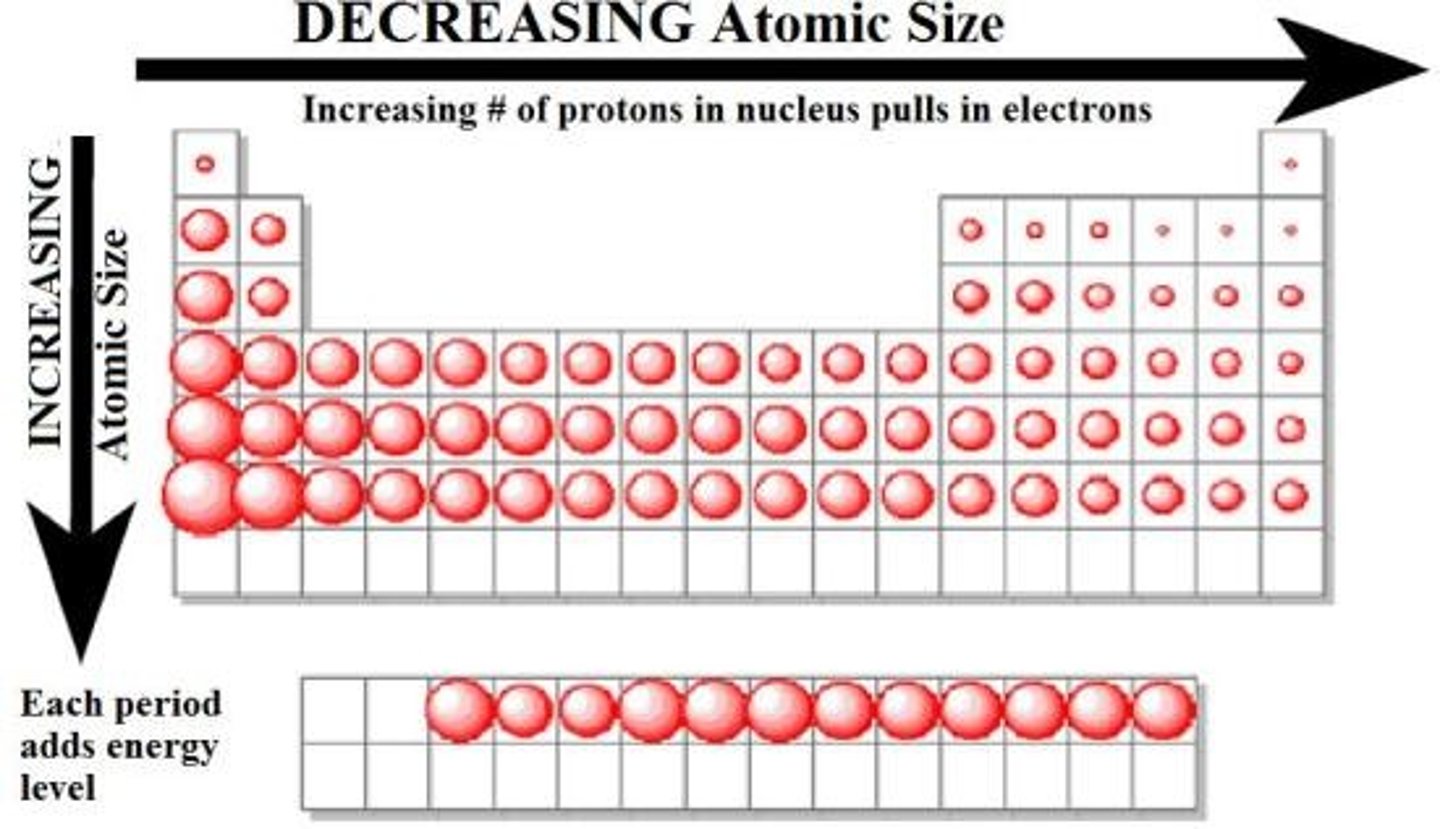
Periodic trends for atomic radius?
Increases down a group, decreases across a period.
Periodic trends for electronegativity? Decreases down a group, increases across a period.
Decreases down a group, increases across a period.
Periodic trends for ionization energy?
Decreases down a group, increases across a period.
Electrons in the outermost shell; determine chemical reactivity.
Valence electrons
3D shape of a molecule based on VSEPR theory (e.g., linear, bent, trigonal planar, tetrahedral).
Molecular geometry
Unequal sharing of electrons (electronegativity difference) and asymmetrical shape.
Polarity in molecules
Using balanced chemical equations to calculate amounts of reactants and products.
Stoichiometry
Mass of 1 mole of a substance (g/mol), found by adding atomic masses.
Molar mass
The reactant that runs out first, limiting the amount of product formed.
Limiting reagent
The reactant left over after the reaction is complete.
Excess reagent
Maximum amount of product possible, based on limiting reagent.
Theoretical yield
Amount of product actually obtained from a reaction.
Actual yield
Percent Yield=Actual Yield/Theoretical Yield×100.
Percent yield
A solution where water is the solvent.
Aqueous solution
Substance dissolves in water.
Soluble
Substance does not dissolve in water.
Insoluble
A substance that donates protons (H⁺) in a solution.
Acid
Does not dissolve in water.
Substance
Proton acceptor or OH⁻ producer, pH > 7.
Base
Neutralization reaction?
Acid + base → salt + water.
Precipitation reaction?
Two aqueous solutions form an insoluble solid (precipitate).
Reaction involving electron transfer. Oxidation = loss of electrons, Reduction = gain of electrons.
Redox reaction
Substance that gets reduced (gains electrons).
Oxidizing agent
Substance that gets oxidized (loses electrons).
Reducing agent
Shows all reactants and products in compound form.
Molecular equation
Shows all strong electrolytes as separate ions.
Total ionic equation
Shows only species that actually change in the reaction.
Net ionic equation
M = moles of solute ÷ liters of solution.
Molarity
Molarity × number of particles a solute forms in solution.
Osmolarity
Effect of a solution on cell volume (hypotonic, hypertonic, isotonic).
Tonicity
pH = -log[H⁺].
Finding pH from [H⁺]
Solution that resists changes in pH by neutralizing added acids or bases.
Buffer
Technique to find concentration of a solution by reacting it with a solution of known concentration.
Titration
Point where moles of acid = moles of base.
Equivalence point in titration
How atoms and molecules interact through chemical bonds and intermolecular forces.
Interactions of matter
Ratio of products to reactants at equilibrium, each raised to their coefficient powers.
Equilibrium constant (K)
Products are favored at equilibrium.
K > 1
Reactants are favored at equilibrium.
K < 1
If a system at equilibrium is disturbed, it shifts to counteract the change.
Le Chatelier's Principle
Add reactants → shift right; Add products → shift left.
Equilibrium shift with concentration change
For exothermic: heat ↑ shifts left; heat ↓ shifts right. For endothermic: heat ↑ shifts right; heat ↓ shifts left.
Equilibrium shift with temperature change
Increase pressure → shift toward fewer gas moles; Decrease pressure → shift toward more gas moles.
Equilibrium shift with pressure change
Amount of solute that can dissolve in a solvent at a given temperature.
Solubility
Ability of two liquids to mix in all proportions without separating.
Miscibility
Energy required to change solid to liquid at melting point.
Heat of fusion
Energy required to change liquid to gas at boiling point.
Heat of vaporization
• Boyle's: P1V1 = P2V2 (inverse P-V) • Charles's: V1/T1 = V2/T2 (direct V-T) • Gay-Lussac's: P1/T1 = P2/T2 (direct P-T) • Ideal Gas: PV = nRT.
Gas laws
Forces between molecules: London dispersion (weakest), dipole-dipole, hydrogen bonding (strongest).
Intermolecular forces (IMFs)
Stronger IMFs → higher boiling/melting points.
IMFs effect on boiling/melting points
What determines the strength of ionic attraction?
High charges + small ions = strong attraction (high lattice energy). Low charges + big ions = weak attraction.
atomic radius trend?
decreases going across and increases going down
What are the three main types of intermolecular forces?
London dispersion, dipole-dipole, hydrogen bonding.
What are London dispersion forces?
Temporary attractions from shifting electron clouds; weakest; present in all molecules. Strength ↑ with molar mass.
What are dipole-dipole interactions?
Attractions between polar molecules (permanent dipoles); stronger than dispersion.
What is hydrogen bonding?
Strong dipole-dipole attraction when H is bonded to N, O, or F; strongest IMF in neutral molecules.
How do you identify if hydrogen bonding is present?
Look for H directly bonded to N, O, or F in the molecule.
How do you know if dipole-dipole is the strongest IMF?
Molecule must be polar but lack H-N, H-O, or H-F bonds.
When is dispersion the strongest IMF?
Molecule is nonpolar (e.g., noble gases, diatomic nonmetals, hydrocarbons).
What is ion-dipole interaction?
Attraction between an ion and a polar molecule; stronger than H-bonding but only in mixtures with ions.
What are the 4 steps to solve any stoichiometry problem?
1. Write the balanced equation (get correct mole ratios).
2. Convert given amount to moles (if not already in moles).
3. Multiply by mole ratio
4. (optional) Convert moles of wanted to desired unit (grams, liters, particles) if needed.
General properties of metals?
Shiny (luster), good conductors of heat/electricity, malleable, ductile, tend to lose electrons (form cations).
General properties of nonmetals?
Dull, poor conductors, brittle when solid, tend to gain electrons (form anions).