bio 102 quiz 1
 Call Kai
 Learn
Learn Practice Test
 Spaced Repetition
 Match
Match Flashcards
 Knowt Play
1/22

There's no tags or description
Looks like no tags are added yet.
Name | Mastery | Learn | Test | Matching | Spaced | Call with Kai | Chat |
|---|
No analytics yet
Send a link to your students to track their progress
23 Terms
What are the characteristics of a Dicotyledonae
Two cotyledons or seed leaves in the embryos
Principle veins leaf branches out from a mideridge forming a distinct network
Flower parts usually arrange in four to five
root system characterized by a woody taproot with branch roots growing from it
Stem with a vascular bundles in a single cylinder (rings)
THe cambium adds as ring of wood each year it grows

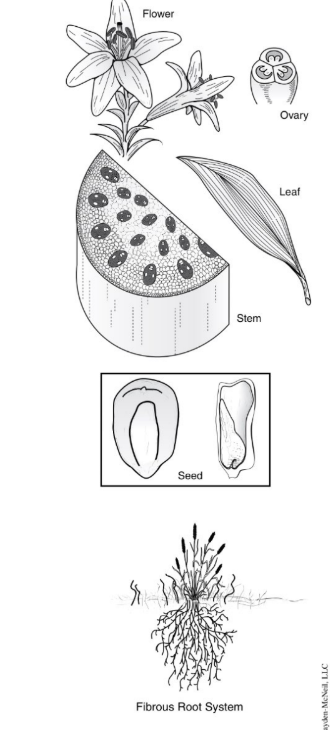
what characteristics of a Monocotyledonae
One cotyledons or seed leaves in the embryos
principle vein leaves are parallele to each other
Flower parts arranged in multiples of three
root system fibourous without taproot , all roots are the same size
stem with vascular bundles complexly arranged in the pith tissue
Stem and root without cambium, no annual ring added
What are the tissue systems of the plant
Dermal
Vesicular
Ground
What is dermal
A single layer of tightly packed cell covering the exterior of young plants. It acts as a protection as well as absorption surface with the enviornment (in the roots) or as a water weight barrier (as in stem and leaves)
What is the two types of vascular
Xylem: a complex tissue of several cells types which conducts water and dissolved solutes in a unidirectional flow form the roots to leaves
Phloem: A composite tissue that transports the products of photosynthesis from the production site ( mature leaves) to the roots.
What is ground
the remainder of a plant tissue that is netiher dermal nor vascula. It cells serve as a support for plant structer but as a sight for phototsynthetis and storage of the production
What are examples of monocots
Grasses
lilies
orchids
palms
what are examples of dicots
Oaks
Beans
Rose
Spinach
What are the ariel shoot system
Stem
Leaves
buds
Flowers
What is the root system
fibrous
taproot
What is the taxonomy
Kingdom (King)
Phylum (Philip)
Class (Cowerd)
Order (over)
Family (family)
Genus (getting)
Species (suspcious)

Name the location
Endodermis
Casperian strip
Pericycle
Phloem
Xylem

Name the locations
Endodermis
pericycle
Cortex
Plastids
Phloem
Xylem

Name the locations
Epidermis
Fiber cap
Phloem
Cambium
Xylem

name the locations
Cuticles
Upper epidermis
Palisade Parenchyma
Spongy Parenchyma
What is Osmosis
Osmosis is the movement of water molecules across a selectively permeable membrane from an area of higher water concentration (lower solute concentration) to an area of lower water concentration (higher solute concentration).
What is water potential
a measure of the potential energy of water per unit volume relative to pure water under standard conditions. It predicts the direction in which water will flow via osmosis, gravity, and mechanical pressure:
what is cohesion
the attractive force between like molecules—the tendency of molecules of the same substance to stick to one another.
What is adhesion
the attraction between different types of molecules the tendency of one substance to cling to a completely foreign surface or material.
What is surface tension
the property of a liquid's surface that allows it to resist an external force, acting like a stretched elastic membrane.
What is capillary action
is the ability of a liquid to flow through narrow spaces without the assistance of—and often in opposition to—external forces like gravity.
What is transpiration
the loss of water vapor from plant tissues, primarily through microscopic pores on leaves called stomata.

Label the parts of the body
stamen
Anther
Filament
Petal
Ovule
Sepal
Megaspore mother cell
Ovary
style
stigma
Carpel