Summarized Org Chem 3
 Call Kai
 Learn
Learn Practice Test
 Spaced Repetition
 Match
Match Flashcards
 Knowt Play
1/17

There's no tags or description
Looks like no tags are added yet.
Name | Mastery | Learn | Test | Matching | Spaced | Call with Kai | Chat |
|---|
No analytics yet
Send a link to your students to track their progress
18 Terms
Substitution
Addition
Elimination
Rearrangement
What are the 4 general types of organic reactions?

Homolysis (A:B→A⋅+B⋅): Bond cleavage where each atom takes one electron, forming radicals.
Heterolysis (A:B→A++:B−): Bond cleavage where one atom takes both electrons, forming ions. Almost always occurs at polar bonds.
What is the difference between Homolytic and Heterolytic bond cleavage?
Electrophiles ("electron-loving"): Electron-deficient species that seek electrons to obtain a stable valence shell (e.g., carbocations).
Nucleophiles ("nucleus-loving"): Electron-rich species that seek a proton or positively charged center (e.g., carbanions).
Define Electrophiles and Nucleophiles.
Carbocation: 6 valence electrons, positive charge ($C^+$).
Carbanion: 8 valence electrons, negative charge ($C:^-$)
What are the valence electron counts and charges for Carbocations and Carbanions?
They show the movement/flow of electrons. An arrow starts at a site of higher electron density (lone pair or covalent bond) and points toward an electron-deficient site
What do curved arrows represent in reaction mechanisms?
Brønsted-Lowry: Acid = proton ($H^+$) donor; Base = proton acceptor.
Lewis: Acid = electron-pair acceptor; Base = electron-pair donor.
Compare the Brønsted-Lowry vs. Lewis definitions of Acids and Bases.

pKa=−log(Ka)
Larger $K_a$ = Stronger acid
Smaller $pK_a$ = Stronger acid (Larger $pK_a$ means weaker acid).
How are $K_a$ and $pK_a$ related to acid strength?
The stronger the acid, the weaker its conjugate base. Conversely, a weak acid has a strong conjugate base.
What is the relationship between the strength of an acid and its conjugate base?
Acid-base reactions always favor the formation of the weaker acid and weaker base (equilibrium shifts away from the stronger acid/base). The weaker pair is always on the same side.
How do you predict the outcome/equilibrium of an acid-base reaction?

Across a Row (Left to Right): Acidity increases due to increasing electronegativity (polarizes bond and stabilizes $A^-$).
Down a Column (Top to Bottom): Acidity increases due to decreasing bond strength to hydrogen.
How does periodic table position affect acidity in rows vs. columns?
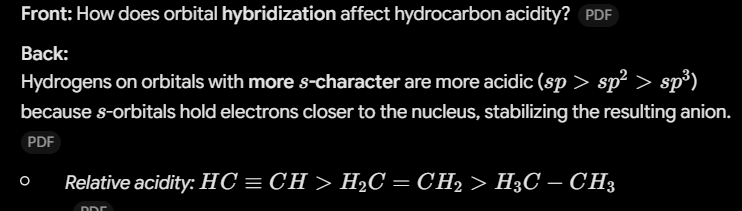
Hydrogens on orbitals with more $s$-character are more acidic ($sp > sp^2 > sp^3$) because $s$-orbitals hold electrons closer to the nucleus, stabilizing the resulting anion.
Relative acidity: HC\equiv CH > H_2C=CH_2 > H_3C-CH_3
How does orbital hybridization affect hydrocarbon acidity?

The transmission of charge through space/bonds. Electron-Withdrawing Groups (EWGs, e.g., $F, Cl$) pull electron density away, highly polarizing the acidic $H$ and stabilizing the conjugate base, thereby increasing acidity.
What is the inductive effect on acidity?

Resonance Stabilization: The carboxylate anion is resonance-stabilized across two equivalent oxygen atoms.
Inductive Effect: The highly polarized carbonyl group ($C=O$) draws electron density away from the hydroxyl group.
Why are carboxylic acids significantly more acidic than alcohols?

Any base stronger than hydroxide ($OH^-$) converts to $OH^-$ in water. To use stronger bases (like $NH_2^-$ or alkyl lithiums), nonaqueous solvents like liquid $NH_3$ or hexane must be used.
What is the leveling effect of water, and how are stronger bases used?

ΔG∘=−RTln(Keq)
ΔG∘=ΔH∘−TΔS∘
If \Delta G^\circ < 0, products are favored ($K_{eq} > 1$).
What are the mathematical relationships for standard free energy (ΔG∘)?

Organic molecules with lone pairs on heteroatoms ($O, N$) can accept protons (e.g., alcohols, ethers, ketones).
π-electrons in alkenes can act as bases by reacting with strong acids to form carbocations.
How can organic compounds without negative charges act as bases?
Step 1: Brønsted acid-base reaction (alcohol oxygen gets protonated by hydronium).
Step 2: Reverse Lewis acid-base reaction / Heterolytic cleavage (alboxonium ion loses water to form a carbocation).
Step 3: Lewis acid-base reaction ($Cl^-$ nucleophile attacks carbocation electrophile)
What are the 3 reaction steps in the conversion of tert-butyl alcohol to tert-butyl chloride using $HCl$?
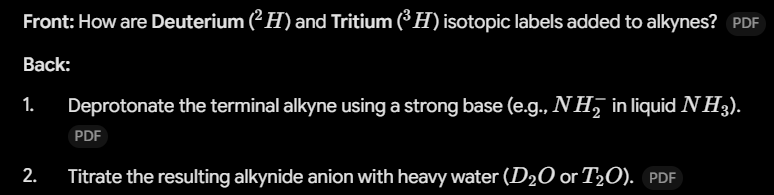
Deprotonate the terminal alkyne using a strong base (e.g., $NH_2^-$ in liquid $NH_3$). Titrate the resulting alkynide anion with heavy water ($D_2O$ or $T_2O$).
How are Deuterium ($^2H$) and Tritium ($^3H$) isotopic labels added to alkynes?