biology module 2 section 3 (nucleic acids and nucleotides)
 Studied by 0 people
 Call Kai
 Learn
Learn Practice Test
 Spaced Repetition
 Match
Match Flashcards
 Knowt Play
1/31

There's no tags or description
Looks like no tags are added yet.
Name | Mastery | Learn | Test | Matching | Spaced | Call with Kai |
|---|
No analytics yet
Send a link to your students to track their progress
32 Terms
what are nucleotides
the building blocks of nucleic acids such as DNA and RNA
monomers that can join together to form dimers (dinucleotides) and polymers (polynucleotides)
what are nucleic acids
a functional molecule made of one or more polynucleotide chains
what are nucleotides made up of
a pentose sugar (contains 5 carbon atoms)
a nitrogenous base (contains carbon and nitrogen)
a phosphate group (contains phosphate)
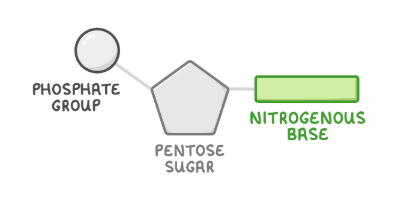
what are polynucleotides and how do they form and break
nucleotides that are joined together via condensation reactions
the phosphate group of one nucleotide forms a covalent bond with the sugar of another forming a phosphodiester bond which can form a chain known as the sugar-phosphate backbone
bonds can break by hydrolysis reactions releasing nucleotide monomers
what is DNA
a type of nucleic acid that contains the instructions needed to make proteins
what is DNA made up of
deoxyribose (pentose sugar)
nitrogenous base (A,T,C or G)
a phosphate group
who discovered DNA structure
1953 James Watson and Francis Crick were credited with working out the structure of DNA.
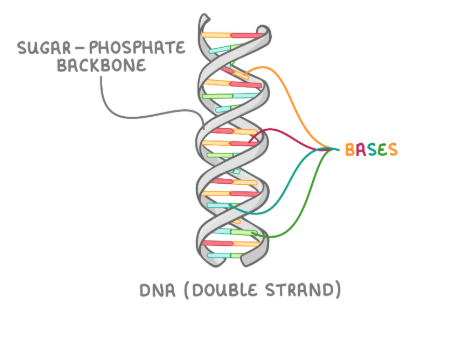
with the help of other scientists like Rosalind Franklin, they found that DNA is made up of two polynucleotide strands wound around each other to form a double helix
describe the purposes of the structure of DNA
sugar phosphate backbone (protects bases)
double stranded (allows strands to act as template in replication)
double helix (compact)
complimentary base pairing (for DNA replication)
weak hydrogen bonds (can separate in DNA replication)
large molecule (to store lots of info)
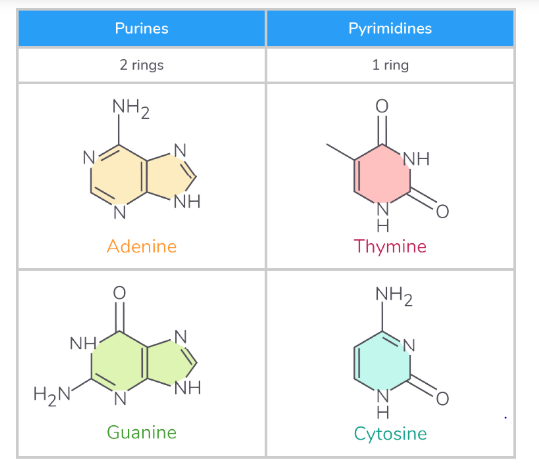
what is the difference between purines and pyrimidines
purines - larger bases that contain 2 carbon ring structures ( A and G)
pyrimidines - smaller bases that contain 1 carbon ring structure ( T and C )
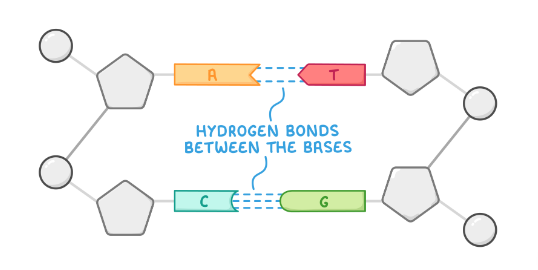
how do the bases pair together
adenine pairs with thymine with 2 hydrogen bonds
cytosine pairs with guanine with 3 hydrogen bonds
smaller pyrimidine always binds to a larger purine to maintain a constant distance between the 2 sugar-phosphate backbones
what is RNA
a type of nucleic acid that uses information from DNA to synthesise proteins
what is RNA made up of
ribose (a pentose sugar)
A, U, C or G base
a phosphate group
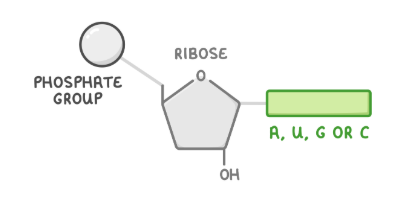
describe the structure of RNA
contains ribose rather than deoxyribose
has uracil instead of thymine
single stranded polynucleotide which is shorter than DNA strands
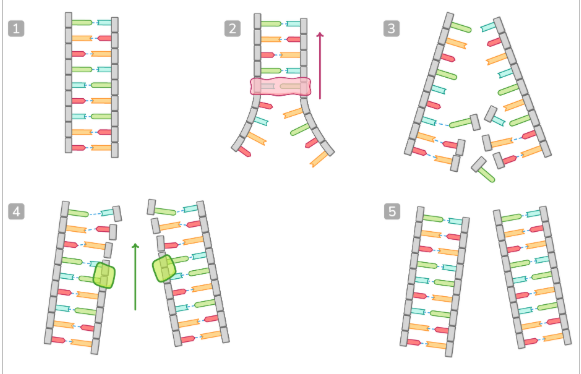
describe the process of DNA (semi-conservative) replication
a DNA molecule that is ready to be replicated unwinds by the enzyme DNA helicase which breaks hydrogen bonds between complimentary bases separating the strands
each strand acts as a template as free nucleotides attract to their complementary bases
enzyme DNA polymerase joins the free nucleotides together via condensation reactions in the 5' to 3' direction forming phosphodiester bonds to create the sugar-phosphate backbone of the new DNA strand
two identical copies of DNA are made. each copy is made up of one original DNA strand and one new DNA strand (semi-conservative replication)
how did meselson and stahl investigate DNA replication
bacteria was grown in a medium containing 15N, so all their DNA is ‘heavy’.
bacteria was transferred to a medium with 14N for one round of replication, so the lighter nitrogen was incorporated into any new DNA strands they made.
DNA was extracted and centrifuged.
steps 2-3 were repeated for another round of replication.
distribution of heavy and light DNA was analysed to track how the DNA was replicating:
the heavier bands sink lower in the test tube.
the intermediate bands, made of DNA with one heavy strand and one light strand, are in the middle of the test tube.
the lighter bands are higher up in the test tube.
what were the results of meselson and stahls experiment
showed that DNA replicates through a semi-conservative process
because in the first replication each resulting DNA molecule consists of one old, heavy strand and one new, light strand
and then in the second replication the other half were completely made of light strand
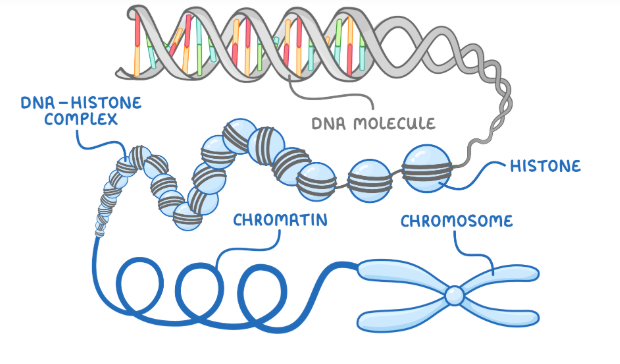
how is DNA condensed into chromosomes
they are wound around proteins as histones to form DNA-histone complexes
they then coil further to form chromatin which helps pack the DNA into chromosomes which each contain just a single molecule of DNA
what is genetic code
genetic codes are summarised into a table
each amino acid is coded for by a sequence of 3 mRNA bases known as codons
it is universal (codons for the same amino acid are the same in all organisms), non-overlapping (each base is only read once), degenerate (most amino acids are coded for by more than one triplet)
what is mRNA
a type of RNA that is synthesised during the process of transcription
used to carry genetic info from DNA to ribosomes
what are the features of mRNA
single-stranded, linear
contains a base sequence complementary to a DNA sequence
contains codons, which are sets of three bases that code for an amino acid
small enough to leave the nucleus
what is tRNA
a type of RNA used in the process of translation
used to transport amino acids to ribosomes to build up a polypeptide chain
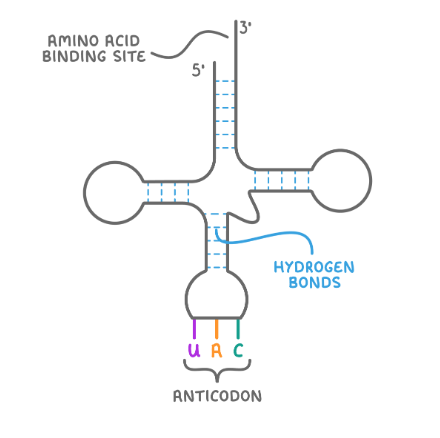
what are the features of tRNA
single-stranded molecule folded into a clover-leaf shape.
hydrogen bonds between complementary base pairs to hold it in shape
contains a specific sequence of three bases at one end, known as the anticodon
contains an amino acid binding site at the opposite end
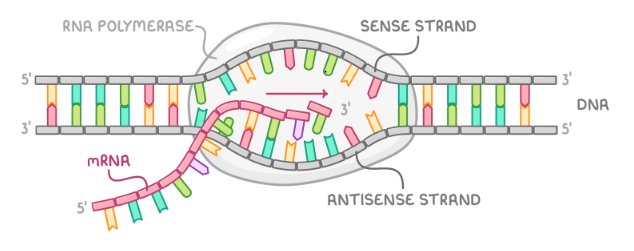
what is transcription and where does it take place
the initial step of synthesis of proteins by creating an mRNA copy of a gene from the DNA template
in eukaryotic cells, occurs in the nucleus where it exits into the cytoplasm for translation
what are the steps of transcription
RNA polymerase enzyme binds to DNA
hydrogen bonds between the DNA bases break so the two strands of the double helix separate
free RNA nucleotides align with the DNA template through complementary base pairing
in the RNA molecule, uracil pairs with adenine, while adenine pairs with thymine, and cytosine pairs with guanine
RNA polymerase catalyses the formation of phosphodiester bonds between adjacent RNA nucleotides.
complementary mRNA strand is formed, carrying the same base sequence as the DNA sense strand
the process ends when RNA polymerase reaches a stop codon, detaches from DNA and terminates transcription
mRNA is released, detaches from DNA, and DNA rewinds into its double helix structure
what is translation and where does it occur
process of decoding the information in mRNA to synthesis a polypeptide chain with the help of tRNA folding into a functional protein
occurs in the cytoplasm, specifically on the ribosome
what are the steps of translation
ribosome attaches to the mRNA strand at a start codon
tRNA molecule, carrying a specific amino acid and with an anticodon that is complementary to the start codon, binds to the mRNA.
second tRNA molecule with an anticodon complementary to the next mRNA codon, and also carrying a specific amino acid, attaches to mRNA.
amino acids carried by the first two tRNA molecules are linked together via a peptide bond using ATP
first tRNA molecule detaches from mRNA and is free to collect another amino acid for future use
ribosome moves along mRNA, allowing another tRNA molecule, which carries the next amino acid, to bind to the next codon on mRNA
process is repeated elongating the polypeptide chain.
sequence continues until the ribosome reaches a stop codon on mRNA
completed polypeptide chain detaches from the ribosome
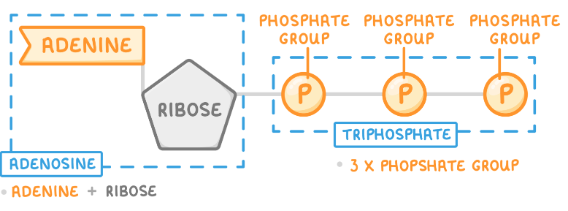
what is the structure of ATP
nitrogenous base (adenine)
ribose (5-carbon sugar)
phosphates (3 phosphate groups
what is ATP used for in the body
movement (eg muscle contraction or for sperm cells to swim)
active transport (eg ions entering plant roots)
synthesis of large molecule (eg DNA and proteins)
secretion of substances from cells (eg releasing hormones from glands)
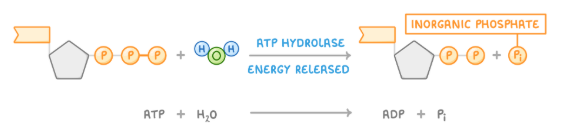
describe hydrolysis of ATP to release energy
when water is added to ATP, it breaks down into ADP and inorganic phosphate (Pi)
catalysed by the enzyme ATP hydrolase
releases energy for use in cells
describe condensation reaction of ATP
when a phosphate group and ADP join, a water molecule is released
reaction is catalysed by the enzyme ATP synthase
process requires energy and traps chemical energy in the bond
how do the properties of ATP relate to its function
hydrolysis releases a small amount of energy, little energy is lost as heat
broken down quickly so energy is released quickly
rapidly re-synthesised so is always readily available
inorganic phosphate from ATP hydrolysis can phosphorylate other compounds, makes them more reactive
bonds between the phosphate groups are unstable, have a low activation energy and are easily broken
soluble, can be easily transported around cells
 Note
Note  Flashcards (71)