US History Regents Review
 Call Kai
 Learn
Learn Practice Test
 Spaced Repetition
 Match
Match Flashcards
1/205

There's no tags or description
Looks like no tags are added yet.
Name | Mastery | Learn | Test | Matching | Spaced | Call with Kai | Chat |
|---|
No analytics yet
Send a link to your students to track their progress
206 Terms
mayflower Compact
A document written by the Pilgrims establishing themselves as a political society and setting guidelines for self-government

Virginia House of Burgesses
First representative government in the colonies

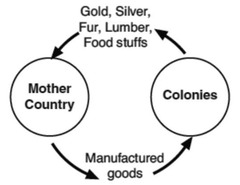
Mercantilism
ECONOMIC SYSTEM WHERE RAW MATERIALS WERE SENT TO THE MOTHER COUNTRY AND THEN THE COLONISTS HAD TO BUY PRODUCTS FROM THE MOTHER COUNTRY
Common Sense
1776: a pamphlet written by Thomas Paine that claimed the colonies had a right to be an independent nation

John Locke
1632 to 1704:believed that people had natural rights to liberty, life and property (Liberalism) (Naturalism) (Social Contract)

Declaration of Independence
1776 statement, issued by the Second Continental Congress, explaining why the colonies wanted independence from Britain.
Articles of Confederation
1st Constitution of the U.S. 1781-1788 (weaknesses-no executive, no judicial, no power to tax, no power to regulate trade)

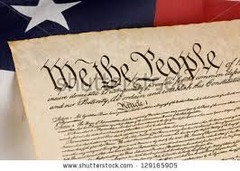
U.S. Constitution
A document written by delegates at the Constitutional Convention that established a national government in the United States.
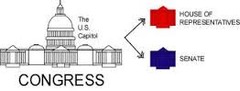
Bicameral Legislature
a lawmaking body with 2 houses - the Senate and the House of Representatives
Virginia Plan
- the idea that representation in both houses of a bicameral Congress should be based on population but naturally giving the larger states an advantage

New Jersey Plan
"Small state plan" at the Constitutional Convention in which each state was represented equally in the legislature.

Great Compromise
Created the House and Senate while resolving the dispute between the large and small states. - Roger Sherman

3/5 Compromise
-each slave would count for 3/5 of a person for taxation and representation purposes

Legislative branch
Branch of government that makes the laws
Executive Branch
Branch of government that enforces the laws

Judicial Branch
Branch of government that decides if laws are carried out fairly.

Federalists
A term used to describe supporters of the Constitution during ratification debates in state legislatures.

AntiFederalists
People who opposed the constitution
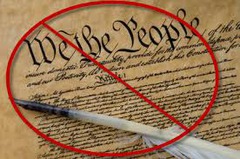
Bill of Rights
a statement of fundamental rights and privileges (especially the first ten amendments to the United States Constitution)

Unwritten Constitution
Political practices that are followed, but are not part of the actual Constitution. Examples include political parties, judicial review, and the Presidential Cabinet.

Strict vs. Loose interpretation
Strict interpretation is when you go exactly by what the constitution says- Thomas Jefferson; loose is where you have more liberal views-Alexander Hamilton
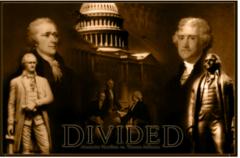
Alexander Hamilton's US bank
pay off all foreign and domestic debts; have a National Bank; have a protective tariff; have an excise tax

Thomas Jefferson
...
Wrote the Declaration of Independence

Marbury V. Madison
established concept of judicial review, first time supreme court declared something 'unconstitutional'

Checks and Balances
A system that allows each branch of government to limit the powers of the other branches in order to prevent abuse of power

Separation of powers
Constitutional division of powers among the legislative, executive, and judicial branches, with the legislative branch making law, the executive applying and enforcing the law, and the judiciary interpreting the law

Reserved Powers
Powers not specifically granted to the federal government or denied to the states belong to the states and the people

Federalism
A system in which power is divided between the national and state governments

Elastic Clause
Article I, Section 8, of the Constitution, which allows Congress to make all laws that are "necessary and proper" to carry out the powers of the Constitution.
George Washington's Farewell address
He advised the nation: 1. to stay away from permanent alliances with foreign nations 2. stay away from political parties

Missouri Compromise
"Compromise of 1820" over the issue of slavery in Missouri. It was decided Missouri entered as a slave state and Maine entered as a free state and all states North of the 36th parallel were free states and all South were slave states.

Compromise of 1850
North-South agreement that added California as a free state, NM and Utah based on popular sovereignty, new fugitive slave law.

Kansas-Nebraska Act
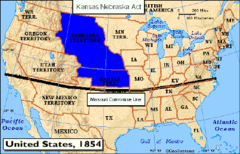
1854 - Created Nebraska and Kansas as states and gave the people in those territories the right to chose to be a free or slave state through popular sovereignty.
Popular Sovereignty
Notion that the people of a territory should determine if they want to be a slave state or a free state.

Sectionalism
Loyalty to one's own region of the country, rather than to the nation as a whole such as the North and South before and during the Civil War.

Uncle Tom's Cabin
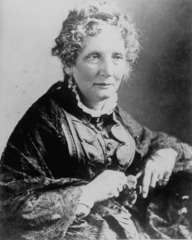
(Harriet Beecher Stowe) Powerful novel that made Americans aware of the harsh and inhumane conditions of slavery.
John Brown and Harper's Ferry
He wanted to start a slave rebellion that swept through the South. In 1859 Brown, 13 whites and 5 blacks took over the arsenal at Harper's Ferry, Virginia. Brown was caught and hanged. The North thought of him ad Jesus-like. The South thought of him as the devil. This further separated the North and the South.

Abolitionist Movement
the movement concentrated on ending slavery in the United States

Dred Scott Case
Supreme Court case which ruled that slaves are not citizens but are property, affirmed that property cannot be interfered with by Congress, slaves do not become free if they travel to free territories or states, fueled abolitionist movement, hailed as victory for the south.

Differences between North and South
economical differences: NORTH: in the north there where more factories that created weapons, tents, uniforms, preserved foods, did not have slavery. SOUTH: agricultural and grew cash crops. few factories, used slaves, had ports for shipping goods.

Secession
Act of formally withdrawing from the Union such as when South Carolina seceded from the union.
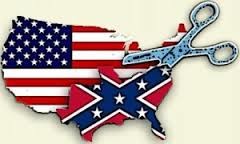
Grant/Lee
Grant commanded the Union Army and Lee Commanded the Confederate Army

Sherman's March
General Sherman led some 60000 troops on a march south across Georgia; burned cities and destroyed everything in his path; killed civilians, destroyed crops. Sherman believed in total war.

Gettysburg
1863-General Lee lead the Confederate troops into Pennsylvania. He surprised the units in Gettysburg and the battle was the most crucial and bloodiest of the war. The victory at Gettysburg belonged to Lincoln and the Union. Turning point; last offensive attack of the South.

Emancipation Proclamation
order issued by President Abraham Lincoln freeing the slaves in areas rebelling against the Union, took effect January 1, 1863

Reconstruction
the period after the Civil War in the United States when the southern states were reorganized and reintegrated into the Union
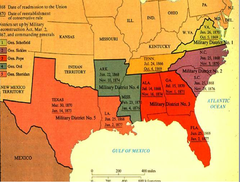
Radical Republican
After the Civil War, a group that believed the South should be harshly punished and thought that Lincoln was sometimes too compassionate towards the South

13th amendment
Abolished Slavery
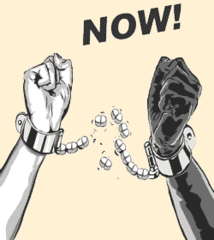
14th amendment
declared that all persons born in the US were citizenship, that all citizens were entilted to equal rights and their rights wer protected by due process
15th Amendment
Citizens cannot be denied the right to vote because of race, color , or precious condition of servitude

Andrew Johnson
17th President of the United States, A Southerner form Tennessee, as V.P. when Lincoln was killed, he became president. He opposed radical Republicans who passed Reconstruction Acts over his veto. The first U.S. president to be impeached, he survived the Senate removal by only one vote. He was a very weak president.

Black Codes
Laws denying most legal rights to newly freed slaves; passed by southern states following the Civil War

Jim Crow Laws
Laws designed to enforce segregation of blacks from whites

Plessy V. Ferguson
separate but equal
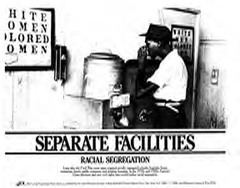
Freedmen's Bureau
1865 - Agency set up to aid former slaves in adjusting themselves to freedom. It furnished food and clothing to needy blacks and helped them get jobs.

Ku Klux Klan
White supremacy organization that intimidated blacks out of their newly found liberties

Sharecropping
A system used on southern farms after the Civil War in which farmers worked land owned by someone else in return for a small portion of the crops.

Poll Tax
A requirement that citizens pay a tax in order to register to vote

Literacy Test
A test administered as a precondition for voting, often used to prevent African Americans from exercising their right to vote.

Grandfather Clause
Law that excused a voter from a literacy test if his father or grandfather had been eligible to vote on January 1, 1867

Manifest Destiny
A notion held by a nineteenth-century Americans that the United States was destined to rule the continent, from the Atlantic the Pacific.

Northwest Ordinance
1787 law that set up a government for the Northwest Territory and a plan for admitting new states to the Union

Louisiana Purchase
1803 purchase of the Louisiana territory from France. Made by Jefferson, this doubled the size of the US.
Mexican Cession
1848. Awarded as part of the Treaty of Guadalupe-Hidalgo after the Mexican American War. U.S. paid $15 million for 525,000 square miles.

Andrew Jackson
..., The seventh President of the United States (1829-1837), who as a general in the War of 1812 defeated the British at New Orleans (1815). As president he opposed the Bank of America, objected to the right of individual states to nullify disagreeable federal laws, and increased the presidential powers.

Homestead Act
1862 - Provided free land in the West to anyone willing to settle there and develop it. Encouraged westward migration.

Indian Removal Act
(1830) a congressional act that authorized the removal of Native Americans who lived east of the Mississippi River

Trust
A group of corporations that unite in order to reduce competition and control prices in a business or an industry.

Industrialists
person whose wealth comes from the ownership of industrial businesses and who favors government policies that support industry

Robber Barons
Negative term used to describe large businessmen of the late 1800's because of the fact that they used ruthless practices to destroy competition and took advantage of workers.
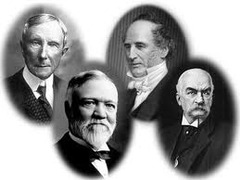
Captains of Industry
A name given company owners such as Carnegie and Rockefeller by people who believed they steered the economy into prosperity.
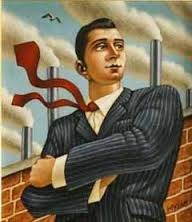
Railroads
Were essential to westward expansion because they made it easier to travel to and live in the west

Rockefeller
Captain of industry that created a monopoly in oil refineries

Carnegie
Captain of industry in charge of steel production
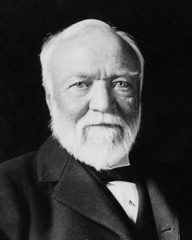
J P Morgan
Banker that controlled 2/3 of the rail roads and eventually merged into the steel industry. Bought Carnegies steel company and formed U S Steel Company.

Social Darwinism
The belief that only the fittest survive in human political and economic struggle.

Laissez-Faire
Hands off. No government intervention in business.
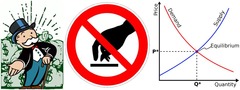
Labor Unions
An organization formed by workers to strive for better wages and working conditions

Strikes
times when workers refuse to work until owners improve conditions

Corporations
businesses that are owned by many investors who buy shares of stock

Socialism
A system in which society, usually in the form of the government, owns and controls the means of production.

Vanderbilt
Captain of Industry in charge of railroad and steamship lines

Monopolies
Corporations that gain complete control of the production of a single good or service.

Sherman Anti-Trust Act (1890)
an 1890 law that banned the formation of trusts and monopolies in the United States

1st Wave of Immigration-Old Immigrants
the immigration of 5 million northern and western Europeans German Irish and Chines, the immigration of 5 million northern and western Europeans German Irish and Chines

2nd Wave of Immigration-Old Immigrants
northern and western Europe (beginning around 1850)
Nativism
A policy of favoring native-born individuals over foreign-born ones

Urbanization
An increase in the percentage and in the number of people living in urban settlements.

Samuel Gompers
He was the creator of the American Federation of Labor. He provided a stable and unified union for skilled workers.

Theodore Roosevelt
26th President of the United States, 26th president, known for: conservationism, trust-busting, Hepburn Act, safe food regulations, "Square Deal," Panama Canal, Great White Fleet, Nobel Peace Prize for negotiation of peace in Russo-Japanese War

Treaty of Paris
agreement signed by British and American leaders that stated the United States of America was a free and independent contry

Panama Canal
a ship canal 40 miles long across the Isthmus of Panama built by the United States (1904-1914)

Monroe Doctrine
an American foreign policy opposing interference in the Western hemisphere from outside powers

Roosevelt Corollary
Roosevelt's 1904 extension of the Monroe Doctrine, stating that the United States has the right to protect its economic interests in South And Central America by using military force

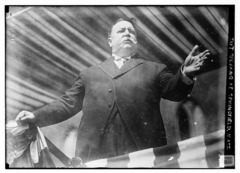
William Taft
27th president of the U.S.; he angered progressives by moving cautiously toward reforms and by supporting the Payne-Aldrich Tariff; he lost Roosevelt's support and was defeated for a second term.
Dollar Diplomacy
Foreign Policy idea by Taft to make countries dependant on the U.S. by heavily investing in their economies
Woodrow Wilson
28th president of the United States, known for World War I leadership, created Federal Reserve, Federal Trade Commission, Clayton Antitrust Act, progressive income tax, lower tariffs, women's suffrage (reluctantly), Treaty of Versailles, sought 14 points post-war plan, League of Nations (but failed to win U.S. ratification), won Nobel Peace Prize

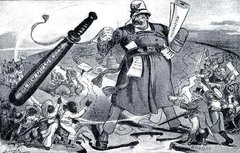
Big Stick Diplomacy
The policy held by Teddy Roosevelt in foreign affairs. The "big stick" symbolizes his power and readiness to use military force if necessary. It is a way of intimidating countries without actually harming them.
Open Door Policy
A policy of the United States that stated China should be open to all nations that wish to trade with them. This policy did not include the consent of the Chinese, and was another form of imperialism.

Meiji Restoration
(1867-1912)The political program that followed the destruction of the Tokugawa Shogunate in 1868, in which a collection of young leaders set Japan on the path of centralization, industrialization, and imperialism.