L14 - Sound Localisation
 Call Kai
 Learn
Learn Practice Test
 Spaced Repetition
 Match
Match Flashcards
 Knowt Play
1/17

There's no tags or description
Looks like no tags are added yet.
Name | Mastery | Learn | Test | Matching | Spaced | Call with Kai | Chat |
|---|
No analytics yet
Send a link to your students to track their progress
18 Terms
Azimuth
The horizontal angle of the sound source. Zero degrees is directly ahead, positive angles are to the right, and negative angles are to the left.
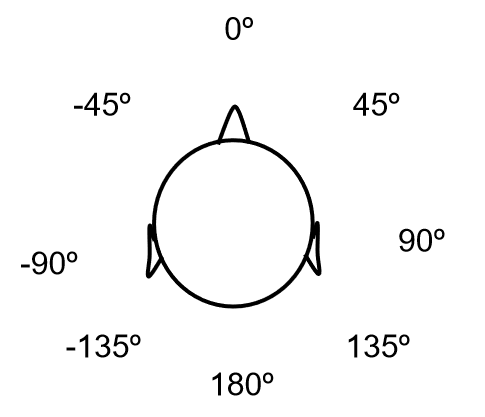
Elevation
The vertical height of the sound source
Distance
How far away the sound is
Extra Dimension of Sound
Externalisation Vs Internalisation = whether sound is percieved as some distance from the head vs inside the head (e.g. in headphones)
Binaural Cues + Two Types
= two ears working together to localise sound on the horizontal plane.
Interaural Level Differences (ILDs)
Interaural Time Delays (ITDs)
What are Interaural Level Differences?
best for high-frequency sounds with short wavelengths
head acts as a physical obstacle to sound
when sound comes from one side, the further ear is in the ‘acoustic shadow’ - sound is quieter
Sound waves also reflect off the near side of the head, causing constructive interference that actually makes the sound louder at the near ear.
How do ILDs change with frequency?
Higher the frequency, the bigger the interaural level difference.
Low frequency waves with long wavelengths are big enough to bend around the head
How do ILDs change with distance?
If speaker is near to you, there will be a larger relative ILD - the difference in volume between two ears will be more noticeable
What are Interaural Time Delays (ITDs)?
best for low-frequency sounds with long wavelengths
the physical distance between the two ears means sound takes extra time to reach the ear furthest from the source
takes up to 700 µs (microsecond) to travel the extra distance
smallest ITD a human can detect is incredibly tiny: roughly 10 µs.
The Jeffress (1948) model of Interaural Time Delays
ITDs are calculated using delay lines and coincidence detectors
This calculation occurs in the Medial Superior Olive (MSO) in the brainstem - signal travels along delay line in brain stem (starts on left side for left ear and right side for right ears).
Coinicdence detectors (Excitatory-Excitatory detectors) will only fire when both neurons are triggered at the same time (point at which they meet) - if neuron fires closer to right side, left signal must have travelled further along MSO, and therefore sound must be coming from that direction.
What is the Endbulb of Held?
the largest synapse in the brain used to preserve the timing of action potentials perfectly (aka phase-locking = the auditory nerve firing perfectly in time with the peaks of a sound wave) - even small differences in timing could make a huge difference to the ITD
completely surrounds the spherical bushy cell
Because of its massive contact area, it ensures that every time the auditory nerve fires, the spherical bushy cell fires immediately and without fail.
One Limitation of the use of Binaural Cues + Evidence
There is a blind spot in binaural hearing for mid-frequency pure tones (around 3000 Hz).
The ILD is too small to be useful, and the ITD is ambiguous because the wavelengths are too short
EVIDENCE: Stevens & Newman (1934) = on roof of harvard uni to avoid reflective surfaces, rotated a loudspeaker on the end of a long beam around the participant to play sounds from different angles. Recorded the participants' localisation errors + found distinct peak in errors at 3KHz.
What are Monaural Cues?
aka Pinna cues = If a sound is directly in front of you, directly above you, or directly behind you, ILD and ITD are identical
creates an area of 3D space called ‘cone of confusion’
Therefore brain uses the shape of the pinna to calculate elevation and front vs back
How do Pinna Cues work? + EVIDENCE
Sound reflects differently off different parts of the pinnae (e.g. concha, flange) - amplifying some frequencies and suppressing others
= people have different shaped ears and so receive sound differently
EVIDENCE (Gardener & Gardener, 1973) = Filling the cavities of the pinna dramatically increases errors in elevation discrimination. - more cavities filled, more errors
How do humans actively resolve or correct front/back confusions?
Head movements = to change the ITD/ILD
What is Reverberation?
Sound bouncing off surfaces in an enclosed room, however sound localisation in reverberant rooms is highly robust.
How are we robust to room reverbaration? + EVIDENCE
The Precedence Effect = The auditory system is incredibly fast; it listens only to the very first wavefront that arrives (the direct sound) and ignores the location of the echoes that arrive just milliseconds later.
Wallach et al (1949) = manipulating the delay of one loudspeaker caused listeners to localize the sound entirely at the speaker that produced the sound first, completely ignoring the delayed speaker
Headphone sound is internalised, but how could we manipulate it to make in sound externalised?
Realistic, individual pinna cues: Using someone else's ear shape measurements causes the sound to collapse back inside the head.
Reverberation: The echoes must be asymmetric (different at each ear) to sound natural.
Source stability during a head turn: In reality, sounds don't move with your head; virtual reality systems must dynamically update the binaural cues to keep the sound source stable when you look around