A. SPECIAL METHODS
 Call Kai
 Learn
Learn Practice Test
 Spaced Repetition
 Match
Match Flashcards
 Knowt Play
1/38

There's no tags or description
Looks like no tags are added yet.
Name | Mastery | Learn | Test | Matching | Spaced | Call with Kai | Chat |
|---|
No analytics yet
Send a link to your students to track their progress
39 Terms
d. Acetylation method
The method used to assay Alcohol in volatile oils
a. Bisulfite method
b. KOH method
c. Babcock bottle
d. Acetylation method
c. Bisulfite method
Assay method used for aldehydes and ketones in volatile oils.
a. Acetylation method
b. KOH method
c. Bisulfite method
d. Babcock bottle method
c. Cassia flask
Flask used in the bisulfite method for aldehydes and ketones.
a. Kjeldahl flask
b. Babcock bottle
c. Cassia flask
d. Erlenmeyer flask
b. Hydroxylamine method (titration)
Alternative assay method for aldehydes and ketones in volatile oils.
a. Acetylation method
b. Hydroxylamine method
c. KOH method
d. Saponification method
c. Residual layer
non-aldehyde/non-ketone/non-phenol
nasa taas na layer
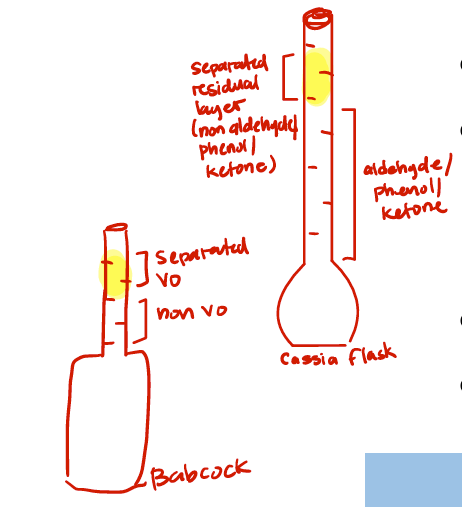
Layer remaining after removal of aldehydes in the bisulfite method using cassia flask
a. Aldehyde layer
b. Ketone layer
c. Residual layer
d. Alcohol layer
b. KOH method
Assay method used for phenols in volatile oils.
a. Acetylation method
b. KOH method
c. Hydroxylamine method
d. Bisulfite method
c. Cassia flask
Flask used in the KOH method for phenols.
a. Volumetric flask
b. Babcock bottle
c. Cassia flask
d. Separatory funnel
c. Babcock bottle
Apparatus used for volatile oil spirit.
a. Cassia flask
b. Soxhlet extractor
c. Babcock bottle
d. Kjeldahl flask
b. Non-volatile oil layer
Layer remaining after removal of Volatile oils in babcock
a. Aldehyde layer
b. Non-volatile oil layer
c. Volatile oil layer
d. Alcohol layer
c. mg of KOH needed to neutralize free acids in 1g of sample
[ASSAY OF FATS AND FIXED OILS]
The Acid Value in assay of fats and fixed oils is defined as
a. mg of KOH needed to saponify esters in 1g of sample
b. mg of KOH needed to neutralize free acids and saponify esters in 1g of sample
c. mg of KOH needed to neutralize free acids in 1g of sample
d. grams of iodine absorbed by 100g of sample
d. mg of KOH needed to saponify esters in 1g of sample
[ASSAY OF FATS AND FIXED OILS]
The Ester Value in assay of fats and fixed oils is defined as
a. mg of KOH needed to neutralize free acids in 1g of sample
b. grams of iodine absorbed by 100g of sample
c. mg of KOH needed to neutralize free acids and saponify esters in 1g of sample
d. mg of KOH needed to saponify esters in 1g of sample
c. mg of KOH needed to neutralize free acids and saponify esters in 1g of sample

[ASSAY OF FATS AND FIXED OILS]
The Saponification Value / Koettstorfer Number is defined as
a. mg of KOH needed to neutralize free acids in 1g of sample
b. mg of KOH needed to saponify esters in 1g of sample
c. mg of KOH needed to neutralize free acids and saponify esters in 1g of sample
d. grams of iodine absorbed by 100g of sample
c. Saponification Value
[ASSAY OF FATS AND FIXED OILS]
aka Koettsdorfer Number
a. Acid Value
b. Ester Value
c. Saponification Value
d. Iodine Value
d. SV = AV + EV
[ASSAY OF FATS AND FIXED OILS]
The formula relating Saponification Value, Acid Value, and Ester Value
a. SV = AV − EV
b. SV = AV × EV
c. SV = AV / EV
d. SV = AV + EV
b. Grams of iodine absorbed by 100g of sample
[ASSAY OF FATS AND FIXED OILS]
The Iodine Value is defined as
a. mg of KOH needed to neutralize free acids in 1g of sample
b. Grams of iodine absorbed by 100g of sample
c. mg of KOH needed to saponify esters in 1g of sample
d. Grams of iodine absorbed by 1g of sample
c. Unsaturated fatty acids
mahilig sa double bond
[ASSAY OF FATS AND FIXED OILS]
The Iodine Value is a quantitative measure of
a. Saturated fatty acids
b. Free fatty acids
c. Unsaturated fatty acids
d. Ester content
c. < 100
[IODINE VALUE CLASSIFICATIONS]
The Iodine Value classification for Non-drying oils (NOA)
a. 100–120
b. > 120
c. < 100
d. > 150
c. Olive oil and Almond oil
“NOA”
[IODINE VALUE CLASSIFICATIONS]
Examples of Non-drying oils
a. Cottonseed oil and Sesame oil
b. Linseed oil and Cod liver oil
c. Olive oil and Almond oil
d. Castor oil and Coconut oil
d. 100–120
[IODINE VALUE CLASSIFICATIONS]
The Iodine Value classification for Semi-drying oils
a. < 100
b. > 120
c. > 150
d. 100–120
c. Cottonseed oil and Sesame oil
“SeCottSe”
[IODINE VALUE CLASSIFICATIONS]
Examples of Semi-drying oils
a. Olive oil and Almond oil
b. Linseed oil and Cod liver oil
c. Cottonseed oil and Sesame oil
d. Castor oil and Coconut oil
d. > 120
[IODINE VALUE CLASSIFICATIONS]
The Iodine Value classification for Drying oils (LiCoD)
a. < 100
b. 100–120
c. > 150
d. > 120
c. Linseed oil and Cod liver oil
“LiCoD”
[IODINE VALUE CLASSIFICATIONS]
Examples of Drying oils
a. Olive oil and Almond oil
b. Cottonseed oil and Sesame oil
c. Linseed oil and Cod liver oil
d. Castor oil and Coconut oil
c. Hanus Method — Iodobromide TS
“1 an*s-bromance”
[Iodine Value Methods]
The USP Method I for Iodine Value uses which reagent
a. Wijs Method — Iodochloride TS
b. Hubl Method — HgCl2 + I2
c. Hanus Method — Iodobromide TS
d. KOH method
d. Wijs Method — Iodochloride TS
“double u” double=2
[Iodine Value Methods]
The USP Method II for Iodine Value uses which reagent
a. Hanus Method — Iodobromide TS
b. Hubl Method — HgCl2 + I2
c. Wijs Method — Iodobromide TS
d. Wijs Method — Iodochloride TS
b. Hubl Method — HgCl2 + I2
“habol - unofficial”
[Iodine Value Methods]
The Unofficial Method for Iodine Value uses which reagent
a. Hanus Method — Iodobromide TS
b. Hubl Method — HgCl2 + I2
c. Wijs Method — Iodobromide TS
d. Wijs Method — Iodochloride TS

Iodine Value Formula
d. Nitrogen
[NITROGEN CONTENT DETERMINATION]
The Kjeldahl Method is used for quantitative determination of which element in organic substances
a. Carbon
b. Sulfur
c. Oxygen
d. Nitrogen
c. Digestion — conversion of organic N into NH4+ by adding H2SO4
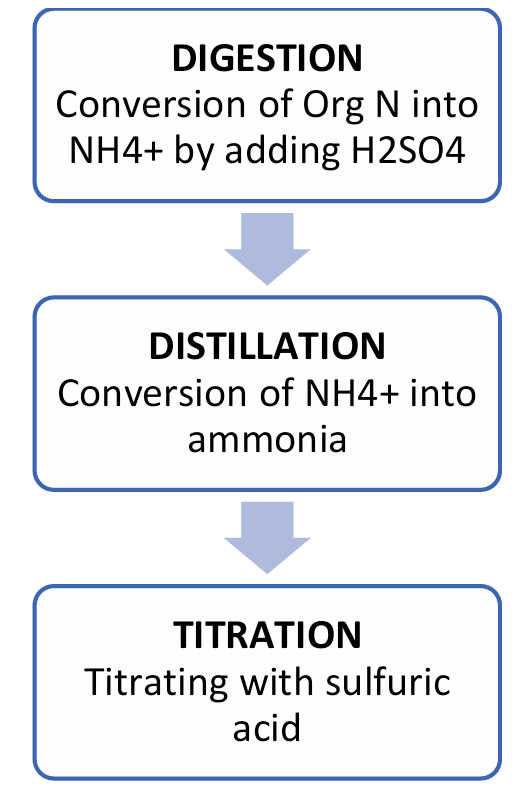
[NITROGEN CONTENT DETERMINATION]
The first step of the Kjeldahl Method
a. Distillation — conversion of NH4+ into ammonia
b. Titration with sulfuric acid
c. Digestion — conversion of organic N into NH4+ by adding H2SO4
d. Precipitation with NaOH
a. Distillation — conversion of NH4+ into ammonia
[NITROGEN CONTENT DETERMINATION]
The second step of the Kjeldahl Method
a. Distillation — conversion of NH4+ into ammonia
b. Titration with sulfuric acid
c. Digestion — conversion of organic N into NH4+ by adding H2SO4
d. Precipitation with NaOH
b. Titration with sulfuric acid
[NITROGEN CONTENT DETERMINATION]
The third step of the Kjeldahl Method
a. Distillation — conversion of NH4+ into ammonia
b. Titration with sulfuric acid
c. Digestion — conversion of organic N into NH4+ by adding H2SO4
d. Precipitation with NaOH
c. Ash content
[ASH & MOISTURE CONTENT DETERMINATION]
The residue left after incineration of organic material which represents the amount of inorganic impurity
a. Moisture content
b. Volatile oil
c. Ash content
d. Fixed oil
d. Total Ash
[ASH & MOISTURE CONTENT DETERMINATION]
The type of ash that is the residue after incinerating at 675 ± 25°C
a. Acid Insoluble Ash
b. Water Soluble Ash
c. Sulfated Ash
d. Total Ash
d. Acid Insoluble Ash
silica content-soil and sand are the source of impurities where plant grows
[ASH & MOISTURE CONTENT DETERMINATION]
The type of ash that is the residue after boiling the total ash with 3N HCl representing silica content
a. Total Ash
b. Sulfated Ash
c. Water Soluble Ash
d. Acid Insoluble Ash
c. Water Soluble Ash
[ASH & MOISTURE CONTENT DETERMINATION]
The type of ash defined as the difference between total ash and the residue after treatment of total ash with water (plant material has been exhausted)
a. Total Ash
b. Sulfated Ash
c. Water Soluble Ash
d. Acid Insoluble Ash
d. Method I
[MOISTURE CONTENT]
The method used to determine Moisture Content using Karl Fischer Titrimetry
a. Method III
b. Method II
c. Method IV
d. Method I
b. Method II
[MOISTURE CONTENT]
The method used to determine Moisture Content using Azeotropic Distillation
a. Method III
b. Method II
c. Method IV
d. Method I
a. Method III
[MOISTURE CONTENT]
The method used to determine Moisture Content using Gravimetry at 105°C
a. Method III
b. Method II
c. Method IV
d. Method I
d. %MC = wt water / wt sample × 100
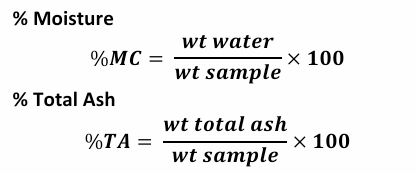
The formula used to calculate percent Moisture Content
a. %MC = wt sample / wt water × 100
b. %MC = wt total ash / wt sample × 100
c. %MC = wt water + wt sample × 100
d. %MC = wt water / wt sample × 100
d. %TA = wt total ash / wt sample × 100
The formula used to calculate percent Total Ash
a. %TA = wt water / wt sample × 100
b. %TA = wt sample / wt total ash × 100
c. %TA = wt total ash + wt sample × 100
d. %TA = wt total ash / wt sample × 100