Waples AP Government Chapter 2
 Call Kai
 Learn
Learn Practice Test
 Spaced Repetition
 Match
Match Flashcards
1/34

There's no tags or description
Looks like no tags are added yet.
Name | Mastery | Learn | Test | Matching | Spaced | Call with Kai | Chat |
|---|
No analytics yet
Send a link to your students to track their progress
35 Terms
Unalienable
A human right based on nature or God

Articles of Confederation
The first constitution of the United States, adopted by Congress in 177 and enacted in 1781. The Articles established a national legislature, the Continental Congress, but most authority rested with state legislatures.
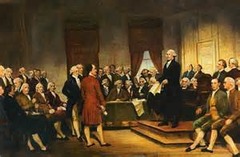
Constitutional Convention
A meeting in Philadelphia in 1787 that produced a new constitution
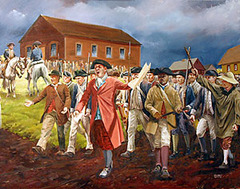
Shays' Rebellion
a series of attacks on courthouses by a small band of farmers led by Revolutionary War Captain Daniel Shay to block foreclosure proceedings
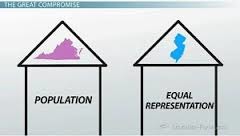
Virginia Plan
Proposal at the Constitutional Convention that called for representation of each sate in congress in proportion to that state's population.
New Jersey Plan
Proposal at the Constitutional Convention that called for equal representation of each state in Congress regardless of the state's population.
Great Compromise (Connecticut Compromise)
Plan to have a popularly elected House based on state population and a state-selected Senate, with two members for each state
Judicial Review
The power of the courts to declare laws unconstitutional
Enumerated Powers
Powers given to the national government alone
Reserved Powers
Powers given to the state governments
Concurrent Powers
Powers shared by the national and state governments
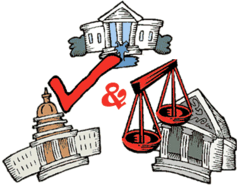
Checks and Balances
Features of the Constitution that limit government's power by requiring that power be balanced among the different governmental institutions. These institutions continually constrain one another's activities.
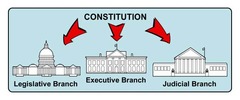
Separation of Powers
a feature of the constitution that requires each of the three branches of government-executive, legislative, judicial-to be relatively independent of others so that one cannot control the others. Power is shared among these three institutions
Faction
Interest groups arising from the unequal distribution of property or wealth

Federalists
Supporters of the U.S. Constitution at the time states were contemplating its adoption. Those who favor a stronger national government and want to ratify the constitution.
Antifederalists
Opponents of the U.S. Constitution. Those who favor a weaker national government and believe the constitution needs individual rights.
Bicameral
legislature comprising of a two house system.
Declaration of Independence
the document approved by representatives of the American colonies in 1776 that stated their grievances against the British monarch and declared their independence.
Natural Rights
rights inherent in human beings, not dependent on governments which include life, liberty, and property.
U.S Consitituion
the document written in 1787 and ratified in 1788 that sets form the institutional structure of the U.S government and the tasks these institutions performed. Replaced the AOC
Writ of habeas corpus
a court order requiring jailers to explain to a judge why they are holding a prisoner in custody.
Republic
a form of government in which the people select representatives to govern them and make laws
Federalists Papers
a collection of 85 articles written by John Jay, James Madison, and Alexander Hamilton under the name of "Publics" to defend the constitution in detail
Bill of Rights
the first 10 amendments to the U.S constitution, drafted in response to some of the Anti-Federalists concerns. The amendments define basic liberties as freedom of religion, speech, press, and guarantee defendant's rights.
Marbury v. Madison
The 1803 case in which chief justice John Marshall and his associates 1st asserted the right of the supreme court to determine the meaning of the U.S constitution. The decisions established the court's power of judicial review over acts of Congress in this case the Judiciary Act 1789.
unicameral
One-house legislature
ex post facto law
a law that makes an act criminal although the act was legal when it was committed
3/5 Compromise
-each slave would count for 3/5 of a person for taxation and representation purposes
Supremacy Clause
Article VI of the Constitution, which makes the Constitution, national laws, and treaties supreme over state laws when the national government is acting within its constitutional limits.
Necessary and Proper Clause
Clause of the Constitution (Article I, Section 8, Clause 3) setting forth the implied powers of Congress. It states that Congress, in addition to its express powers, has the right to make all laws necessary and proper to carry out all powers the Constitution vests in the national government
Amendment
A change to the Constitution
James Madison
"Father of the Constitution," Federalist leader, and fourth President of the United States.
Federalist 10
An essay composed by James Madison which argues that liberty is safest in a large republic because many interests (factions) exist. Such diversity makes tyranny by the majority more difficult since ruling coalitions will always be unstable.
Federalist 51
"Ambition must be made to counteract ambition." But what is government itself but the greatest of all reflections on human nature." If men were angels.... checks and balances. Give the constitutional means and personal motives to resist encroachment of the others. People are the primary check.
Brutus, The Antifederalist, No. 1
Argument against the Federalist Papers, Fed 10, fights for smaller gov't to have control