Ch. 5 Cell Resp. + Met. video 1 of 2
 Call Kai
 Learn
Learn Practice Test
 Spaced Repetition
 Match
Match Flashcards
 Knowt Play
1/136

Earn XP
Description and Tags
40m full run through
Name | Mastery | Learn | Test | Matching | Spaced | Call with Kai | Chat |
|---|
No analytics yet
Send a link to your students to track their progress
137 Terms
What is the main goal of cellular respiration and metabolism?
Making energy for the body in the form of ATP
What is the common pathway for making ATP?
Glucose
Besides glucose, what two molecules can be used to make ATP?
Lipids.
Proteins.
What is metabolism?
All reactions in the body that involve energy transformations.
What are the 2 categories of metabolism?
Catabolism: breaks down molecules, releases energy (exergonic)
Anabolism: builds molecules, requires energy (endergonic)
What does catabolism do?
Breaks down large molecules (like glucose) into smaller ones and releases energy (ATP).
What is the primary source of energy for making ATP?
Catabolism
Is catabolism of glucose exergonic or endergonic?
Exergonic (releases energy)
What does anabolism do?
Builds larger molecules and requires energy
Anabolism is the source of what?
The body's large energy-storage compounds
Is making ATP an anabolic or catabolic reaction?
Anabolic
Are anabolic reactions exergonic or endergonic?
Endergonic (require energy)
Which drives which: catabolism or anabolism?
Catabolism drives anabolism
Where does the energy to make ATP come from?
Energy released from the catabolism (breakdown) of glucose
The complete catabolism of glucose is often called what?
Cellular respiration
Why is it called "respiration"?
Energy is made with oxygen
What is the overall equation for cellular respiration?

What are the 3 products of cellular respiration?
6 CO₂
6 H₂O
ATP
How many ATP does 1 glucose make with oxygen (in this class)?
~38 ATP
Cellular respiration is the opposite of what plant process?
Photosynthesis (6 CO₂ + 6 H₂O → glucose, using the sun)
Where does the glucose used to make ATP initially come from?
The blood
What are the 2 sources of blood glucose?
Digestive system (food).
Breakdown of glycogen in the liver.
What is the only organ that can release glucose back into the blood?
The liver
Can other organs break down glycogen into glucose?
Yes, but only the liver can release that glucose into the blood.
What are the 3 steps of aerobic respiration?
Glycolysis (cytoplasm)
Krebs cycle (mitochondria)
Electron transport chain (Inner mitochondrial membrane)
(Aerobic = making ATP with oxygen).

Where does glycolysis occur? And what does it do?
Cytoplasm
Breaks down glucose into pyruvic acid AKA pyruvate.

Does glycolysis require oxygen?
No
Glycolysis is shared by which 2 pathways?
Aerobic respiration.
Anaerobic metabolism.

If oxygen is present, where does pyruvic acid go after glycolysis?
Into the mitochondria for the Krebs cycle.

Where does the Krebs cycle occur?
Mitochondria
Where does the complete catabolism of glucose take place?
Krebs cycle
What is the main function of the Krebs cycle?
To extract electrons from what remains of glucose
How many ATP does the Krebs cycle make?
2 ATP

Where do the electrons from the Krebs cycle go?
Electron transport chain (ETC)

Where does the ETC occur?
Mitochondria
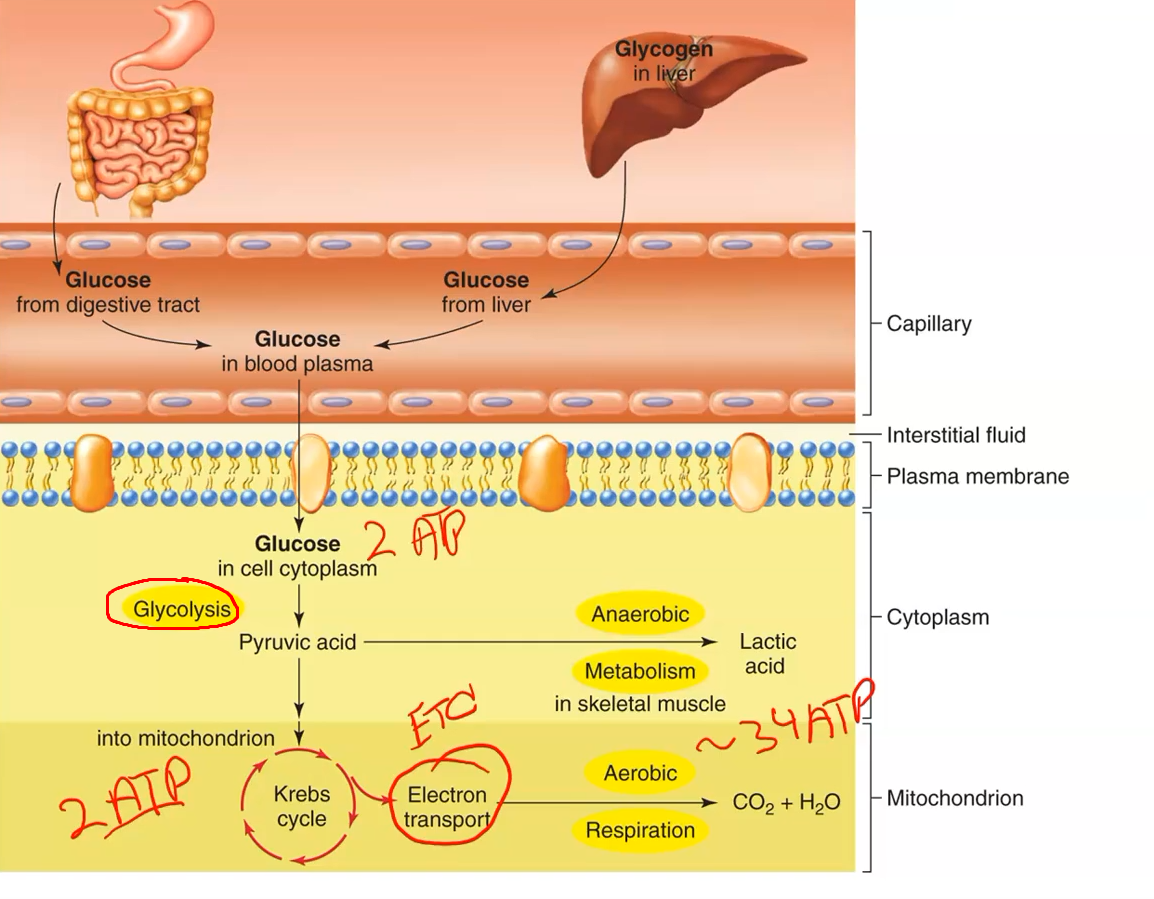
Where is the majority of ATP made?
Electron transport chain
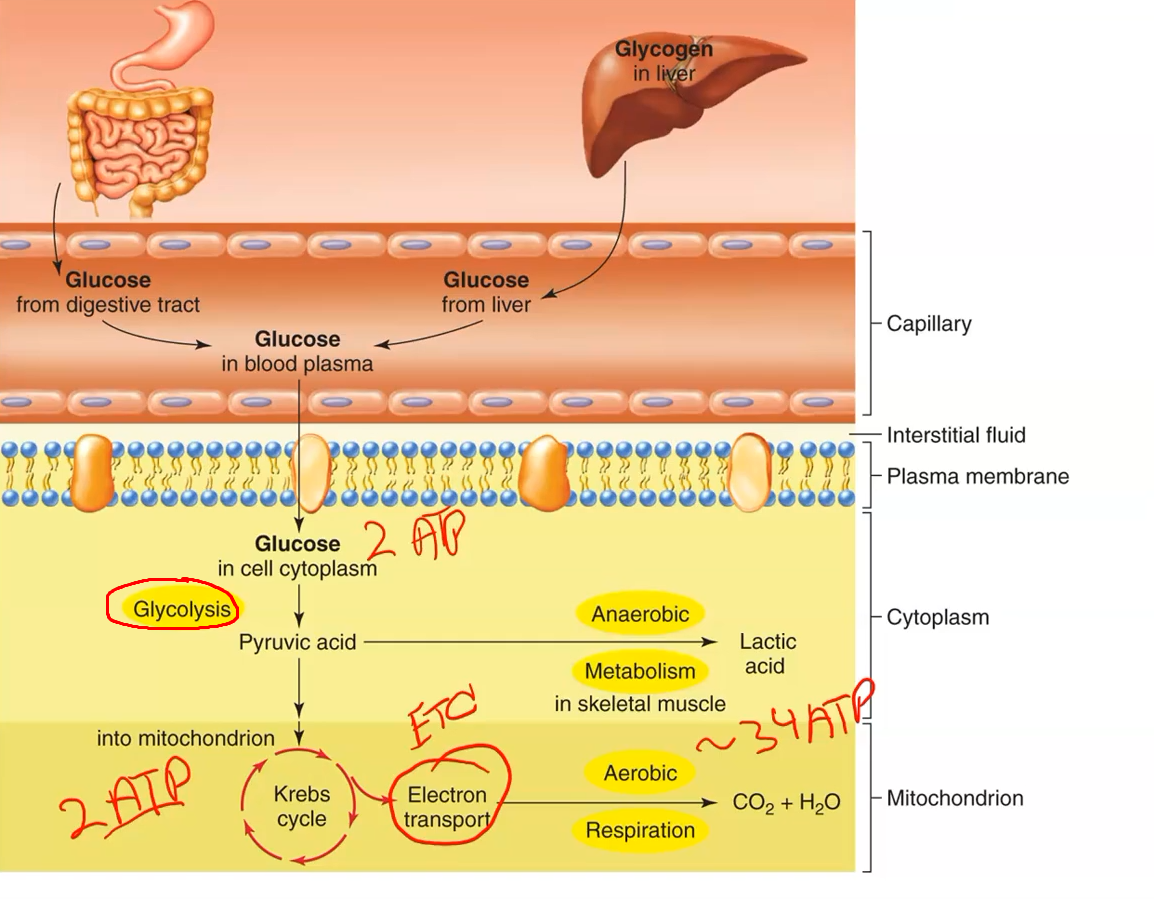
How many ATP does the ETC make?
34 ATP

How do you get 38 total ATP?
Glycolysis: 2
Krebs cycle: 2
ETC: 34

When does anaerobic metabolism happen?
When activity is too high and the body can't bring in enough oxygen
What are the 2 steps of anaerobic metabolism?
Glycolysis (this is both for Anaerobic and Aerobic).
Lactic acid fermentation
(both of these occur in the cytoplasm)
(Making ATP without oxygen)

Why can't pyruvic acid continue to the Krebs cycle without oxygen?
It can't enter the mitochondria
What is pyruvic acid converted into without oxygen?
Lactic acid
What is converting pyruvic acid into lactic acid called?
Lactic acid fermentation - made when there’s no O2 for Pyruvic acid.

How many ATP are made converting pyruvic acid to lactic acid?
ZERO…
you get 2 ATP from glycolysis but nothing from lactic acid
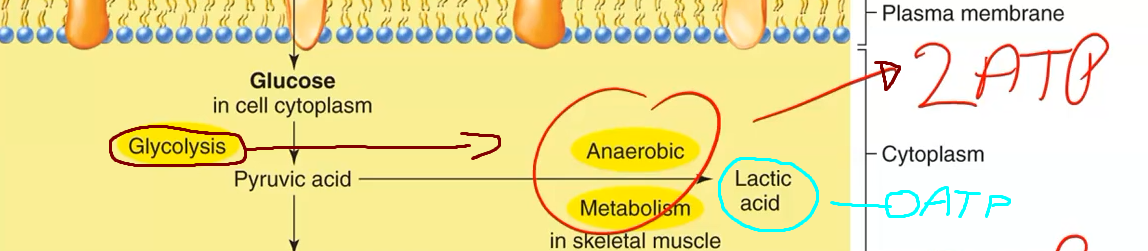
Is it better to make ATP with or without oxygen? Why?
With oxygen, because it makes more ATP (38 vs 2)
Is anaerobic metabolism permanent or temporary?
Temporary
What happens if cells stay in anaerobic metabolism too long?
The cell can die
How is ATP made in glycolysis?
Substrate-level phosphorylation
Glycolysis is done in the cytoplasm

What does "phosphorylation" mean?
Adding a phosphate to something
What is the reaction for substrate-level phosphorylation?
ADP + Pi + energy → ATP (made by an enzyme)

In what form are electrons extracted in biological systems?
Hydrogen atoms
What does NAD & FAD become when it carries electrons?
NADH
FADH2
Which 2 electron carriers are used in the Krebs cycle?
NAD (NADH).
FAD (FADH₂).
Where is CO₂ released for the first time in cellular respiration?
The step between glycolysis and the Krebs cycle, where pyruvate is broken down a little more

What is another name for the Krebs cycle?
Citric acid cycle
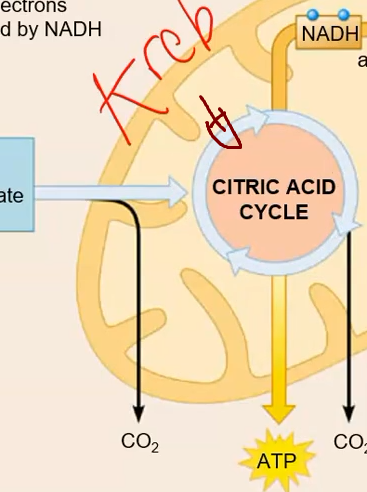
How is ATP made in the Krebs cycle?
Substrate-level phosphorylation
What’s the main purpose of the citric acid cycle (Krebs cycle)
Extract electrons, yes it makes 2 ATP but the main purpose is electron extraction.
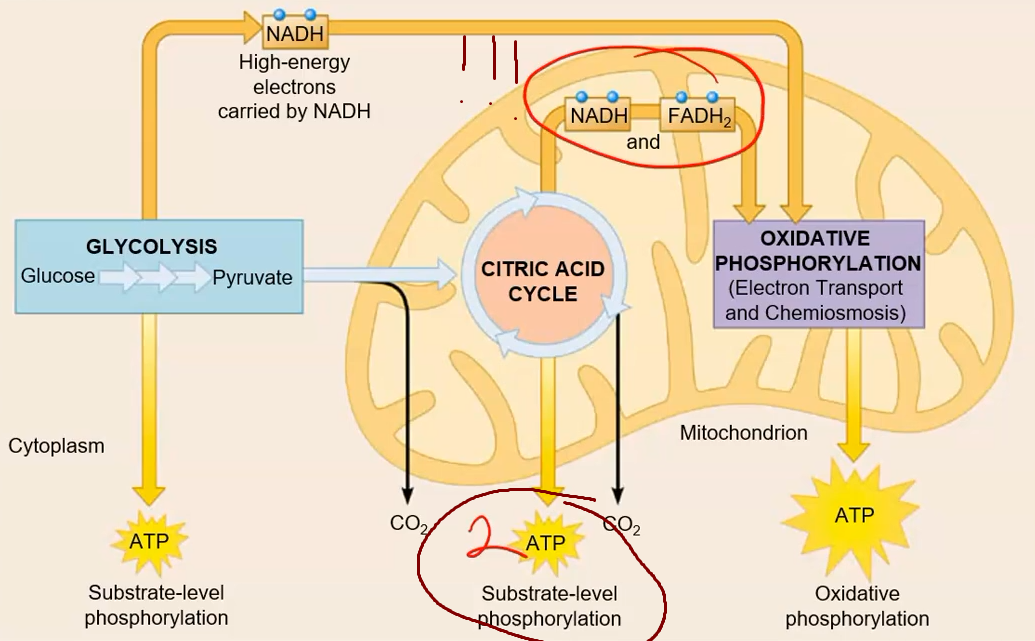
Besides ATP and electrons, what is released in the Krebs cycle?
CO₂
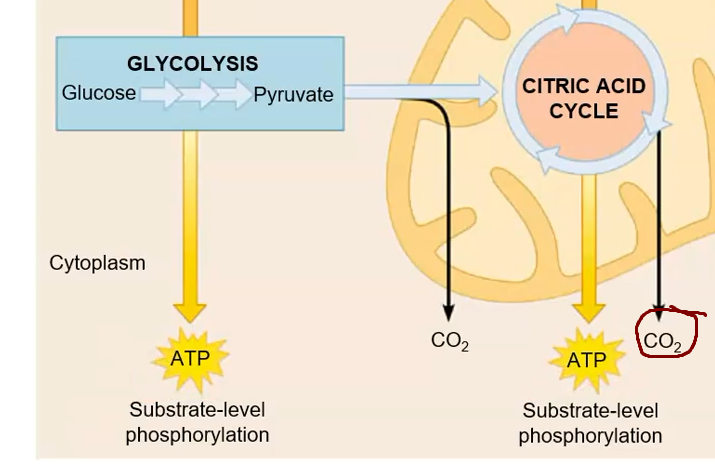
How is ATP made in the ETC?
Oxidative phosphorylation
Done in the mitochondrial membrane (ETC).
Electrons from which steps go into the ETC?
Glycolysis.
Krebs cycle.
If oxygen is low, which step(s) of cellular respiration still occur?
Only glycolysis (no Krebs cycle, no ETC).

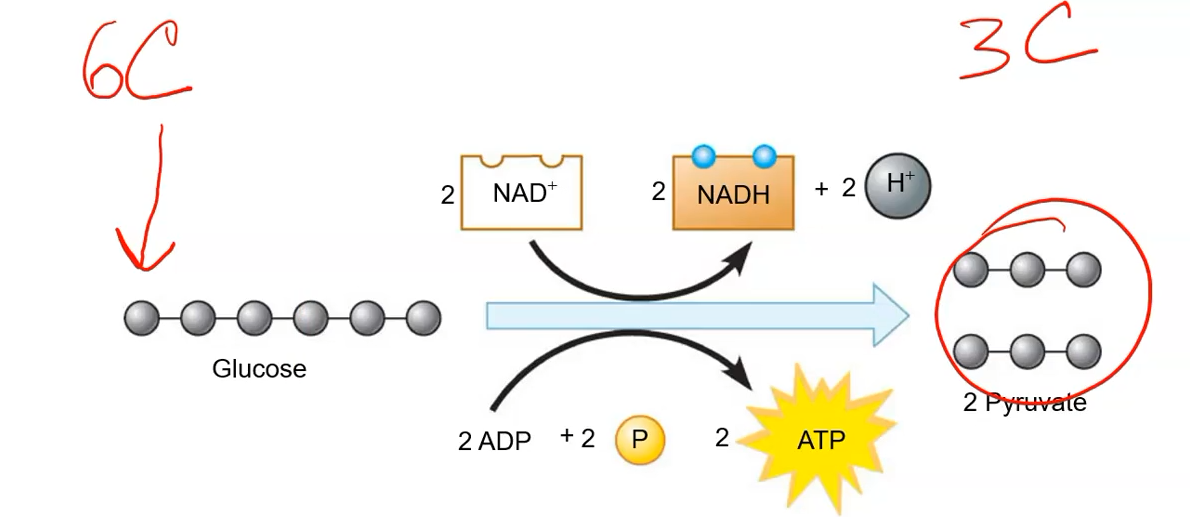
How many pyruvic acids does 1 glucose make in glycolysis?
2
What is the overall net equation for glycolysis?
Glucose + 2NAD + 2ADP + 2Pi → 2 pyruvic acid + 2 NADH + 2 ATP
Glucose → 2 pyruvic acid (6 carbons in glucose become 3, makes two pyruvic).
2NAD → 2NADH.
2ADP + 2Pi → 2 ATP.
FIRST STEP TO BOTH AEROBIC AND ANAEROBIC RESPIRATION
What happens to glucose structurally in glycolysis?
It is split in half into two 3-carbon molecules (pyruvate).
Remember Glucose = C6 H12 O6
Is glycolysis exergonic or endergonic?
Exergonic
How many total ATP are actually made in glycolysis? And how many do we need to START glycolysis?
Made a total of 4. Invested 2 to start the glycolysis process.
But only gained 2 net ATPs.
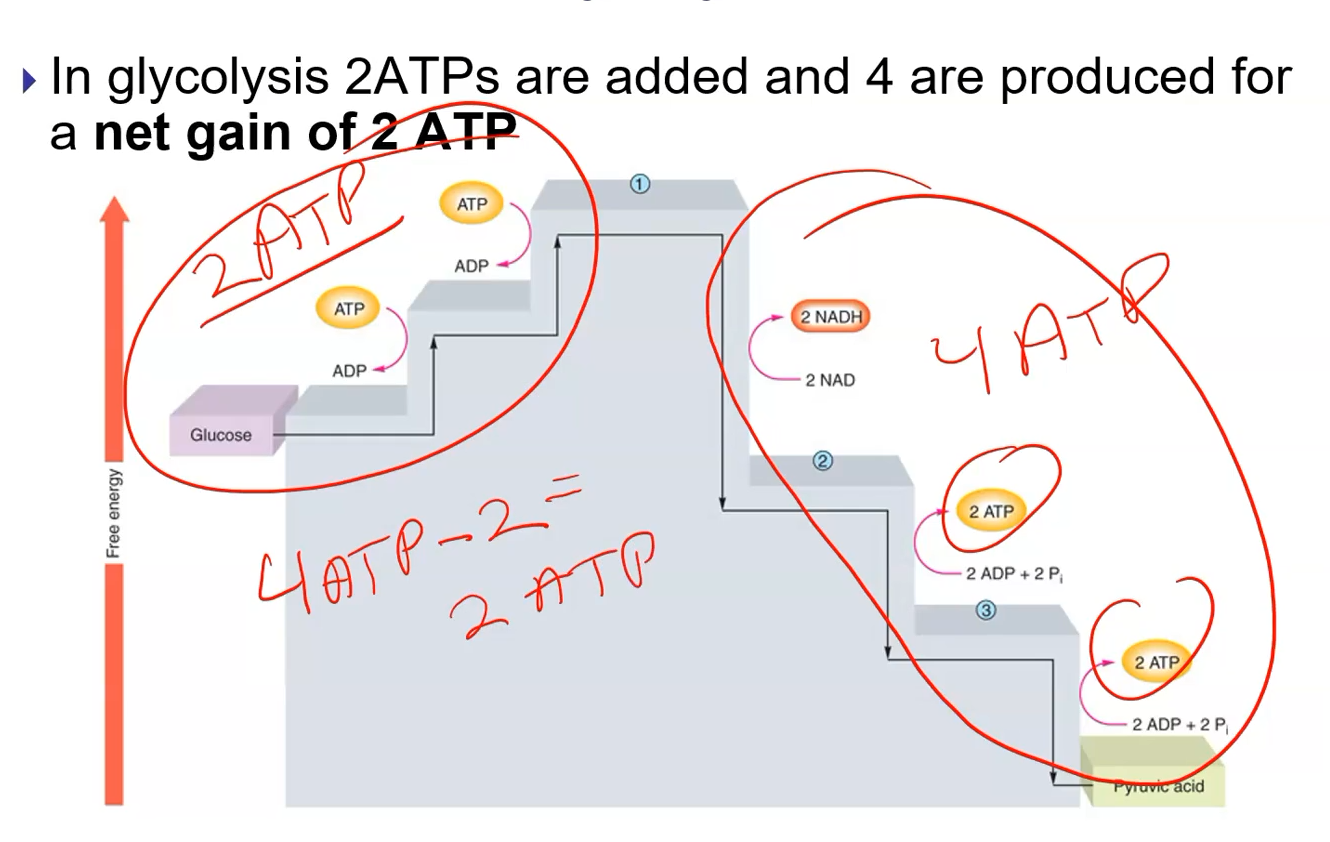
Glucose activation with 2 ATP is what process?
Phosphorylation
What does phosphorylation of glucose do?
Traps glucose inside the cell
What are the 2 phases of glycolysis?
Energy-requiring steps.
Energy-releasing steps.

What happens in the energy-requiring steps?
2 ATP are invested
Where is the first ATP used in glycolysis?
Converting glucose into Glucose 6-phosphate.
When you remove a phosphate from ATP it releases ADP.

What does Glucose 6-phosphate mean?
What is converting glucose into Glucose 6-phosphate called?
It means it was phosphorylated (added a phosphate) to glucose, specifically to carbon atom #6, which is why its called Glucose 6-phosphate.
Glucose trapping, the glucose cannot exit the cell and go back into the blood.
Only the liver has the enzymes to convert it back into glucose.

What happens when you add the 2nd ATP?
Glucose splits into two 3 carbon molecules.

Can glucose 6-phosphate exit the cell?
No
What is the only organ that can dephosphorylate glucose 6-phosphate back into glucose?
The liver
Recall:
Glucose trapping, the glucose cannot exit the cell and go back into the blood.
Only the liver has the enzymes to convert it back into glucose.
In the energy-releasing steps, what is oxidized and what is reduced?
The 3-carbon molecule is oxidized (loses electrons)
NAD is reduced to NADH (gains electrons)
How much NADH and ATP does each 3-carbon molecule make?
Each column: 1 NADH + 2 ATP
Both columns (total): 2 NADH + 4 ATP

In lactic acid fermentation, where do NADH's electrons go?
Back to pyruvate, converting it into lactic acid
In lactic acid fermentation, what is oxidized and what is reduced?
NADH is oxidized to NAD⁺ (gave electrons away).
Pyruvate is reduced to lactatic acid from NADH

Lactic acid fermentation regenerates what?
2 NAD+ so it can be reused in glycolysis

Why must pyruvate be converted into lactic acid without oxygen?
To prevent end product inhibition
How would end product inhibition happen without fermentation?
Pyruvate accumulates and inhibits a step in glycolysis
Therefore, pyruvate MUST be turned into Lactic acid.

What happens to ATP production if end product inhibition shuts down glycolysis?
It drops from 2 ATP to 0
Good review: What is lactic acid fermentation?
When the body lacks O2 it takes a lactic acid fermentation route for anaerobic respiration

What are the 2 ways glycolysis can shut down?
End product inhibition (Enzyme chapter)
Running out of NAD (No more electron transportation)

Why does lactic acid build up in muscles during intense activity?
Muscles run out of oxygen and go into anaerobic metabolism.
What does lactic acid do to muscle pH?
Decreases it (more acidic)
What effect does lactic acid buildup have on muscle?
It can't contract effectively, causing fatigue
What causes muscle soreness after a workout?
Micro tears in the muscle (not lactic acid)
What do yeast make instead of lactic acid when oxygen is low?
Alcohol (ethanol)
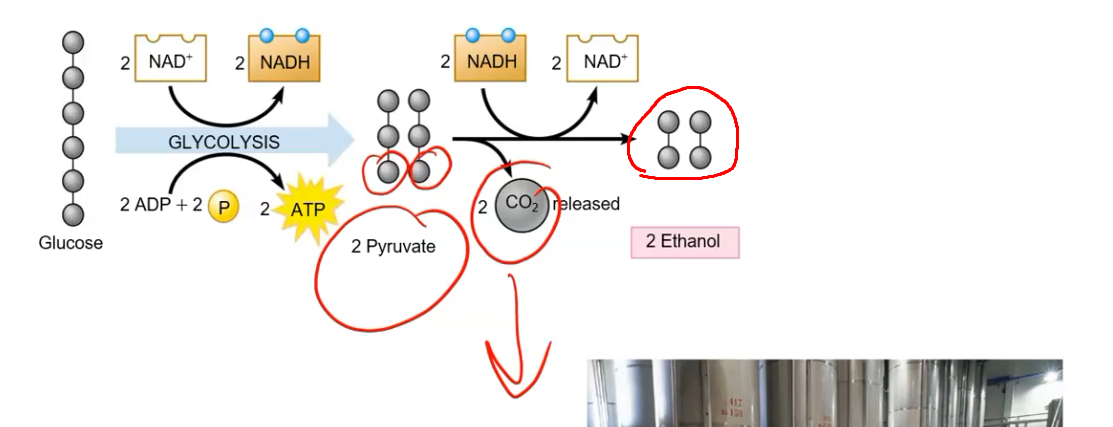
What is converting pyruvate into alcohol called?
Alcohol fermentation
What are the products of alcohol fermentation?
Ethanol
CO₂
NAD⁺ (regenerated)
What is the removal of a carbon as CO₂ called?
Decarboxylation
Why do yeast undergo alcohol fermentation?
To prevent end product inhibition and running out of NAD
In lab, how do we know yeast are doing anaerobic metabolism?
CO₂ bubbles accumulate in the test tubes
What does more CO₂ in the tube mean?
More glycolysis is happening
What does little to no CO₂ in the tube mean?
Glycolysis has decreased or stopped
Why can't cells store many free glucose molecules?
Osmotic reasons (water movement)
What would happen if cells stored lots of free glucose?
The cell becomes hypertonic, water enters, and the cell could lyse (pop)
How do cells store glucose instead?
As glycogen