PHAR 116 Exam 1
 Call Kai
 Learn
Learn Practice Test
 Spaced Repetition
 Match
Match Flashcards
 Knowt Play
1/163

There's no tags or description
Looks like no tags are added yet.
Name | Mastery | Learn | Test | Matching | Spaced | Call with Kai | Chat |
|---|
No analytics yet
Send a link to your students to track their progress
164 Terms
What is the bond angle of the O - H in water, and what is the significance?
104.5 degree angle
creates polarity
What is the O-H bond distance in water?
0.958 Armstrong
A Hydrogen donor group such as __________ are also ____
O - H, N - H, or S - H are also weakly acidic.
A Hydrogen acceptor atom is a _______ such as
Weakly basic, such as O, N, S
What would be the bond strength (kJ mol-1) of O - H, C - H, C - C? What type of bond is it?
Covalent
~400 kJ
What would be the bond strength of COO- and NH3+ and what time of bond is it?
Noncovalent bond, Ionic interaction
~80 kJ * mol
What would be the bond strength of OH and O and what time of bond is it?
van der Waals forces or H bond
20 kJ * mol-1
What would be the bond strength of C=O and C=O? What type of bond is it?
Dipole-Dipole Interaction
~10 kJ*mol
What would be the bond strength of CH3 and CH3? What type of bond is it?
London dispersion forces
0.3 kJ
Solubility
depends on the ability of a SOLVENT to interact with a SOLUTE more strongly than solute participles interact with each other
Water is an excellent solvent for what type of material and why?
hydrophilic material:
polar material (OH)
ionic material (NaCl)
Water is a very poor solvent for what type of naterial?
Hydrophobic materials (oil)
Hydrophobic Effect
tendency of water to minimize its contacts with hydrophobic molecules by aggregating nonpolar molecules in water
delta G
Gibbs free energy change measured in kJ * mol
When delta G is negative then the reaction is…
spontaneous
When delta H is negative….
a bond is formed
When you want a reaction to be spontaneous, what should the values of delta G = delta H. - T(delta S)?
delta H must be negative, and delta S must be positive or higher, so
delta G is negative = spontaneous
Amphiphlies
polar (carboxylate) and nonpolar (akyl grounps CH2) functional groups
Forms a micelle or a bilayer in water
What is the cause of sickled red blood cells?
results from an error, mutation in just one amino acid of hemoglobin
All amino acids derived from protein (except ____) are _____
Glycine, are chiral
All chiral amino acids have
L-stereochemistry
pH
The measure of acidity or basicity of an aqueous solution
The lower the Ph the more acidic the aqueous solution
pKa = -log Ka
Ka is a quantitative measure of the strength of an acid
The lower the pKa the stronger the acid
What is the pKa of a protonated un-ionized carboxylic acid?
pKa ~ 4.5
What is the pKa of a unprotonatec unionized amine?
pka ~ 9
What happens when pH < pKa?
equilibrium shift to Protonated (more H+)
What happens when pH > pka?
equilibrium shift to un-protonated (less H)
Ionized molecules are
more hydrophillic
Un-ionized molecules are more
lipophilic
pH = pKa
50 : 50 (Protonated:De-protonated)
pH = 4.5 vs pka = 5.5
There is a 1 unit difference the percentage of unprotonated and protonated is 90:1
90% un-protonated and 10% protonated
pH = 3.5 vs pka 5.5
There is 2 unit difference. The percentage will be 99 to 1.
99% un-protonated and 1% protonated
glutathione
glutamic acid + cysetine + glycine (GSH)
a major antioxidant in the body, super abundant and the SHORTEST peptide (3 aa)
2 GSH + Xoxidized → GSSG + X reduced
GFP
green fluorescent protein
Ser - Tyr - Gly
absorbs blue light and emits green light
used for gene tracking
Peptide bonds have ____ bonds that create _____ and allows for protein ______.
double, rigidity, bonding
What is the pka of the phenol group in Tyr?
10.5
What is the pka of the SH in Cys
8.37
What is the pka of the amine in proline?
10.6Wh
What is the pka of the CCOH in proline?
1.95
What is the pka of the NH3+ in Lys
10.5
What is the pka of the NH - C - NH2 = NH2+ in Arg
12.5
What is the pka of the N ring in His?
6
NOTE: neutral but protonated in pH 7
What is the pka of the COO- in Asp
3.9
What is the pka of the COO- in Glu
4.07
What is special about the peptide bond in GSG ?
THe peptide bond is formed with the C gamma of glutamic acid, meaning the C of the side chain forms a bond with the C=O of Cysteine
Primary Structure
linear sequence of amino acids in peptide chain
Secondary Structure
local spatial arrangment of polypetide’s backbone atoms without regard to the conformations of its side chains
(e.g. alpha helix, bela sheets, b turns
Tertiary Structure
3D structure of entire polypeptide, including its side chains
If unfolded, theres only type type or 1 peptide chain
Quaternary structure
spatial arrangment of 2 or more polypeptides or subunits
a-Helix
right-handed spiral with side chains facing outwards
How many residues does a helix have per turn?
3.6
What is the distance between each helix rise?
5.4 A
What is the average length of a helix?
12 residues (ie 3 helical turns and a length of 18 A)
What stabilizes the backbones in alpha helices?
H-bonds, from the C=O bond of the nth residue points along the helix axis towards the peptide N-H group of the (n+4)th residue
What wound be the optimum distance for H bonds?
2.8 A
What three possibilities of a residue would break the helix?
bulky side chain next to each other
2 similar charges next to each other, similar amino acids
Proline
B-sheet
contains 2 - 22 polypeptide strands, average od 6 strands
H-bonds between strands
each strand may contian up to 15 residues
What is the average number of residues in a B-sheet and how many residues can it contain?
6 average residues and up to 15
Why are parallel B-sheets containing < 5 strands rare?
The H bond distance is > 2.8 A, so it has weaker stabilization
What connects secondary structure units?
B-bends
What amino acids are commonly found in B-bends
Glycine and proline
T/F Parallel bends have shorter bends
False, because B-bends conencts from N→C terminus and parallel sheets makes the bend longer
What are Supersecondaries?
Structural Motifs, a combination of secondary structures present in tertiary structures
BaB motif
B hairpin
aa motif
Greek key motif
Tertiary Structure
association of a secondary structure units within a single polypeptide chain to give a 3D structure
How are protein structure determined by?
X-ray crystallography: needs crystals HIGHEST resolution
Cryo-EM: no crystals, best for large complexes and multiple conformations
NMR Spectroscopy: solution state, small proteins; shows dynamics and flexibility
Alpha Fold: prediction, not experiment; good starting model, weak on ligand-bound pockets
What type of topology does retinol have?
B-barrel: antiparallel B bends and B-sheets
Domain
a globular cluster of secondary/supersecondary structures
polypeptides with >200 residues
What is the average diameter of a domain and how many residues does it consist?
25 A, 40 to 200 residues
Quaternary Structure
NON-covalent association of 2 or more POLYpeptide chains to form a native protein structure
Disulfide bond (two Cys) is the only covalent bond that occur in quaternary structureTr
Transthyretin
transports Retinol Binding Protein +Vitamin A from the liver to the rest of the body
What drives the binding of retinol binding protein?
hydrophobic effect (want the hydrophobic parts inside and the polar OH head sticking out)
high entropy of water
Hydrogen bonding of OH

What type of secondary structure is this and what protein has this structure?
B-barrel: Retinol Binding Protein
What is the difference between a domain and a subunit?
Domain is part of ONE protein, so when you unfold it you will have one type of polypeptide chain
ex: enzyme with a catalytic domain and a binding domain
ex: Secondary/Supersecondary
Subunit is a separate protein chain that can associate with other polypeptides ex: Hemoglobin has 4 protein subunits
ex: Quaternary Structure
What is the advantages of having Quaternary Structure?
Defects can be repaired by simply only replacing the flawed subunit
Provides structural basis for the regulation of their activities
a-Keratin
Fibrous Protein: has repeating secondary structure
Coiled-coil secondary structure of alpha helices
Rich in Cys residues
What substrate reduces S-S bonds?
Ammonium thioglycolate
What substrate oxdizes to form Hydrogen bonds
Hydrogen peroxide
What is the importance of prolyl hydroxylase?
It is a protein that makes Proline to Hyp, Hyp is used to make collagen fibers
What is the composition of collagen?
Histidine and activated Lysine covalent bond
No Cys-Cys
30% Gly
15-30% Pro and Hyp (PTM of proline with OH)
Scurvy
caused by low ascorbic acid (vitamin C) deficiency which results in poor collagen fibers
- Low activity of Prolyl hydroxylase
- Low amount of Hyp
- weak collagen fibers
What is the average MW of an amino acid?
110 Dalton
What is the average MW of a protein?
(# of amino acids) x 110
Where are nonpolar residues found on a protein?
Val, Leu, Met, Ile, Met, Phe occur mostly in the interior of a protein, out of contact with the aqueous solvent
Where are charged polar residues found a protein?
Arg, His, Lys, Asp, Glu are usually located on the surface of a protein in contact with the aqueous solvent because it wants to interact
Where are noncharged, neutral residues found on a protein?
Ser, Thr, Asn, Gln, and Tyr are usually on the protein surface but also occur in the interior of the molecule (When burried in the protein, these residues are H-bonded to other groups)
ex; catalysis of substrate
What is the major determinant of protein stability?
Hydrophobic Effect
increase in Entropy of water molecules make hydrophobic parts of the amino acid be inside the surface
What is the major determinant of protein structure?
Hydrogen bonds
small difference in hydrogen bonding free energies between the native and unfolded states -2 to 8 kJ mol
Unfolded protein forms hydrogen bonds with water
Which properties have minor contributions to protein stability?
Hydrogen bonds
Ionic interactions: loss of entropy of side chains due to ion-pair formation
If the ionic bond is broken, the enthalpy decreases (delta h), but the deltaS entropy increases because motion from further hydrogen bonds so they somewhat balance each other making the delta G low.
Disulfide bonds are found in
Cross-link extracellular proteins
Found in the blood
They are rare in intracellular proteins because the cytoplasm is a reducing environment, thus will likely break SS bonds by glutathione
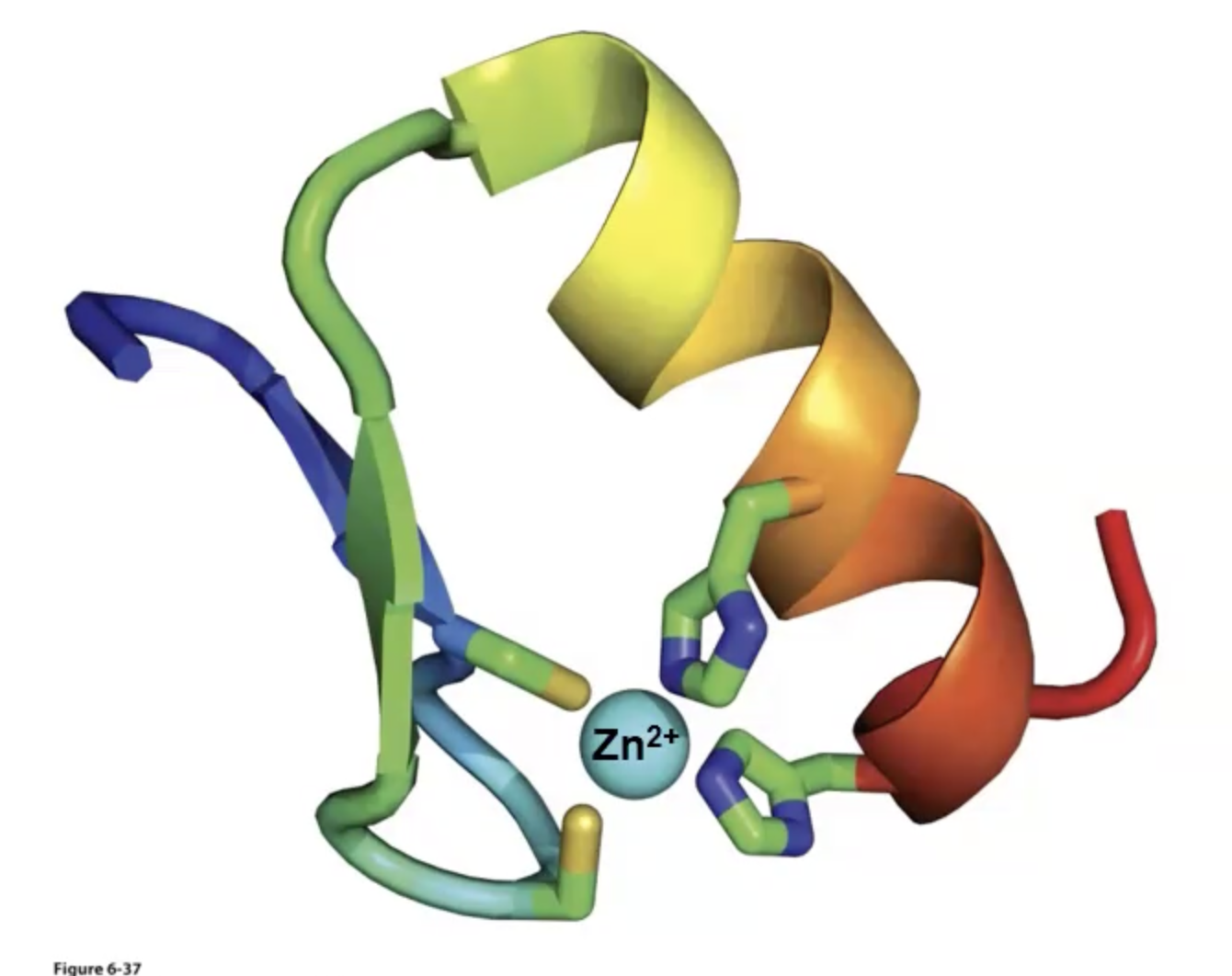
What structure is this? How does it contribute to protein stability?
Zinc finger motif
stabilizes small protein structures
25-60 residues arranged around one or 2 Zn2+ ions on Cys and His
- functions as interaction modules that bind DNA, RNA, proteins
How do proteins denature?
Heat
Acid Base Reactions
Detergents
Reducing Agents
Chaotropic Agents
What is an example of a detergent?
sodium dodecyl sulfate (SDS)
will destroy 3D structures
amphiphillic
What is an example of a reducing agent?
dithiothreitol
B-mercaptoethanol; break Disulfide bonds
What is an example of a chaotropic agent?
urea, guanidinium
increases solubility of nonpolar substances in water
DISRUPTS Hydrogen bonds and hydrophobic interactions
How do you stop PPO activity?
Heat, Reducing pH, Removing Oxygen
What are the conditions of protein renaturing?
The backbone must be intact.
Urea and Mercaptoethanol can break what bonds?
S-S bonds. Remove those two and ADD OXYGEN, protein can renature
What is a molten globule and what force helps it become a tertiary (3) protein structure?
A precursor of tertiary protein structure
Hydrophobic Collapse makes the secondary structures have hydrophobic effect and promotes folding
Molecular Chaperones
assist in the folding of native structure by
covering partly folded proetin and keep them folded
What is the significance of Hsp90?
“Heat shock protein”. An ATPase that uses 2 arms to protect the heat damaged protein to prevent misfolding under increased temp