Audit Final Exam
 Call Kai
 Learn
Learn Practice Test
 Spaced Repetition
 Match
Match Flashcards
 Knowt Play
1/29

There's no tags or description
Looks like no tags are added yet.
Name | Mastery | Learn | Test | Matching | Spaced | Call with Kai | Chat |
|---|
No analytics yet
Send a link to your students to track their progress
30 Terms
When designing audit procedures - auditors can select items for testing by:
Selecting all items (100% examination)
Selecting specific items
Audit sampling
All items appropriate when
Not efficient often
Certain cases it is okay
Population is made up small number of large value items that individually exceed performance materiality
When performing tests of details if the risk of error is expected to be high then 100% or use or large sample size
If auditor plans to use audit data analytics it may be easier to efficiently test entire population for certain attributes or other process
Selecting specific items
High value or key items could individually result in a material misstatement
All items over a specified value
Any unusual or sensitive items or FS disclosure
Any items highly susceptible to misstatement
Items to test control activities (auditor may use judgement to select and examine specific items to determine if a particular control activity is being performed)
Sampling
Representative sample of items from the population
For reaching a conclusion about an entire population (data set) by selecting and examining a representative sample
Stratification of the population
Separates the population into distinct groups of items with similar characteristics
Eg. all large items can be extracted and tested separately and then a representative sample could be taken from the remaining items
Audit sampling
The application of audit procedures to less than 100% of the items in the population
While ensuring all sampling units have a chance of selection
In order to provide a reasonable basis to make a conclusion on the entire population
Sampling
key part of auditor’s risk response
Population
items that make up a class of transactions or an account balance
Representative sampling
sample in which the characteristics in the sample are approx. the same as the population as a whole
Risk of incorrect conclusions are due to
Sampling error → called sampling risk
Risk an auditor reaches an inappropriate conclusion because the sample is not representative of the population
Non sampling error → called nonsampling risk
Risk an auditor makes an incorrect conclusion due to failure to recognize exceptions and/or inappropriate or ineffective audit procedures
Two ways to control sampling risk:
Adjust sample size
Increasing sample size reduces risk (sample of all items of a pop. has zero risk - this is not acc. sampling)
Use an appropriate method of selecting sample items in the population
Audit sampling methods can be divided into two categories:
Statistical sampling → applies mathematical rules so that auditors can quantify (measure) sampling risk in planning the sample (step 1) and evaluating the results
Nonstatistical sampling → auditors use their professional judgement in considering the effect of sampling risk
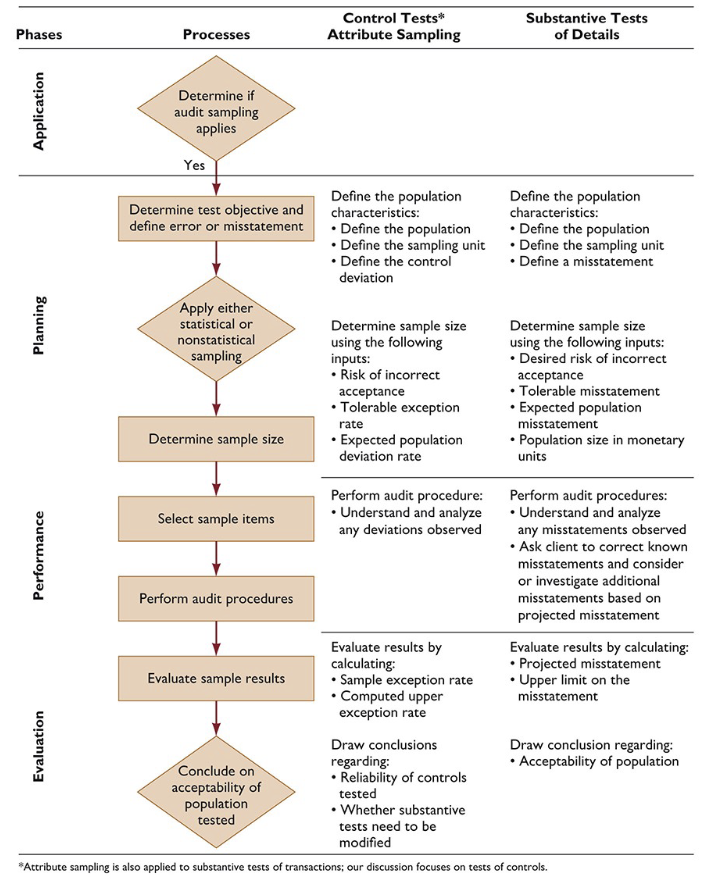
Both categories involve three phases
Step 1: Planning - plan the sample and determine sample size
Step 2: Performance - select the sample and perform the tests
Step 3: Evaluation - evaluate the results and conclude on the acceptability of the population tested
Probabilistic VS Nonprobabilistic Sample Selection
Fall under performance (step 2)
Probabilistic sample selection: the auditor randomly selects items such that each population item has a known probability of being included in the sample
Nonprobabilistic sample selection: the auditor selects sample items using non probabilistic methods that approximate a random sampling approach
Common sample selection methods
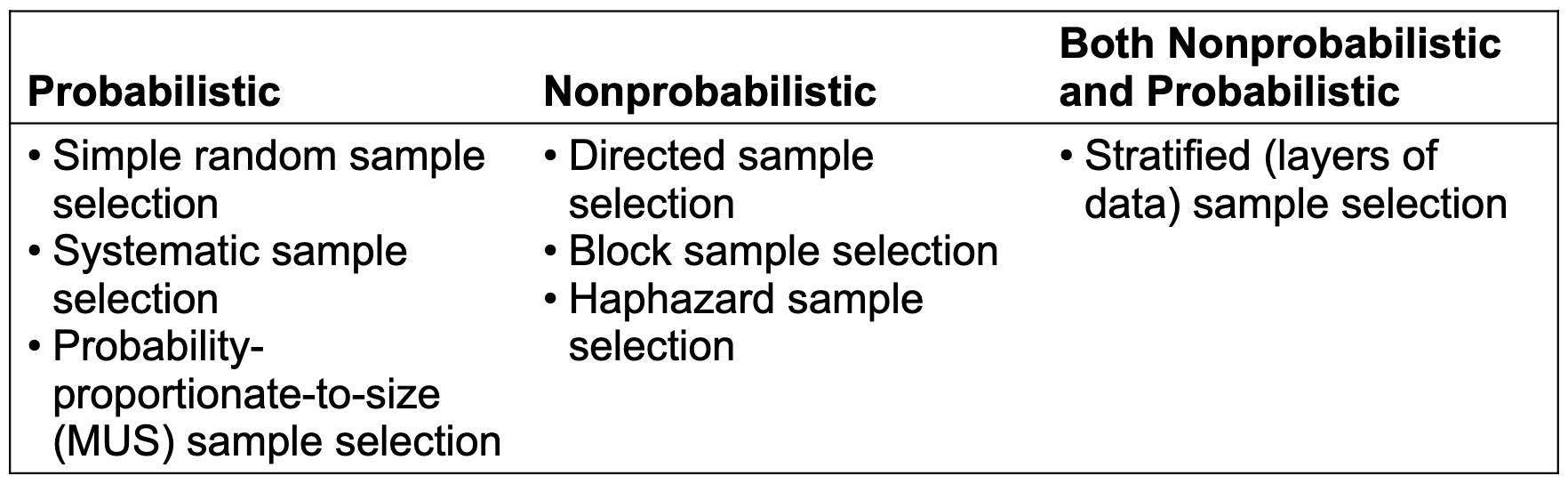
Simple random sample selection:
Simple random sample selection: every possible combo of population items has an equal chance of being selected
Often software is used for random numbers
Systematic sample selection:
Systematic sample selection: auditor calcs an interval and selects the items for the sample based on the size of the interval and a randomly selected number between zero and the sample size
Easy to use
Possibility of bias
Probability proportionate to size sampling or Monetary unit sampling (MUS) or dollar sampling:
modified form of systematic sample selection. Focuses on the individual dollar (or unit of currency. Eg. euro) as the unit of interest.
Directed sample selection:
each item in the sample is selected on the basis of some judgmental criteria
Block sample selection:
auditors select the first item in a block and the remainder of the block is chosen in sequence
Haphazard sample selection:
items chosen without regard to size, source or other distinguishing characteristics
Stratified sampling:
all the elements in the total population are divided into two or more subpopulations that are tested independently
Audit Sampling Process for Tests of Controls and Substantive Tests of Details
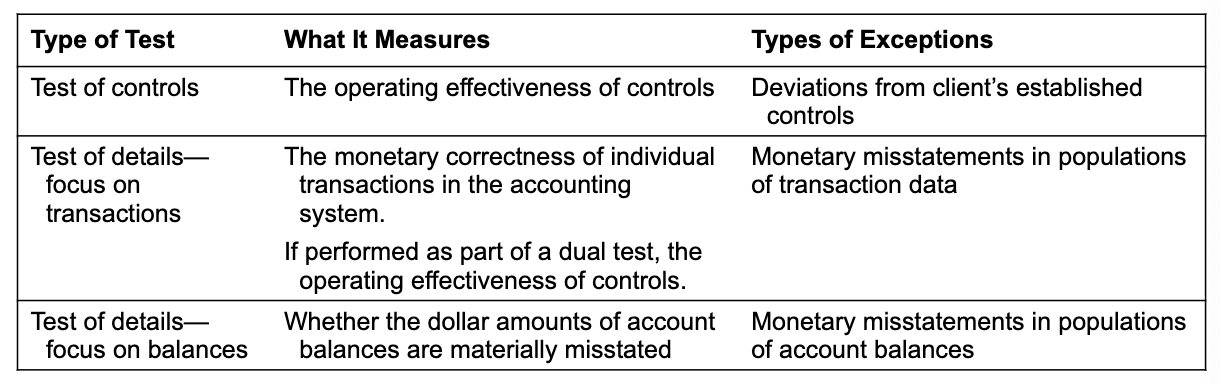
Using Sampling for Tests of Controls
Help conclude if the control is operating as intended
Sampling for exceptions: auditors estimate the percent of items a population containing a characteristic or attribute of interest
Exception: refer to deviation from the client’s control procedure and amounts not monetarily correct
Also use statistical sampling for tests of controls. If used to reach conclusion about exception rate this is called attributes sampling
Nonstatistical sampling for substantive tests
tolerable misstatement
acceptable risk of incorrect acceptance
Tolerable misstatement: application of performance materiality to a particular sampling procedure
Planned sample size increases as the amount of misstatements expected in the population approaches tolerable misstatement
Acceptable risk of incorrect acceptance (ARIA): risk that the auditor is willing to take of accepting a balance as correct when the true misstatement in the balance is greater than tolerable misstatement
Nonstatistical sampling for substantive tests of details: projecting misstatements
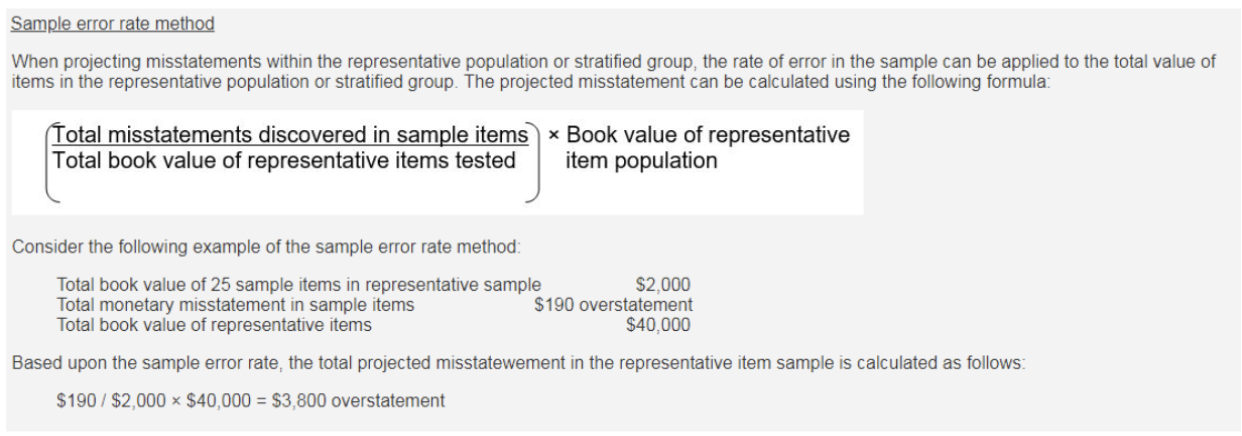
Nonstatistical sampling for substantive tests - eval the results
Eval the sample results: quantitative eval, request client to correct known misstatements, qual assessment
Conclude on acceptability of population
Take no action until tests of other audit areas are complete
Perform expanded audit tests in specific areas
Increase sample size
Adjust the account balance
Refuse to give an unqualified opinion
Steps of Audit Sampling Process
Audit data analytics VS sampling
If using data analytical tools may be more efficient to test entire population for certain attributes/process
ADAs can be used for tests of controls, substantive test, and substantive analytical procedures
Auditor may use ADAs when
There is data that is relevant for the assertion or attribute that is being testing (ADA is most suited for testing accuracy and cut-off assertions)
The data is reliable (if it is from the client, then there are strong controls in place or if it is from an external source, that source is reliable)
The data is accessible and has been scrubbed of errors so it is in a usable format