3 - Effect of temperature on rate of a reaction
 Call Kai
 Learn
Learn Practice Test
 Spaced Repetition
 Match
Match Flashcards
 Knowt Play
1/9

There's no tags or description
Looks like no tags are added yet.
Name | Mastery | Learn | Test | Matching | Spaced | Call with Kai | Chat |
|---|
No analytics yet
Send a link to your students to track their progress
10 Terms
How can the rate of reaction be measured?
Initial rates method: iodine clock reaction
Continuous monitoring method: measuring the volume of gas produced in a reaction over time
Why does the rate of reaction increase with increasing temperature?
As temperature increases, the kinetic energy of the molecules also increases, meaning more molecules have energy greater than or equal to the activation energy, so can react
As the kinetic energy of the molecules increases, their velocities increase, resulting in more frequent & successful collisions

How would you investigate how rate of this reaction varies with temperature?
This reaction produces a cloudy sulfur precipitate:
time how long it takes for a cross underneath a test tube to disappear, using a stopwatch
repeat this at 5 different temperatures & compare times taken
What are some issues with the continuous monitoring method?
The disappearing cross is judged by the human eye, therefore can be unreliable
There may be a delayed reaction time with the stopwatch
At low temperatures, the reaction may be too slow
There may not be enough precipitate for the cross to disappear
How could the data be analysed for this practical?
For a graph of the amount of sulfur against time, it would be a straight line initially, as the reaction has only just begun
Therefore, the gradient of this straight section = rate of reaction
Compare the rate of reaction for each temperature (for further analysis, plot a graph of rate of reaction against temperature)
What is a control variable?
A variable that is kept constant throughout the experiment
In an experiment investigating the effect of temperature on rate of reaction, what are the control variables?
Concentrations/volumes of the reactants & products
Use the same test tubes & cross
Use the same person to decide when the cross has disappeared
How can a substance be kept at a constant temperature?
Using a thermostatically controlled water bath
What is the method for this practical?
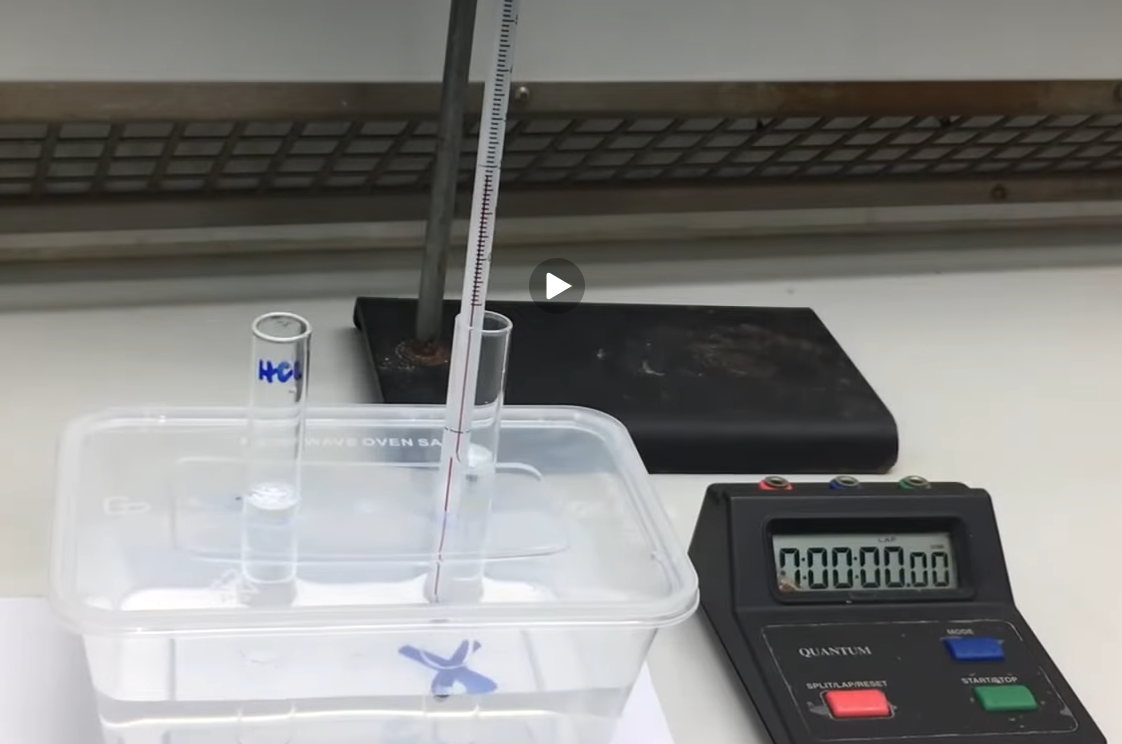
Add 10cm of 1.00 moldm-3 HCl to the ‘acid’ tube & place this tube into the hole of the plastic container, without the cross under it
Use a measuring cylinder to add 10cm of 0.05 moldm-3 of sodium thiosulfate solution to the second tube. Place this tube into the hole of the plastic container with the cross under it & carefully place a thermometer in this tube. Leave both test tubes for 3 minutes to equilibrate
Record the start temperature & then add 1cm of HCl to the thiosulfate solution & start timing
Look down through the tube from above & record the time for the cross to disappear
Record the final temperature of the reaction mixture, then pour the cloudy contents of the tube into a sodium carbonate solution (prevents any toxic SO2 gas being produced)
Add water from a kettle to the plastic container (no hotter than 55°C). Add cold water if necessary
Measure another 10cm of 0.05moldm-3 sodium thiosulfate into a clean test tube & insert into the correct hole in the plastic container. Leave the tubes to equilibrate to 3 minutes
Repeat to obtain results for at least 5 different temperatures
What are some safety precautions to be aware about?
To minimise the escape of toxic SO2 gas, use a lid (two holes should be made using a hot, wide cork borer)
could also perform the experiment in a fume cupboard or well-ventilated room
Wear gloves & safety goggles, as HCl can cause skin burns & eye damage (irritant)