Statistics of Life Sciences: Exam 1 Definitions
 Call Kai
 Learn
Learn Practice Test
 Spaced Repetition
 Match
Match Flashcards
 Knowt Play
1/13

There's no tags or description
Looks like no tags are added yet.
Name | Mastery | Learn | Test | Matching | Spaced | Call with Kai | Chat |
|---|
No analytics yet
Send a link to your students to track their progress
14 Terms
What sample says every member of the population is equally likely to be selected.
Simple Random Sample (SRS)
What are 3 additional properties of Simple Random Sample (SRS)
members chosen are independent of each other
every possible sample size n has an equal probability of being selected
it is the foundation of most other sampling methods
Is grabbing whoever is in reach valid?
No, this is convenience bias
A SRS of clusters is selected, and every subject within the selected clusters is included in the sample
Random Cluster Sampling
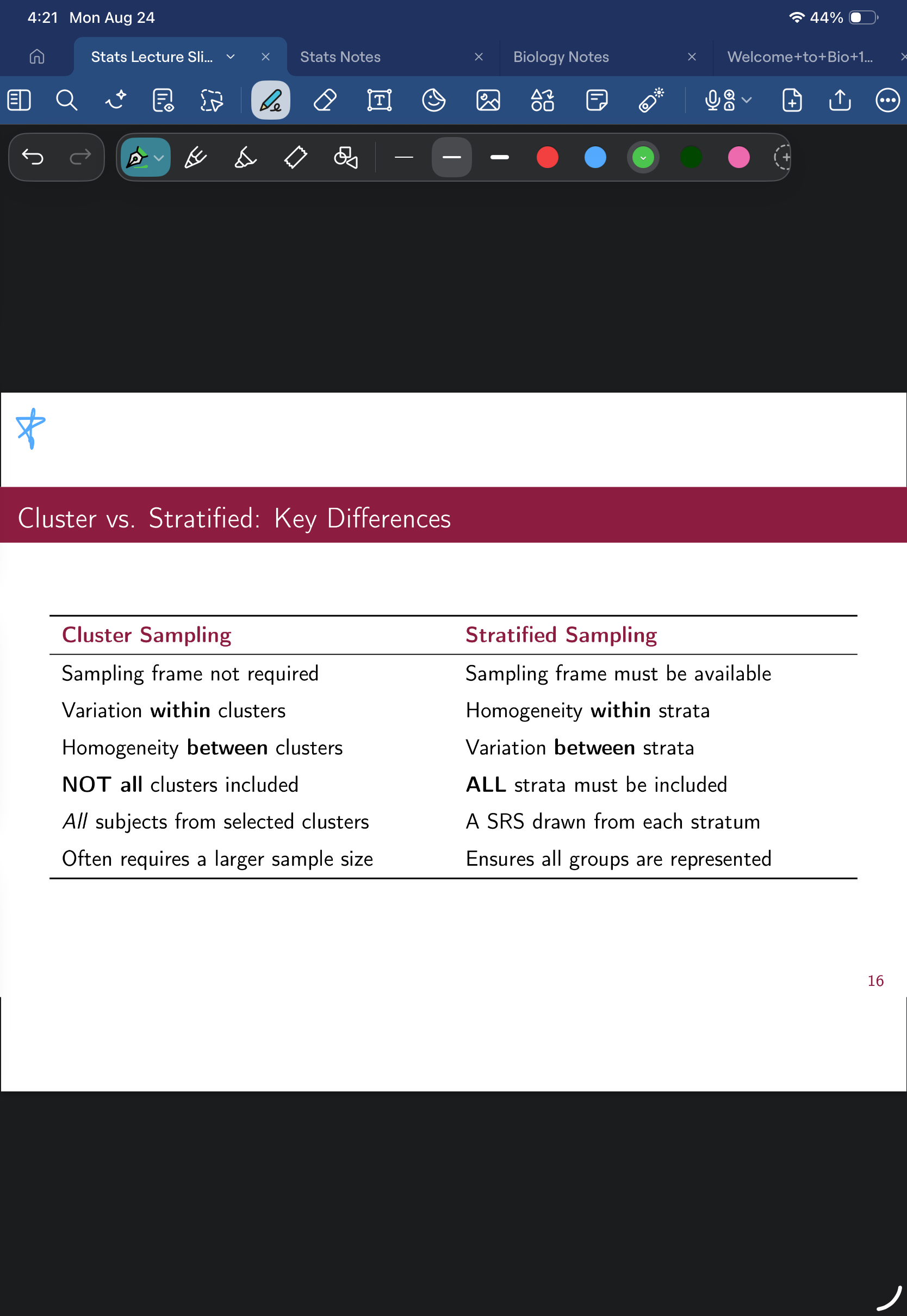
How are stratified sample and random cluster sampling different.
Stratified - All strata must be included; variation between strata, homogeneity within strata
Random - Not all clusters are included, but all subjects within a cluster are included; variation within cluster, homogeneity between clusters
The population is divided into groups sharing a common characteristic, then a separate SRS is drawn from each group.
Stratified Random Sampling
What are 3 properties of Stratified Random Sampling?
members within a strata are similar
members across strata are different
all strata must be represented
Proportional Allocation
Each stratum contributes to the sample in proportion to its share of the population
Sampling Error
the natural discrepancy between true value and estimate/sampled value (decreases as sample size increases)
Sampling Bias
systematic tendency to favor certain subjects over others regardless of sample size (must be designed out)
What form of bias is it when a portion of the population is underrepresented in the sample?
Undercoverage Bias
What bias is it when the individuals themselves decide whether or not to be in the sample? How do you eliminate it?
Self-Selection Bias; randomly select individuals (do not ask for volunteers)
What bias if it when researches select individuals, but some do not participate because they are unwilling or unable to do so? How do you reduce it?
Nonresponse Bias; obtain a larger sample size
What bias is it when the responses do not reflect the true feelings of the individuals in the sample? How do you reduce it?
Response Bias; contract phrasing carefully and randomize the order of the questions