Work, Energy, and Power
 Call Kai
 Learn
Learn Practice Test
 Spaced Repetition
 Match
Match Flashcards
 Knowt Play
1/13

There's no tags or description
Looks like no tags are added yet.
Name | Mastery | Learn | Test | Matching | Spaced | Call with Kai | Chat |
|---|
No analytics yet
Send a link to your students to track their progress
14 Terms
the work done on a body by a single external force F is defined by the equation
dW = F * dr
If n external forces are acting on an object simultaneously, the net work is
dW = Fnet * dr
The net work is equal to the algebraic sum of
the work done by each individual force. (A * B + C * B = (A+C) * B
Another equation for work due to multiple forces

TO calculate the net work done by multiple forces, you have two options
calculate the work done by each force and sum these individual works
calculate the net force and compute the work done by the net force using the equation dW = Fnet * dr
Work and energy have units of
newton * meter, or a joule
kg*m²/s²B
Work is a scalar whose magnitude and sign
are determined by the component of the net force parallel to the direction of motion
the displacement vector dr is parallel to the
velocity
work is negative when
the force has a component antiparallel to the displacement vector dr and thus antiparallel to the velocity.
tangential acceleration causes the object’s speed to decrease
When work is zero,
the force has no c opponent parallel or the displacement vector dr
no component parallel to the velocity
no tangential acceleration
speed does not change
When work is positive,
The force has a component parallel to the displacement vector dr and the velocity
tangential acceleration parallel to velocity
increases object’s speed
For constant forces, we can evaluate the work integral
W = F * Δr
work due to a constant net force
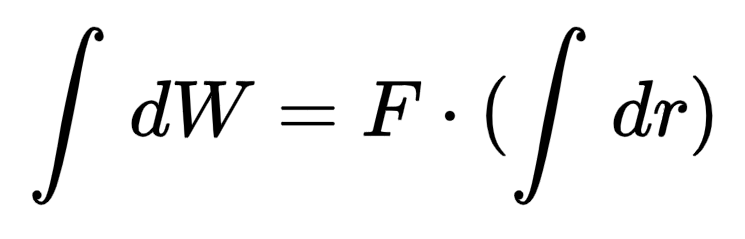
For 1D motion, work equals
W = ∫ Fx dx
work = area underneath Fx(x) curve
kinetic energy equation
KE = mv²/2
similar to work and other forms of energy, KE has units of joules