Human Phys: Chapter 8: Hormones - draft 1
 Call Kai
 Learn
Learn Practice Test
 Spaced Repetition
 Match
Match Flashcards
 Knowt Play
1/22

There's no tags or description
Looks like no tags are added yet.
Name | Mastery | Learn | Test | Matching | Spaced | Call with Kai | Chat |
|---|
No analytics yet
Send a link to your students to track their progress
23 Terms
What is a hormone?
A hormone is a chemical messenger.
the four big criteria of a hormone are:
Made and secreted by a cell or group of cells
Secreted into the blood
Travels to a distant target
Works at a very low concentration
And most importantly:
The target cell must have the right receptor.
What do hormones control?
Hormones are especially important for long-term body functions like:
metabolism
temperature regulation
water balance
ion balance
reproduction
growth
development
They can also cause faster responses depending on the hormone.
How can a hormone change a cell?
(There are 3 basic ways:)
A. Change enzyme activity
B. Change membrane transport
C. Change gene expression
ETG: Enzymes — Transport — Genes
A. Change enzyme activity
The hormone makes certain chemical reactions happen faster or slower.
B. Change membrane transport
The hormone changes what ions or molecules can enter or leave the cell.
Example idea:
glucose entering a cell
C. Change gene expression
The hormone changes which genes are being used.
Endocrine
Travels through blood to a distant target

Endo = distant
Paracrine
Acts on nearby cells

Para = neighbor
Autocrine
Acts back on the same cell that secreted it
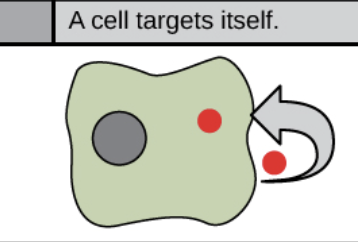
Auto = self
Neurohormone
a hormone made by a neuron
So it is basically a nerve cell sending a chemical message into the blood.
Ectohormone
An ectohormone is a chemical signal released outside the body.
instead of sending a message inside your body, you send it into the outside world.
Pheromone
A pheromone is a type of ectohormone that affects another member of the same species.
Example:
Ants leave a chemical trail that basically says:
“Food is this way.”
Other ants smell it and follow.
That is a pheromone.
Hormones work in tiny amounts
Hormones are powerful because you do not need much of them.
Even a tiny amount can cause a big effect.
Think of food coloring:
One little drop can change a whole glass of water.
Hormones are kind of like that.
Hormones need receptors
A hormone only works if the target cell has the right receptor.
Best example:
hormone = key
receptor = lock
If the key does not fit the lock, nothing happens.
So even if a hormone reaches lots of cells, only the cells with the correct receptor respond.
One hormone can do different things in different cells
The same hormone can cause different effects depending on the cell.
Think of one teacher saying:
“Get ready.”
A basketball player might grab a ball.
A student might grab a notebook.
Same message, different response.
That is what can happen with hormones.
The cell's response depends on what kind of receptors and machinery it has.
Insulin example
Insulin does not do exactly the same thing everywhere.
In some tissues, it helps change:
glucose transport
glucose metabolism
In other tissues, it mainly changes enzyme activity.
The big point is:
Same hormone does not always mean same effect.
Cellular mechanism of action
What happens inside the cell after the hormone binds to its receptor.
So:
Hormone binds receptor → cell does something
That “something” is the mechanism of action.
Candidate hormone
A candidate hormone is basically:
“We think this might be a hormone, but we are not 100% sure yet.”
It has not met every rule clearly enough.
Growth factors
Growth factors help cells:
grow
divide
But many work only on nearby cells, so they do not always fit the classic hormone definition.
Think:
They act more like local messages than long-distance messages.
Cytokines
Cytokines are also chemical messengers.
They can act a lot like hormones, but scientists usually put them in a different group.
The main point from your textbook:
The line between “hormone” and “other chemical messenger” is sometimes blurry.
Berthold rooster experiment
This is basically the first big proof that glands can send messages through the blood.
He removed the roosters' testes.
The roosters became:
less aggressive
less sexual
had smaller combs
Then he put testes back in.
Those traits came back.
The important part:
The testes were not connected to nerves.
So the testes had to be releasing something into the blood.
That “something” was a hormone-type signal.