PSYC 102 Textbook (Ch 8, 11)
 Call Kai
 Learn
Learn Practice Test
 Spaced Repetition
 Match
Match Flashcards
 Knowt Play
1/226

Earn XP
Description and Tags
Ch 8, 11
Name | Mastery | Learn | Test | Matching | Spaced | Call with Kai |
|---|
No analytics yet
Send a link to your students to track their progress
227 Terms
Cognition
All mental activities associated with thinking (such as knowing, remembering, solving problems, making judgements & decisions, and communicating)
Cognitive psychology
Study of mental activities and how they work
Mental representations
Internal mental symbols that stand for some object, event, or state of affairs int he world
Why are mental representations useful?
Allow people to think about things even when those things are absent
E.g. Don’t have to look at your lunch or a good friend to think about those things . . . humans even have mental representations for things that only exist in imagination, like unicorns or aliens
Concepts
Mental categories that group similar objects, events, ideas, or people (essentially, concepts = mind’s way of organizing mental representations)
e.g. most people have a concept of “chair” - this includes many sorts of chairs they encounter, such as office chairs, dining chairs, high chairs, rocking chairs, etc. . .
Why are concepts important?
Allow us to use prior experiences to understand and react to new things we encounter
e.g. You encounter an unusual green substance for the first time. If you are told that the new substance is food, you can immediately draw on your prior experiences with other types of food to predict that the substance is edible and that it should be put into your mouth rather than smeared into your hair
Do concepts need boundaries?
Yes; to be useful, concepts need to have boundaries that help you determine whether something does or does not fit within the concept
family resemblance structure (part of concept)
some members of the same biological family can look alike, even though they don’t have all the same features in common
e.g. one child has a similar nose and chin as their father, and a second child has the father’s nose but mother’s chin. . . they look different, but still like a family
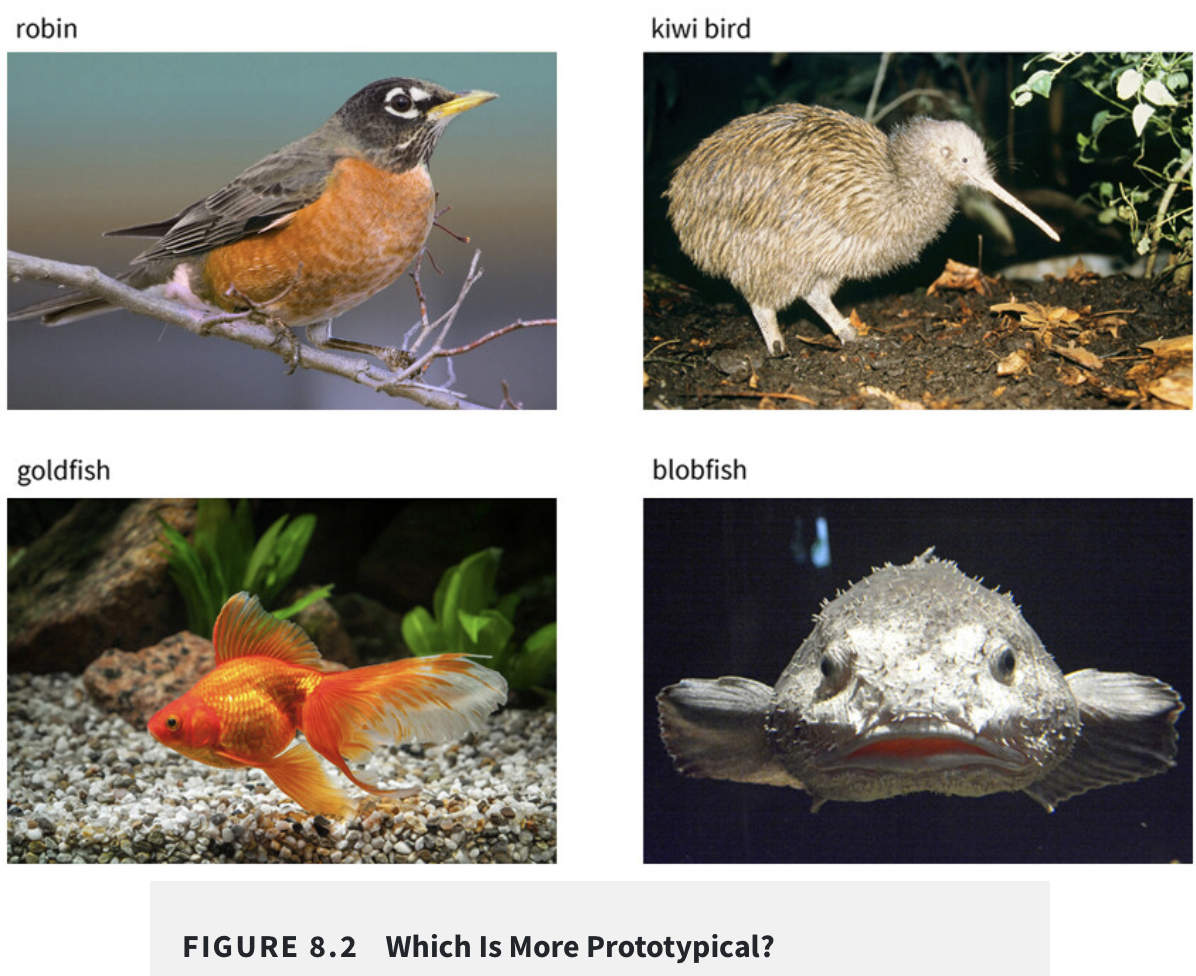
prototype
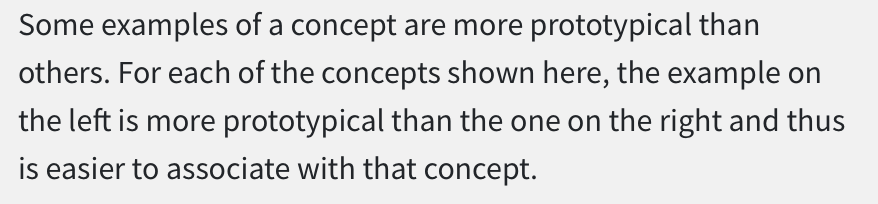
a best example or average member that incorporates more of the features most commonly associated with it; the closer something is to the prototype of a concept, the more quickly people can identify it with that concept
things that are more different from a prototype can be challenging to identify:
e.g. children struggle to recognize dolphins as fish or mammals, or whether tomatoes are fruits or vegetables
hierarchies (definition + names)
= levels that the mind organizes concepts into
superordinate —> basic-level —> subordinate
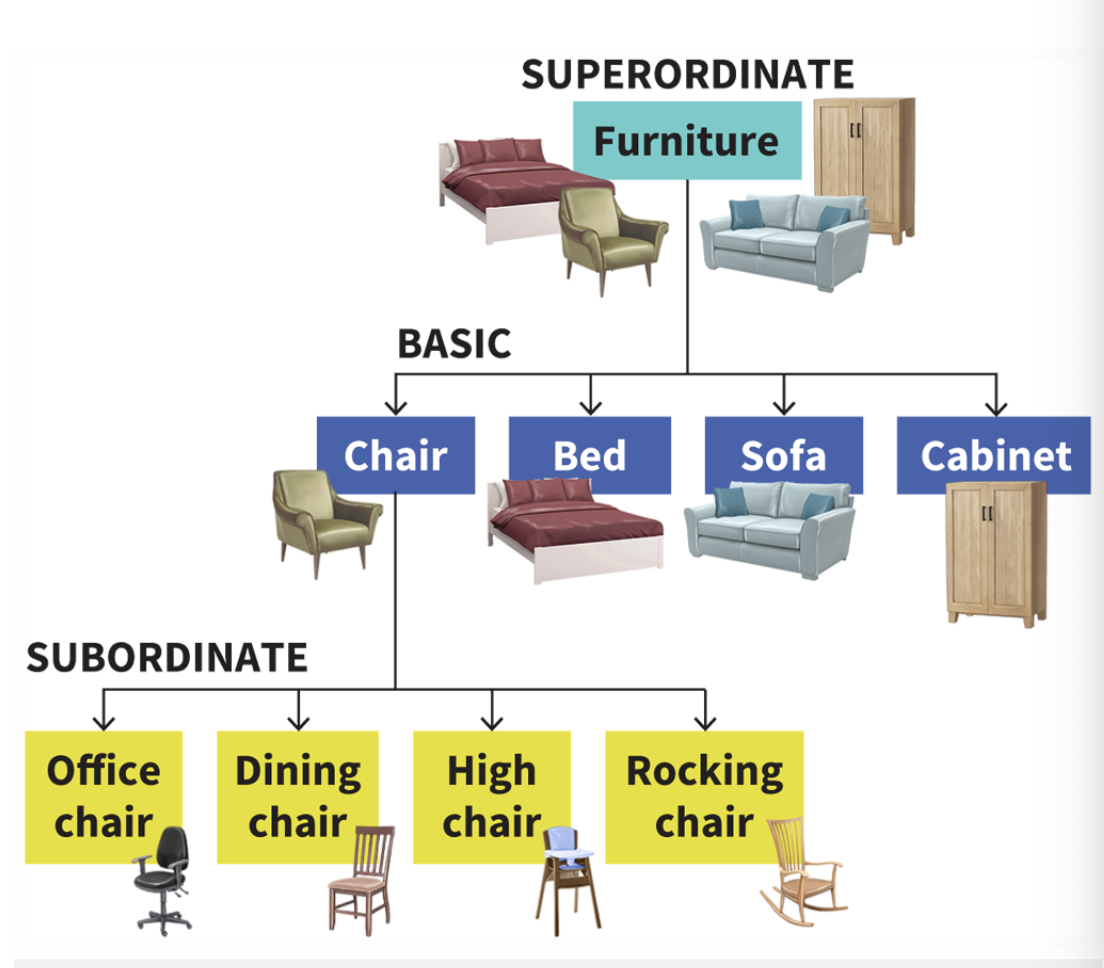
Basic-level concept (of hierarchies) + examples
broad or abstract enough to include a lot of members (like how there are more chairs than rocking chairs), yet their members still have a lot of features in common (such as similar parts, movements, functions, and shapes)
members of basic-level concepts share a striking family resemblance and have clearly defined prototypes
e.g. chair, apple, bird
superordinate concept (of hierarchies) + examples
far fewer features in common and a looser family resemblance
e.g. furniture, fruit, animal
subordinate concept (of hierarchies) + examples
the most specific concept level in concept hierarchies
e.g. rocking chair, Granny Smith apple, hummingbird
which concept level in the concept hierarchy is most easily learned by children and is usually the first that come to mind when people see objects?
basic-level concepts
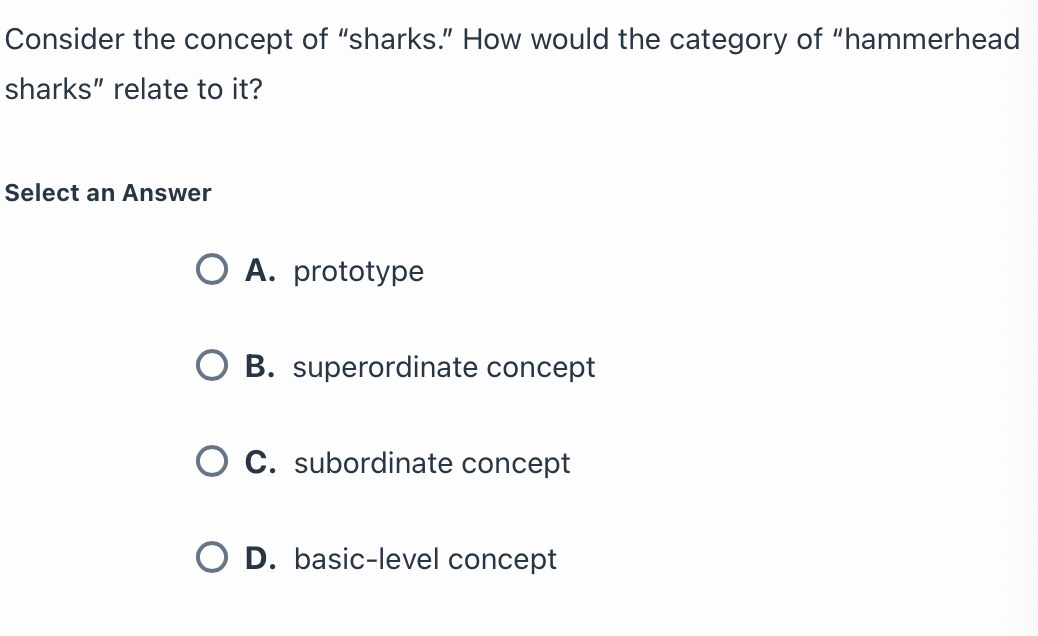
C). Subordinate concept
Hammerheads are a specific kind of shark with distinctive features but clearly subordinate to (i.e., a subset of) the concept of sharks generally.
well-defined problems
have a cleat goal and clear set of available options to reach that goal
e.g. anagram problems (rearranging letters to make a word)
ill-defined problems + how to solve
hazy goals and indistinct paths to reach them
e.g. solving climate crisis, finding job for next summer
solution: people often spend time trying to define the goal better, perhaps by adding extra constraints and assumptions
e.g. perhaps you want your summer job to be outdoors, but you also need a certain amount of money
trial and error
trying actions or strategies at random until finding something that works
algorithms
a step-by-step procedure that guarantees a solution
e.g. using algorithms to get the ATM PIN that we forgot, rather than trying all possible 4 digit number combos randomly
insight
sudden, conscious change in a person’a understanding of some situation or problem
subliminal
any sensory stimulus that falls below the absolute threshold of conscious awareness
e.g. flashing subliminal words on the screen just Long enough for participant’s brain to process some of the meaning of the words but too quickly for participants to consciously report what they saw
did seeing subliminal words before solving anagrams help participants?
Yes; when participants saw subliminal hints before an anagram task, they (a) solved the anagrams faster and (b) experienced more feelings of insight.
how does mood affect insight?
good mood = more insight
before solving a problem ANALYTICALLY, which part of the brain did participants show more activity in?
visual cortex
before solving a problem WITH INSIGHT, which part of the brain did participants show more activity in?
temporal lobes & anterior cingulate cortex
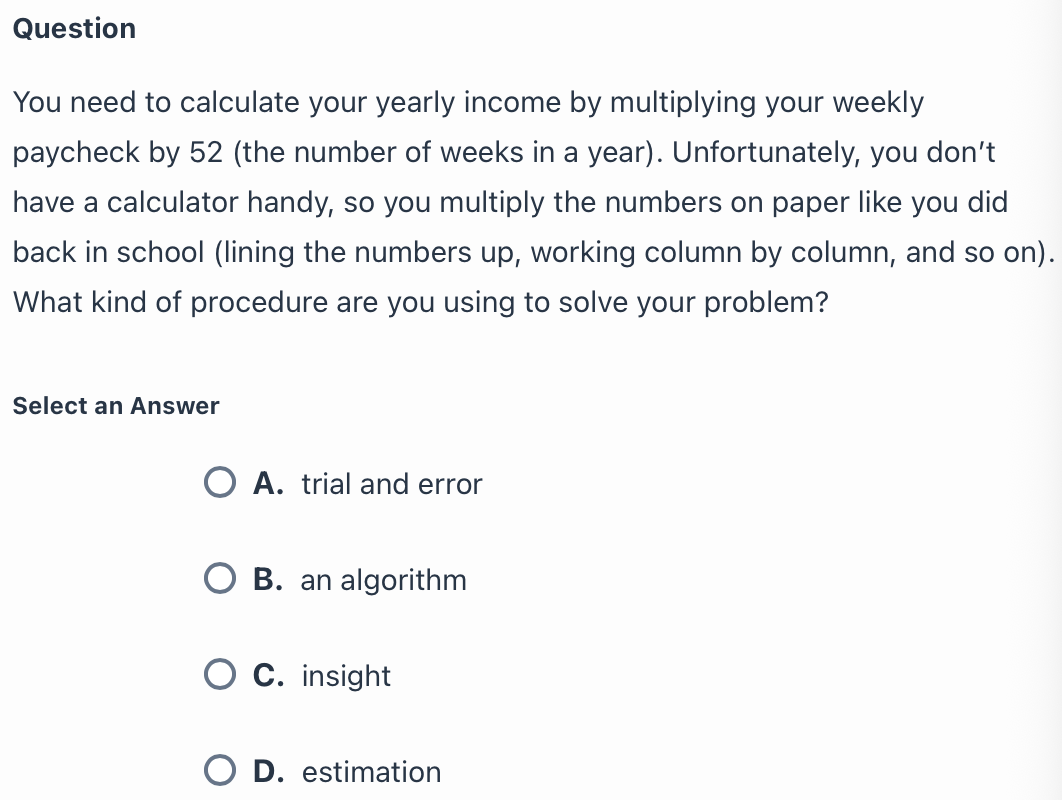
B) algorithm
The procedure used to multiply numbers by hand is an algorithm because it has a clear, step-by-step structure and is guaranteed to yield an answer.
mental set
mental framework for how to solve a problem based on prior experience with similar problems
functional fixedness
tendency to focus on an object’s typical functions and thus fail to recognize unusual functions that could solve a problem
e.g. Imagine you couldn’t find a hammer to use to hang a picture on the wall. Instead of wasting time scouring home for one or buying new one, you could use a sturdy hairbrush as a substitute. But this solution requires you to see beyond a hairbrush’s usual function.
restructuring
process of reorganizing one’s understanding of a problem to facilitate a solution
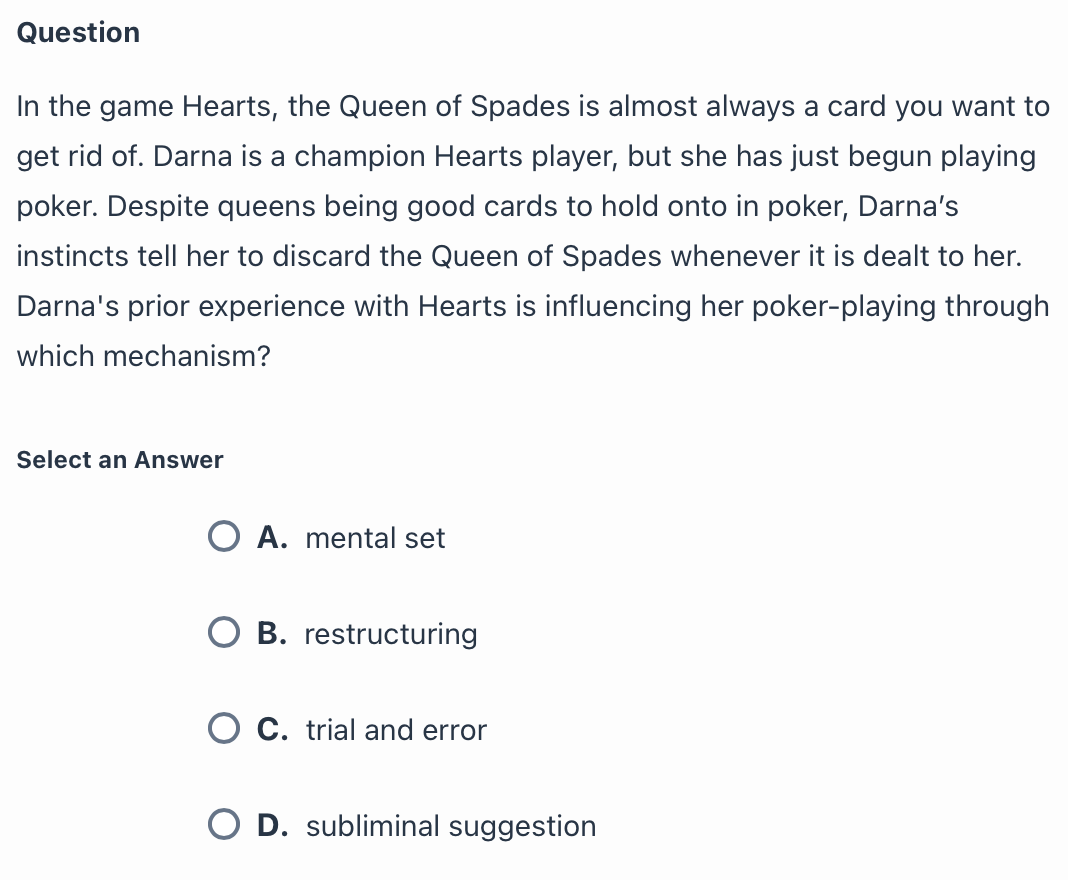
A) mental set
Darna’s experience playing Hearts has given her a sense of what role the Queen of Spades might play in a card game.
judgements often lead to ________, that affect out behaviour
decisions
rational decision
a logical, objective choice made by carefully evaluating alternatives, costs, and benefits
Are people more or less likely to stop for a taste test of jams if there are many more options to choose from?
more likely to taste test
Are people more or less likely to buy a jar of jams if there are many more options to choose from?
less likely to buy
Why are people more likely to sample something with more options but less likely to buy something with more options?
there’s a limit to how much information new can consider when making a decision; our thinking capabilities are limited. . . we have limited attention, memory capabilities, information, time and processing power
bounded rationality
idea that rational decision making is constrained by limitations in people’s cognitive abilities, available information, and time
our capacity to make rational decisions is bounded or constrained by limited resources
dual-processing theories
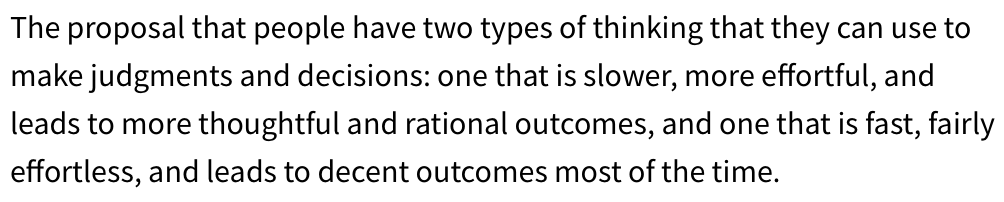
2 types of thinking that people can use to make judgements & decisions
controlled system
slower & more effortful; leads to more thoughtful and rational outcomes
e.g. weighing pros & cons of details in someone’s dating profile, writing an essay, navigating an unfamiliar town, playing chess
automatic system
fast & fairly effortless; leads to decent outcomes most of the time
e.g. skipping someone’s profile because you don’t like their shirt, reading simple sentences, driving a very familiar highway, feeling disgust at sight of rotten food
how do controlled and automatic systems have trade-offs?
because of trade-offs, people selectively use one mode or the other depending on needs. . . e.g. because automatic system allows for quick judgement, people use this mode when they are tired or overwhelmed by information
e.g. because controlled system takes more time & mental energy, people engage it for decisions that really matter and don’t involve time pressure
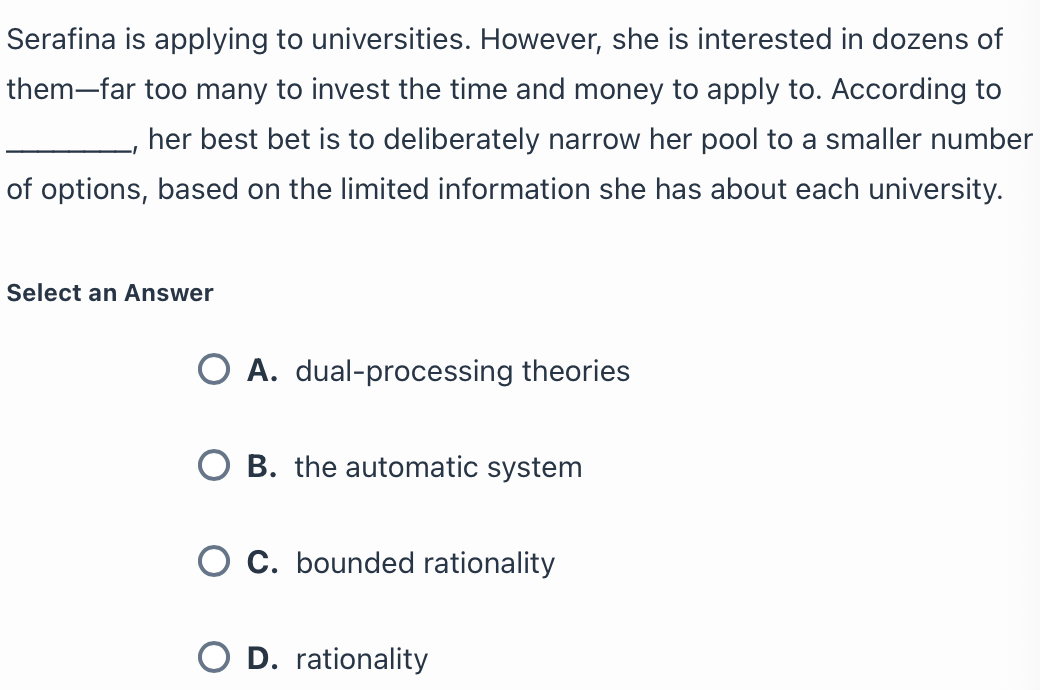
C) bounded rationality
Even though there is a risk that Serafina might not apply to the school that is the very best fit for her, it is better for her to recognize that she has limited resources and to make a smaller number of applications as strong as possible.
heuristics
mental shortcut that allows people to efficiently solve problems and make judgements and decisions
part of automatic system of thinking
typically operate unconsciously
heuristics can lead people to make illogical decisions
representativeness heuristic
mental shortcut for judging the likelihood of something based on how well it represents some category
judging based on how much something “looks like” a typical case
e.g. the tallest person is likely a basketball player
availability heuristic
mental shortcut for deciding how frequent or probable something is based on how easily examples come to mind
e.g. which do you think causes more death annually? lightning or flood? —> majority of participants say flood, and this is correct
when availability heuristic leads us astray, it can cause _______ fears
irrational
e.g. many people fear shark attacks because it is reported frequently in the news, making it very available in people’s minds, though the odds of being killed by shark is lower than being killed by a dog
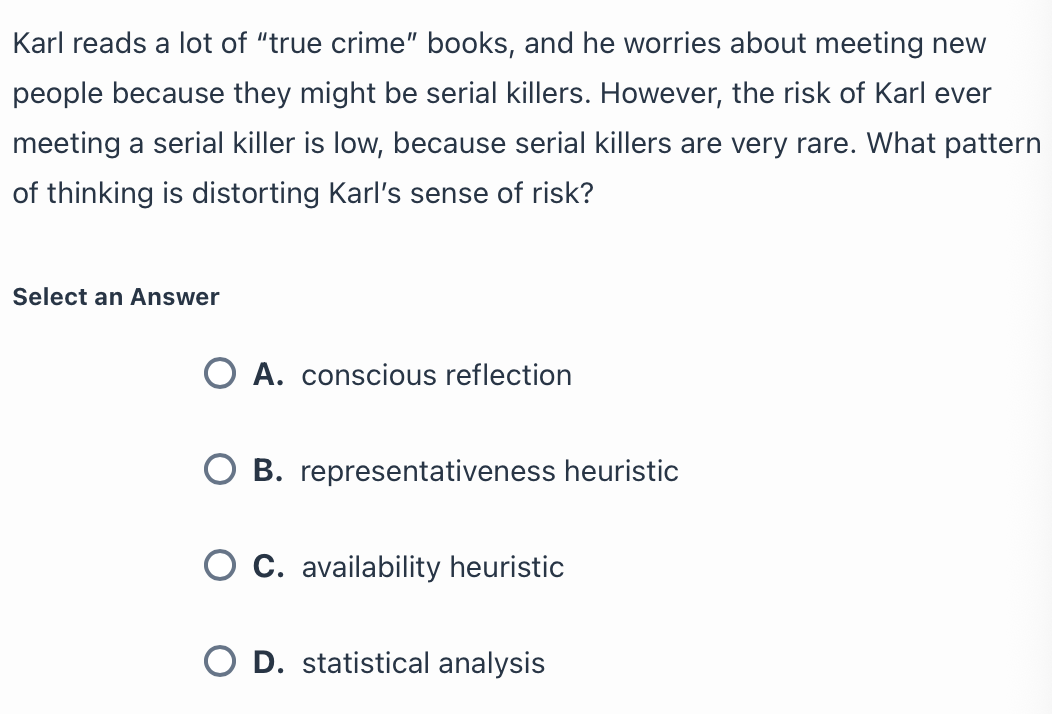
C) availability heuristic
Karl can think of a lot of examples of serial killers because of his reading habits, which makes them seem a lot more common than they actually are.
affective reaction
key ingredient in our emotions, moods, and attitudes; basic feeling of “good-for-me” (positive affect) or “bad-for-me” (negative affect)
quick and automatic; guide people’s decisions more often than reason
affect heuristic
mental shortcut for making decisions and judgements that involves relying on affect; the good-for-me/bad-for-me feelings we associate with various objects & events in the world
e.g. imagine standing on an 80-story building → will probably feel a little nervous vs. imagine going on a vacation with friends → will probably feel excited
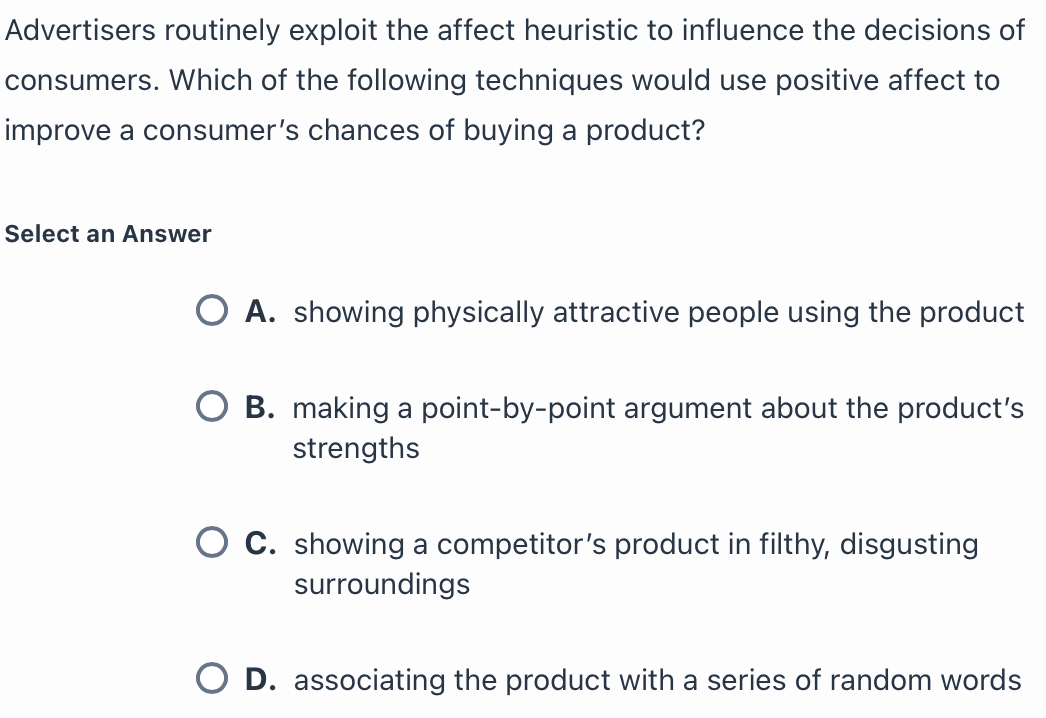
A) showing physically attractive people using the product
Regardless of the intended use of the product, merely associating it with feelings of attraction may make a consumer more likely to engage with the product.
confirmation bias
tendency to look for and weigh evidence that confirms pre-existing beliefs more strongly than evidence that is inconsistent with those beliefs
e.g. guessing the design sequence of three numbers, 2-4-6
most participants believe they were “even numbers counting by 2s” even when provided feedback
belief perseverance
tendency for people to resist changing their beliefs, even when faced with disconfirming evidence
confirmation bias can make it difficult for people to change they beliefs, even when faced with evidence . . . this phenomenon is called belief perseverance
confirmation bias (and the belief perseverance it causes) may be to blame for many frustrating conflicts in daily life. . .
e.g. your belief that roommate is a slob may mean you notice when she leaves dirty dishes int he sink and that you fail to acknowledge that she takes out the trash twice a week
it can also be a problem for scientists
how to reduce confirmation bias and belief perseverance that results from it?
give people a concrete strategy to reduce bias, by encouraging them to actively imagine and consider the opposite POV
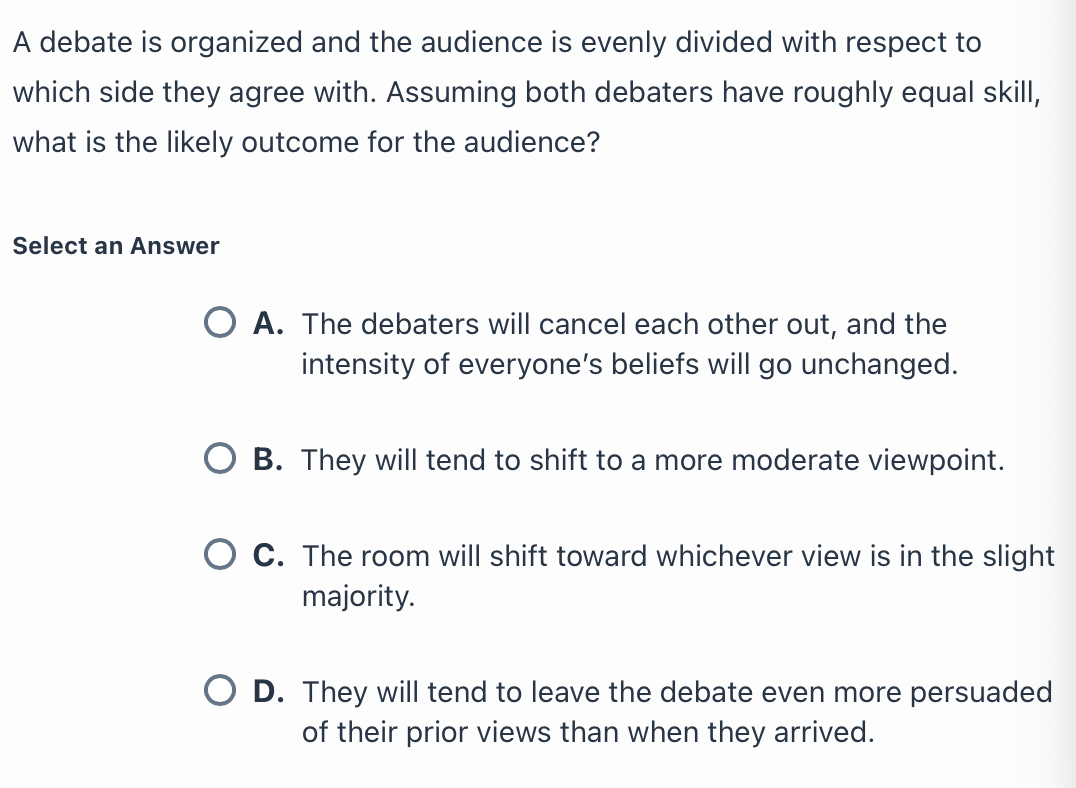
D) They will tend to leave the debate even more persuaded of their prior views than when they arrived.
Thanks to belief perseverance, presenting both sides of an argument equally tends to polarize people, because they treat confirming evidence as being more persuasive and contradictory evidence as less persuasive.
framing
particular way a decision, issue, or set of options is described; framing can change decisions by shifting the decision maker’s reference point
loss aversion
tendency to make choices, including riskier ones, that minimize losses
status quo
what is considered the default
opt in
e.g. the default in Canada is to not be an organ donor, people have to “opt in” to the organ donor program
opt out
e.g. some countries make organ donation the default, so that people have to “opt out” of being a donor
are people more likely to agree to be organ donors in countries where organ donation is the default?
yes
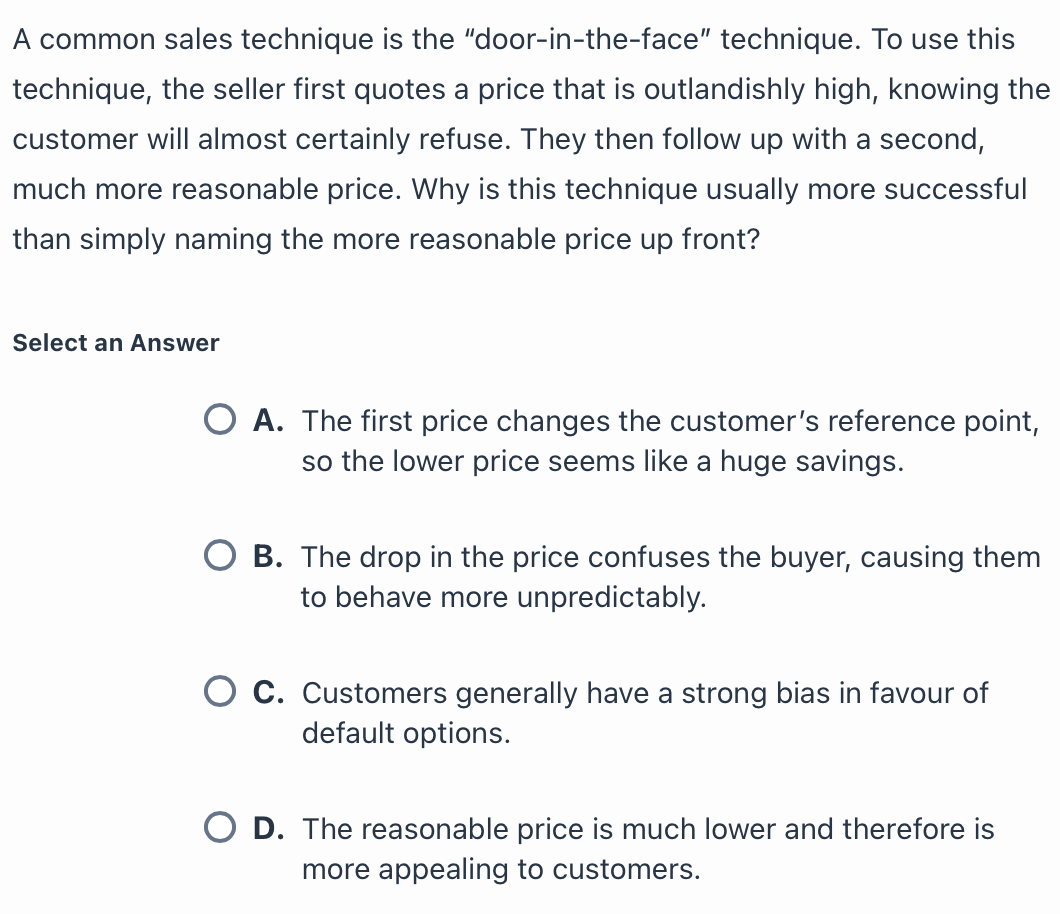
A) The first price changes the customer’s reference point, so the lower price seems like a huge savings.
By framing the reasonable price as a savings, the seller makes customers feel like they’ve gained something in the negotiation, even though the seller always intended to settle for the reasonable price.
overconfidence bias
tendency to overestimate the accuracy of one’s knowledge and judgements
e.g. experiencing overconfidence in judging how long it would take to complete an assignment or get ready for school
hindsight bias
tendency, once some outcome is known, to overestimate the likelihood that one would have predicted that outcome in advance
e.g. students believe that psychology is simply common sense - once a psychological phenomenon is learned, they feel so intuitive that surely, we think, we knew them all along
how to reduce hindsight bias
to ask individuals to provide specific reasons to why each of the possible options might be correct
what causes overconfidence bias
usually people can’t truly know if their answers are correct, so in judging their confidence, they have to rely on imperfect information
overconfidence might improve one’s mental health, increase their motivation, and give them social advantage and romantic edge
B) hindsight bias
Even if your friend had a strong feeling about the election at the time, hindsight bias will tend to make him even more confident about the outcome after seeing the results.
language
shared system of symbols, including spoken, written, and signed words & gestures, and a set of rules of how to combine those symbols to communicate meaning
phonemes
smallest unit of language, such as the individual sounds that make up speech
e.g. dog is composed of phonemes that correspond to the “d”, short “o”, and hard “g” sounds.
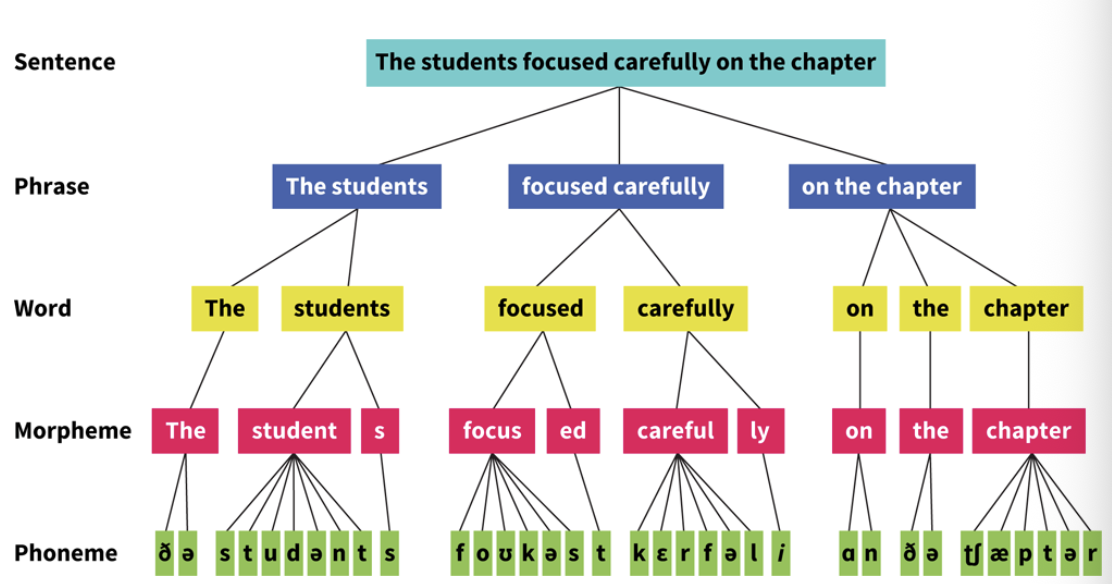
morphemes
smallest units of language that carry bits of meaning; morphemes include words and also word parts like prefixes and suffixes that change a words meaning
e.g. talk, student, -ing in talking or -s in students
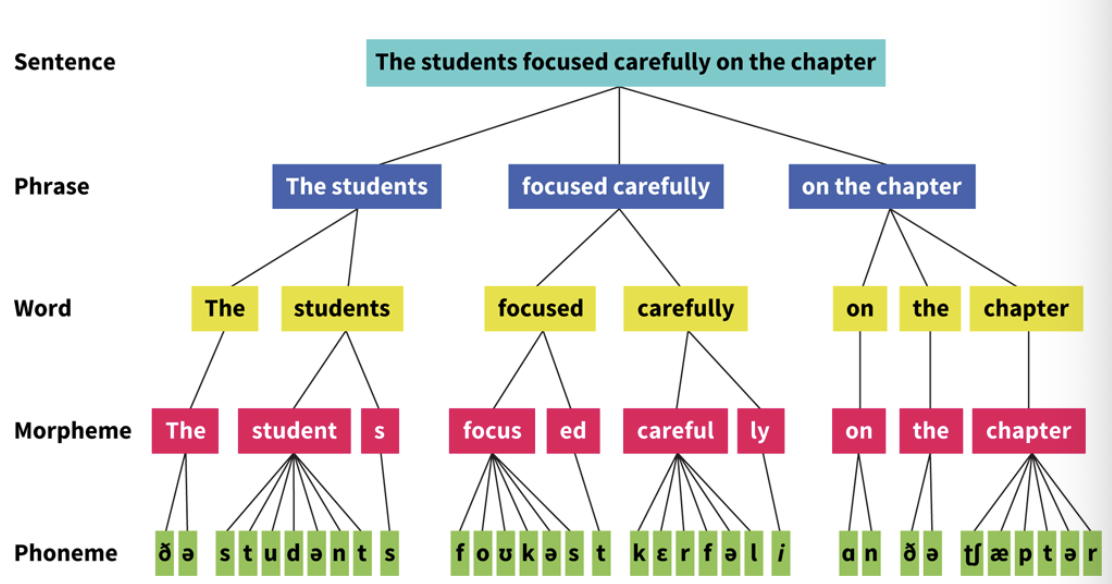
grammar
system of rules that governs the way that language parts are put together so that people can understand each other
syntax
grammatical rules that govern how words and phrases combine into well-formed sentences
pragmatics
rules that govern the practical aspects of using language
e.g. taking turns, using gestures, and talking to different people
D) morpheme
Morphemes are the smallest possible meaningful bits of language. Even though “ing” is not a full word, it still conveys a meaning—it signifies ongoing action of some kind.
linguistic determinism hypothesis (aka Whorfian hypothesis)
Whorf’s proposal that different languages impose different ways of understanding the world that can constrain and shape our thinking
verbal interference task
e.g. perform a difficult task at the same time: listening to a news broadcast and repeating it word-for-word while listening
A) will not experience sadness”
Whorf’s hypothesis is surprisingly radical. In his view, language is thought. Many who study language’s effects on cognition today take a more moderate view.
language acquisition
process in human children
Language acquired too quickly for behaviourism explanation to be true
Poverty of stimulus: Not enough language exposure
E.g. baby hears a word and says it later but they’ve never been reinforced for it
Language used too creatively for behaviourism
Universal Grammar hypothesis
E.g. “Colourless green ideas sleep furiously” → even small children know this is nonsensical, but still grammatical (they have innate, or native, universal grammar)
conditioned head-turn procedure
method based on operant conditioning
used to study infant speech perception capabilitie
infant seats on caregiver’s lap across research assistant, who shows infant toys. both caregiver + researcher wear sound cancelling headphones to not hear what infant hears and accidentally provide infant with cues
To one side of the infant is a speaker and a box. The speaker is used to present speech stimuli. The inside of the box can be illuminated to reveal and activate a mechanical toy, which is used as a reward to teach the infant to turn her head in its direction whenever she detects a change in a speech stimulus. Incorrect head turns are not reinforced.
Once the infant is conditioned to respond to changes in the stimulus stream, the testing phase begins. While the research assistant engages the infant by showing her toys, a computer presents a stream of speech sounds. For each interval, the computer randomly determines whether to repeat the previous sound or switch to a second sound. A second researcher, who cannot hear the stimuli, records when the infant turns to look for the activity of the mechanical toy.
babbling
production of speech sounds by infants
emerge around 6-7 months of age
consonant-vowel combinations (e.g. “ma” or “ba” repeated). . . babies make all sorts of language sounds, including ones not found in the language spoken by their caregivers
what happens by the time babies reach their 1st birthday for language
they can hear only speech differences in their own language (not universal anymore unlike when they were infants, 6-7 months)
By what age can babbling start to sound more like the hushed language
10 months
what does babbling look like for children born in signing households
babble with mouths AND with their hands
at what age can babies determine where the words in speech begin and end (by mentally keeping track of which syllables tend to co-occur with other syllables - e.g. rap is likely to occur with it because they are part of the same word: rabbit)
before their 1st birthday
B) being able to distinguish between the phonemes of all languages
Remarkably, infants are able to distinguish between the phonemes of every natural language as early as 1 or 2 months old.
what age do infants show their understanding of words and when do they speak their first word
By 6-9 months: infants understand some words
By 1st birthday: can produce single words
by 1st bday → quickly begin speaking in single-word utterances
For young children, a single word is used to mean all sorts of things. “Juice” might be said to request juice, to point out a juice spill, to identify a favourite juice in the grocery store, or even to refer to someone drinking juice.
What happens for children’s language development by age 3?
children’s speech progresses rapidly, and children can say short sentences that include not only nouns, verbs, adjectives, and adverbs, but also FUNCTION words such as of and the
they also use their emerging understanding of grammar to learn even more words
What happens for children’s language development by age 5?
children speak very much like adults, and it is clear they are mastering the grammatical rules of their language
overregularization errors
language error made by children that involves extending rules of word formation - these errors reveal children’s understanding of grammar
C) “In my dream I catched two gooses!”
“Catch” has an irregular past tense (“caught”), and “goose” has an irregular plural (“geese”), but until these exceptions are learned, children will modify these words in the standard way to express themselves.
what structure in the throat makes it possible for vocal sounds to be made in humans and other animals
larynx
If natural selection predisposed humans to speak, did it also predispose them to learn language? What was Skinner’s perspective?
language acquisition is not a specialized capacity but involves the same learning principles that govern how people and animals learn any behaviour, such as formation, imitation, and reinforcement
Skinner says that there’s nothing particular special about language learning - children learn words the same way a dog learns tricks (behaviourism → fall of behaviourism was due to Chomsky → nativism & cognitive revolution)
language acquisition device
innate mechanism that Chomsky proposed to explain the process of language acquisition in children. Says that no direct teaching is necessary.
nativism
universal grammar (hypothesis)
Language used too creatively for behaviourism
Universal Grammar hypothesis
E.g. “Colourless green ideas sleep furiously” → even small children know this is nonsensical, but still grammatical (they have innate, or native, universal grammar)
children understand innately
A) It arose spontaneously, invented by deaf children who had no adult teachers.
Because the rules emerged from children, rather than being imposed by adults, a strong claim can be made that the language instinct is innate in ways that even reading and writing are not.
sensitive period
early period in life during which it is especially sensitive to and able to learn from specific information in its environment
during this period, language acquisition can occur, but afterward language acquisition will be limited
do participants who begin learning English prior to puberty (around age 12) achieve proficiency? what about after?
near-native proficiency; after that point, there is a steep drop-off
less is more hypothesis
languages are learned best from the ground up: Learners master the smallest components of language first (phonemes and morphemes), followed by the more complex components.
young children have no choice but to process language in this way because their powers of cognition are limited. in this view, although adults are capable of picking up new languages, more mature cognitive abilities may present obstacles, to their learning.
adults process language in larger chunks, such as whole words rather than their parts, and this leads them to miss some of language’s fine details
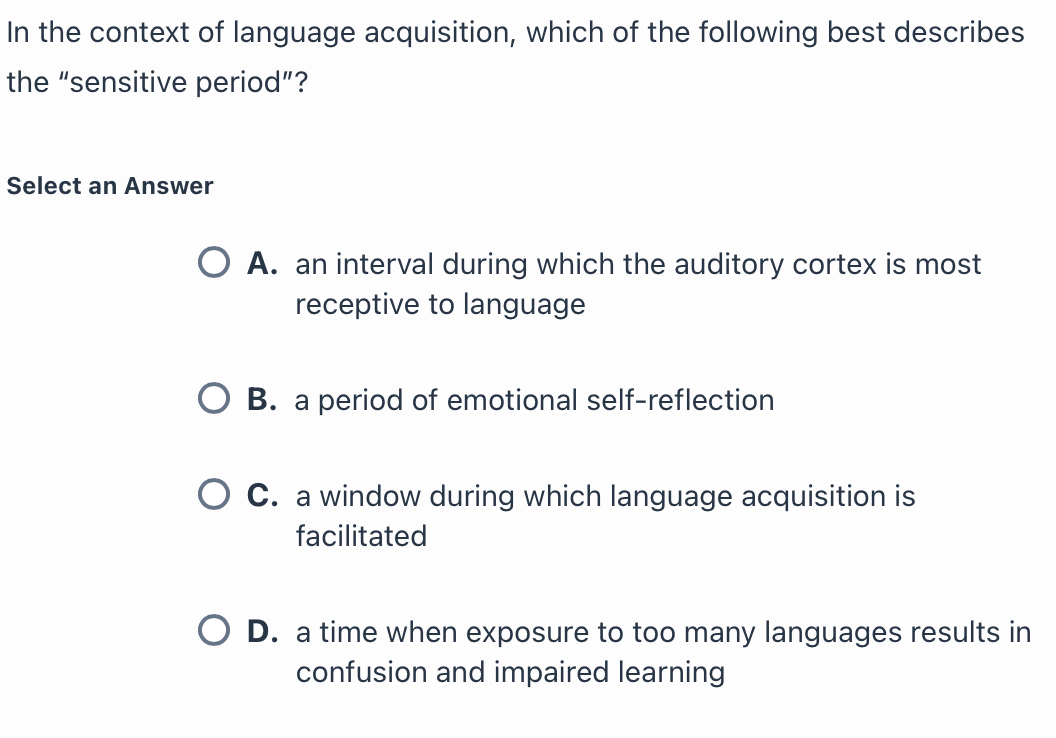
C) a window during which language acquisition is facilitated
Young children who are immersed in a language-filled environment are able to acquire that language more deeply and durably than those who enter that environment as adolescents and adults.
intelligence
capability to think abstractly, comprehend complex ideas, reason, plan, solve problems, learn from experience, and acquire new knowledge.