BIOC B (midterm)
 Call Kai
 Learn
Learn Practice Test
 Spaced Repetition
 Match
Match Flashcards
 Knowt Play
1/149

There's no tags or description
Looks like no tags are added yet.
Name | Mastery | Learn | Test | Matching | Spaced | Call with Kai | Chat |
|---|
No analytics yet
Send a link to your students to track their progress
150 Terms
Ea, rate of rxn
enzymes catalyze [S]→[P] by lowering ___ and increasing _____
no
do enzymes change the equalibrium?
cleavage done by proteases that is irreversible
what is proteolytic cleavage?
Vo=Vmax [S]/ Km+ [S]
what is the M-M equation
concentration when ½ Vmax
what is Km?
T
with higher [S] more product is made (T/F)
an enzyme that is regulated
what is a regulatory enzyme?
rate limiting, regulatory enzymes (enzymes that are regulated)
multistep metabolic pathways have at least one ______ step mediated by ______
first step
at what step of the pathway does feedback inhibition occur at?
yes
is inhibition reversible?
the first enzyme- not at the active site but allosterically at another site.
in L-thr to L-ile pathway what site does ile bind to to inhibit the pathway? (neg feedback)
allostery- reversible, non-covalent binding or allosteric modulators
reversible covalent modification mediated by seperate system of enzymes
interaction with regulatory proteins
proteolytic clevage (irreversible)
4 mechanisms of enzyme regulation
A regulatory enzyme with catalytic activity
modulated by the noncovalent binding of a
specific compound at a site other than the
active site
what is an allosteric enzyme?
non competitive inhibitors are non-physiological and cannot be overcome by the addition of substrate
what is the difference between non-competitive inhibitors and allosteric modulators?
an inhibitor that binds to the catalytic site
what is a competitive inhibitor
T
modulators can make enzyme go T→R or R→T (T/F)
slower (note use K0.5 not kM for allosteric enzymes tho)
if kM is high the rxn is _____
allosteric enzymes are more complex needing more subunits, have allosteric sites and do not follow M-M kinetics
how are regulatory enzymes (allosteric) different from simple enzymes?
not really, only in non allosteric competitively inhibited enzymes
can increasing concentration of substrate overcome inhibition in allosteric enzymes
both, but in this class be able to identify which one from a graph is being effected
do modulators effect K0.5 or Vmax?
increases
a positive modulator _____ vmax (increase/decrease)
decreses
a positive modulator _____ K0.5 (increase/decrease)
homotropic allosteric modulator- act as modulator and substrate
hetertropic allosteric modulator- act as only modulators
homotropic allosteric modulator-
hetertropic allosteric modulator-
aspartate transcarbamoylase, enzyme that catalyzes commited step of prymidine nucleotide biosynthesis (CTP,TTP, UTP)- makes DNA bases from AAs
what does ATCase stand for, what is its role in the body?
aspartate + carbamoyl phosphate → N-carbamoylaspartate + Pi
what are substrates and products of ATCase?
carbamoyl joins onto amine of aspartate
where does ATCase join the aspartate + carbamoyl?
the pathways final product CTP turns off ATCase when in high [ ], 6 CTP bind 1 ATCase
what is the negative feedback inhibitor of ATCase? how many bind?
12 peptide chains
6 regulatory dimers and 6 catalytic trimers
how many peptide chains does ATCase have?
what types of subunits, how many of each?
x2 c3 (catalytic trimers) - 6 total c subunits
z3 r2 (regulatory dimers)- 6 total r subunits
subunit structure of ATCase r and c units
zinc domains (of the regulatory subunit; zinc domains
have cysteines coordinating a structural
zinc ion)
how are ATCase subunits held together?
r subunits
where do modulators ATP and CTP bind on ATCase?
interfaces of c chains
(center of complex)
where do substrates bind ATCase?
subunits seperate
when treating cyctines with mercury compound what happens?
native- one peak c6r6
mercury instead of zinc- two peaks 2c3 and 3r2
with Hg treatment, what do you expect to see on a graph of native vs mercury structures?
asparatate- pos homotropic
ATP- pos heterotropic
what are the pos modulators of ATCase
increases, decreases
how does CTP binding ATCase effect K0.5? what about Vmax?
T
in what state of ATCase is the active site loop (240S) blocked?
add substrate, add substrate analoge to mimic both substrates, add activator
three ways to push ATCase to R state?
if you only add one susbtrate to ATCase it stays in teh same state and you can study it
why can you typically not add substrate to study a protein but you can with ATCase?
F, still some but very low level
function of ATCase completely stops in T state (T/F)
PALA
_____ is a mimic of the reaction bisubstrate intermediate of ATCase but is inactive (holds protein in R state withougt reacting(
no
do analogs react?
trimers seperate 12A and rotate 15 degrees flexing of c chains, dimers rotate 10 degrees, there are changes in bend of r chains
when T→R what types of rotation happens?
T
ATP-binding can induce T → R conversion in
the absence of substrate (T/F)
EMAIL HIM
ASK PROF ABOUT ATP INCREASING PALA KD STILL CONFUSED
higher
when higher nH ____ cooperativity and activity
concerted (all units are T or all units are R)
is ATCase concerted or sequential?
structure and function of E. Coli aspartate transcarbamoylase trapped in the middle of its catalytic cycle
what is the paper we studied in class called?
carbomoyl phosphate (CP) binds active site
aspartate binds active site (changes to R state)
condensation rxn
product N-carbamooyl-L-aspartate (CA) released
Pi released
what is the order of the 5 events of ATCase rxn and what are they?
T
the ATCase remains in R state as long as there is substrate (T/F)
Asp236 on the catalytic chain (D236c) and Lys143 on the regulatory chain (K143r)
what are the residues that interact to stabalize the T state of ATCase
it can no longer adopt the T conformation
if either the DC236c or K143r become mutated what effect happens to the ATCase?
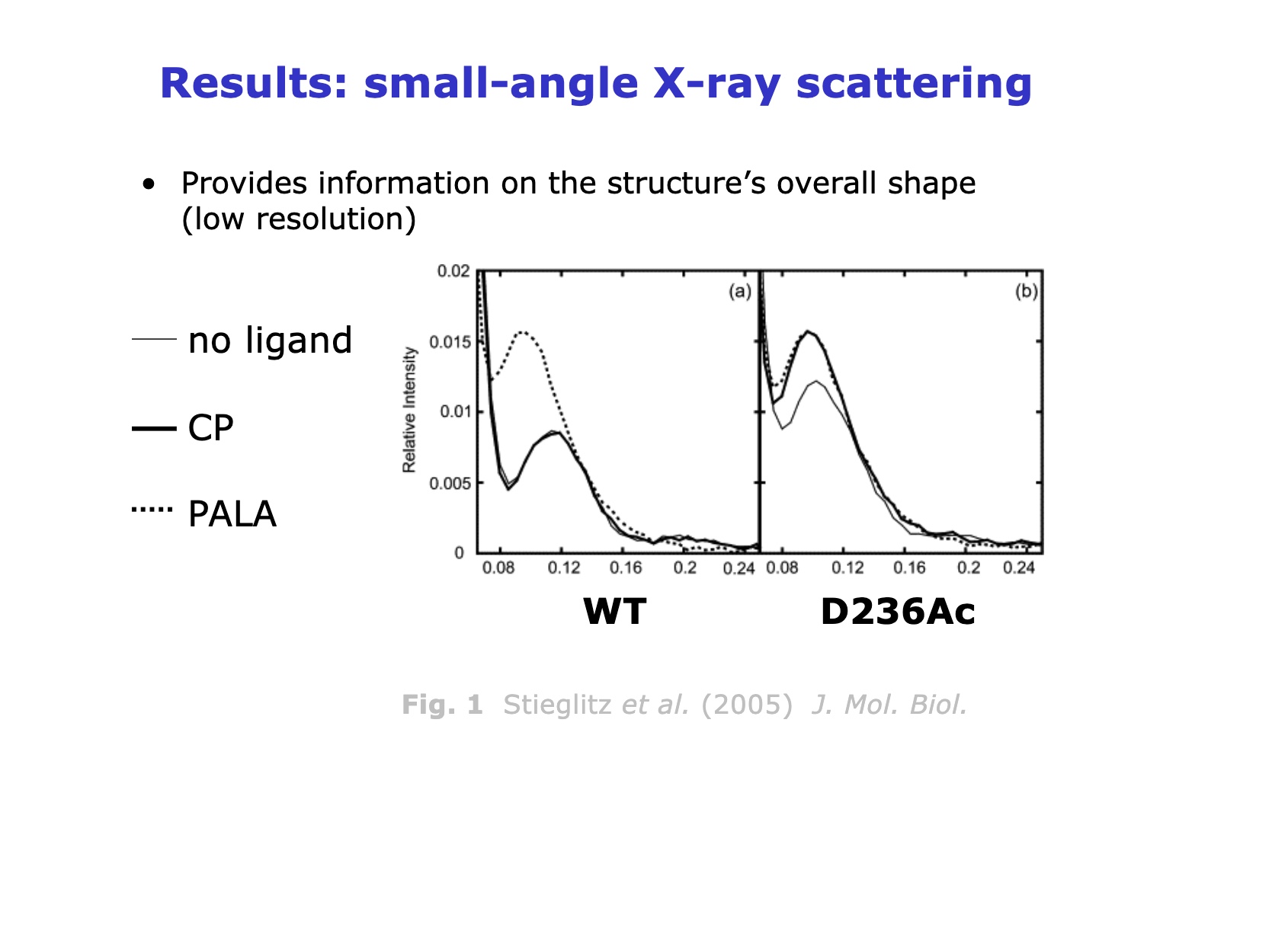
In the absence of ligands, WT and D236Ac ATCase have different structures. However, in the presence of PALA, WT ATCase and D236Ac are the same (WT=wildtype)
what are two key findings of the paper that led to the conclusion that if one is mutated, ATCase cannot adopt T state?
asp→ ala
D236Ac ATCase indicates the swap of what AAs
PAM- non reactive CP (carbamoylphosphate) analog
malonate- non reactive aparatate analog
(analogs of the two substrates of ATCase)
what is PAM?
what is malonate?
-in the absence of ligand, WT ATCase and D236Ac
are different (mutant should be in T state but appears in R)
- bound to PALA, WT and D236Ac are very similar
- CP has little effect on WT ATCase
- CP mimics effect of PALA in D236Ac
what do these graphs tell us?
one is neg one is pos
why are D236c and K143r a good on pair?
x-ray scattering (provides low res info on shape)
how were results of the study obtained and graphed?
larger RMS (difference)
thicker lines on overlapped structures indicate what?
mutant- R state (even with only one bound-concerted)
wildtype- stays in T state
when D236Ac ATCase binds to PAM (CP analog) it adapts the ____ state.
when D236c ATCase binds to PAM (CP analog) it adapts the ______ state
PAM and malonate
the catalytic site of mutant D236Ac when bound to PAM structurally resembles wildtype D236c when bound to ______
adenylation, acetylation, methylation, ubiquitination, phosphorylation, etc…
what are some common reversible covalent modifications for regulation?
ser, thr, tyr, his
what amino acids can be reverisbly phosphorylated?
kinases do phosphorylation and use ATP→ADP
phosphoprotein phosphatases do dephosphorylation and use H2O→Pi
what enzyme phosphorylates? what involved in rxn?
what enzyme dephosphorylates? what involved in rxn?
X-R-[RK]-X-[ST]-B
PKA (protein kinase A) phosphorylates sites on a protein that contain ____________ sequence
X- any AA
R- arginine
[RK]- either arginine or lysine
[ST]- either serine or threonine
B- any hydrophobic AA
X-R-[RK]-X-[ST]-B what do all the letters mean?
catalytic
the PKA binding sit X-R-[RK]-X-[ST]-B is recognized by what site on PKA?
S/T
what part of X-R-[RK]-X-[ST]-B is phosphorylated?
2) L-R-R-S-Y-I would be inhibitory as the first half of teh sequence L-R-R-S follows the correct sequence to bind, however, the Y instead of S/T would cause inhibition because only S and T can be phosphorylated at that site.
other options:
1) L-R-L-K-V-I- would not even bind to the site due to incorrect AA early on
3) L-R-K-K-S-I- would bind normally as it perfectly fits sequence
out of the following sequences, which one would be INHIBITORY if BOUND? why?
1) L-R-L-K-V-I
2) L-R-R-S-Y-I
3) L-R-K-K-S-I
cAMP-dependant protein kinase
PKA full name
binding of regulatory subunit to catalytic subunit: regulatory subunit has a inhibitor sequence that blocks the catalytic active site.
how is PKA inhibited?
K-R-R-G-A-I
inhibitory due to A in place of S/T therefore cannot be phosphorylated (activated)
what is the sequence of the regulatory subunit inhibitor sequence in PKA? why is it inhibitory?
the regulatory subunits bind to cAMP (4 of them) and release hold on catalytic subunit by interacting with themselves and cAMP. release of the catalytic subunit means it is active and able to phosphorylate substrates.
how does cAMP activate PKA?
cAMP is short lived and is hydrolyzed by cyclic nucleotide phosphodiesterase cAMP→ AMP. when cAMP is broken down to AMP, it dissociates from the regulatory subunits which causes tehm to reassociate and inhibit the catalytic PKA subunit.
how is PKA inactivated?
glycogen metabolism, fatty acid metabolism, cell surface ion channels, glycolysis
and DNA condensation of histones- learned in MCB not here.
as a response to cAMP, PKA regulates various cell activities including:
Bulk- can cause steric hindrance
Charge- negative phosphate groups can cause attraction or repulsion
Oxygen atoms- allow for H-bonding
Site for protein-protein interactions
what are 4 features that phosphoryl groups contribute when something is phosphorylated?
activated cAMP binding (4 of them)
deactivated cAMP dissociation (cAMP→AMP)
function- when active is a kinase (phosphorylates)
so recap- how is PKA activated and deactivated?
what is PKA function
phosphorylation, phosphorolysis (breakdown of glycogen using phosphate)
glycogen phosphorylase is activated by _______ and catalyzes ______
a and b
glycogen phsophorylase has 2 forms- inactive and active or ____ and ____
activates by phosphorylase kinase, phosphorylates (2ATP→2ADP)
deactivates by phosphoprotein phosphatase 1, dephosphorylates (2H2O→2Pi)
what enzyme activates glycogen phosphorylase? how?
what enzyme deactivates glycogen phosphorylase? how?
Ser14, R state (active)
what amino acid is targeted for phosphorylation in glycogen phosphorylase? when phsophorylated what state is favoured?
dimer of two identical monomers
is glycogen phsophorylate a monomer or dimer?
activated- glycogen phsophorylase
inactivated- glycogen synthase
proteins such as ______ are activated by phosphorylation, however proteins such as _______ are inactivated by phosphorylation
T
on proteins with many phosphorylation sites (such as glycogen synthase), phosphorylation can produce varied degree of effect based on what site is phosphorylated (T/F)
PKA and GSK3 (glycogen synthase kinase 3)
enzymes _____ and _____ both phosphorylate glycogen synthase at different sites
GSK3 (note when talking about inactivators more +++++ could mean more inhibitory so read table carefully)
does PKA or GSK3 have a stronger inhibitory effect on glycogen synthase?
phosphoserine binding domain, means that it can to bind to a serine that has been already phsophorylated. glycogen synthase can undergo autoinhibition- when its own serines are phosphorylated it binds to itself therefore becoming inhibted. this is why phosphorylation inhibits glycogen synthase rather than activating it. glycogen syntahse is activated when dephosphorylated (stops binding to its own phsophoserine sites)
what binding domain does glycogen synthase have? what does this mean for the function of the protein?
GSK3 can bind to serines on other proteins only when they are phosphorylated. ex. phosphorylated serine on GS is required for GSK3 to bind.
ex. phsophorylation of the GSK3 protein itself causes it to for a ser-phosphate bind to itself inhibiting its own function after its phosphorylated.
phosphorylation can promote enzyme-substrate or protein-protein binding. explain this in the case of glycogen synthase.
4) GS activity stays the same
GSK3 only phosphorylates (inhibits) the GS if the GS is already primed with phosphorylation by another kinase. so GSK3+ATP does not change activity of GS the same way PKA+ATP would because GSK3 needs a primer phosphorylation first.
other answers:
1) GS activity increases somewhat
2) GS activity increases a lot
dont make sense because phosphorylation of GS is inhibitory
3) GS activity decreases a bit
could only occur if GS was primed first
What best describes glycogen synthase
(GS) activity after the addition of GSK3 and ATP to GS?
1) GS activity increases somewhat
2) GS activity increases a lot
3) GS activity decreases a bit
4) GS activity stays the same
phophorylated tyrosines (phosphotyrosines)
SH2 (Src homology 2) also are able to make new protien-protein intearactions through phosphorylation, what can they bind to?
GSK3- phosphoserines
SH2-phosphotyrosines
GSK3 binds to _______, SH2 binds to ________ on target proteins. both are examples of phosphorylation allowing more protien-protein binding
SH2- insulin signalling
GSK3- glucose storage/breakdown
SH2 domain protein interactions are important in what process?
(and what as GSK3 involved in again?)
The SH2 domain is on Grb2 and binds phosphotyrosines on IRS proteins
In insulin signaling, where is the SH2 domain located and what does it bind?
phosphotyrosine binding domain
what does PTB stand for?
inactive
phosphorylation of a substrate promotes kinase binding at SH2 domain, allowing kinase to continue to phosporylate substrate.
alternatively the kinase itself can be phosphorylated which can make the SH2 domain bind to itself making the kinase _______
protease
a zymogen is activated by a _____
non-protease
a proenzyme is activated by a ____
no, it is proteolytic activation to expose active site, proteolysis is irreversible
is zymogen activation reversible?
zymgogen
is chymotrypsin a zymogen or proenzyme?
digestive
many ____ enzyme proteases are activated by proteolysis