Population Health: Determinants
 Call Kai
 Learn
Learn Practice Test
 Spaced Repetition
 Match
Match Flashcards
 Knowt Play
1/28

There's no tags or description
Looks like no tags are added yet.
Name | Mastery | Learn | Test | Matching | Spaced | Call with Kai | Chat |
|---|
No analytics yet
Send a link to your students to track their progress
29 Terms
What is a “population”?
Whole number of people or inhabitants in a country or region
Total of individuals occupying an area or making up a whole
Group of people or animals of a particular kind that live in a place
Population Health v.s. Public Health
Pop Health
Focuses on outcomes
Measures health of groups
E.X: Diabetes rates in Texas
Public Health
Focuses on systems
protects communities
Implements programs and policies
E.X: Vaccinations campaign
Medicine and Health Care
“Medical thinking has been largely concerned with the needs of sick individuals”
FOCUS: Treat disease after it occurs
Determinants of Health
Policymaking
Biology and genetic factors
Individual behavior
Social factors
Environmental factors
Healthy People 2030: 5 Domains of Social Determinants of Health
Economic stability
Employment
Income
Education access and quality
Early childhood education
Literacy
Health Care Access and quality
Insurance coverage
Primary care
Neighborhood and Built Environment
Safe housing
Transportation
Social and Community Context
Social support
Community engagement
Individual lifestyle factors
Exercise, sexual activity, and diet and constitutional factors within a person are direct determinants of a person’s health
Social and community networks
Within the immediate environment of an individual
DOH
Other general macro-environmental conditions of socioeconomic, cultural, and environmental conditions that impact health
Education
Work environment
Food production
Housing
Water and sanitation
Physical environment
Public health interventions like clean water, sanitation, and food safety have prevented millions of illnesses before people ever needed medical treatment
Clean air and safe drinking water
Safe housing and neighborhoods
Food safety and sanitation
Healthy environments reduce disease risk and improve quality of life
Environmental Health Challenges
Environmental conditions can influence the health of entire populations
Climate change
More heat waves, floods
Loss of green spaces
Reduced opportunities for physical activity
Air Pollution
Increased asthma, heart disease, premature death
Urban development
Housing quality, transportation
Environmental Health Problems
E.X of Environmental Exposures
Air pollution and secondhand tobacco smoke
Pesticides and other chemical exposures
Poor housing quality (lead, paint, mold, asbestos)
One disaster, many health impacts
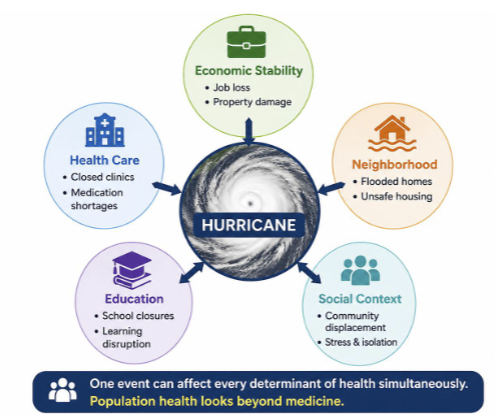
Socioeconomic States (SES): A powerful predictor of health
SES influences nearly every determinant of health
Better housing
Safer neighborhoods and quality homes
Better nutrition
More access to healthy, affordable foods
Better education
More opportunities and higher educational attainment
Better access to health care
Insurance, preventative care and quality providers
Longer life expectancy
Better overall health, and longer, healthier lives
Why SES matters?
Resources create opportunities for better heatlh
Socioeconomic status v.s. Health
Research consistently shows that higher SES is associated with:
Lower mortality
Lower chronic disease
Greater use of preventative care
Better access to specialists and advanced treatments
Better overall quality of life
Health Disparities in the United States
DIFFERENCES IN HEALTH OUTCOMES ACROSS POPULATIONS
Disparities can occur across:
Race and ethnicity
Socioeconomic status
Geographic location
Reflect unequal access to opportunities and resources, not simply individual choices
Reducing health disparities is a major goal of population health and public heatlh
Social connectedness
Complex relationships between individuals and among groups
Strong social ties can have a direct and positive impact on health
Strong social connectedness is associated with:
Lower risk of depression and anxiety
Better cardiovascular health
Stronger immune function
Lower risk of premature mortality
The importance of Place
Housing quality— Safe and affordable housing
Neighborhood environment— Parks, walkability and community safety
Access to services— Health care, grocery stores, pharmacies, and public transportation
Environmental conditions— Air quality, water quality, and environmental hazards
Population-Level Prevention
Upstream interventions
Improve housing
Improve transportation
Reduce environmental hazards
Increase access to healthy foods
Improve education
Downstream interventions
Health screenings
Vaccinations
Disease treatment
Rehabilitation
Universal preventive measure
Recommended for everyone in an eligible population
Selective preventive measure
Recommended only when an individual is a member of a subgroup of the population whose risk of becoming ill is above average
Indicated preventive measure
Applicable to a person who, on examination, manifests a risk factor, condition, or abnormality that identifies them individually as being at nigh risk for the future development of a disease
Effectiveness of Preventive Measures
In some cases, universal measure may be more optimal and cost-effective than interventions targeted further downstream
Tobacco use prevention
Automobile-related injury prevention population-based strategies
Upstream policy interventions may refer to modifying the broader, social determinants of health
Public Health: Not a One Agency Job!
Partnership with all entities in public health system
Make program and policy decisions based on the evidence
Communicate effectively
Accountability
Who is responsible for improving health?
Individual
Society
Government
Prevention, collaboration, addressing social determinants
Health care is viewed as an economic good
Core beliefs:
Individual responsibility
Competition improves efficiency
Ability to pay influences access
Limited government involvement
Private sector provides most services
Social justics
Health care is viewed as a social good
Shared responsibility
Government helps ensure access
Ability to pay should not determine basic care
population health benefits everyone
Market Justice
Individual responsibility and private markets
Social justice
Shared responsibility and equitable access