DNA Structure, Bidning Proteins, and chromatin
 Call Kai
 Learn
Learn Practice Test
 Spaced Repetition
 Match
Match Flashcards
 Knowt Play
1/74

There's no tags or description
Looks like no tags are added yet.
Name | Mastery | Learn | Test | Matching | Spaced | Call with Kai | Chat |
|---|
No analytics yet
Send a link to your students to track their progress
75 Terms
the most common form of double standed DNA is
B DNA
B DNA forms from
hydrated DNA
BDNA is
right handed
the rise of B DNA is
3.4A
The pitch of BDNA is
36A
bases of BDNA are
oriented inward in center of the helix, perpendicular to the helix axis
bdna minor groove
lined with ribose rings coming towards you
bdna major groove
bases are accesible
RNA double helix is mostly
A form
DNA-RNA hybrids are
A-DNA
in A form the
major grove is deep and the minor groove is shallow
B-form as viewed down the axis
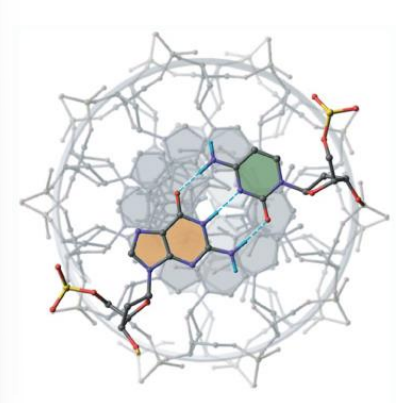
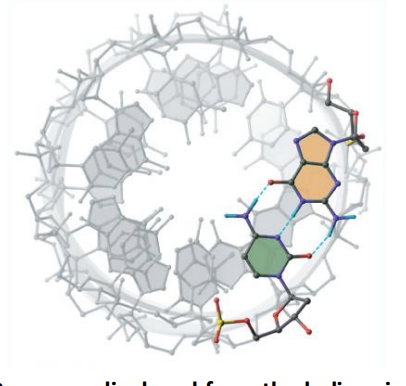
alpha form as viewed down the axis
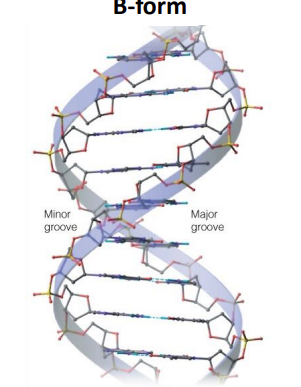
b form
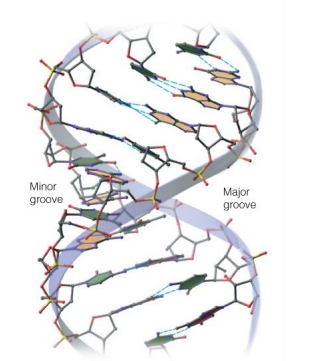
alpha form
water plays a crucial
role in DNA structure
B-DNA is
hydrated (roughly 30% water by weight)
A-T rich sequences have a
chain of water molecules along the DNA minor groove
alternating purine and pyridine strands can
form Z-DNA
ZDNA is a
left handed helix where pyrimidines are anti and purine are syn
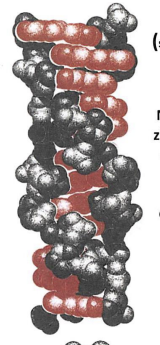
ZDNA
The B form helix has a
wide and deep major groove
Becuase of the wide and deep major groove of B-helix
proteins like transcription factors that bind to specific sequences have a good opportunity to bind
The A form helix narrowness of major groove
does not allow proteins to contact the bases
in vivo it is only when DNA is
severely underwound that the Z form will appear
DNA structure appears rigid but there is lots of flexibility depdning on the
sequence
nucleotides can heavily influence the
nucelic acid structure
there are 6
covalent bonds of free roatation per nucelotide
The types of flexibility in nucelotides are
base rotation around X angle
sugar pucker
free roation around PO4 bonds
factors that affect double stand stability
base composition
solvent
cations
denaturants
temperature
base composition
G residues tend to have better stacking energy, so GC-rich DNA will have more stability.
H2O is polar, interacts well with the DNA/RNA backbone and the stacking of the base-pairs contributes to helix stability because of
hydrophobic effec
Decreasing the solvent polarity by addition of organic solvents will
destabilize the helix (mainly by decreasing the hydrophobic effect).
cations are important becuase they
neutralize the repulsive interaction between PO4 - groups in the complementary strands.
Decreasing the salt enough will
cause strand separation
urea or frmadie are agents that will
a) H-bond with the bases
b) decrease polarity of the solvent
So these will destabilize the double helix
free energy change for double helix is the sum of
enthalpy and entropy terms
Increases in temperature will result in a
delta g positve and therefore double helix is unstable
DNA can
supercoil as a way to maintain a constant twist value
DNA likes to have a helical twist of
10.5 bp/turn
if the twist of DNA underwines or overwinds the energy is
unfavorable and will try to change back to a normal twist
closed circular DNA can relieve bad twist is to
supercoil
supercoil is in which
a double helix winds around itself
the state of the DNA to which it twists is called
topology
Supercoiling is a real problem in a living cell because transcription (RNA synthesis) and DNA synthesis (replication)
ause changes in DNA twist with consequential changes in supercoiling
The cell deals with DNA twisting/supercoiling through the activity of the enzymes called
topoisomerases
topoisomerases
change topology isomers
topoisomerases work by inducing breaks in the
DNA backbone and allowing strand roation which releives the twisting
Chromatin
Organizes the 6 x 10⁹ base pairs in 46 chromosomes in the human genome
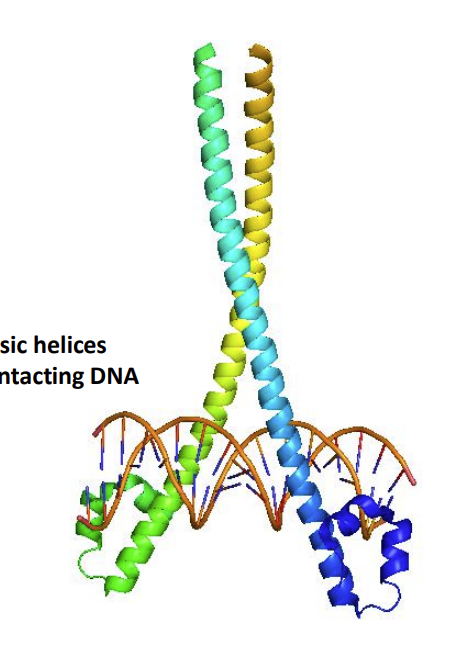
Asn (Gln) forms two Hbonds to
A of T-A bp in the major groove
Arg forms two Hbonds to
G of C-G bp in major groove
What binding protein is this
MAFA
almost all of the DNA in a cell is packaged into
chromatin in the interphase cell and during division
1 meter of DNA must be condensed to fit into the
nucleus
Condensation begins when dna interacts with the
octamer of a histone to wrap around the core and create a nucelosome
How many types of proteins are found with dna when chromatin is isolated
2 (basic and acidic)
Basic proteins are the
histones
acidic proteins are the
non-histone chromosmal proteins that carry out transcription and reuguation tasks
nucelosomes are the first level of chromatin
organization in eukarytic organisms
interactions that stabilize nucleosomes must be
sequence indepenednt
The core structure of a nucelosome consists of a
histone octomer that self assmables with 146 BP of dna wrapped around it
a histone octomer is
2 histone molecules (h2a h2b h3 and h4)
an additional histone H1 bidns on the
outside of the DNA
modifications of histons H3 and H4 regulate
DNA accesibility
histones contain many
Arg and Lys residues to neutrilize DNA phosphate backbond negative charge
six levels are folding are needed to go from
nuceosomes to chromsomes
What is the second step of folding
nucleosomes as beads on a string
the third step of organization is
a helix of nucelosomes wids into a fiber
the fourth step of folding is
the fiber of nuceosomes loops into a loop domain
after a loop domain is formed the
buncing of loops forms a rossette around a nucelar scaffold
rosettes are stacked to form a
coil
soils are stacked to form the
chromatid
What are the two key roles of chromatin
storage
regulation of gene expression
Prokaryotes do not
have chromatin
Prokaryotes turn off genes by
bidning repressor proteins