Humanities Unit 4 - Ancient Worlds
 Call Kai
 Learn
Learn Practice Test
 Spaced Repetition
 Match
Match Flashcards
 Knowt Play
1/57

Earn XP
Description and Tags
Name | Mastery | Learn | Test | Matching | Spaced | Call with Kai | Chat |
|---|
No analytics yet
Send a link to your students to track their progress
58 Terms
Civilisation
A complex human society, often urban, with organised government, social classes, art, technology, and writing
Key features of a civilisation
Cities: Large population centres.
Organised Government: Leaders and laws.
Complex Religions: Belief systems and rituals.
Job Specialisation: People do different jobs (farmers, builders, soldiers).
Social Classes: Groups of people with different statuses.
Arts & Architecture: Unique buildings, art, and crafts.
Public Works: Roads, bridges, irrigation systems.
Writing: A system for recording information
Ancient Mesopotamia
c.3500 BCE - 539 CE
Located between the Tigris and Euphrates Rivers (Modern-day Iraq)
One of the earliest civilisations.
Key Contributions:
• Cuneiform: One of the first writing systems.
• Wheel: Invented for transportation and pottery.
• Plow: Revolutionised farming.
• Ziggurats: Large temple structures.
• Hammurabi's Code: One of the first written law codes
Ancient Egypt
c 3100 BCE - 30 CE
Developed along the Nile River in Africa
Ruled by powerful pharaohs
Key Contributions:
• Pyramids: Giant tombs for pharaohs.
• Hieroglyphics: Picture-based writing system.
• Papyrus: Early paper made from reeds.
• Mummification: Preserving bodies for the afterlife.
• Calendar: Developed a 365-day calendar.
Ancient India
c. 2500 BCE - 1200 CE
Located along the Indus River (modern day Pakistan and India)
Famous for well planned cities like Mohenjo-Daro and Harappa
Key Contributions:
• City Planning: Grid streets, impressive drainage systems, public
baths.
• Standardised Weights & Measures: Used for trade.
• Early Plumbing: Some of the first civilisations with private
bathrooms.
• Mysterious writing system (undeciphered).
Ancient China
c. 2070 BCE - 220 CE
Began along the Yellow River (Huang he).
Ruled by different dynasties (families of rulers)
Key Contributions:
• Silk Production: Created the famous "Silk Road" trade route.
• Paper: Invented around 105 AD.
• Great Wall of China: Built to protect from invaders.
• Confucianism & Taoism: Important philosophies.
Ancient Greece
c. 800 BCE - 600 CE
Developed on a peninsula and many islands in the Mediterranean Sea.
Famous city-states like Athens and Sparta.
Key Contributions:
• Democracy: Idea of government by the people.
• Philosophy: Great thinkers (Socrates, Plato, Aristotle).
• Olympics: Athletic games.
• Theater: Developed plays (comedies and tragedies).
• Architecture: Columns (Doric, Ionic, Corinthian).
Ancient Rome
753 BCE - 476 CE
Began as a small city in Italy, grew into a huge empire.
Known for its powerful army and engineering.
Key Contributions:
• Republic/Empire: System of government and vast territory.
• Roads & Aqueducts: Master engineers, built long-lasting
structures.
• Concrete: Invented a strong building material.
• Latin Language: Basis for many modern European languages.
• Roman Law: Influenced legal systems around the world
Timeline of Rome
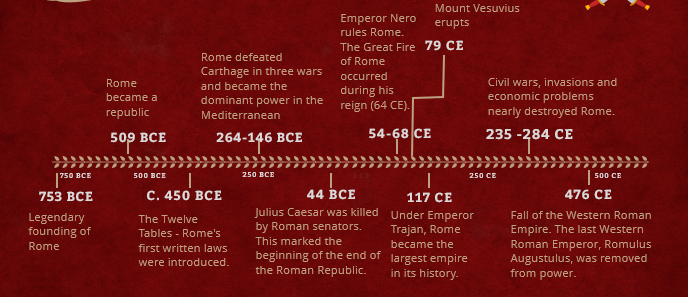
Roman Time Periods - Regal
753 BCE - 509 BCE
Rome was ruled by kings
Roman Time Periods - Republican
509 BCE - 27 BCE
Rome was governed by elected officials
Roman Time Periods - Imperial
27 BCE - 476 CE
Rome was ruled by emperors
Hierarchy
A system where people are organised into different levels of power and status.
(Roman) Citizen
A person who belonged to Rome and had legal rights and responsibilities
(Roman) Non-citizen
A person living in the Roman Empire who did not have the same rights as Roman citizens
The Social Hierarchy
Emperor
Patricians
Equites
Plebeians
Peregrini
Freedmen
Slaves
Patricians
a small, elite group of wealthy landowners
were descendants of ruling class of Rome
only married other patricians
held leadership positions; could interpret and veto the law
did not take part in trade or commerce
Equites
were high ranking citizens in the military, e.g knights and cavalry of Roman army
were initially made up of patrician men, but over time wealthy plebieans who provided their own horse could also join
were influential in politics and business
Plebeians (middle/lower class)
comprised most of the population
were considered lower class, with jobs such as shopkeeper, artisan, soldier or farmer
some were property owners and others were poor; both groups took part in the law through a citizens’ assembly
in 494 BCE, revolted against the patricians; over the next 200 years, they gained more rights including the right to marry a patrician and run for government positions
Peregrini (non-citizens)
were free men from outside Rome
had some rights, but not those of citizens, e.g could conduct business and marry citizens
by second century CE, made up 80% of the Empire’s population
were given full Roman citizenship in 212 CE
Freedmen (Liberti)
were slaves who were set free or paid for freedom
had a restricted form of citizenship
were obliged to keep working for their master, often taking the master’s family name
could run small shops or farms
Slaves
had no rights
were prisoners of war, foreigners or people sold by their families and bought as ‘goods’
by first century BCE, made up 30% to 40% of the population
most worked on farms, in mines or building roads
were treated cruelly and had a life expectancy of 17 years
Slaves captured through warfare
Capturing prisoners during military expansion was a primary engine of the slave trade. Victorious generals brought back hundreds of thousands of captives from campaigns in Gaul, Carthage, and Greece, reshaping Roman the economy into a major slave society.
Slaves used for agricultural labourers
Formed the economic backbone of ancient Rome, driving production on massive rural estates (latifundia). Field slaves endured brutal conditions, often working in chains from dawn until dusk, housed in prison-like barracks (ergastula), and treated as expendable property rather than human beings.
Domestic Servants (Slaves)
Lived inside wealthy households, performing daily chores, cooking, cleaning, and managing family finances. While they generally experienced better material conditions than rural or mine workers, they remained legal property with no rights and were subject to the total control and abuse of their owners.
Gladiators
Enslaved people, prisoners of war, or condemned criminals forced to fight in arenas for public entertainment. Despite their low legal status as property, successful ones received elite medical care, ate high-energy diets, and could win fame, wealth, or their freedom.
Freedmen
Former slaves who gained their freedom through a legal process called manumission. Upon release, they typically became Roman citizens with certain legal and political restrictions, forming a vital, industrious part of the Roman economy as merchants, craftsmen, and managers.
Why slavery mattered in the Roman Empire
It formed the foundational engine of its economy, wealth creation, and social structure. Enslaved people provided the essential labor for agriculture, mining, construction, and elite households, effectively functioning as the infrastructure that allowed Roman society to expand and thrive.
Pompeii
A thriving Roman city near Mount Vesuvius. Without warning, the volcano erupted on 24 August 79 CE, sending ash, rock and hot gases high into the sky. Over the next 24 hours, it was buried beneath metres of volcanic ash.
Why was Pompeii significant?
Provides one of the best-preserved examples of a Roman city.
Buildings, streets, food, artwork and everyday objects were preserved beneath the ash.
Archaeologists have uncovered these remains to learn about life in Ancient Rome.
Reasons why the Roman Army was one of the strongest fighting forces in the Ancient World
Well trained - soldiers trained regularly, even when there was no war
Disciplined - soldiers were expected to obey orders at all times
Organised - soldiers had a clear role and knew where to stand during battle
Well equipped - soldiers carried high quality weapons, armour and shields
The Roman Army in Numbers
A Roman legion contained about 5,000 soldiers.
There were around 30 legions across the empire. At Rome’s peak there were 50 legions.
Roman Soldier Uniform - Helmet
Galea: Used for protecting the head
Roman Soldier Uniform - Shield
Scutum: Protected soldier and was used to form shield walls such as the testudo.
Roman Soldier Uniform - Armour
Lorica segmentata: Protecting the head and body from enemy attacks. Is called ‘segmentata’, meaning ‘segments’ (or ‘parts’), as it was created out of different parts that were joined together to allow flexibility.
Roman Soldier Uniform - Sandals
Caligae: Allowed soldiers to march long distances.
Roman Soldier Uniform - Sword
Used for close hand-to-hand fighting
Roman Soldier Uniform - Dagger
Pugio: A small weapon used as a backup
Roman Soldier Uniform - Spear
Thrown before close combat to weaken the enemy.
Trajan’s Column
Built in AD 113 to celebrate Emperor Trajan's victory in the Dacian Wars.
The column is covered with stone reliefs— carvings that stand out from the surface— showing Roman soldiers in battle.
Today, it helps historians understand Roman warfare, weapons, armour and military tactics.
Colosseum
Opened in 80 CE
• Could hold around 50,000 spectators
• Used for gladiator contests, animal hunts and public spectacles
• One of the largest amphitheatres ever built
Seating in the Colosseum
• Entry was free for all Roman citizens
• Places were divided according to social status – the seats at the top were for the common people, with distinct sections for men and women.
• The nearer to the arena, the higher social status
Arena - The Colosseum
• Stage for shows
• Floor was made out of a mixture of brick and wood
• The floor was sometimes covered in sand, which gladiators used to blind others before killing them
Underground areas - the Colosseum
• Housed lifts and hoists with counter-weights, which were used to hoist up animals and gladiators who burst into the arena through trapdoors
• There was an underground passageway which was linked directly to the Gladiators’ barracks
Religion in Ancient Rome
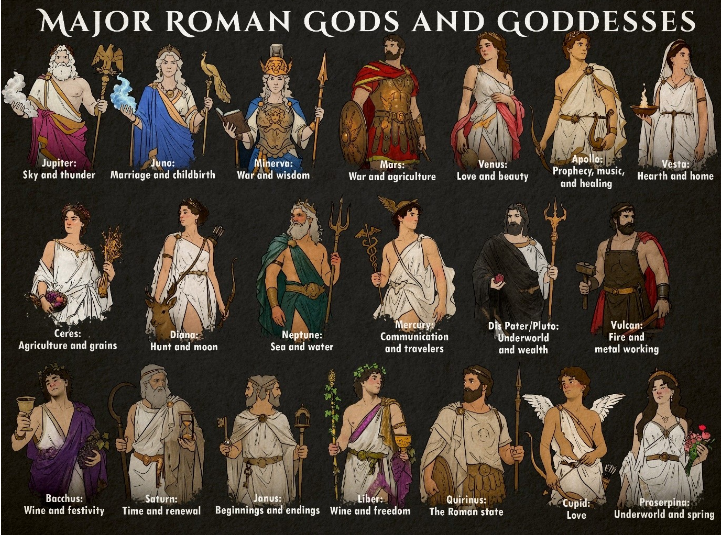
The Romans worshipped multiple gods and they firmly believed that these gods had direct influence over their daily lives. They performed rituals and sacrifices to appease them and sought favor for various aspects of life, including agriculture, warfare, and family.
Christianity in Ancient Rome
For about 300 years, Romans who converted to Christianity were often tortured or killed. However, St Paul helped to spread Christianity’s message throughout the empire. It appealed to the poor masses and slaves as the religion preached to help those most in need.
Secret gatherings would occur in underground tombs with growing numbers. By 313 CE, Christianity was legal and churches were built in Rome. By 380 CE< Emperor Theodosius made it Rome’s official religion.
Major Roman Gods and Goddesses
Conspirator
A person who secretly plans with others to do something, often to overthrow or harm someone.
Assassination
The planned killing of an important person, usually for political reasons.
Civil War
A war fought between groups within the same country.
Dictator
A ruler given complete power over a country.
Life in Ancient Rome - Urban Planning
Massive Networks for roads
Aqueducts, water from nearby mountains, rivers and lakes
This was important to everyday life because it improved trade, public health, and living conditions throughout the empire
Life in Ancient Rome - Roman Housing
Homes varied based on a person’s social status or wealth
They were generally colourful houses
Roman villas were large country houses for wealthy people, which were usually surrounded by farmland.
Ordinary Romans lived in insulaes (apartments), which were crowded, noisy and uncomfortable.
This was important to everyday life because housing provided Romans a place to live, and how social status affected how they lived.
Life in Ancient Rome - Fashion
People who were wealthier could afford better fabrics
An adult male citizen wore a toga
Married women citizens wore a stola
The colour purple was valuable, as the dye was rare
This was important to everyday life because it showed a person’s status through fashion. Jewellery, hair styles, and footwear were a way to show status.
Life in Ancient Rome - Education
Highly valued in Ancient Rome
Not every child had the opportunity to attend school
Children from wealthy families were often taught by private tutors or attended schools where they learned reading, writing and mathematics
Boys generally received more formal education than girls, although girls from wealthy families sometimes received private tutoring at home
This was important to everyday life as education prepared younger Romans for responsibilities when in adulthood and helped preserve Rome’s traditions and culture.
Being able to speak confidently was an important skill for anyone hoping to become a politician, lawyer or government official
Life in Ancient Rome - Roman Baths
Enter baths: specific routine – exercise in open courtyard, enter to tepidarium
Heated room – caldarium
This was important to everyday life, because hygeine was important. It also allowed a place for people to connect, meet new people, exercise, and business.
Life in Ancient Rome - Food and Dining
Bread was the main food, which was often eaten with olives, vegetables, cheese or fruit
Markets were a place to buy food
Banquets were hosted by ‘rich people’, used to impress guests. They had lots of food and could last for hours.
This was important to everyday life, as food was essential for survival. These banquets showed wealth, hospitality, and social status.
The Fall of Ancient Rome
Rome did not fall because of one single problem
Political, economic, military and social problems all made the empire weaker
As these problems grew, Rome became less able to defend itself and govern its people
In 476 CE, the last Western Roman Emperor was removed from power, marking the end of the Western Roman Empire