UWorld RxPrep MPJE 8th Edition - Chapter 5: Compounding (Missouri-Focused)
 Call Kai
 Learn
Learn Practice Test
 Spaced Repetition
 Match
Match Flashcards
 Knowt Play
1/57

There's no tags or description
Looks like no tags are added yet.
Name | Mastery | Learn | Test | Matching | Spaced | Call with Kai | Chat |
|---|
No analytics yet
Send a link to your students to track their progress
58 Terms
In order for a pharmacist to prepare a compounded drug for an individual patient, the dose or formulation cannot be:
commercially available
________________ sets the standards for compounding preparations.
USP (U.S. Pharmacopeia)
What USP chapter includes nonsterile preparations?
795
What USP chapter includes sterile preparations?
797
What USP chapter includes hazardous drugs?
800
Due to a fungal meningitis outbreak caused by contaminated methylprednisolone injections prepared at the New England Compounding Center, in 2012 the FDA revised the Drug Quality and Security Act (DQSA) to divide compounding pharmacies into what two groups?
503A and 503B
___________ facilities are pharmacies that perform traditional compounding based on patient-specific prescriptions.
503A
___________ facilities are pharmacies that can prepare medications in bulk and without a prescription written for an individual patient.
503B
___________ facilities are registered with their state boards of pharmacies and the DEA, while ___________ facilities are registered with the FDA.
503A; 503B
Which type of compounding facility can compound medications for office use?
503B
Does Missouri have stricter requirements for compounding than federal requirements?
no
In Missouri, can out-of-state pharmacies compound drugs for dispensing to patients in this state?
Yes, a Missouri non-resident pharmacy permit must be obtained. This includes an application fee, copy of recent inspection and acknowledgement of a compounding activity statement.
All APIs must be manufactured at an FDA-registered facility and have a ______________________ to confirm the quality.
Certificate of Analysis (CoA)
For nonsterile compounding, if the pharmacist has to assign an expiration date (i.e., a component is without an expiration date), that date should be no more than _______ years from the date of receipt.
3
For sterile compounding, if the pharmacist has to assign an expiration date (i.e., a component is without an expiration date), that date should be no more than _______ years from the date of receipt.
1
Nonsterile, aqueous (Aw > 0.60), nonpreserved preparations should have a BUD of:
14 days (store in refrigerator)
Nonsterile, aqueous (Aw > 0.60), preserved preparations should have a BUD of:
35 days
Nonsterile, nonaqueous (Aw < 0.60), oral preparations should have a BUD of:
90 days
Nonsterile, nonaqueous (Aw < 0.60), nonoral preparations should have a BUD of:
180 days
The ____________________ sets the standards for air quality, which is determined by the number and size of particles per volume of air.
ISO (International Standards Organization)
The ___________ (lower/higher) the particle count, the lower the ISO class number, and the ___________ (cleaner/dirtier) the air.
lower; cleaner
In critical areas that are closest to exposed sterile drugs and containers (i.e., inside the sterile hood), the air must be at least ISO _____.
5
What type of device or room provides an ISO 5 environment for sterile compounding?
PEC (primary engineering control)
What is the most common way to achieve ISO 5 air?
using a sterile hood (i.e., laminar airflow workbench (LAFW)
A compounding aseptic isolator (CAI) is a type of PEC that is often located where instead of a buffer room?
SCA (segregated compounding area)
A compounding aseptic isolator (CAI) is commonly referred to a _______________.
glovebox
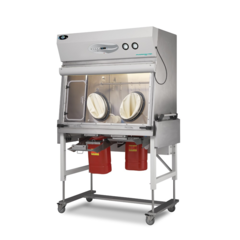
What is the room called that contains the PEC or multiple PECs, and what is it commonly called?
SEC (secondary engineering control); buffer area
The buffer area (SEC) must be at least ISO ______.
7
The _____________ connects the rest of the pharmacy to the buffer room (SEC).
anteroom
The anteroom must be at least ISO ______ if it opens into a positive-pressure area (non-hazardous sterile compounding), or at least ISO ______ if it opens into a negative-pressure buffer area (hazardous sterile compounding)
8; 7
For non-hazardous compounding, what type of air pressure is required inside the PEC and SEC?
positive
What can be performed to determine if a longer BUD is possible?
stability and sterility testing
How often is a passing score required on the gloved fingertip test?
initially then every 6 months is compounding only Category 1 and 2 CSPs or every 3 months if compounding Category 3 CSPs
To pass the media-fill test, the liquid must stay clear after _______ days of incubation.
14
How often must the media-fill test be performed by a compounder?
initially during training and at least every 6 months for Category 1 and 2 CSPs or at least every 3 months for Category 3 CSPs
How often must the temperature of the SEC (buffer room) be checked? What temperature must it be kept under?
once daily; 20C (68F) or lower
How often must the temperature of CSP storage areas (e.g., refrigerator, freezer) be checked? What temperature must it be kept at?
daily; between 2-8 °C for fridge and between -25 and -10 °C for freezer
How often is airborne particle sampling performed as a test to ensure that the compounding environment for sterile products is acceptably free of contaminants?
every 6 months
How often is surface sampling performed as a test to ensure that the compounding environment for sterile products is acceptably free of contaminants?
every 30 days and at the end of each shift for areas touched most frequently (door handles, inside PEC, etc)
How often is air pressure testing performed as a test to ensure that the compounding environment for sterile products is acceptably free of contaminants?
at least once daily or with every work shift
Who determines which drugs are hazardous and require special precautions in order to prevent work-related injury and illness?
NIOSH (National Institute for Occupational Safety and Health)
_____________ are safety documents required by OSHA to be accessible to all employees who work with hazardous materials.
SDS (safety data sheets)
How often must a pharmacy review their list of hazardous drugs they stock?
every 12 months or whenever a new drug or dosage form is stocked or used
Hoods and buffer rooms used for compounding HDs include the word ___________________.
containment
The C-SEC must maintain ISO _____ air at all times.
7
The air in a C-PEC and C-SEC must be externally ventilated through ________________________ with > ______ air changes per hour (ACPH) for sterile HD compounding.
HEPA filtration; 30
The air in a C-PEC and C-SEC must be externally exhausted or passed through at least ________________________ with > ______ air changes per hour (ACPH) for nonsterile HD compounding.
two HEPA filters in a series; 12
C-PECs and C-SECs have (positive/negative) air pressure.
negative
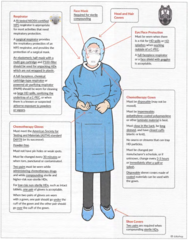
What are the garbing requirements for hazardous drugs?
1) two pairs of ASTM D6978 (chemo)-rated gloves when compounding or cleaning spills, one pair for receiving and storing
2) disposable and impermeable gowns for preparing, administering, and spill clean-up
3) head, hair, and shoe covers (2 paid for sterile)
4) eye and face protection if there is a risk for spills or splashes
5) N95 respirator
All trace antineoplastic waste should go in what color container?
yellow
All bulk antineoplastic waste should go in what color container?
black
Pharmacies must perform wipe sampling of all HD compounding surfaces to ensure that hazardous residue is adequately controlled how often?
initially and every 6 months
Personnel should receive initial training before handling any HDs, and competency should be assessed how often thereafter?
every 12 months or when a new HD or equipment is introduced
An N95 respirator is sufficient for most HD compounding, but does not provide adequate protection against gases, vapors, or direct liquid splashes. When there is a risk of respiratory exposure, what type of protection should be worn instead?
a fit-tested respirator mask with attached gas canisters ("gas mask") or a powered air-purifying respirator (PAPR) that blows air through a filter to the user
Container labels for sterile and nonsterile compounded products must contain what information?
1) generic name of active and inactive ingredients
2) quantity or concentration of each API
3) dosage form or volume
4) BUD
5) storage conditions and auxiliary labels
6) prescription or lot number
Does Missouri have specific requirements for labeling compounded products?
Sterile preparations shall be labeled with:
1) Beyond-use date
2) Storage requirements
3) Any device specific instructions
4) Auxiliary labels
5) Designation if preparation is hazardous
A ______________________ plan outlines the steps and actions that ensure the maintenance of proper standards for compounded preparations and includes the SOPs, which are itemized steps on how to perform routine and expected tasks in the pharmacy.
quality assurance (QA)
If a FDA-approved drug is being repackaged (e.g., tablets or capsules are left intact in the original form and put into a different container), USP and FDA guidance assigns a BUD of ____________ From the date of repackaging.
6 months