CFA L1 - Incorrect Questions
 Call Kai
 Learn
Learn Practice Test
 Spaced Repetition
 Match
Match Flashcards
 Knowt Play
1/3

There's no tags or description
Looks like no tags are added yet.
Name | Mastery | Learn | Test | Matching | Spaced | Call with Kai | Chat |
|---|
No analytics yet
Send a link to your students to track their progress
4 Terms
An interest rate is best interpreted as a?
Required rate of return or the opportunity cost of consumption
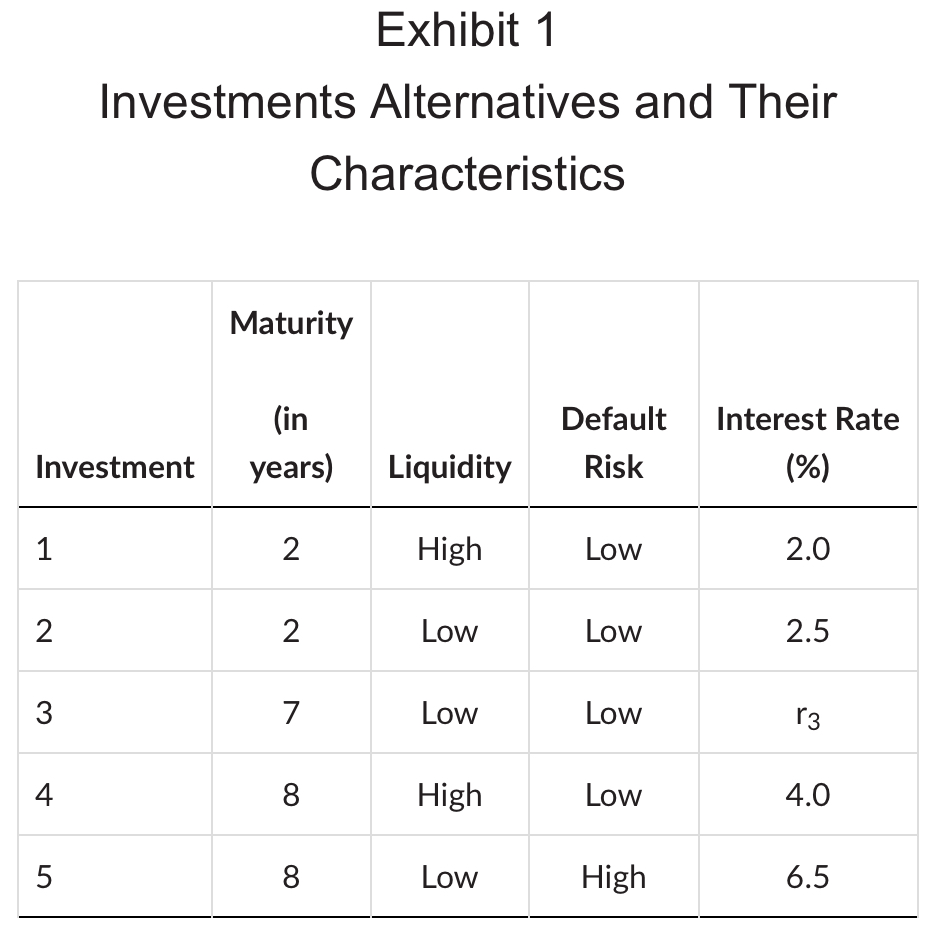
Estimate the default risk premium effecting all securities
To estimate the default risk premium, identify two investments that have the same maturity but different levels of default risk. Investments 4 and 5 both have a maturity of eight years but different levels of default risk. Investment 5, however, has low liquidity and thus bears a liquidity premium relative to Investment 4. From Part A, we know the liquidity premium is 0.5 percent. The difference between the interest rates offered by Investments 5 and 4 is 2.5 percent (6.5% − 4.0%), of which 0.5 percent is a liquidity premium. This implies that 2.0 percent (2.5% − 0.5%) must represent a default risk premium reflecting Investment 5’s relatively higher default risk.
An investor buys a share of stock for $40 at time t = 0, buys another share of the same stock for $50 at t = 1, and sells both shares for $60 each at t = 2. The stock paid a dividend of $1 per share at t = 1 and at t = 2. The periodic money-weighted rate of return on the investment is closest to:
22.2%, 23.0%, 23.8%
Using the cash flow functions on your financial calculator, enter CF0 = –40; CF1 = –50 + 1 = –49; CF2 = 60 × 2 + 2 = 122; and CPT IRR = 23.82%.
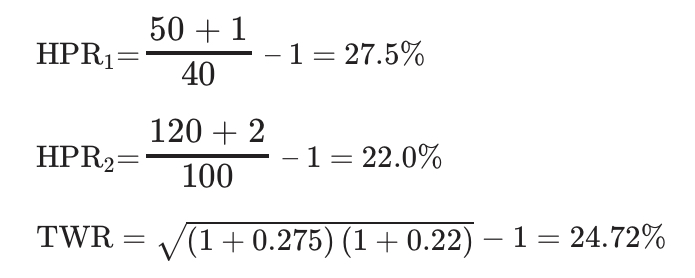
An investor buys a share of stock for $40 at time t = 0, buys another share of the same stock for $50 at t = 1, and sells both shares for $60 each at t = 2. The stock paid a dividend of $1 per share at t = 1 and at t = 2. The time-weighted rate of return on the investment for the period is closest to:
24.7%, 25.7%, 26.8%