GPE Spring 2025 Chapter 3
 Studied by 0 people
 Call Kai
 Learn
Learn Practice Test
 Spaced Repetition
 Match
Match Flashcards
 Knowt Play
1/28

There's no tags or description
Looks like no tags are added yet.
Name | Mastery | Learn | Test | Matching | Spaced |
|---|
No study sessions yet.
29 Terms
What does “comparative advantage” mean in trade theory?
The ability of a country to produce a good at a lower opportunity cost than another country.
What does “absolute advantage” mean?
The ability of a country to produce more of a good with the same resources than another country.
According to Ricardo, why should countries specialize?
Because specialization according to comparative advantage increases overall efficiency and welfare.
What does the Heckscher-Ohlin model emphasize?
That countries export goods using their abundant factors and import goods using their scarce factors.
What does the term “factor endowments” mean?
The resources (land, labor, capital) a country possesses that determine comparative advantage.
What does “terms of trade” measure?
The ratio of export prices to import prices.
If terms of trade improve, what happens to a country’s purchasing power?
It rises, since the country can buy more imports per unit of exports.
What does “increasing returns to scale” mean?
Costs per unit fall as production increases.
What are quotas?
Limits on the quantity of imports allowed into a country.
What are non-tariff barriers?
indirect obstacles to trade (rules and restrictions)
What is protectionism?
Policies designed to restrict trade to protect domestic industries.
What is an antidumping duty?
A tariff imposed to counter dumping practices.
What is the World Trade Organization’s main role?
To regulate international trade, resolve disputes, and enforce agreements.
What principle requires WTO members to treat all trading partners equally?
Most Favored Nation (MFN).
What is “national treatment” in WTO rules?
Foreign goods must be treated the same as domestic goods once inside a country.
What are regional trade agreements (RTAs)?
Agreements between countries in a region to reduce barriers and increase trade.
What are free trade areas (FTAs)?
Arrangements where members eliminate tariffs among themselves but maintain independent external policies.
Trade barriers decrease the size of the potential market hampering
the prospects of specialization, technological progress, mutually beneficial exchange, and wealth creation
What is trade creation?
When regional integration leads to replacement of higher-cost domestic production with lower-cost imports from members.
What is a trade surplus?
When exports exceed imports.
What is a trade deficit?
When imports exceed exports.
What is foreign direct investment (FDI)?
Investment where a firm acquires a lasting interest and control in a foreign enterprise.
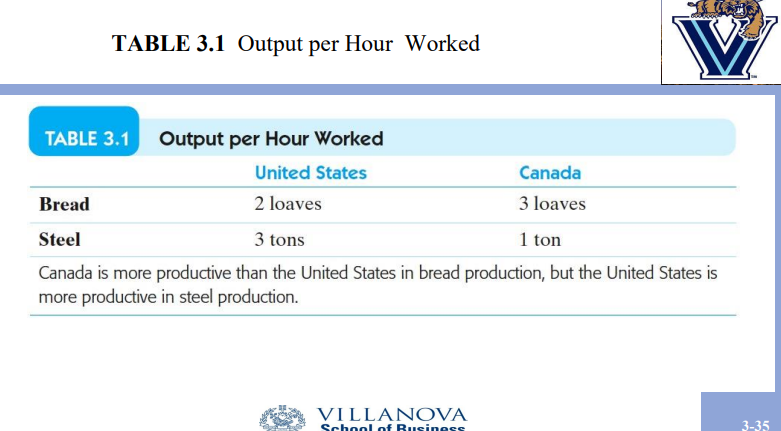
what is US opportunity cost of steel?
2/3 loads of bread
Comparative advantage allows a country that lacks absolute advantage to sell its products abroad; it implies that each country or region should produce, manufacture or create what it can produce
most “efficiently” (eg. using the least amounts of raw materials or inputs). This is the basis of all international trade
In South Korea, the fertility rate — the average number of children born to a woman in her reproductive years — is now 0.
68,
Demographic dividend requires a demographic transition, in other words, where a country switches from a largely rural agrarian economy with high fertility and high mortality rates to an urban industrial society characterized by
low fertility and low mortality rates.
dependency ratio is an age-population ratio of those typically not in the labor force (the dependent part ages 0 to 14 and 65+) and those typically in the labor force (the productive part ages 15 to 64). It is used
to measure the pressure on the productive population.
South Korea Comparative advantage?
Education, (2) Capital, (3) Infrastructure
chaebols
large family-owned business conglomerate.