Exam 1 Review - Strategic Management
 Call Kai
 Learn
Learn Practice Test
 Spaced Repetition
 Match
Match Flashcards
 Knowt Play
1/23

There's no tags or description
Looks like no tags are added yet.
Name | Mastery | Learn | Test | Matching | Spaced | Call with Kai | Chat |
|---|
No analytics yet
Send a link to your students to track their progress
24 Terms
Strategic Management
a diagnosis of the competitive challenge (analysis of firm’s internal/external environments)
guiding policy to address the competitive challenge (formulation results in corporate, business, and functional strategies)
set of coherent actions to implement the firm’s guiding policy (implementation)
Sustainable Competitive Advantage
a firm is able to outperform its competitors or the industry average over a prolonged period
Difficulty of Sustainable Competitive Advantage
pace of technology and external factor increase the difficulty in sustaining competitive advantage
Unique Strategic Position
a successful combination of strategic activities
Where does competitive advantage come from
performing different activities
performing the same activities differently than rivals
Vision
What do we want to accomplish ulimately?
Mission
How do we accomplish our goals?
Values
what commitments do we make?
what safeguards do we put in place?
how do we act both legally and ethically as we pursue our vision and mission?
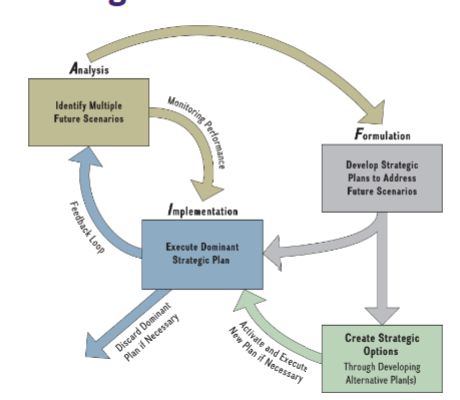
Scenario Planning
Tradeoffs
Managers must make tradeoffs
how to allocate resources?
which activities to pursue?
The PESTEL Framework
1.) Political
2.) Economic
3.) Sociocultural
4.) Technological
5.) Ecological
6.) Legal
Strategic Positioning
a firms ability to create value for customers (V) while containing costs (C)
goal is to generate a large gap between V-C
Porter’s Five Forces Model

Resources, Capabilities, and Activities
help organizations develop core competencies
Resources
any asset that firms can draw on when crafting and executing strategy (cash, buildings, machinery, IP)
Capabilities
organizational and managerial skills needed to orchestrate resources (structure, routine, culture)
Activities
distinct and fine-grained business procedures (order-taking, invoicing)
Core Competencies
unique strengths embedded deep within a firm; expressed through structures, processes, routines and allow the firm to differentiate from rivals
Resource-Based View (RBV)
helps identify core competencies; resources (assets, capabilities, competencies) are key to superior firm performance
Resources fall into 2 categories:
tangible resources that have physical and visible attributes
intangible resources are not physical or visible
Resource Heterogeneity
a firm is a unique bundle of resources, capabilities, and competencies; these bundles differ across firms
Resource Immobility
resources are “sticky” and do move easily from firm to firm
are difficult to replicate
can last for a long time
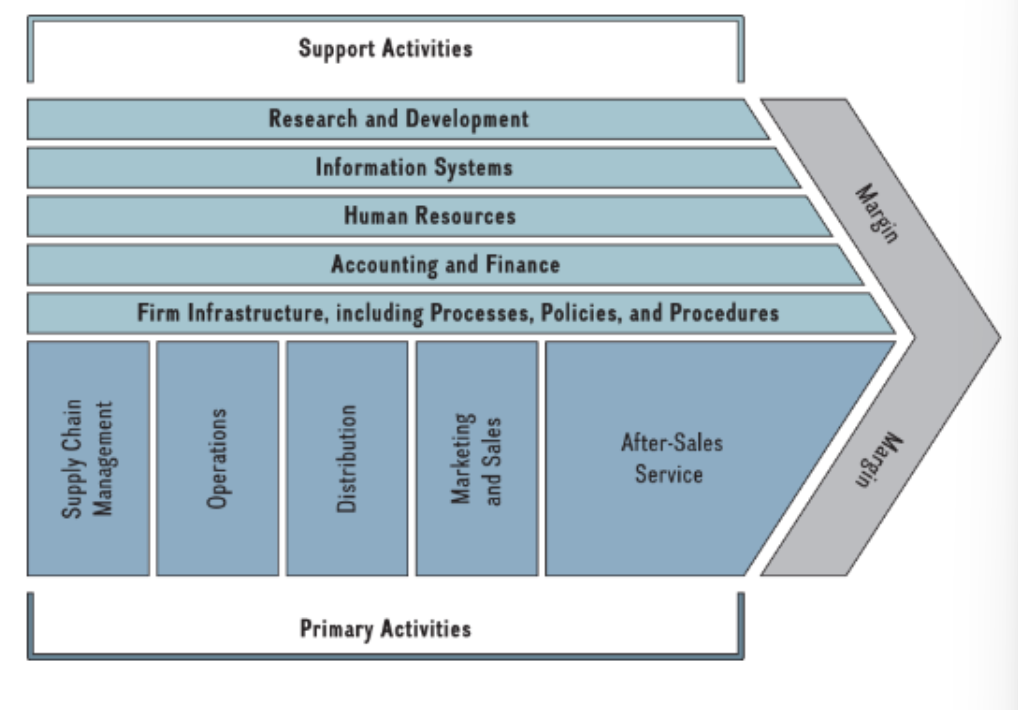
firm value chain
core strategic vision
an organization's aspirational, future-oriented destination and the compelling purpose that guides its actions and decisions to achieve long-term goals, providing direction, inspiring stakeholders, and aligning resources toward a shared ambition
are the company’s resources, capabilities, and strategy aligned with core vision, mission, and value statements?