APES Exam: Study guide
 Call Kai
 Learn
Learn Practice Test
 Spaced Repetition
 Match
Match Flashcards
 Knowt Play
1/204

There's no tags or description
Looks like no tags are added yet.
Name | Mastery | Learn | Test | Matching | Spaced | Call with Kai | Chat |
|---|
No analytics yet
Send a link to your students to track their progress
205 Terms
Ecological Footprint
Amount of biologically productive land and water needed to supply a population with the renewable resources it uses and to absorb or dispose of the wastes from such resource use. It is a measure of the average environmental impact of populations in different countries and areas
Ecological Tipping Point
Threshold level at which an environmental problem causes a fundamental and irreversible shift in the behavior of a system.
Ecology
Biological science that studies the relationships between living organisms and their environment; study of the structure and functions of nature.
Natural Capital
Natural resources and natural services that keep us and other species alive and support our economies.
Per Capita
Annual gross domestic product (GDP) of a country divided by its total population at midyear. It gives the average slice of the economic (or environmental) pie per person.
Ecosystem Services
Natural services or natural capital that support life on the earth and are essential to the quality of human life and the functioning of the world's economies.
Perpetual Resource
has a never-ending supply. Some examples of perpetual resources include solar energy, tidal energy, and wind energy
Environmental Wisdom Worldview
Set of assumptions and beliefs about how people think the world works, what they think their role in the world should be, and what they believe is right and wrong environmental behavior (environmental ethics).
Planetary Management Worldview
Worldview holding that humans are separate from nature, that nature exists mainly to meet our needs and increasing wants, and that we can use our ingenuity and technology to manage the earth's life-support systems, mostly for our benefit. It assumes that economic growth is unlimited.
Stewardship Worldview
Worldview holding that we can manage the earth for our benefit but that we have an ethical responsibility to be caring and responsible managers, or stewards, of the earth. It calls for encouraging environmentally beneficial forms of economic growth and discouraging environmentally harmful forms.
Sustainability
Ability of earth's various systems, including human cultural systems and economies, to survive and adapt to changing environmental conditions indefinitely.
scientific principles of sustainability
To live more sustainably we need to rely on solar energy, preserve biodiversity, and recycle the chemicals that we use. These three principles of sustainability are scientific lessons from nature based on observing how life on the earth has survived and thrived for 3.5 billion years
First Law of Thermodynamics
Whenever energy is converted from one form to another in a physical or chemical change, no energy is created or destroyed, but energy can be changed from one form to another; you cannot get more energy out of something than you put in; in terms of energy quantity, you cannot get something for nothing. This law does not apply to nuclear changes, in which large amounts of energy can be produced from small amounts of matter.
Second Law of Thermodynamics
Whenever energy is converted from one form to another in a physical or chemical change, no energy is created or destroyed, but energy can be changed from one form to another; you cannot get more energy out of something than you put in; in terms of energy quantity, you cannot get something for nothing. This law does not apply to nuclear changes, in which large amounts of energy can be produced from small amounts of matter. It asserts that a natural process runs only in one sense, and is not reversible.
Negative Feedback Loop
Feedback loop that causes a system to change in the opposite direction from which is it moving.
Positive Feedback Loop
Feedback loop that causes a system to change further in the same direction
Law of Conservation of Matter
In any physical or chemical change, matter is neither created nor destroyed but merely changed from one form to another; in physical and chemical changes, existing atoms are rearranged into different spatial patterns (physical changes) or different combinations (chemical changes).
Electromagnetic Radiation
Forms of kinetic energy traveling as electromagnetic waves. Examples include radio waves, TV waves, microwaves, infrared radiation, visible light, ultraviolet radiation, X-rays, and gamma rays.
Ph
Numeric value that indicates the relative acidity or alkalinity of a substance on a scale of 0 to 14, with the neutral point at 7. Acid solutions have pH values lower than 7; basic or alkaline solutions have pH values greater than 7.
High-Quality energy
energy that is concentrated and has great ability to perform useful work; e.g. heat and energy in electricity, coal, oil, gasoline, sunlight, nuclei of uranium-235
low quality energy
energy that is dispersed and has little ability to do useful work; e.g. low-temperature heat
Ions
Atom or group of atoms with one or more positive (+) or negative (−) electrical charges. Examples are Na+ and Cl-.
Isotopes
Two or more forms of a chemical element that have the same number of protons but different mass numbers because they have different numbers of neutrons in their nuclei.
Species
Group of similar organisms, and for sexually reproducing organisms, they are a set of individuals that can mate and produce fertile offspring. Every organism is a member of a certain species.
Population
Group of individual organisms of the same species living in a particular area.
Community
Populations of all species living and interacting in an area at a particular time.
Ecosystems
One or more communities of different species interacting with one another and with the chemical and physical factors making up their nonliving environment.
Biosphere
Zone of the earth where life is found. It consists of parts of the atmosphere (the troposphere), hydrosphere (mostly surface water and groundwater), and lithosphere (mostly soil and surface rocks and sediments on the bottoms of oceans and other bodies of water) where life is found.
Atmosphere
Whole mass of air surrounding the earth.
Troposphere
Innermost layer of the atmosphere. It contains about 75% of the mass of earth's air and extends about 17 kilometers (11 miles) above sea level.
Stratosphere
Second layer of the atmosphere, extending about 17-48 kilometers (11-30 miles) above the earth's surface. It contains small amounts of gaseous ozone , which filters out about 95% of the incoming harmful ultraviolet radiation emitted by the sun.
Hydrosphere
Earth's liquid water (oceans, lakes, other bodies of surface water, and underground water), frozen water (polar ice caps, floating ice caps, and ice in soil, known as permafrost), and water vapor in the atmosphere. See also hydrologic cycle.
Abiotic
Nonliving
Biotic
Living
Aerobic Respiration
Complex process that occurs in the cells of most living organisms, in which nutrient organic molecules such as glucose combine with oxygen to produce carbon dioxide , water , and energy.
Anaerobic Respiration (Fermentation)
Form of cellular respiration in which some decomposers get the energy they need through the breakdown of glucose (or other nutrients) in the absence of oxygen.
Autotrophs/Producers
Organism that uses solar energy (green plants) or chemical energy (some bacteria) to manufacture the organic compounds it needs as nutrients from simple inorganic compounds obtained from its environment.
Photosynthesis
Complex process that takes place in cells of green plants. Radiant energy from the sun is used to combine carbon dioxide and water to produce oxygen , carbohydrates (such as glucose, ), and other nutrient molecules.
Gross Primary Productivity (GPP)
Rate at which an ecosystem's producers capture and store a given amount of chemical energy as biomass in a given length of time.
Heterotrophs/Consumers
Organism that cannot synthesize the organic nutrients it needs and gets its organic nutrients by feeding on the tissues of producers or of other consumers; generally divided into primary consumers(herbivores), secondary consumers (carnivores), tertiary(higher-level) consumers, omnivores, and detritivores(decomposers and detritus feeders).
Carnivores
Animal that feeds on other animals.
Omnivores
Animal that can use both plants and other animals as food sources.
Herbivores (Primary Consumers)
Organism that feeds on some or all parts of plants (herbivore) or on other producers.
Decomposer
Organism that digests parts of dead organisms, and cast-off fragments and wastes of living organisms by breaking down the complex organic molecules in those materials into simpler inorganic compounds and then absorbing the soluble nutrients. Producers return most of these chemicals to the soil and water for reuse. Decomposers consist of various bacteria and fungi.
Detritivores
Consumer organism that feeds on detritus, parts of dead organisms, and cast-off fragments and wastes of living organisms. Examples include earthworms, termites, and crabs.
Food Chain
Series of organisms in which each eats or decomposes the preceding one. Shows how each living thing gets food, and how nutrients and energy are passed from creature to creature
Food Web
Complex network of many interconnected food chains and feeding relationships.
Trophic Level
each of several hierarchical levels in an ecosystem, comprising organisms that share the same function in the food chain and the same nutritional relationship to the primary sources of energy.
Pyramid of Energy Flow
Diagram representing the flow of energy through each trophic level in a food chain or food web. With each energy transfer, only a small part (typically 10%) of the usable energy entering one trophic level is transferred to the organisms at the next trophic level.
Biogeochemical Cycles
pathway by which a chemical substance moves through both the biotic (biosphere) and abiotic (lithosphere, atmosphere, and hydrosphere) components of Earth.
Carbon Cycle
the series of processes by which carbon compounds are interconverted in the environment, chiefly involving the incorporation of carbon dioxide into living tissue by photosynthesis and its return to the atmosphere through respiration, the decay of dead organisms, and the burning of fossil fuels

Greenhouse Gases
a gas that contributes to the greenhouse effect by absorbing infrared radiation, e.g., carbon dioxide and chlorofluorocarbons.
Hydrologic Cycle
Biogeochemical cycle that collects, purifies, and distributes the earth's fixed supply of water from the environment to living organisms and then back to the environment

Nitrogen Cycle
Cyclic movement of nitrogen in different chemical forms from the environment to organisms and then back to the environment

Phosphorus Cycle
Cyclic movement of phosphorus in different chemical forms from the environment to organisms and then back to the environment

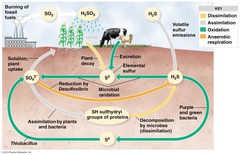
Sulfur Cycle
Cyclic movement of sulfur in various chemical forms from the environment to organisms and then back to the environment.
Adaptation
a change or the process of change by which an organism or species becomes better suited to its environment.
Background Extinction
refers to the standard rate of extinction in earth's geological and biological history before humans became a primary contributor to extinctions.
Mass Extinction
The extinction of a large number of species within a relatively short period of geological time, thought to be due to factors such as a catastrophic global event or widespread environmental change that occurs too rapidly for most species to adapt.
Biological Diversity
variability among living organisms from all sources including, inter alia, terrestrial, marine and other aquatic ecosystems and the ecological complexes of which they are part; this includes diversity within species, between species and of ecosystems.
Biological Evolution
defined as any genetic change in a population that is inherited over several generations.
Ecological Niche
is the role and position a species has in its environment; how it meets its needs for food and shelter, how it survives, and how it reproduces.
Native Species
Found originally in the area: can be either endemic (found only within a particular region) or indigenous (found both within the region and elsewhere)
Nonnative Species
Introduced to area: can be either endemic (found only within a particular region) or indigenous (found both within the region and elsewhere)
Endemic Species
plants and animals that exist only in one geographic region.
Indicator Species
indicates if levels of something are off in environment, ex lichen
Keystone Species
a species on which other species in an ecosystem largely depend, such that if it were removed the ecosystem would change drastically. (Alligator)
Foundation Species
used to refer to a species that has a strong role in structuring a community. ( kelp, whose existence provide shelter and suitable habitat for numerous other organisms in marine ecosystems)
Extinction
the state or process of a species, family, or larger group being or becoming extinct.
Fossils
the remains or impression of a prehistoric organism preserved in petrified form or as a mold or cast in rock.
Generalist Species
able to thrive in a wide variety of environmental conditions and can make use of a variety of different resources
Specialist Species
able to thrive in limited environmental conditions
Species
a group of living organisms consisting of similar individuals capable of exchanging genes or interbreeding.
Speciation
the formation of new and distinct species in the course of evolution.
Species Diversity
the measure of diversity in an ecological community
Theory of Evolution
is the process by which organisms change over time as a result of changes in heritable physical or behavioral traits
Mutations
the changing of the structure of a gene, resulting in a variant form that may be transmitted to subsequent generations, caused by the alteration of single base units in DNA, or the deletion, insertion, or rearrangement of larger sections of genes or chromosomes.
Freshwater
not of the sea
Rivers
a large natural stream of water flowing in a channel to the sea, a lake, or another such stream.
Source Zone
headwater or mountain highand streams of cold, clear water rush over waterfals and rapids.
Transition Zone
the headwater streams merge to form wider, deeper streams that flow down gentler slopes with fewer obstacles.
Floodplain Zone
streams join into wider and deeper rivers that meander across broad, flat valleys.
Eutrophic Lake
commonly a lake or pond, has high biological productivity. Due to excessive nutrients, especially nitrogen and phosphorus, these water bodies are able to support an abundance of aquatic plants.
Mesotrophic Lake
fall somewhere in between eutrophic and oligotrophic lakes
Oligotrophic Lake
characterized by a low accumulation of dissolved nutrient salts, supporting but a sparse growth of algae and other organisms, and having a high oxygen content owing to the low organic content
Littoral Zone
the nearshore area where sunlight penetrates all the way to the sediment and allows aquatic plants (macrophytes) to grow
Limnetic Zone
the well-lit, open surface waters in a lake, away from the shore.
Profundal Zone
a deep zone of an inland body of freestanding water, such as a lake or pond, located below the range of effective light penetration.
Benthic Zone
the ecological region at the lowest level of a body of water such as an ocean or a lake, including the sediment surface and some sub-surface layers.
Turbidity
secchi disk,the cloudiness or haziness of a fluid caused by large numbers of individual particles that are generally invisible to the naked eye, similar to smoke in air
Salinity
is the measure of all the salts dissolved in water.
DO
(dissolved oxygen) is the amount of oxygen that is present in the water
Inland Wetlands
Land away from the coast, such as a swamp, marsh, or bog, that is covered all or part of the time with freshwater. Compare coastal wetland.
Mitigation Banking
allows destruction of existing wetlands as long as an equal or greater area of the same type of wetland is created or restored
Marine
of, found in, or produced by the sea
Saltwater
of or found in salt water; living in the sea.
Euphotic Zone
sunlight zone is the depth of the water in a lake or ocean that is exposed to such intensity of sunlight which designates compensation point
Intertidal Zone
The area of shoreline between low and high tides.
Open Sea
Part of an ocean that lies beyond the continental shelf.
Abyssal Zone
"bottomless" the bottom of a sea, no light