Bio 112
 Note
Note Call Kai
 Learn
Learn Practice Test
 Spaced Repetition
 Match
Match Flashcards
 Knowt Play
1/44

Earn XP
Description and Tags
4
Name | Mastery | Learn | Test | Matching | Spaced | Call with Kai | Chat |
|---|
No analytics yet
Send a link to your students to track their progress
45 Terms
Meiosis
A specialized form of cell division that reduces the chromosome number by half, resulting in four genetically diverse daughter cells.
Meiosis I
The first stage of meiosis, where homologous chromosomes are separated.
Meiosis II
The second stage of meiosis, where sister chromatids are separated into haploid cells.
Gametes
Reproductive cells (sperm and eggs) produced during meiosis.
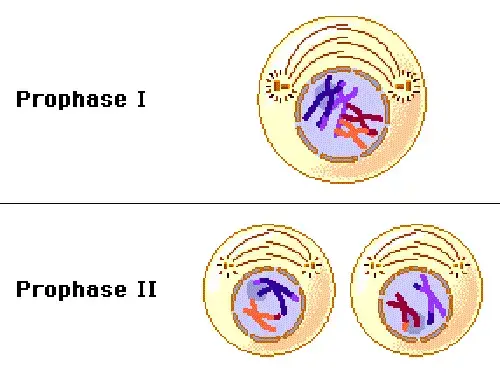
Prophase I
chromosomes condense and homologous chromosomes pair up to form bivalents. While paired, they exchange sections of DNA in a process called crossing over. This creates genetic variation in the resulting cells.
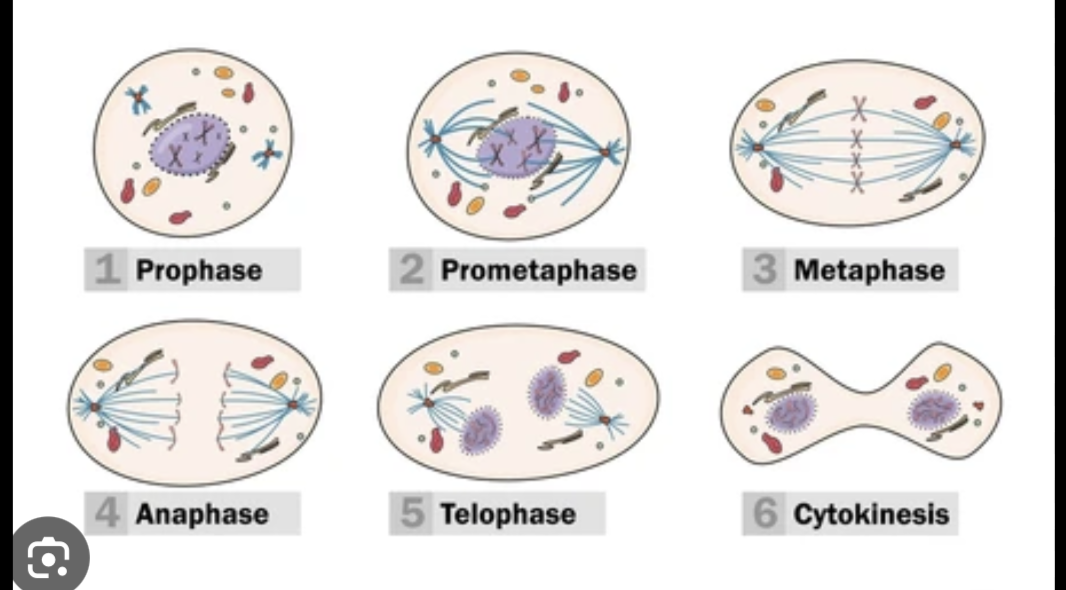
Prometaphase I
spindle fibers attach to kinetochores, which are special structures on chromosomes. The spindle fibers use the kinetochores to line up the homologous chromosome pairs across the center of the cell. This sets them up to be pulled apart in the next phase.
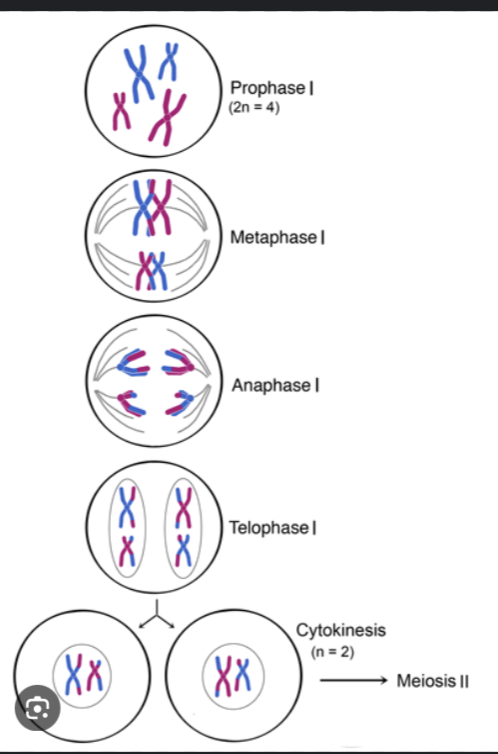
Metaphase I
Homologous pairs align at the cell's equatorial plane during this phase of Meiosis I.
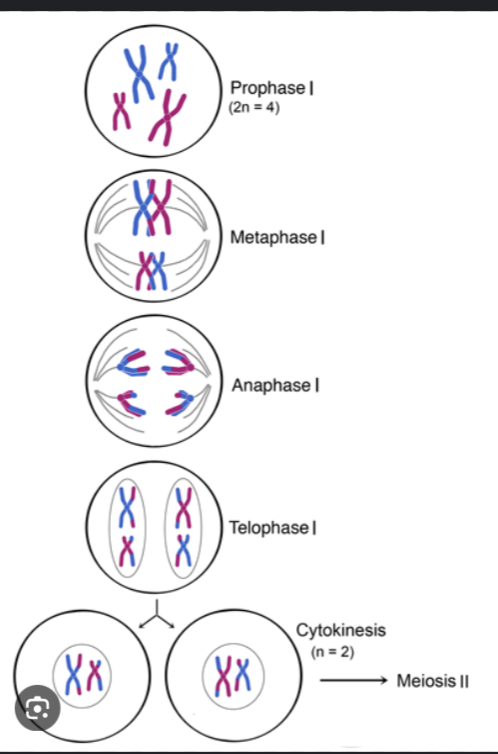
Anaphase I
In this phase, homologous chromosomes are pulled apart to opposite poles.
Telophase I
Chromosomes decondense and the nuclear envelope re-forms, resulting in two daughter cells.
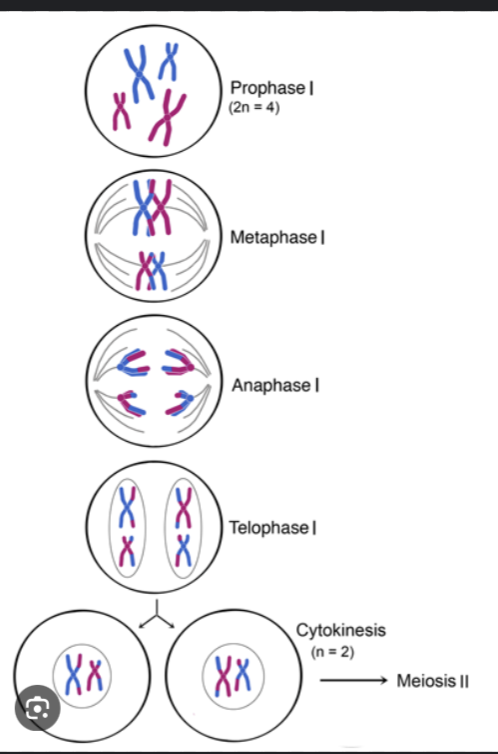
Cytokinesis
The process where the cytoplasm divides to yield daughter cells after telophase.
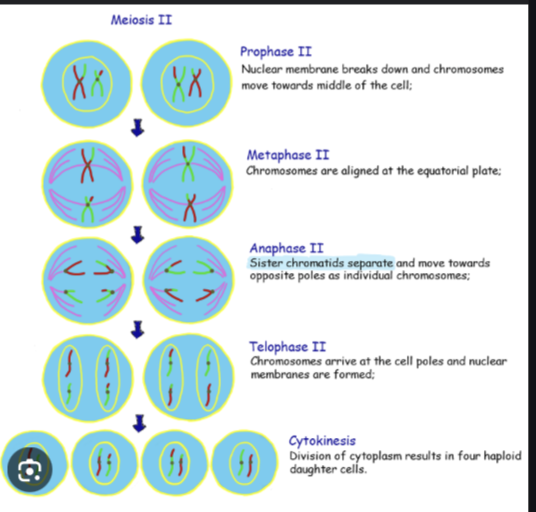
Prophase II
The phase where the nuclear envelope breaks down and chromosomes condense for the second meiotic division.
Prometaphase II
Similar to mitosis, spindle fibers attach to kinetochores on chromosomes in this phase.
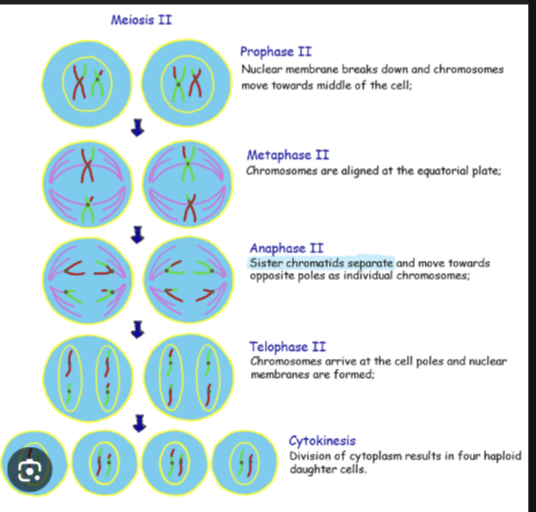
Metaphase II
Chromosomes align at the center of the cell for separation during this phase.
Anaphase II
Centromeres split and sister chromatids are pulled apart to opposite poles.
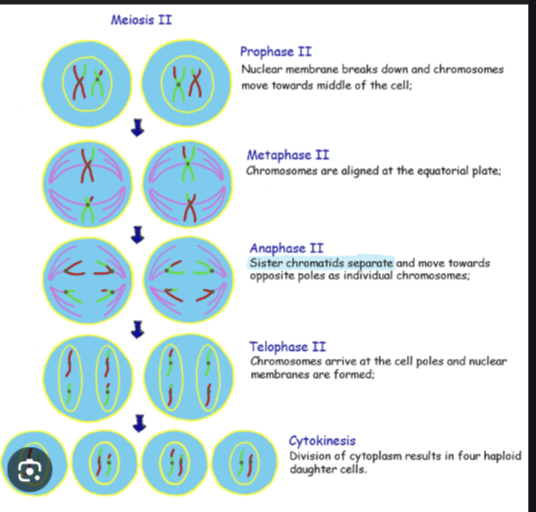
Telophase II
Chromosomes decondense, the nuclear envelope re-forms, and the cytoplasm divides.
Crossing Over
The exchange of genetic material between homologous chromosomes during Prophase I.
Independent Assortment
The random arrangement of chromosomes during Metaphase I leading to genetic variation.
Non-Disjunction
The failure of chromosomes to separate properly during meiosis.
Down Syndrome
A genetic condition caused by trisomy of chromosome 21, resulting from non-disjunction.
Epistasis
Interaction between genes where one gene may mask or modify the expression of another gene.
Pedigree
A diagram representing family relationships and genetic traits across generations.
Dominant Allele
An allele that masks the expression of a recessive allele in heterozygous individuals.
Recessive Allele
An allele whose effect is masked by the presence of a dominant allele.
Principle of Segregation
The principle stating that alleles segregate during gamete formation, so each gamete carries one allele.
Test Cross
A method to determine an unknown genotype by crossing it with a homozygous recessive individual.
Phenotypic Ratio
The ratio of different phenotypes in the offspring, for example, typically 3:1 in F2 progeny.
Incomplete Dominance
A type of inheritance where heterozygotes display an intermediate phenotype.
Codominance
A genetic scenario where both alleles are expressed equally in the phenotype.
Mutation
A change in the DNA sequence that can affect gene function, classified as somatic or germline.
Allele Frequency
The relative frequency of an allele at a genetic locus in a population.
Hardy-Weinberg Principle
A principle that describes the genetic variation in a population under ideal conditions.
p + q = 1
Equation representing the relationship of allele frequencies for a two-allele locus.
Evolution
Change in allele or genotype frequencies over time within a population.
Hydrostatic Skeleton
A skeleton type characterized by fluid-filled cavities providing support.
Exoskeleton
A hard outer structure providing support and protection, commonly seen in insects.
Endoskeleton
An internal skeleton that supports and protects internal organs, found in vertebrates.
Muscle Fiber
Type of muscle cell, including red slow-twitch and white fast-twitch fibers.
Actin and Myosin
Protein filaments that interact to produce muscle contraction.
Compact Bone
The dense outer layer of bone that provides strength and structure.
Spongy Bone
Inner layer of bone characterized by a porous structure that houses bone marrow.
Nucleus
Membrane-bound organelle containing the cell's genetic material.
Cytoskeleton
A network of fibers that provides structural support and shape to eukaryotic cells.
Symbiosis
A close and long-term interaction between two different biological species.
Lichens
Symbiotic relationships between fungi and algae or cyanobacteria.
Parasitism
A relationship where one organism feeds on another without necessarily killing it.