B4
 Call Kai
 Learn
Learn Practice Test
 Spaced Repetition
 Match
Match Flashcards
 Knowt Play
1/90

There's no tags or description
Looks like no tags are added yet.
Name | Mastery | Learn | Test | Matching | Spaced | Call with Kai | Chat |
|---|
No analytics yet
Send a link to your students to track their progress
91 Terms
Photosynthesis produces oxygen.
(a) Complete the word equation for photosynthesis.
Carbon dioxide+water→glucose+oxygen
Explain how oxygen is used in cells.
(used in aerobic) respiration
do not accept anaerobic
1
to release / transfer energy
A student investigated the effect of light from different coloured light bulbs on
photosynthesis.
The student:
• used pondweed in a beaker of water
• used different coloured light bulbs in a lamp
• counted the number of bubbles of oxygen the pondweed produced in 2
minutes for each colour of light bulb.
(c) Give one hazard the student would need to consider when using the
apparatus in this investigation.
Give the risk the hazard would cause.
Hazard
any one pair from:
• bulb / lamp is hot
(so) may burn you / skin
1
1
• glassware is breakable (1)
(so) may cut skin (1)
• electricity in close proximity to water (1)
allow named example of electrical item
in close proximity to water
(so) may get electric shock (1)
• scissors / scalpel (to cut pondweed) are sharp (1)
may cut skin (1)
mark in pairs
The student needed to keep the temperature of the water in the beaker the
same throughout the investigation.
Describe how the student could keep the temperature of the water the
same.
(use a) water bath
(e) The beaker of water contained the pondweed.
Explain why the temperature of the water in the beaker needed to be kept
the same throughout the investigation.
(change in) temperature affects / changes (the rate of)
photosynthesis
allow temperature is a limiting factor (of
photosynthesis)
allow temperature affects enzyme
(activity)
allow temperature affects rate of
reaction
1
(so) will affect / change the number of bubbles (produced
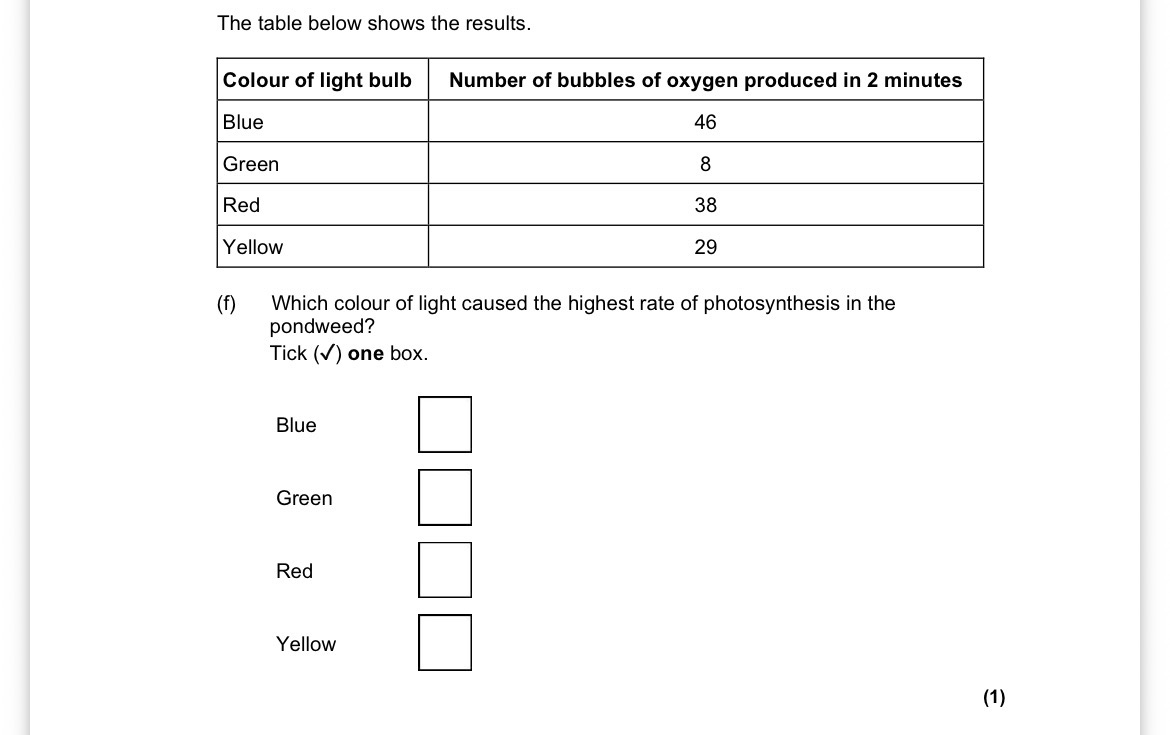
Blue

What is the best way to display the data in the table above?
Bar graph
h) The student wanted to measure the volume of oxygen the pondweed
produced in 2 minutes.
Name one piece of apparatus the student could use to measure the
volume of oxygen.
any one from:
• measuring cylinder
• (gas) syringe
• burette
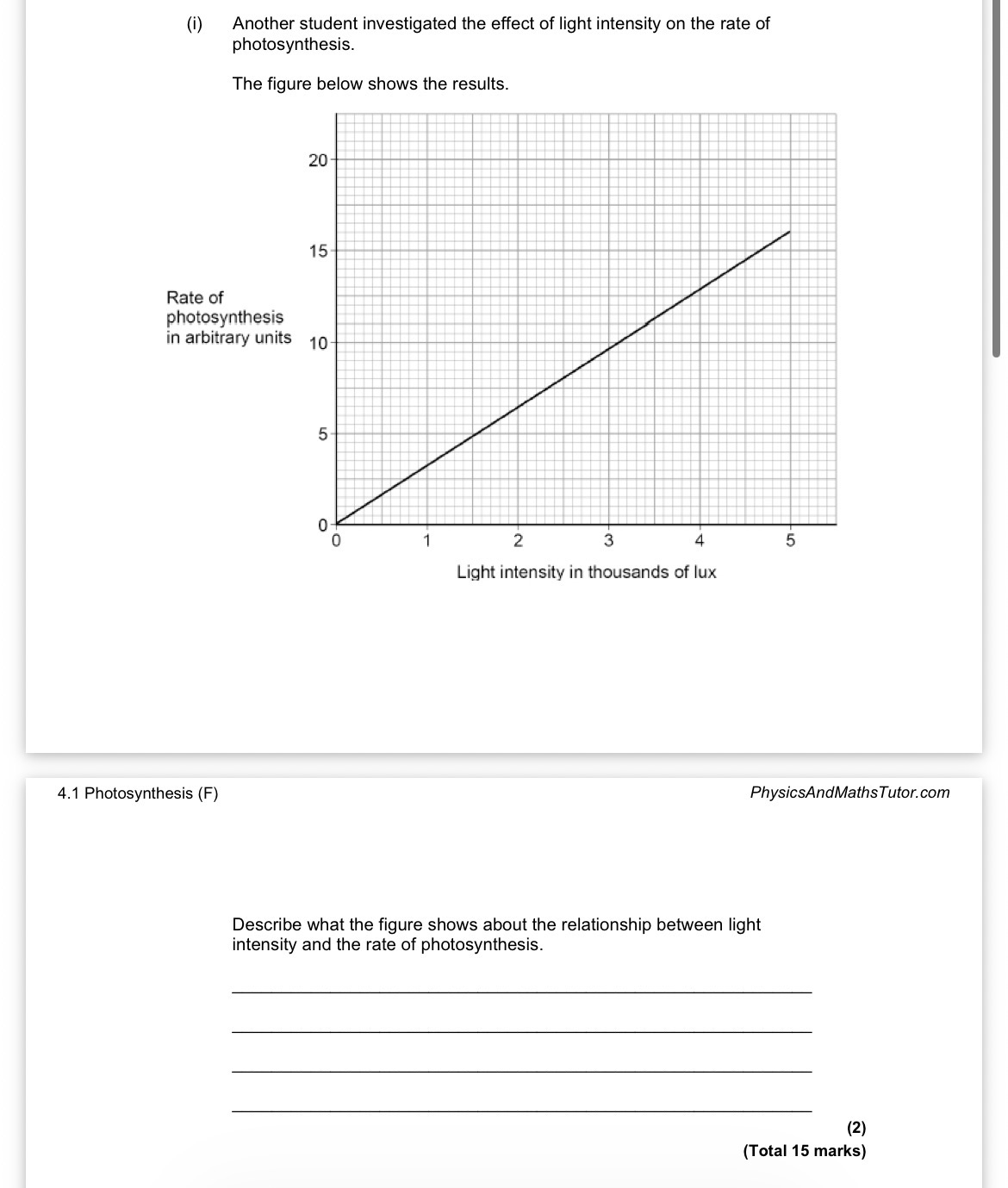
(i) as light (intensity) increases, rate / photosynthesis increases
allow positive correlation
1
(rate / photosynthesis increases) at the same rate as light (intensity)

Give two control variables the scientist should have used in the
investigation
any two from:
• temperature
• size of tomato plants or size / number of leaves
allow age of plant
• light
• (volume of) water
allow (amount of) water
• (amount / type of) fertiliser / minerals / ions / nutrients (given to
plants)
allow (type of) compost / soil
allow named example of mineral ion such as nitrate
/ magnesium
• time before rate readings are taken
How could the scientist have improved the validity of the results?
repeat each reading three times and calculate a mean

Explain the change in the rate of photosynthesis when the concentration of
carbon dioxide increased between 0.00% to 0.08%.
(the rate of photosynthesis) increases
ignore values
1
(because) carbon dioxide is needed for photosynthesis
allow 2 marks for (there is) more carbon dioxide for
(more) photosynthesis
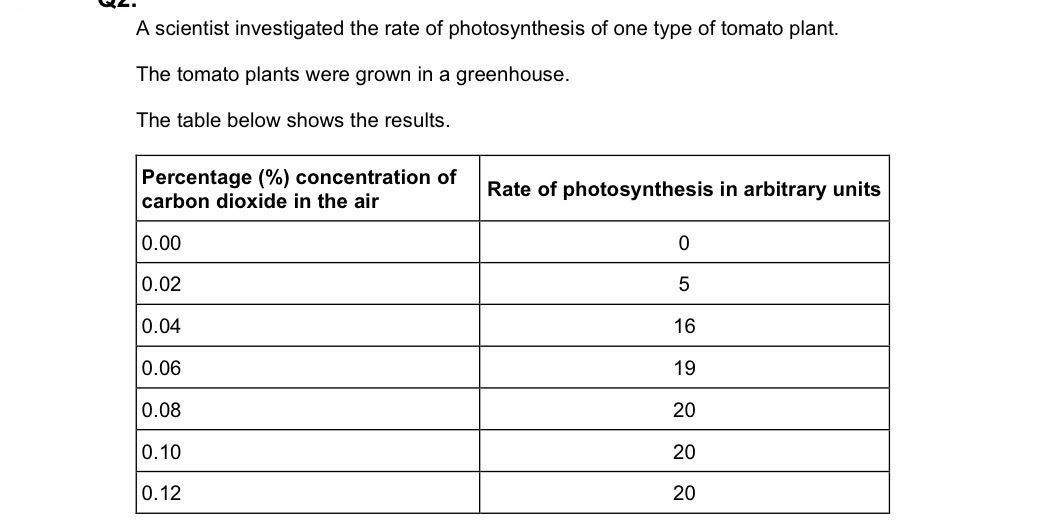
A farmer decided not to use a concentration of carbon dioxide higher than
0.08% to grow tomato plants.
Suggest two reasons for the farmer’s decision.
Use information from above table and your own knowledge.
any two from:
• it would not increase the rate (of photosynthesis)
allow it would not change the rate (of
photosynthesis)
allow photosynthesis would not increase
• it would not increase the growth of tomatoes
• it would cost more
allow idea of profit will not increase
allow reference to avoiding global warming

Leaf 1 or covered with black paper
no light so no photosynthesis (occurs)
ignore reference to water
ignore reference to carbon dioxide
1
Leaf 2 or covered with transparent plastic
no carbon dioxide so no photosynthesis
1
Leaf 3 or not covered
light and carbon dioxide present so leaf can photosynthesise
ignore no limiting factors
1
for either Leaf 1 / 2
(so) glucose not made
1
(and therefore) glucose / sugar cannot be converted to starch

B)green) starch / present / positive
allow blue-black / black or dark blue
and
(white) no starch or not present or negative
C)green part contains chlorophyll and white part does not
ignore chloroplasts
1
(so) light is absorbed by green part (but not by white part) so
photosynthesis occurs and starch can be formed
In some leaves, the green parts become yellow because of an ion deficiency.
(d) Which ion is deficient in a plant with yellow leaves?
magnesium
Give the scientific term that describes the yellow colour of the leaves.
Chlorosis
The rate of photosynthesis is affected by different factors.
How could the oxygen produced during photosynthesis be used to
measure the rate of photosynthesis?
(measure the) volume (of oxygen) released / produced in a given time
or
(count / number of) bubbles released / produced in a given time
What is meant by a ‘limiting factor’?
a factor that) if increased would increase the rate (of a reaction)
or
(a factor that) prevents the rate (of a reaction) increasing

Explain the effect of increasing temperature and increasing carbon dioxide
concentration on the rate of photosynthesis shown in Figure 2.
increasing temperature while keeping the carbon dioxide
(concentration) constant increases the rate (of photosynthesis)
allow increasing the carbon dioxide (concentration)
while keeping temperature constant increases the
rate (of photosynthesis)
1
increasing the temperature increases the movement of the
molecules / particles / substrate
or
increasing the temperature increases the rate of enzyme activity
increasing carbon dioxide concentration increases (the
concentration of) substrate / reactants
1
all rates plateau at a certain point due to another factor being limiting


from 0 to 5 000 lux
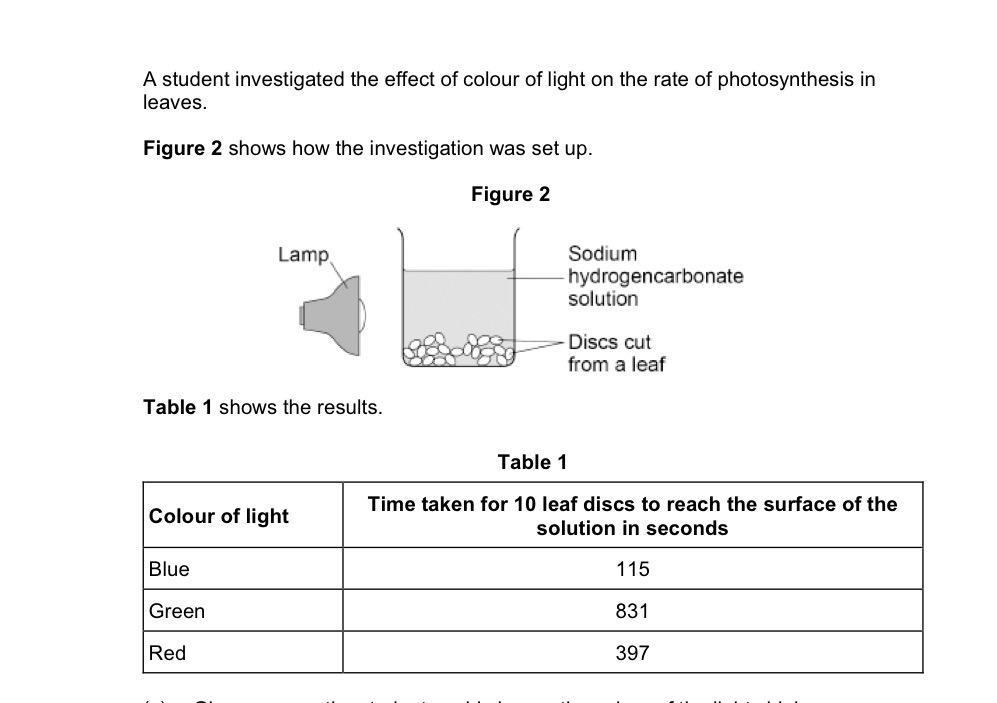
Give one way the student could change the colour of the light shining on
the leaf discs.
any one from:
• use (different) coloured bulb(s) / LED(s)
• use (different) coloured filter(s) in front of lamp
• put (different) coloured transparent material(s) over lamp /
beaker
allow named transparent material(s)

Give the independent variable and the dependent variable in this
investigation
independent
colour of light
allow wavelength of light
ignore colour of filter / bulb / lamp
1
dependent
time (taken for 10 leaf discs to reach the surface of the solution)
All of the air had to be removed from the leaf discs before placing them in
the beaker.
Suggest one reason why.
any one from:
• so that discs would sink (to the bottom of the beaker)
allow leaf for disc throughout
allow so the discs do not float
• so any gas (that makes the discs rise) is from photosynthesis
• air is a gas so any left in discs would add to the oxygen
produced by photosynthesis
ignore reference to carbon dioxide
allow as a control variable
The leaf discs were placed in a beaker of sodium hydrogencarbonate
(NaHCO3) solution.
Explain why sodium hydrogencarbonate solution was used instead of
water.
(sodium hydrogencarbonate) provides / releases carbon dioxide
ignore (sodium hydrogencarbonate)
contains carbon dioxide
ignore provides water
1
(carbon dioxide is used) for photosynthesis
Explain why the leaf discs moved to the surface of the solution during the
investigation
oxygen was produced in photosynthesis
1
oxygen / gas is trapped in / around disc / leaf
Suggest the advantage to a plant of having two types of chlorophyll.
to absorb / use many / more colours / wavelengths of light
allow to increase the rate of
photosynthesis

The leaf discs in the investigation are green.
Explain the results in Table 1 for blue light and for green light.
Use data from Figure 3 and Table 2.
chlorophyll absorbs most or a lot of blue light
chlorophyll absorbs least or very little or not much green light
if neither mark awarded allow 1 mark for
chlorophyll absorbs more blue light
(than green light)
allow chlorophyll reflects most of the
green light
1
1
(so) discs in blue light took the least time to rise (to surface) because
they photosynthesised faster / more
or
(so) discs in green light took the most time to rise (to surface)
because they photosynthesised slower / less
1
use of data (from Figure 3 and Table 2) eg approximately 80% of
blue light absorbed
CF reduces the amount of oxygen that can enter the blood from the alveoli.
Explain how a reduced amount of oxygen entering the blood will affect the
human body.
less (aerobic) respiration
allow (more) anaerobic respiration
1
(so) less energy (released)
created
do not accept less energy produced / made /
1
(results in) less muscle contraction
or
or
(results in) reduced metabolism
allow relevant named metabolic processes
(results in) increased breathing rate / depth
or
(results in) increased heart rate
allow (results in) person getting out of breath
OR
(more) anaerobic respiration (1)
(so) lactic acid produced (1)
(results in) muscle fatigue
or
or
or
(results in) less muscle contraction
(results in) increased breathing rate / depth
(results in) increased heart rate (1)
allow muscle ache / cramp / tiredness / pain
allow (results in) person getting out of breath
Gas exchange happens in the alveoli in the lungs.
Describe three features of the alveoli that help maximise gas exchange.
large surface / area
allow large surface / area to volume (ratio)
1
(large) capillary network
or
good / efficient blood supply
allow many capillaries
1
walls are thin
or
walls are one cell thick
This question is about exercise.
(a) During vigorous exercise, anaerobic respiration occurs in a person’s body.
Explain two effects of anaerobic respiration on the person’s body.
effect) muscle fatigue or oxygen debt occurs (1)
allow muscle cramp ignore fatigue /
cramp unqualified
(reason) caused by (build-up of) lactic acid (1)
• (effect) (continued) heavy / deep / fast breathing (1)
(reason) to provide the oxygen needed to break down (built-up)
lactic acid (1)
allow to repay the oxygen debt
• (effect) (continued) increased heart rate (1)
(reason) to provide the oxygen needed to break down (built-up)
lactic acid (1)
allow to repay the oxygen debt
• (effect) fewer / weaker muscle contractions (1)
(reason) (because) less energy is released / available (1)
do not accept energy being produced /
made / created
Design an investigation to show the effect of different types of exercise on
the heart rate of athletes.
• test a group of athletes
• use at least two different types / intensities of exercise
• get each athlete to do all exercises or have a large (≥30) group
doing each exercise
• record heart rate for each athlete before and after exercise or
calculate increase in heart rate for each athlete after exercise
• calculate the mean increase in heart rates for each type / intensity
of exercise
• compare mean increase in heart rates for each type / intensity of
exercise
• control variables:
o same (biological) sex or mix of sexes
o same level of activity / exercise
o same age
o same caffeine / drug / medicine intake
o same length of time for exercise
o no health issues / illnesses
o return to resting heart rate before each exercise
Anabolic steroids are drugs.
Anabolic steroids:
• increase muscle mass in humans
• are banned in most competitive sports.
Some athletes take anabolic steroids to improve their performance in sport.
(c) Explain how taking anabolic steroids could improve an athlete’s
performance.
athlete is) faster / stronger
allow description of improved
performance
allow reference to increased stamina /
endurance
1
(because more muscle mass so) more / stronger muscle contractions
Scientists use monoclonal antibodies to test for the presence of anabolic steroids
in an athlete’s urine.
To produce monoclonal antibodies, a mouse lymphocyte is combined with a
tumour cell.
(d) What type of cell is created when a mouse lymphocyte and a tumour cell
combine?
hybridoma
Describe how scientists make monoclonal antibodies using the cell created
when a mouse lymphocyte and a tumour cell combine.
any three from:
• (cell) is cloned
ignore name of cell
• many (identical) cells are produced
allow many clones are produced
• all the cells make the same antibody
• the antibody is (collected and) purified
What property makes a monoclonal antibody useful in detecting the
presence of an anabolic steroid in urine?
a monoclonal antibody only binds to the anabolic steroid
The end of the test strip is dipped in urine.
The urine moves up through the test strip.
The test area and the control area contain a dye.
The dye turns blue when monoclonal antibodies bind to it.
(g) Suggest the purpose of the control area in the test strip.
to show that the test is working
Describe the evidence in Figure 2 that shows the test for athlete B has not
worked.
Suggest one reason why the test did not work
evidence
no blue / visible dye (in control area)
allow no line(s) (in control area) allow
no colour change (in control area)
1
reason
(because) no (free) monoclonal antibodies bound to control area
allow the (free) monoclonal antibodies
did not move up the test strip
allow urine did not move up the test
strip
1
or
(because) there were no (free) monoclonal antibodies on the end of
the (test) strip
Name the sub-cellular structures where aerobic respiration takes place
mitochondria / mitochondrion
Energy is released in respiration.
Give two uses of the energy released in respiration.
any two from:
• movement / muscle contraction
• keeping warm
• active transport
• building larger molecules
ignore reference to metabolism
unqualified
allow examples of movement
allow examples of building larger
molecules e.g. making (named) proteins
/ cellulose
allow cell division
ignore growth
Describe two differences between aerobic and anaerobic respiration in
humans.
Do not refer to oxygen in your answer.
any two from:
• anaerobic produces lactic acid and aerobic does not
allow anaerobic creates an oxygen debt
and aerobic does not
• aerobic produces carbon dioxide and anaerobic does not
• aerobic produces water and anaerobic does not
• aerobic occurs (mainly) in the mitochondria and anaerobic
does not
allow anaerobic only occurs in the
cytoplasm
• anaerobic releases less energy than aerobic
allow anaerobic releases less ATP
(than anaerobic)
do not accept anaerobic produces /
makes / creates less energy
What are the two products of anaerobic respiration in plant cells?
Co2
Ethanol

pondweed takes in CO2 for photosynthesis
snail and pondweed are respiring producing CO2

Suggest why the concentration of carbon dioxide increased between day 5
and day 10.
no light so) no photosynthesis
or
plant is not taking in CO2
and
snail and plant are respiring and so are releasing CO2

On day 10, the pond snail died.
Explain why the death of the pond snail caused the concentration of carbon dioxide to increase after day 10.
snail is being decayed / decomposed / broken down
ignore being fed on
1
(by) decomposers / bacteria (in pond water / snail)
allow fungi / microbes / microorganisms
1
(therefore) respiration (of decomposers / bacteria) releases CO2
Describe how energy for the photosynthesis reaction is gained by plants
light
ignore description of subsequent parts of the
photosynthesis reaction
allow sunlight
ignore sun
1
(light) is captured / trapped / absorbed by chlorophyll / chloroplasts
Suggest one possible cause of the anomalous result. (Measuring rate of photosynthesis)
any one from:
• scale / value was misread
ignore human error
ignore references to counting bubbles or time
allow measurement error
• there was air / oxygen in the syringe / measuring cylinder / apparatus
• the lamp / light was moved
temperature changed
• had different mass / length of pondweed
• pondweed had not acclimatised
Give one factor the students should have kept constant in this
investigation. (Photosynthesis)
any one from:
• light (intensity)
do not accept temperature
ignore time
allow distance / power / colour of lamp / light
• carbon dioxide (concentration)
• pondweed size / amount
• pondweed species
allow same (piece of) pondweed
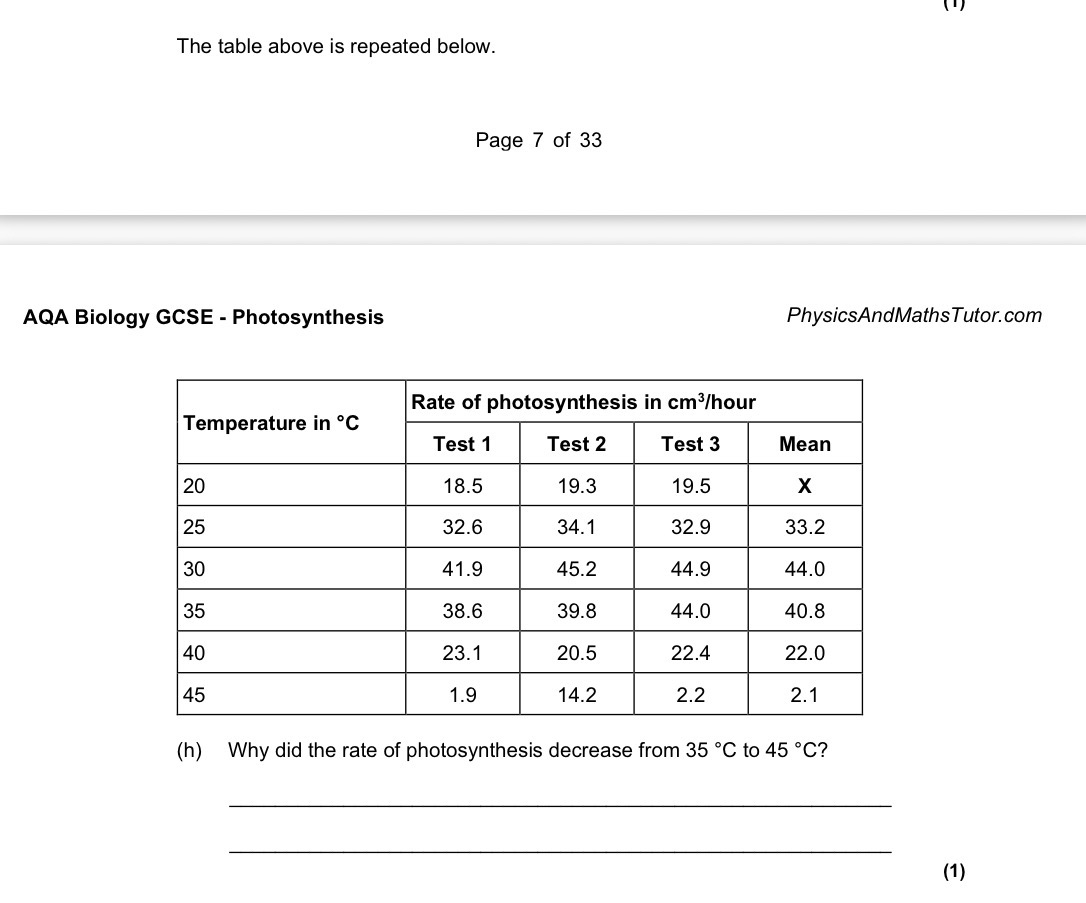
enzyme(s) lose the shape of the active site
allow enzyme(s) (start to) denature
allow enzyme(s) destroyed / damaged
do not accept enzyme(s) killed

glucose from photosynthesis
do not accept starch made in
photosynthesis
(excess) glucose converted to starch

g) Explain why the leaf left in a cupboard with no light for two days did contain
glucose but did not contain starch.

Suggest one way the students could develop the investigation to find out
more about glucose and starch production in plants.
any one from:
• test roots / stems of plants (in the light and dark)
do not accept reference to changing the
independent variable
allow test other parts of the plants
• test other species of plant
allow test other types of plant
• measure the concentrations of glucose and starch
ignore mass / amount
• vary the time in the dark / light
• test variegated leaves
allow any other valid extension ignore
repeats

B) power output of bulb
C) any two from:
• repeat and calculate a mean
or
repeat and to eliminate anomalies
ignore do a control experiment
unqualified
• control the (water) temperature
allow a method of controlling (water)
temperature
• control the concentration of carbon dioxide
allow a method of controlling carbon
dioxide concentration
• control the distance of the bulb from the pondweed
• control the mass / length / species / age of the pondweed
allow use the same piece of pondweed
• give pondweed time to equilibrate
allow do experiment with the bulb off / in
the dark


A)rate of photosynthesis increases
or
number of bubbles produced (in one minute) increases
or
volume of gas / oxygen produced (in one minute) increases
allow decreases / stays the same throughout
B)light intensity
C)reduces the effect of heat from the lamp
or
prevents temperature affecting photosynthesis

D)52
E)should be 62- is to 3sf/ not rounded
the numbers of bubbles at each distance are similar

blue light gives highest (rate of) photosynthesis
allow ecf from candidate’s graph allow blue light is
best
1
green light gives the lowest (rate of) photosynthesis
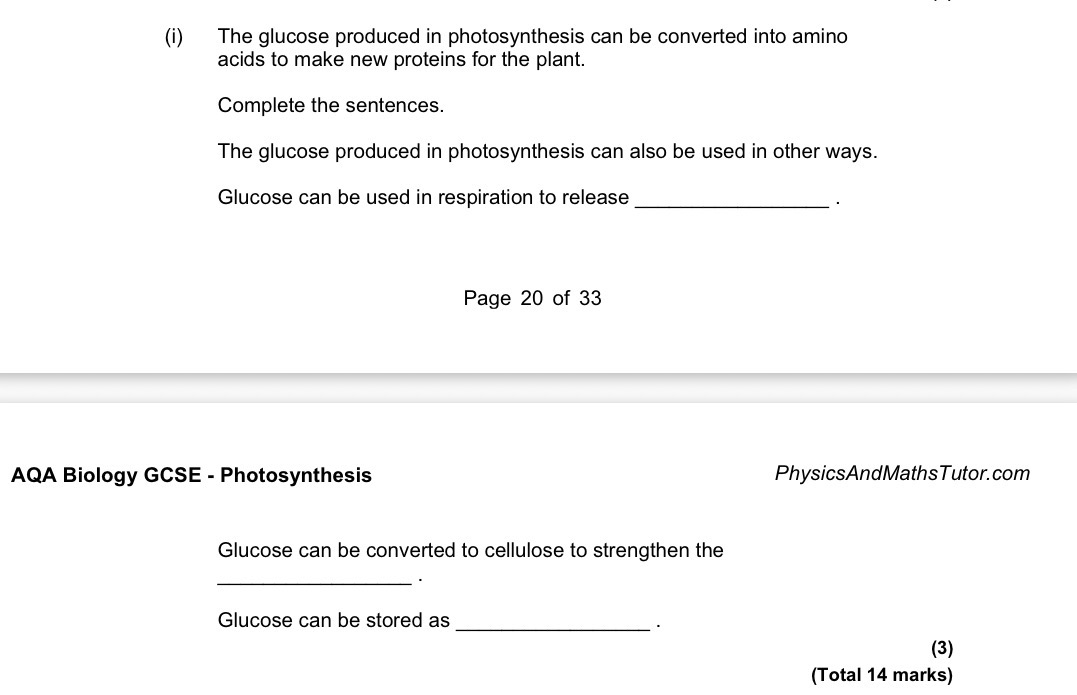
energy
in this order only
1
cell wall(s)
allow cell
do not accept (cell) membrane
starch / fat / oil / lipid

apparatus set up:
– weed in water in beaker
– light shining on beaker
• method of varying the light intensity–eg changing distance of lamp from
plant
• method of controlling other variables
– use same pond weed or same length of pond weed
– temperature: water bath or heat screen
– CO2
• leave sufficient time at each new light intensity before measurements taken
• method of measuring photosynthesis – eg counting bubbles of gas
released or collecting gas and measuring volume in a syringe
• measuring rate of photosynthesis by counting bubbles for set period of
time
• repetitions

A) trachea
(b) any two from:
• only one air space (per balloon)
or
alveoli not represented
• blood vessels / capillaries not represented
• bronchioles not represented
do not accept bronchi not represented
• glass tube not flexible (like trachea / bronchi)
• bell jar does not move during breathing (like ribs)
• ribs have gaps between them
• rib cage contains muscles
• pleural cavity not represented
A scientist investigated the effect of exercise on breathing rate.
This is the method used.
1. Record the breathing rates of 10 male non-smokers at rest.
2. Tell each man to run on a treadmill at the same speed for 8 minutes.
3. Record the breathing rate of each man every 2 minutes.
4. Continue to record the breathing rate of each man for 4 minutes after he
stops running.
(c) Give two variables the scientist controlled in the investigation.
(c) any two from:
• speed (of treadmill)
• type of exercise or all were running
• (biological) sex or all male
• all were non-smokers
• time spent running
allow ran for 8 minutes
ignore reference to time interval for
counting breaths


Explain why the man’s breathing rate increased when he was running
to get more oxygen (into the blood)
for use in respiration or for releasing energy (for muscle contraction)
or
to remove more carbon dioxide (1)
produced in respiration (1)
Give one measurement that could be taken to show a different effect of
exercise on the body.
Do not refer to breathing rate in your answer.
any one from:
• heart / pulse rate
allow heart beat per minute
• depth / volume of breathing
allow amount of sweat
• volume of sweat
• body temperature
allow body mass / measurement
The men in the investigation were all non-smokers.
Give one effect that smoking can have on the body.
any one from:
• (lung) cancer
• increased blood pressure
• lung disease
allow named example of lung disease
e.g. asthma
• low birth weight in babies of mothers who smoke
• increased risk of heart / cardiovascular disease
allow persistent cough ignore cough
unqualified

A 45-year-old man exercised on a rowing machine for six minutes.
A fitness monitor recorded his heart rate and breathing rate every minute.
The graph below shows the results.
increased (at first)
until 4 minutes or 50 breaths per minute
(then) stayed constant (from 4 minutes or at 50 breaths per minute)
Explain the ways the man’s body has responded to the exercise.
Use information from the graph above.
heart rate increased
○ to increase blood flowing to muscles / lungs
○ to provide more oxygen (to muscles)
○ to provide more glucose (to muscles)
○ to remove carbon dioxide more quickly (from the
muscles / blood)
○ to remove lactic acid more quickly (from the muscles)
• breathing rate increased
○ supplies more oxygen / air to lungs
○ so more oxygen to blood
○ more carbon dioxide removed
• more oxygen to muscles
○ needed for (increased) respiration
○ to release / provide energy
○ for muscle contraction
• anaerobic respiration occurs
○ due to lack of oxygen
○ which causes a build-up of lactic acid
○ oxygen debt
○ muscle fatigue / pain

What conclusion can you make about the relationship between the mass of
sugar used and the volume of gas produced?
the greater the mass of sugar, the greater the volume of foam / gas
produced

Why was no foam produced in the mixture with 0 g of sugar?
no respiration occurs
or
sugar / glucose is needed for respiration
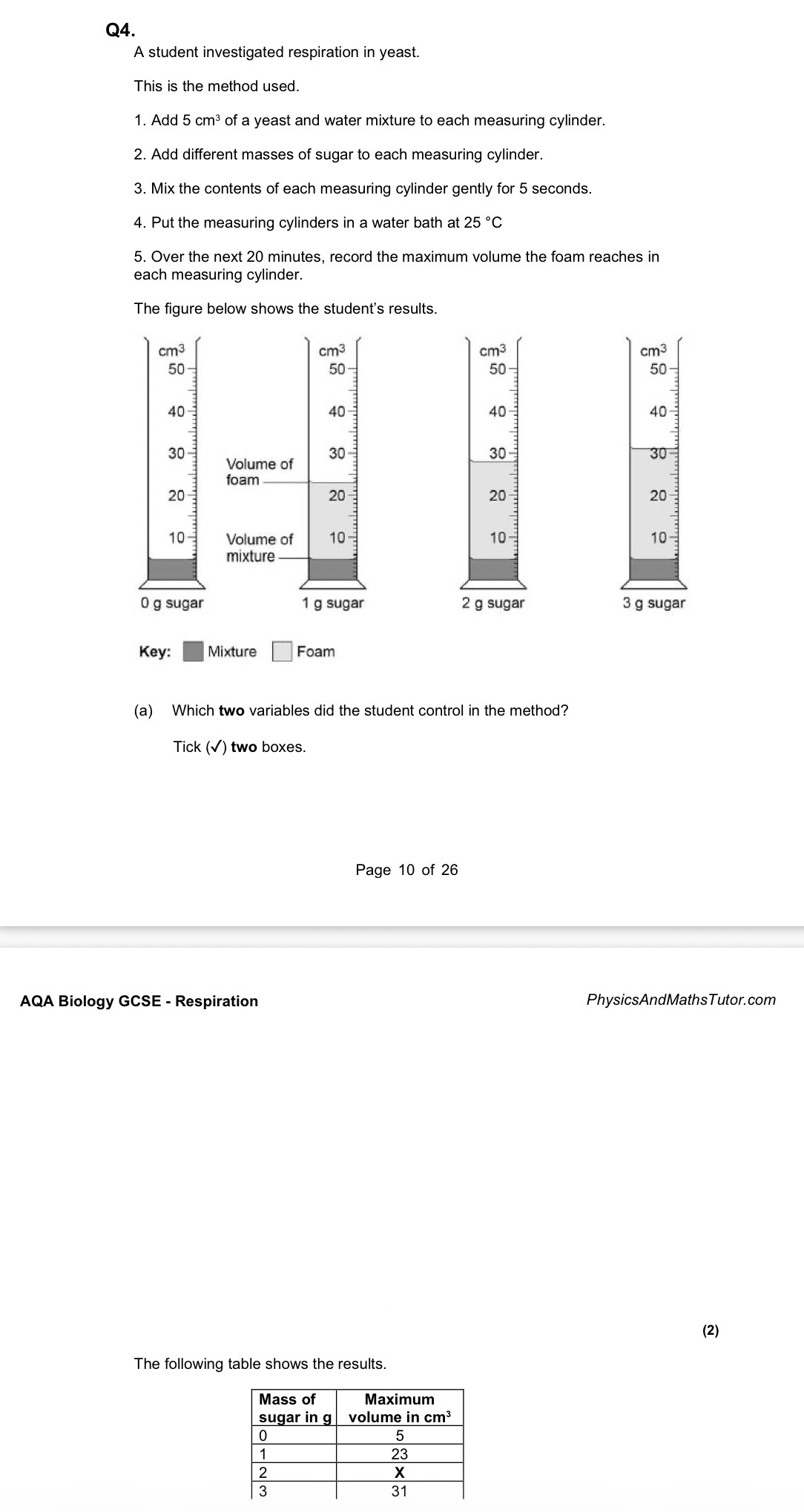
Why was the measuring cylinder with 0 g of sugar included in the
investigation?
for comparison / to compare
allow as a control (experiment)
allow as a base line
do not accept as a control variable
or
to check that no other factor / variable is influencing the results
or
to ensure validity
The top of the mixture can be covered with a layer of oil after step 3 in the
method.
Suggest why the layer of oil stops the yeast respiring aerobically.
it) stops the oxygen / air getting in / through
Metabolism is the sum of all the chemical reactions in the cells of the body.
One metabolic reaction is the formation of lipids.
(a) Give one other metabolic reaction in cells.
any one from:
• respiration
• formation of proteins
• formation / breakdown of glycogen
• breakdown of (excess) protein or formation of urea
• photosynthesis or formation of glucose / starch (in plants)

males have a higher metabolic rate than females after five years of
age
the mean metabolic rate of females decreases faster than males up
to 25 years of age

Calculate the percentage decrease in the mean metabolic rate of males
between 5 years and 45 years of age.
Use the equation:
Decrease in metabolic rate/original metabolic rate x100
Give your answer to 3 significant figures.
17/53×100
32.075472…
32.1

any two from:
allow converse
• (person) R heart rate rose / increased more slowly than
(person) S
• (person) R heart rate levelled off whereas (person) S continued
to increase
• (person) R heart rate rose less (overall / after 5 minutes of
exercise) than S
allow correct use of figures
e.g. R increased (overall) by 39 bpm /
65% and S by 54 bpm / 69%
ignore lack of units

132-78/12
54/12
4.5
A student made the following hypothesis about the heart rate of smokers
and non-smokers during exercise.
“During exercise, the heart rate of smokers increases more than
the heart rate of non-smokers.”
Design an investigation that would allow you to test this hypothesis.
two groups of people − non-smokers and smokers
• have at least five people in each group or large groups
• get each person to do (named) exercise
• controlled variables:
− same number of people in each group or large groups
− same gender
− same level of activity / exercise
− same age
− no health issues / illnesses
− same type of exercise
− same time for exercise
• record heart rate for each person before and after exercise
• calculate increase in heart rate for each person after exercise
• compare results for each group
Limewater goes cloudy when carbon dioxide is added to it.
(b) After 10 minutes the limewater in flask B was cloudy, but the limewater in
flask A remained colourless.
Explain why.
atmospheric air contains less carbon dioxide than exhaled air
allow converse
(flask B goes more cloudy because) carbon dioxide is produced in
(aerobic) respiration (by woodlice)
do not accept anaerobic respiration
Flask A acts as a control in this investigation.
What is the purpose of a control?
) for comparison / to compare
allow answers in the context of the investigation
e.g.
or
to check that no other factor / variable is influencing the results to prove that the results obtained were due to the
woodlice respiring and nothing else
or
to prove that the woodlice produced the carbon
dioxide and nothing else
The student repeated the investigation with no woodlice.
Describe the appearance of the limewater in flask A and flask B after 10
minutes
flask A) would remain colourless
ignore references to clear
allow not cloudy
(flask B) would remain colourless
Exercise cannot be sustained when anaerobic respiration takes place in
muscle cells.
Explain why.
muscles become fatigued / stop contracting
because not enough energy is transferred

C) co2
D) count the bubbles or measure volume of gas In a given time
E) bread making/ brewing
All living cells respire.
(a) Respiration transfers energy from glucose for muscle contraction.
Describe how glucose from the small intestine is moved to a muscle cell.
glucose is absorbed by diffusion into the bloodstream
1
then blood delivers glucose to muscles in capillaries
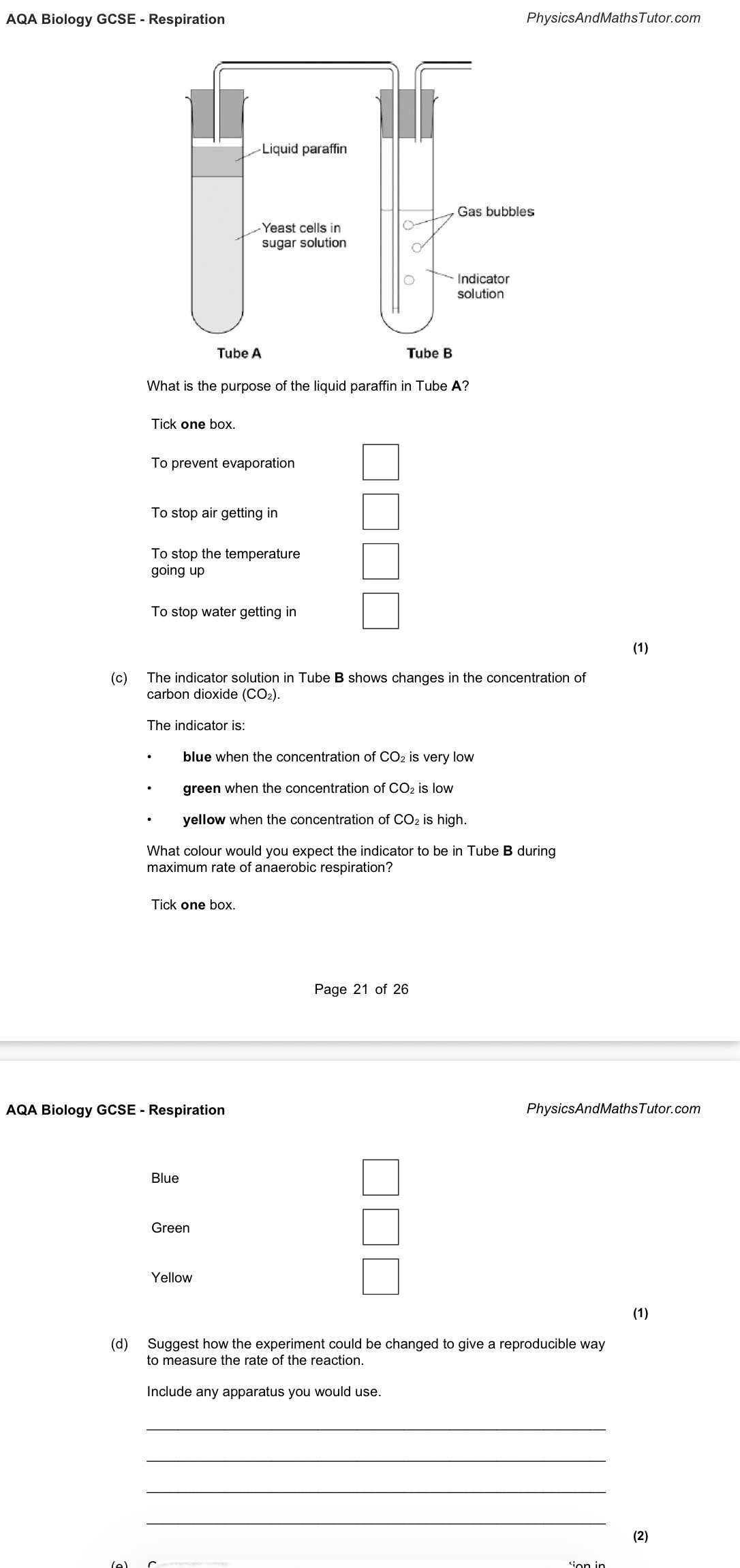
(b) to stop air getting in
(c) yellow
(d) collect the CO2 / gas with a measuring cylinder / gas syringe
(volume collected) in a certain time using a timer / watch
) Compare anaerobic respiration in a yeast cell with anaerobic respiration in
a muscle cell.
yeast produces ethanol but muscles produce lactic acid
marks can be awarded from correct word or
balanced symbol equations
yeast produces CO2 but muscles do not
answers must be comparative
both release small amounts of energy

Without oxygen
ii) more high/ increased lactic acid

Describe what happens to the rate of blood flow through the athlete’s
muscles during the run.
Use data from Figure 2 in your answer.
I)1.5
increases at first and levels off
ignore subsequent decrease
1
1
1
suitable use of numbers eg
rises to 10 / by 9 (dm3 per min)
or
increases up to 1.5 (min) / levels off after 1.5 (min) (of x axis
Explain how the change in blood flow to the athlete’s muscles helps
him to run.
supplies (more) oxygen
supplies (more) glucose
need ‘more/faster’ once only for full marks
allow removes (more) CO2 / lactic acid / heat as an
alternative for either marking point one or two,
once only
for (more) respiration
1
1
1
releases (more) energy (for muscle contraction)
do not allow energy production or for respiration
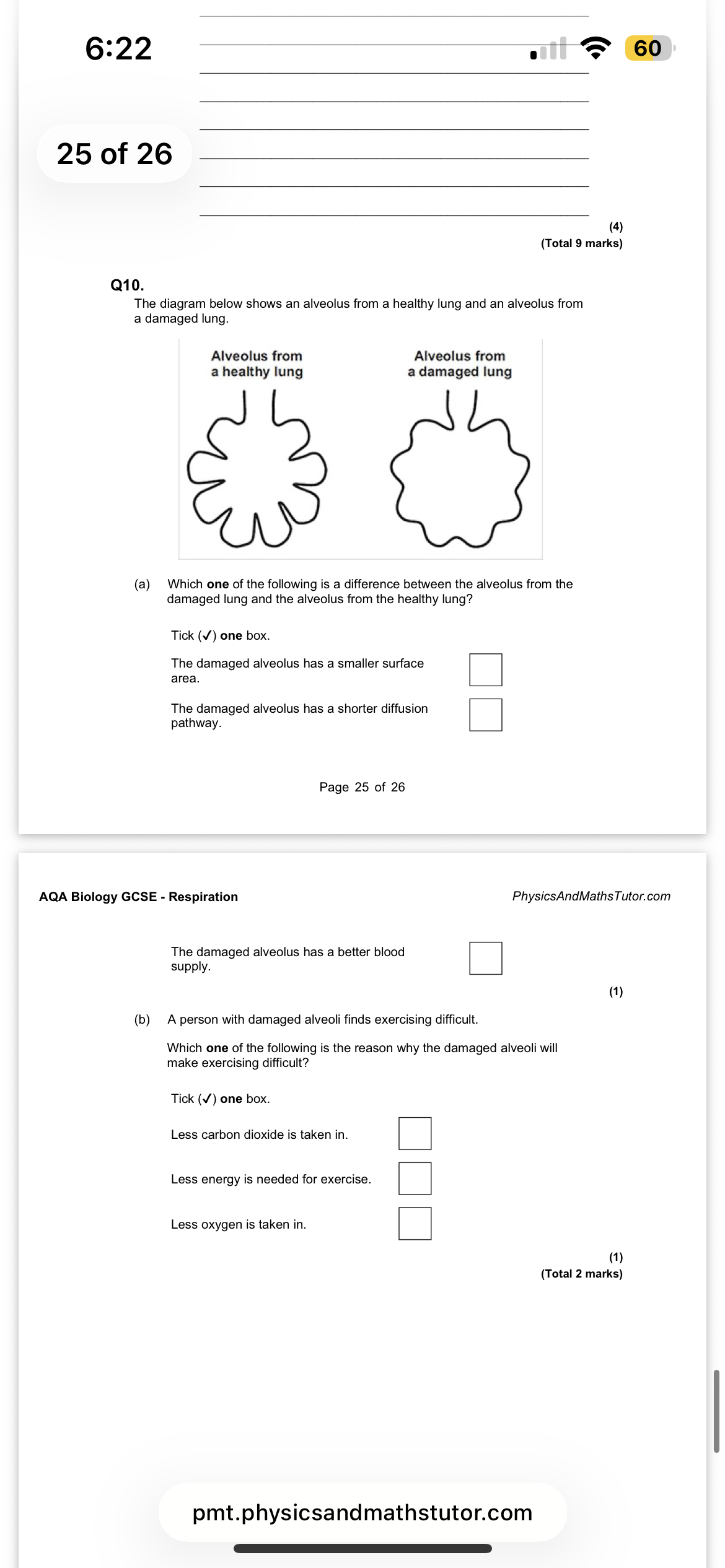
The damaged alveolus has a smaller surface area.
1
(b) Less oxygen is taken in