Lecture 2: Electrolyte Disorders I
 Call Kai
 Learn
Learn Practice Test
 Spaced Repetition
 Match
Match Flashcards
 Knowt Play
1/84

There's no tags or description
Looks like no tags are added yet.
Name | Mastery | Learn | Test | Matching | Spaced | Call with Kai | Chat |
|---|
No analytics yet
Send a link to your students to track their progress
85 Terms
Mild Hyponatremia
Na
Arginine Vasopressin (AVP)
-Also called vasopressin or antidiuretic hormone (ADH).
-A peptide hormone from the posterior pituitary that promotes water conservation.
Dehydration
high sodium and low volume = __________________
Overhydration
low sodium and high volume = ___________________
135-145 mEq/L
normal sodium levels
Severe Hyponatremia
Na
50
if [Na] is
Hyponatremia
-Mild: nausea and malaise
-Moderate: headache, nausea, disorientation confusion, agitation, ataxia, areflexia
-Severe: intractable vomiting, seizures, coma, ultimately respiratory arrest due to brainstem herniation
Step 1: Determine plasma osmolality
Step 2: In hypotonic, determine urine osmolality
Step 3: If urine Osm >100, determine volume status and urine sodium
What are the steps of hyponatremia evaluation?
Osmolar Gap
measured osmolality - calculated osmolality
True Hyponatremia
-low Osmolality (
False Hyponatremia
-normal osmolality (285-295 mmol/L)
-lab error
-hyperlipidemia
-hyperproteinemia
-multiple myeloma
False Hyponatremia
-high osmolality (>295 mmol/L)
-serum increased concentration of effective osmoles
-mannitol, glucose, glycine
1.6
Each 100 mg/dL increase in plasma glucose above 100 mg/dL decreases serum sodium by ________ mEq/L
Diluted
Sodium is ____________ when water intake exceeds water output
Dependent
ADH ______________________ Hypo-osmolar Hyponatremia:
-High (>200-300 mOsm/kg)
-Check volume status
-Hypervolemic - heart failure
-Hypovolemic - Loss of fluid
-Euvolemic - hormone related
Independent
ADH _____________________________ Hypo-osmolar Hyponatremia:
-Low (
Hypovolemic
-dehydrated
-Urine Na < 20; high Uric H+
-Renal Losses (U-Na>20)
-GI Losses
-Other: Skin, lungs, etc
Euvolemic
-Urine Na > 20; low Uric H+
-Hypothyroid
-Adrenal Insufficiency
-SIADH
-Cerebral Salt Wasting
Hypervolemic
-edema
-Urine Na < 20; High Uric H+
-Heart Failure
-Liver Failure
-Nephrotic syndrome
Diuretics
Urine sodium not accurate in patients on ________________
SIADH
• Diagnosis of exclusion, check thyroid panel, cortisol levels
• ADH lowers water excretion (causes naturesis), intake easily exceeds output
• Uric acid is suppressed and may drop below normal.
• Often transient. If persistent, look for causes: CNS, malignancy, drugs
-Fluid restriction
-Low dose loop diuretic
-Solute load (salt tabs or ure-na)
Treatment for SIADH
-SSRIs
-Anti-epileptics
-Sulfonylureas
-Opiates
meds that cause SIADH
Acute Hyponatremia
-
Chronic Hyponatremia
->48 hours
-defect in excretion/reabsorption of sodium
• Lower rate of excretion due to low volume of distal delivery of filtrate
• Vasopressin actions, lowering rate of water excretion (SIADH)
• Rapidly increase sodium by 4-6 mEq/L
• Infuse with 3% hypertonic saline (100 mL bolus over 10 minutes, repeat up to 3 times, until symptoms improve)
Treatment of acute hyponatremia with severe symptoms (coma, seizures, etc)
• Aim to increase sodium by 5 mEq/L daily, not exceeding 6 mEq/L
• Change in Plasma Na = (infusion[Na]-serum[Na])/(TBW+1)
Treatment of mild-moderate symptoms or chronic hyponatremia
• D/C ongoing active treatment
• Start D5W
• Add DDAVP
treatment for hyponatremia IF overcorrected (>10 mEq/L in first 24 hrs)
Vaptans
-AVP antagonists
-cause you to excrete dilute urine
-unpredictable increases in serum sodium
-expensive
-risk of liver toxicity
Shrink
too rapid correction of hyponatremia cause cause cells to _______________
Hypernatremia
• Usually results from a deficit of TBW or net gain of Na.
• Symptoms more evident with rapid changes, due to cell shrinking
• Nausea, vomiting, lethargy, weakness, polyuria
Hypernatremia
• Generally, a patient with an impaired sense of thirst, or limited access to water.
• Risk factors: elderly, infants, decompensated diabetes, hospitalized patients.
Cerebral Edema
rapid correction of hypernatremia can result in ___________________
Hypernatremia
Risk factors:
• >65 years old
• Mental or physical disability with impaired thirst
Hypernatremia
Causes:
• Diuretics
• Osmotic diuresis
• Renal salt wasting
• Post obstructive diuresis
• Diuretic phase of ATN
• GI (diarrhea/vomiting) and cutaneous (excessive sweating/heat/exercise)
Large sodium ingestion (like sea water)
if someone has hypernatremia and is hypervolemic, assess for _________________________________
Extrarenal Losses (GI, sweat, vent)
if someone has hypernatremia and is hypovolemic and:
-If urine osmolality >800 and FeNa
Diabetes Insipidus
if someone has hypernatremia and is hypovolemic and:
If urine osm 300-800, this suggests ________________________
Diabetes Insipidus
condition where kidney is unable to resorb free water
Central
____________________ Diabetes Insipidus:
-inadequate ADH production
Nephrogenic
____________________ Diabetes Insipidus:
-ineffective ADH receptors
Treat Underlying Cause
treatment for Nephrogenic Diabetes Insipidus
Trial DDAVP- PN 10 mcg/q12hr
treatment of Central Diabetes Insipidus
• If there is a response - central DI
• If no response, nephrogenic DI
What do you do for Diabetes Insipidus after DDAVP trial?
D5W (Dextrose in Water or basically just pure water with some sugar) at a SLOW
treatment for hypernatremia greater than 48 hours or not sure
-D5W (Dextrose in Water or basically just pure water with some sugar)
-Can be given at a quicker rate
treatment for hypernatremia less than 48 hours
10-12
treatment goal for hypernatremia is _________ mmol/day correction
K+
-the major intracellular cation
-used to balance intracellular anions
Muscle
majority of body potassium is where?
0.1; 0.6
For over __________ decrease in pH, [K+] rises by __________ mEq/L
Hypokalemia
• Cell membrane partially depolarized, diminished sodium permeability, decreased action potentials
Hypokalemia
-ECG: ST depressions, t-wave flattening, U wave, QT prolongation
• Sinus tachycardia, torsades de pointes, atrial fibrillation,
ventricular rhythms (VT/VF/ectopy)
Hypokalemia
• Fatigue, weakness, palpitations, paralysis (periodic paralysis)
• Paralytic ileus, myopathy, rhabdomyolysis - 2/2 muscle ischemia
Hypokalemia

1. Insufficient dietary intake (fasting, eating disorder, alcoholism)
2. Intracellular shifts
3. Increased losses
most frequent causes of hypokalemia
Glucose/Insulin
rapidly shifts potassium into cells
Alkalosis
-condition that causes potassium to follow hydrogen ions
-intracellular shift
Beta 2-Agonists (Asthma)
drugs that cause an intracellular shift of potassium
Hypokalemia
Causes:
• Renal tubular acidosis - causes alkalotic state and shift
• Hyperaldosteronism
• Magnesium Depletion
• Leukemia
• Vomiting
• Diarrhea
• Laxatives
• Ileal loop
2.5 mEq/L
Hypokalemia symptoms start when K+ levels are < _________
• Loop diuretics
• Thiazide diuretics
• Magnesium deficiency
• Bartter/Gitelman syndrome
what can cause urine chloride to be high?
-Adrenal adenomal
-Glycocorticoid suppressible hyperaldostronism
What can cause low renin, high aldosterone and >13 mEq/g Creatinine?
• Renal Artery Stenosis
• Renin secreting tumor
What can cause high renin and high aldosterone and >13 mEq/g Creatinine?
• Cushings
• Liddle Syndrome
What can cause low renin and low aldosterone and >13 mEq/g Creatinine?
Bartter's Syndrome
-cause of hypokalemia
-mutations in sodium-potassium-chloride co-transporter at the TAL of loop of henle
• 5 subtypes
• Associated with metabolic alkalosis, hypercalciuria, salt wasting, kidney stones.
• *Normal blood pressure.
Bartter's Syndrome
What conditions presents as a loop diuretic?
Gitelman's Syndrome
-cause of hypokalemia
- gene mutation causing salt wasting, and secondary hyperaldosteronism, decreased absorption of sodium in the distal tubules
• Hypocalciuric
• Hypomagnesemia
• Hypokalemic Periodic Paralysis
Fanconi's Syndrome
-failure to reabsorb bicarb which leads to metabolic acidosis, excretion of K and Ca
-nephrogenic DI
- replace orally
• Can give 100-150 mEq/day safely
• Liquid is bitter, both irritating
• Generally 10 mEq for every 0.1 mEq/L
treatment for mild hypokalmeia (>3)
- IV replacement
• Give 100 mEq for every 0.3 mEq/L deficit
• Peripheral - 10 mEq/hr
• Central - 20 mEq/hr
treatment for severe hypokalemia (
Glucose solutions
what should you avoid in hypokalemia treatments?
Magnesium (20-60 mEq/24hr)
In treatment of hypokalemia, you should also replace __________________ because it optimizes tubular uptake of K+
Hyperkalemia
• Commonly a lab error due hemolysis during phlebotomy
• Clinical manifestations due to disordered membrane polarization:
• Resting potential of myocardium, slower/reduce amplitude of action potential
Hyperkalemia
Symptoms: neuromuscular dysfunctional weakness, paresthesias, areflexia, ascending paralysis, GI effects (N/V/D)
Hyperkalemia
-prolonged PR, tall peaked T waves, short QT
-Flattened P wave
-Widening QRS
-QRS degradation into sinusoidal pattern
Extrarenal
Spot urine K > 20 mEq/L means it is a ______________ cause
oliguric kidney failure, or ACE/ARB effect
Urine K
Hyperkalemia
Causes:
• Excessive intake (melons, citrus juice)
• Cellular redistribution - tissue damage, tumor lysis
• Decreased renal excretion
• Decreased distal delivery of sodium
• Decreased mineralocorticoid activity
• Distal tubular defect
Hyperkalemia
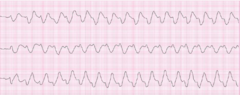
• Calcium chloride 5-10 mL IV
• Calcium gluconate 10-20 mL IV
Hyperkalemia treatment: membrane stabilization
a) NaHCO3 - 50-150 mEq IV if met acidosis present
b) Albuterol - 10-20 mg/4mL over 10 minutes
c) Insulin/glucose - 5-10 Units IV/25g glucose (sometimes start d10W drip)
Hyperkalemia treatment: shifting potassium into cells
Furosemide 40-80 mg IV
Hyperkalemia treatment: renal excretion
a) Sodium zirconium cyclosilicate
b) Sodium polystyrene sulfonate
Hyperkalemia treatment: binds K+ in GI tract
Hemodialysis
Hyperkalemia treatment:
Removes K+