Learn: Group Case Study Unit 1
 Call Kai
 Learn
Learn Practice Test
 Spaced Repetition
 Match
Match Flashcards
 Knowt Play
1/42

There's no tags or description
Looks like no tags are added yet.
Name | Mastery | Learn | Test | Matching | Spaced | Call with Kai | Chat |
|---|
No analytics yet
Send a link to your students to track their progress
43 Terms
Richard is home and begins to smell smoke, he proceeds to his bedroom door to check on what may be causing the odor. He touches his doorknob and immediately feels a hot sensation and withdraws his hand.
What is the stimulus?
The hot door knob
Richard is home and begins to smell smoke, he proceeds to his bedroom door to check on what may be causing the odor. He touches his doorknob and immediately feels a hot sensation and withdraws his hand.
What is the receptor?
The nerves int he hand (thermoreceptors)
Richard is home and begins to smell smoke, he proceeds to his bedroom door to check on what may be causing the odor. He touches his doorknob and immediately feels a hot sensation and withdraws his hand.
What is the control center (integration)?
The brain
Richard is home and begins to smell smoke, he proceeds to his bedroom door to check on what may be causing the odor. He touches his doorknob and immediately feels a hot sensation and withdraws his hand.
What is the output signal?
The signal sent from the brain to the hand to remove it from the door knob (motor neuron)
Richard is home and begins to smell smoke, he proceeds to his bedroom door to check on what may be causing the odor. He touches his doorknob and immediately feels a hot sensation and withdraws his hand.
What is the target/effector?
The hand
Richard is home and begins to smell smoke, he proceeds to his bedroom door to check on what may be causing the odor. He touches his doorknob and immediately feels a hot sensation and withdraws his hand.
What is the response?
Pulling his hand away from the door
Richard is home and begins to smell smoke, he proceeds to his bedroom door to check on what may be causing the odor. He touches his doorknob and immediately feels a hot sensation and withdraws his hand.
Is this negative or positive feedback?
Negative feedback
What are the different layers affected in a third-degree burn of thick skin?
-Stratum corneum
-Stratum lucidum
-Stratum granulosum
-Stratum spinosum
-Stratum basale
-Dermis
-Subcutaneous
What is the function of the stratum corneum?
Physical barrier of the skin that protect the inside of the body

What is the function of the stratum lucidum?
It is nearly transparent and tough.
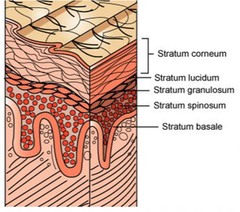
What is the function of the stratum granulosum?
Waterproofing the skin by producing lipid-filled vesicles that release a glycolipid by exocytosis

What is the function of the stratum spinosum?
Gives the skin strength and flexibility. Protects cells from UV rays and synthesizes keratin

What is the function of the stratum basale?
Produces keratinocytes and melanocytes and contains stem cells that differentiate into other cells
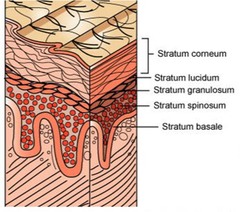
What is the function of the epidermis?
Protection, waterproofing, skin tone, and sensation of light touch
What is the function of the dermis?
-Support and protect the body
-Helps with thermoregulation
-Contains nerve endings and glands
What is the function of the subcutaneous?
-Protects internal organs and muscles
-Thermoregulation
-Insulation
-Energy storage
-Structural support
What features of the skin prevent pathogen invasion of underlying tissue?
-Physical (tight junctions in the skin)
-Biological barriers (cells within the skin) including macrophages, mast cells, dendritic cells, keratin, sebum, acidic sweat, and lipids released by lamellar granules.
Why do burn patients have an increased risk of developing hypothermia?
The layers of the skin that help with thermoregulation, the dermis and subcutaneous, are burned away, meaning the body is unable to maintain the proper temperature, which can lead to hypothermia. The blood vessels are damaged, meaning they are unable to help with thermoregulation.
How does intact skin normally accomplish body temperature regulation? What tissue type specifically contributes to this?
Glandular epithelium tissue and smooth muscular tissue helps with thermoregulation by dilating/constricting the blood vessels and sweating
Why were Richard's second degree/partial thickness burns more painful than his very serious third degree-full thickness burn?
In his third degree burns, he has burned away all of his nerve endings and pain receptors, meaning he is unable to feel the pain. In second degree burns, those receptors are still intact, leading to pain.
Richard is administered painkillers and IV fluid; why is IV fluid administration an important aspect of Richard's therapy?
IV fluid is administered because burns cause rapid water loss, which can lead to severe dehydration. Warm IV fluid also helps prevent hypothermia and minimize heat loss as well as shock caused by the burns.
What will happen if Richard receives a hypertonic IV fluid?
He would become dehydrated faster as the water in his cells would rush out of the cells to maintain homeostasis, causing the cells to shrink. This IV fluid is used to maintain sodium levels.
What will happen if Richard receives a hypotonic IV fluid?
This fluid would help with his dehydration because the water from the solution would rush into his cells, causing them to swell. Can lead to the depletion of intervascular fluid levels though as the liquid flows into the cells.
What are examples/location of epithelial tissue?
Covers body surface (skin surface) and lines hollow cavities and ducts.
What are examples/locations of connective tissue?
Supports skin and other organs as well as cartilage, bone, and blood. Example: Extracellular matrix
What are examples/locations of muscular tissue?
Located in the muscles of the body
What are examples/locations of nervous tissue?
Located in nerves throughout the body (brain, spinal cord, nerves)
What is the anatomy/description of epithelial tissue?
Cells (squamous, cuboidal, or columnar shaped) arranged in continuous sheets.
What is the anatomy/description of connective tissue?
Composed of cells and matrix (ground substance and protein fibers). Made up of loose fibrous connective tissue.
What is the anatomy/description of muscular tissue?
Composed of cells specialized for contraction and generation of force
What is the anatomy/description of nervous tissue?
Contains dendrites, cells body, and axon.
What is the function of epithelial tissue?
Protection, filtration, absorption, sensory perception, excretion, and secretion.
What is the function of connective tissue?
Binds structures, provides a framework, supports body/organs, storage, transportation, protects, and repair of tissue
What is the function of muscular tissue?
Produce movement
What is the function of nervous tissue?
Detects change inside and outside of the body and generates a response to these changes.
What are some unique features of the epithelial tissue?
avascular and innervated
What are some unique features of the connective tissue?
Contains embryonic and mature classifications. Cells are randomly scattered about the matrix and have irregular/round shape
What are some unique features of the muscular tissue?
Cells are elongated and thin, sometimes branched (heart). Excitable (stimulated by electrical impulses)
What are some unique features of the nervous tissue?
Highly branched or elongated. Excitable
What are some ways a chemical can inhibit an enzyme?
It can bind to specific parts of the molecule, either right at the active site or on another part and can then either change the shape of the active site or block the active site in order to inhibit the enzyme. Outside factors can also inhibit an enzyme, such as temperature and pH differences.
What effect will grapefruit juice have on Richard taking this medication given that it will inhibit the enzyme that metabolizes it?
It will block the enzyme from metabolizing the medication, causing the medication to build up in the system.
Is the epithelium likely to be simple or stratified? Why?
It is simple squamous cells because it facilitates diffusion, which is important in kidneys which they constantly diffuse molecules across them (secretes and absorbs)
The movement of sodium ions drives the transcellular transport of water. Why does the water follow sodium?
Water follows sodium in order to maintain homeostasis by balancing out the amount of water and sodium on both sides of a border.