UNIT2 AOS1 SBA
 Call Kai
 Learn
Learn Practice Test
 Spaced Repetition
 Match
Match Flashcards
 Knowt Play
1/93

There's no tags or description
Looks like no tags are added yet.
Name | Mastery | Learn | Test | Matching | Spaced | Call with Kai | Chat |
|---|
No analytics yet
Send a link to your students to track their progress
94 Terms
Revenue
These are increases in assets or decreases in liabilities that result in an increase in owner's equity (other than by a contribution by the owner).
Expenses
These are decreases in assets or increases in liabilities that result in a decrease in owner's equity (other than by a withdrawal by the owner).
Profit
The excess of revenues over expenses for a specific period of time.
Assets
These are present economic resources under the control of the entity, which have the potential to produce economic benefits as a result of past transactions.
liabilities
These are present obligations of an entity to transfer economic resources to another entity as a result of past transactions or other past events.
Owner's equity
This is a residual amount after liabilities have been deducted from assets.
Owner's equity equation
Assets - Liabilities = Owner's Equity
Timeliness
The information should be available to decision-makers as quickly as possible so that it is useful for decision-making.
Understandability
means the financial information should be presented in a format which can be understood by users with a reasonable knowledge of business and economic activities and they can comprehend their meaning. Information should be presented concisely and clearly.
Relevance
refers to the usefulness of financial information in helping users make decisions. Relevant financial information will help the users to predict the outcomes of past, present or future events.
Faithful representation
Information reported must be a faithful representation of the real-world economic events it claims to represent and be complete, free from material error and neutral (without bias).
Comparability
ensures that users can identify similarities and differences in financial reports with other entities or over different reporting periods
Verifiability
The premise that financial information is supported by evidence such as the retention of source documents that can be used to check its accuracy.
How does a physical inventory count satisfy verifiability?
It provides evidence that the inventory reported is faithfully represented and allows different users to reach the same conclusion.
Period assumption
The assumption that reports are prepared for a particular period of time such as a month, quarter or year in order to obtain comparability of results. In each reporting period revenue earned is compared with expenses incurred so as to calculate an accurate profit for the reporting period.
Accural Basis Assumption
Under accrual accounting, profit is determined by subtracting the expenses incurred from the revenue earned in the same period. Revenue is recognised when it is earned, not when the cash is received whereas expenses are recognised when they are incurred, not when the cash is paid.
Going concern assumption
The assumption that a business entity will continue to operate and will not be wound up in the foreseeable future and records are kept on this basis.
Accounting entity assumption
A business has its own financial status and is completely separate from its owner and other entities.
inventory
goods purchased by a trading from for resale
purchases
transactions involving a trading firm acquiring inventory for resale
sales
the revenue a trading firm earns by providing goods to its customers
credit note
a business document confirming that goods have been returned and credit has been granted to the customer
current assets
assets expected or intended to be used up or turned into cash within the next 12 months.
Non-current assets
assets of a long term nature, usually under the control of the business entity for a period greater than 12 months.
current liabilities
Economic obligations due to be settled or paid off within the next 12 months
non-current liabilities
obligations of a long-term nature, usually due for a settlement or payment over a period greater than 12 months.
trading firm
a business that earns its revenue from buying and selling goods.
Why is it necessary for businesses to use a cost assignment method?
→ Inventory may be purchased at different cost prices.
→ A cost must be assigned to inventory sold to determine cost of sales and profit.
identified cost
an inventory system that allows the actual cost of each inventory item to be identified
FIFO (first in, first out)
a system of recording inventory movements, based on the assumption that the first goods purchased are the first goods sold
Why use FIFO instead of Identified Cost?
→ Used when it is impossible or impractical to identify each individual item's original cost.
→ FIFO provides a systematic way of assigning costs.
Inventory card
a document used to record all movements of a particular line of inventory
Benefits of inventory cards
→ Identify fast and slow-moving inventory.
→ Assist with reordering inventory.
→ Help identify inventory losses/gains by comparing the card to a physical count.
Key rules when recording inventory cards
→ Record the source document + number.
→ Record cost price only — ignore selling price and GST.
→ Keep different cost prices on separate lines.
purchases return
a return of inventory items to the supplier
Cost of sales
the cost price of inventory sold by a trading firm
sales return
the return of goods orginally sold to accounts receivable on credit
FIFO: How do you determine Cost of Sales for a Sales Return?
→ Apply FIFO in reverse.
→ Work backwards through the OUT column, starting with the most recent cost allocated.
Identified Cost: How do you determine Cost of Sales for a Sales Return?
→ Use the actual cost of the specific inventory returned.
Reasons for Sales Returns
→ Incorrect inventory supplied.
→ Damaged/faulty inventory.
→ Inventory does not meet customer expectations.
Strategies to reduce Sales Returns
→ Improve quality control.
→ Check orders before delivery.
→ Provide accurate product information.
What is cost assignment?
The process of determining which cost price is assigned to inventory when it is sold or otherwise removed from the business.
When would a business use FIFO?
When it is impossible or impractical to keep track of each individual inventory item's original cost.
When would a business use Identified Cost?
When inventory items can be individually identified and their actual cost can be determined, usually for a limited variety of high-cost items.
perpetual inventory system
recording movements of inventory by maintaining continuous records throughout a period
What is inventory management?
The process of monitoring and controlling inventory to meet customer demand while avoiding excessive levels of inventory.
How do inventory cards assist inventory management?
They help identify fast and slow-moving inventory, assist with reordering, and identify inventory losses and gains by comparing the card with a physical count.
What price is recorded on an inventory card?
Only the cost price. Selling prices and GST are ignored.
What does the IN column record?
Inventory entering the business, such as purchases, inventory gains and sales returns.
What does the OUT column record?
Inventory leaving the business, such as sales, inventory losses, purchase returns, drawings and advertising.
What does the BALANCE column show?
The quantity and cost of inventory currently on hand.
physical stocktake
the process of physically counting the number of units of inventory on hand at a particular date
What is a physical inventory count?
The process of determining the actual number of inventory items on hand and adjusting the inventory card to match.
Why does a business perform a physical inventory count?
To ensure the amount reported for Inventory matches the actual inventory on hand.
inventory loss
when the number of units revealed by a stocktake is less than the quantity shown on an inventory card
What can cause an inventory loss?
Undersupply from supplier, oversupply to customer, damaged inventory removed but not recorded, or error in physical inventory count.
What cost is used for an inventory loss under FIFO?
The oldest cost price in the Balance column.
How does inventory loss satisfy the definition of an expense?
It decreases assets (Inventory), resulting in a decrease in Owner's Equity other than drawings.
inventory gain
when the number of units revealed by a stocktake is greater than the quantity shown on an inventory card
What can cause an inventory gain?
Oversupply from supplier, undersupply to customer, or error in physical inventory count.
What cost is used for an inventory gain under FIFO?
The most recent cost price in the IN column.
How does an inventory gain satisfy the definition of revenue?
It increases assets (Inventory), resulting in an increase in Owner's Equity other than capital contributions.
Where is an inventory return to a supplier recorded?
In the OUT column because inventory is leaving the business.
What cost is used when inventory is returned to a supplier?
The cost price shown on the supplier's credit note.
Where is inventory returned by a customer recorded?
In the IN column, because the inventory is returning to the business.
How is the cost of a sales return determined under FIFO?
Use FIFO in reverse, starting with the most recent cost price in the OUT column.
What are drawings of inventory?
When the owner withdraws inventory from the business for personal use.
What cost is used for drawings under FIFO?
The oldest cost price in the Balance column.
What is donations recorded as
advertising expense
What is advertising involving inventory?
When inventory is used or given away to promote the business or its products rather than being sold.
Where are drawings and advertising recorded on an inventory card?
In the OUT column, because inventory is leaving the business.
Why can FIFO and Identified Cost produce different results?
When cost prices change, each method may allocate different costs to Cost of Sales and closing Inventory, causing different profit and inventory values.
inventory turnover
a financial indicator that shows how many days it takes a business to turn its inventory into sales
What does Inventory Turnover measure?
The average number of days it takes a business to sell its inventory.
What does a faster Inventory Turnover mean?
A decrease in the number of days it takes to sell inventory, which is generally favourable.
What does a slower Inventory Turnover mean?
An increase in the number of days it takes to sell inventory, which is generally unfavourable.
liquidity
is the ability of a business to meet its short term obligations as they fall due.
How does a faster Inventory Turnover improve liquidity?
Inventory is converted into cash faster, making it easier to meet short-term debts as they fall due.
How can a faster Inventory Turnover improve profitability?
Selling more inventory can increase Sales, profit and therefore profitability.
Why might faster Inventory Turnover not improve profitability?
The business may have reduced its mark-up/selling price, meaning less profit is earned per unit sold.
Why can slower Inventory Turnover be unfavourable?
Inventory remains unsold for longer, increasing the risk of it becoming obsolete and requiring an inventory write-down.
What is a benchmark?
A standard or target used to compare a business's actual performance against.
What is a trend?
The general direction or pattern of change in financial information over a period of time.
What is a strategy?
A specific action or plan implemented by a business to achieve an objective or improve performance.
What strategies can improve Inventory Turnover?
Advertising, changing selling prices/mark-up, ordering smaller amounts more frequently, relocating inventory within the store.
How can advertising improve Inventory Turnover?
Advertising may increase customer awareness and sales, causing inventory to be sold faster and Inventory Turnover to improve.
How can reducing selling prices improve Inventory Turnover?
Lower prices may increase demand and sales, allowing inventory to be sold faster.
What is a disadvantage of reducing selling prices?
A lower mark-up means less profit per unit, potentially reducing profit and profitability.
How can ordering smaller quantities more frequently improve Inventory Turnover?
It reduces the quantity and value of inventory held, helping improve Inventory Turnover.
What is a disadvantage of ordering smaller quantities more frequently?
The business risks running out of inventory, losing sales and having higher transportation expenses.
How can relocating inventory improve Inventory Turnover?
Placing inventory in a more visible area of the store may attract customers and increase sales.
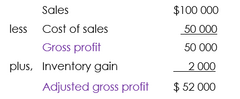
gross profit
sales revenue for a period less the cost of sales over that same period
adjusted gross profit
sales revenue minus cost of goods sold and any adjustment for inventory loss or inventory gain
how to calculate gross profit