OP Summer Psychology - Week 2 Notes
 Call Kai
 Learn
Learn Practice Test
 Spaced Repetition
 Match
Match Flashcards
 Knowt Play
1/37

There's no tags or description
Looks like no tags are added yet.
Name | Mastery | Learn | Test | Matching | Spaced | Call with Kai | Chat |
|---|
No analytics yet
Send a link to your students to track their progress
38 Terms
Resting Potential
-70mV, distribution of ions
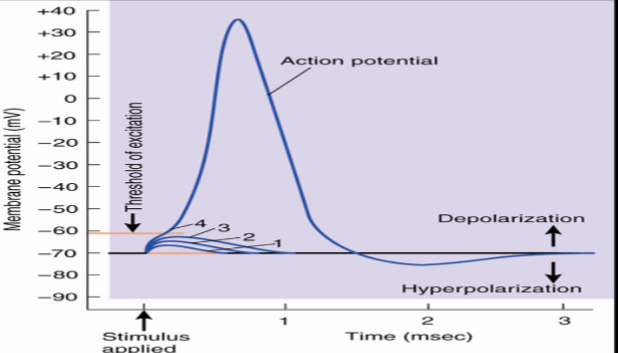
Threshold of excitation
-55mV, voltage gated sodium channels open to fire an impulse (aka action potential)
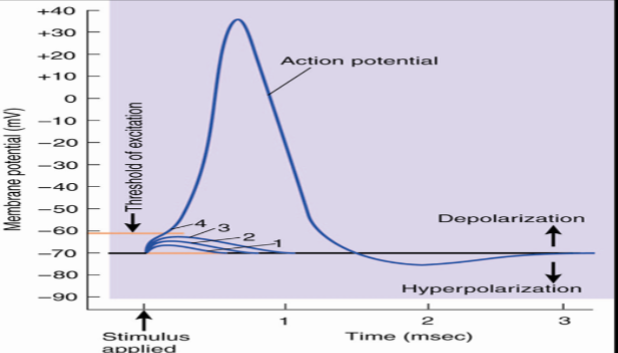
Chanel closing
+40mV

Depolarization - What potential is being released and what ion moves in/out?
EPSP, sodium channels open and Na+ moves into the neuron
Hyperpolarization - What potential is being released and what ion moves in/out?
IPSP: potassium channels open and K+ moves out of the neuron
Why does Na+ move in?
Na+ moves from high to low concentration when channel opens because inside the axon, it is a negative environment
Why does K+ move out?
K+ moves outside because all the Na+ ions have got in (and now the interior has gone in) and so K+ would move outside the axon because it moves from high to low concentration
Sodium potassium pump
This is when the graph reaches rest. It pumps K+ inside and Na+ pumps outside (to restore distribution)
If a neuron goes from -70mV to -73mV, is it:
a. EPSP
b. IPSP
c. Need more information
d. None of the above
b. IPSPs are negative and so if mV geos down, that means it is caused by the negative inhibitor
Learning
acquiring knowledge, permanent change for the learner
Habituation
repeated exposure of a stimulus, your response declines over time (you get used to it)
Sensitization
a form of learning that leads to an increase response of a later stimulus
Example: a person has a traumatic event, they used to not react to the environment at all but now they have a heightened reaction
Classical conditioning (Ivan Pavlov)
you pair a neutral stimulus with a natural trigger. over time the neutral stimulus brings forth an automatic reaction (Ivan Pavlov studying dogs & bells w/ food)
Unconditioned stimulus (UCS)
a trigger that naturally causes a reflex (like food making you hungry)
Unconditioned Response
a natural and automatic reaction to the UCS (like drooling from food)
Neutral stimulus
a sign that causes no reflex at first (like a bell)
Conditioned stimulus (CS)
the old neutral sign after it links to the UCS, now causing a reaction on its own
Conditioned response (CR)
the learned reaction to the new CS
Acquisition
first phase of learning or conditioning when a person first establishes a new behavior or response
(a neutral trigger links to an unconditioned trigger until the brain recognizes the pattern and forms the new habit)
Extinction
a learned response stops because the signal is shown without the main trigger (Example: a bell rings over and over but no food comes. The dog stops salivating at the sound of the bell)
Spontaneous recovery
a learned behavior recovering from extinction after a rest period
Generalization
the tendency to respond to new, similar stimuli or situations the same way we learned to respond to the original one
Discrimination
the ability to tell the difference between various stimuli and respond only to a specific one
Operant Conditioning
type of learning that voluntary behavior is shaped by its consequences (actions are followed by rewards and punishments)
Law of effect
behaviors that tend to be repeated are those that are rewarded and behaviors that aren’t likely to repeat are due to negative consequences
Operant Behavior
behavior that an organism produces has some impact on the environment
Positive reinforcement
adding a stimulus to continue the behavior
Mom gives cookie to a girl who is doing what the mother wants (desired stimulus) so the girl does it again
Negative reinforcement
adding a stimulus to continue the behavior
The parent is nagging and only stops when the child leans the messy room (removing the stimulus when the child cleans their room)
Positive punishment
Decreases behavior by adding a negative stimulus (like adding a bad saying)
toddler throws toys and father yell “Stop it” (adding a negative stimulus when the child yells and getting yelled at will likely not do it again after being yelled at)
Negative punishment
Taking away a desired stimulus to decrease the behavior
a teenager goes out past curfew and the parent takes away the privilege to go out/grounds the teenager and so this will likely decrease the behavior of the teenager going out too late again
Primary reinforcers
help satisfy biological needs/desires (food, water, shelter)
Secondary needs
things you want but don’t need to survive (trophies, money, etc)
Immediate and Delayed Reinforcement and Punishment
you want to reward/punish the person then and not wait till after for the result to be more effective
Fixed interval schedule (FI)
reinforcement is provided for the first action after a specific amount of time has passed
Example: a student studying more intensely as a scheduled weekly quiz approaches
Variable interval schedule (VI)
reinforcement is given for the first action after unpredictable time intervals
Example: checking an email inbox for an important message that arrives at random times throughout the day
Fixed ratio schedule (FR)
reinforcement is delivered after a set number of actions
Example: receiving an award after completing every 5 practice problems
Variable ratio schedule
reinforcement is based an unpredictable number of actions
Example: a salesperson making several calls before securing a sale. This schedule often results in high, steady rates of behavior.
The reinforcement is…. (tips to remember)
Fixed = consistent
Variable = varies
Ratio = number of times
Interval = amount of times