AP Macroeconomics - Unit 4 Progress Check: MCQ
 Studied by 2 people
 Call with Kai
 Learn
Learn Practice Test
 Spaced Repetition
 Match
Match Flashcards
 Knowt Play
1/42

There's no tags or description
Looks like no tags are added yet.
Name | Mastery | Learn | Test | Matching | Spaced | Call with Kai |
|---|
No study sessions yet.
43 Terms
4.1
Which of the following is true for both stocks and bonds?
A
They are interest-bearing assets.
B
They are financial assets.
C
They are risk-free assets.
D
They are equity.
E
They are ownership in a company.
Answer B
Correct. Bonds and stocks are both financial assets.
4.1
Which of the following rankings lists these assets from the least liquid to the most liquid?
A
Cash, bonds, house, savings account
B
Bonds, house, savings account, cash
C
Savings account, cash, bonds, house
D
House, bonds, savings account, cash
E
Cash, savings account, bonds, house
Answer D
Correct. House, bonds, savings account, cash are listed in order from least liquid to most liquid.
4.1
Nathan has been unable to trust banks since the failure of his savings and loan bank. He claims that storing his hard-earned money at home is costless. Is Nathan correct?
A
Yes, because money is the most liquid form of financial assets.
B
Yes, because there is no opportunity cost in holding money.
C
Yes, because the opportunity cost of holding money is the real value of goods and services it can purchase.
D
No, because money is the least liquid form of financial assets.
E
No, because the opportunity cost of holding money is the lost interest he could have earned on other financial assets.
Answer E
Correct. Nathan is incorrect because the opportunity cost of holding money is the interest income that could have been earned from holding other financial assets, such as bonds.
4.2
Which of the following is adjusted by the actual inflation rate?
A
Nominal wages
B
Automatic stabilizers
C
Unemployment rate
D
Price of previously issued bonds
E
Real interest rates
Answer E
Correct. Real values are adjusted for inflation. A real interest rate is adjusted for inflation.
4.2
Spencer took a 9 percent one-year fixed-rate loan to buy a new car. He expected to pay a real interest rate of 5 percent. If at the end of the year Spencer only paid a 3 percent real interest rate, which of the following is true?
A
The nominal interest rate was 3%.
B
The nominal interest rate was 5%.
C
The actual inflation rate was 2%.
D
The actual inflation rate was 4%.
E
The actual inflation rate was 6%.
Answer E
Correct. The actual inflation rate is the difference between the nominal interest rate and the actual real interest rate, 9%−3%=6%.
4.2
If the interest rate on a one-year loan is 5% and the expected inflation rate is −2% for the same period, what is the expected real interest rate on the loan?
A
−7%
B
−2%
C
2%
D
3%
E
7%
Answer E
Correct. The expected real interest rate is calculated as the nominal interest rate minus the expected inflation rate; 5%−(−2%)=7%.
4.3
Which of the following transactions will keep M1 unchanged?
A
Sam transferred money from his certificate of deposit to his checking account.
B
Mike purchased government bonds and paid with a check.
C
Leila deposited coins from her piggy bank into her checking account.
D
Sandy converted a small-denomination time deposit into cash.
E
Patty increased her monthly cash deposits to her retirement funds.
Answer C
Correct. M1 is composed of currency in circulation and checkable deposits. This transaction will keep M1 unchanged because currency will decrease and checkable deposits will increase by the same amount.
4.3
Which of the following is included in the monetary base?
A
Currency held by the public and commercial bank reserves held with the central bank
B
Currency held by the public, demand deposits at depository institutions, and commercial bank reserves held with the central bank
C
Currency held by the public, demand deposits, savings deposits, and certificates of deposit
D
Currency held by the public and small and large time deposits
E
Currency held by the public, small and large time deposits, and commercial bank reserves held with the central bank
Answer A
Correct. The monetary base includes currency in circulation and bank reserves.
4.3
Mia transferred $1,000 from her checking account to a certificate of deposit. How will the M1 and M2 measures of the money supply change?
A
M1 will increase and M2 will decrease.
B
M1 will increase and M2 will increase.
C
M1 will decrease and M2 will increase.
D
M1 will decrease and M2 will not change.
E
M1 will not change and M2 will increase.
Answer D
Correct. M1 is composed of currency in circulation, demand deposits, and other liquid deposits such as savings deposits. M2 is composed of M1 and other small-denomination time deposits and balances in retail money market funds. Therefore, transferring money from checking accounts to certificates of deposit will reduce M1 but will not affect M2.
4.4
Northern City Bank keeps no excess reserves. Assume Northern City Bank receives a cash deposit of $50 dollars. As a result of the deposit, Northern City Bank's required reserves increase by $10. What is the maximum possible change in the money supply in the banking system that could result from the $50 deposit?
A
The money supply will increase by a maximum of $10.
B
The money supply will increase by a maximum of $40.
C
The money supply will increase by a maximum of $50.
D
The money supply will increase by a maximum of $200.
E
The money supply will increase by a maximum of $250.
Answer D
Correct. Since the bank keeps no excess reserves, all excess reserves will be lent out and will result in a maximum increase in loans of $200, which is the product of excess reserves (=deposits−required reserves=$50−$10=$40) and the money multiplier (=1/required reserve ratio=1/(required reserves or deposits)=1/($10 or $50)=1/0.2=5).Therefore, the money supply will increase by a maximum of $200.
4.4
Southern City Bank has $100 million in deposits and has $8 million in excess reserves. If the required reserve ratio is 5%, which of the following is true?
A
The money multiplier is 20, and the bank can lend out up to $160 million.
B
The money multiplier is 8, and the bank can lend out up to $20 million.
C
The money multiplier is 8, and the bank can lend out up to $5 million.
D
The money multiplier is 8, and loans can increase in the banking system by a maximum of $8 million.
E
The money multiplier is 20, and loans can increase in the banking system by a maximum of $160 million.
Answer E
Correct. The money multiplier is the inverse of the required reserve ratio and is equal to 10.05=20. The bank can lend out its excess reserves up to $8 million. When the bank lends out all its excess reserves, loans in the banking system can increase by a maximum of $160 million which is equal to the product of the bank's excess reserves and the money multiplier; $8million×20 = $160million.
4.4
Which of the following explains why the amount predicted by the value of the simple money multiplier may be overstated?
A
It does not take into account the amount of bank loans.
B
It does not take into account the marginal propensity to consume.
C
It does not take into account a bank’s desire to hold excess reserves.
D
It does not take into account changes in expected inflation.
E
It does not take into account changes in savings.
Answer C
Correct. The amount predicted by the simple money multiplier may be overstated because it does not take into account a bank's desire to hold excess reserves or the public holding more currency.
4.5
Which of the following describes the relationship between the nominal interest rate and the quantity of money people want to hold as depicted by the money demand curve?
A
Positive, and the money demand curve is upward sloping.
B
Positive, and the money demand curve is downward sloping.
C
Positive, and the money demand curve is vertical.
D
Inverse, and the money demand curve is upward sloping.
E
Inverse, and the money demand curve is downward sloping.
Answer E
Correct. As the nominal interest rate falls, people hold more money because the opportunity cost of holding money decreases, which leads to a downward-sloping money demand curve.
4.5(图片见后页)
Which of the following is true at the nominal interest rate (i3) ?
A
The money market is at equilibrium because the quantity demanded is equal to the quantity supplied.
B
There is a surplus in the money market because the quantity demanded is less than the quantity supplied.
C
There is a surplus in the money market because the quantity demanded is greater than the quantity supplied.
D
There is a shortage in the money market because the quantity demanded is greater than the quantity supplied.
E
There is a shortage in the money market because the quantity demanded is less than the quantity supplied.
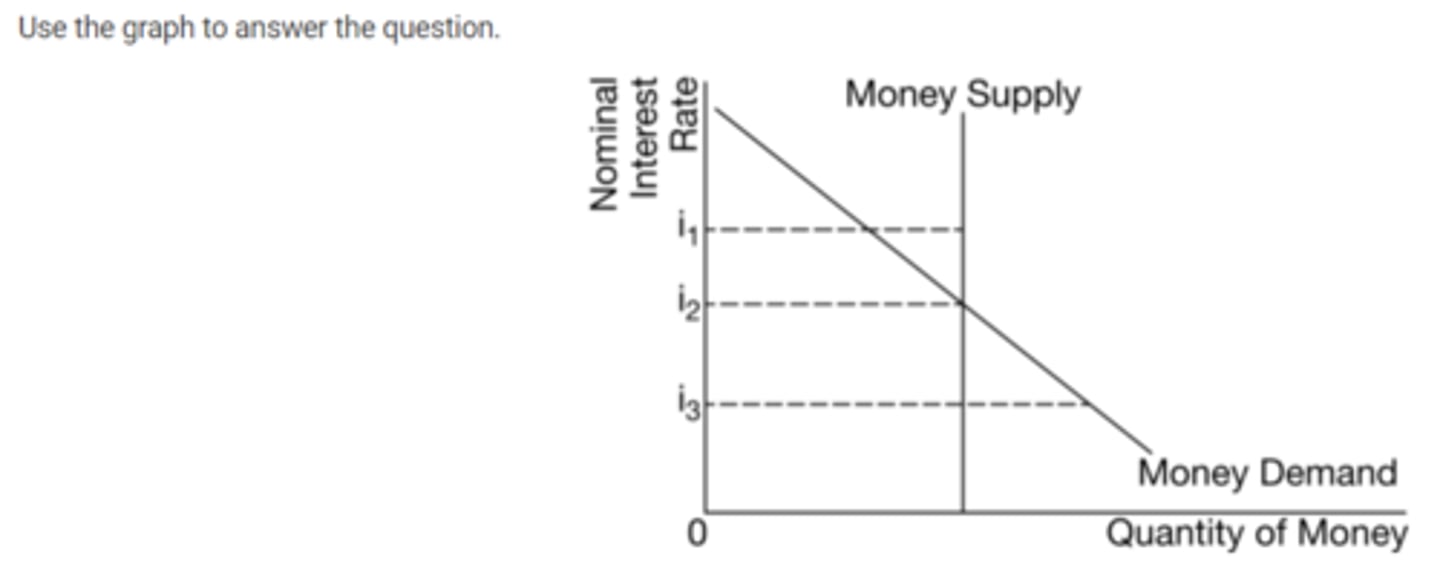
Answer D
Correct. At i3 the quantity of money demanded is greater than the quantity of money supplied; therefore, there is a shortage in the money market.
4.1 4.5
An increase in the price level will affect the money market and bond market in which of the following ways?
A
The nominal interest rate rises, and the price of previously issued bonds rises.
B
The nominal interest rate falls, and the price of previously issued bonds is unaffected.
C
The nominal interest rate rises, and the price of previously issued bonds falls.
D
The nominal interest rate falls, and the price of previously issued bonds rises.
E
The nominal interest rate is unaffected, and the price of previously issued bonds rises.
Answer C
Correct. A rise in price level causes the money demand curve to shift to the right, causing the nominal interest rate to rise. Nominal interest rates and bond prices move in opposite directions. Therefore, an increase in the nominal interest rate will result in a decrease in the price of previously issued bonds.
4.6
Suppose that the banking system in an economy has ample reserves, and the economy has entered a recession. Which of the following is a monetary policy action the central bank can take to restore full-employment output in the short run?
A
Selling government bonds
B
Decreasing government spending
C
Decreasing administered interest rates
D
Increasing the policy rate
E
Increasing the required reserve ratio
Answer C
Correct. Decreasing administered interest rates is an expansionary monetary policy that will decrease the policy rate and thereby decrease nominal interest rates in the economy, which will increase interest-sensitive spending and move the economy back towards full employment.
4.6(图片见后页)
Country X's economic situation is depicted by the graph above. Which of the following will happen if Country X's central bank conducts a contractionary monetary policy?
A
The economy will be in a recessionary gap; the price level will decrease, and the real output level will increase.
B
The economy will be in a recessionary gap; the price level and the real output level will decrease.
C
The economy will be at full employment; the price level and the real output level will increase.
D
The economy will be in an inflationary gap; the price level and the real output level will increase.
E
The economy will be in an inflationary gap; the price level will increase, and the real output level will decrease.
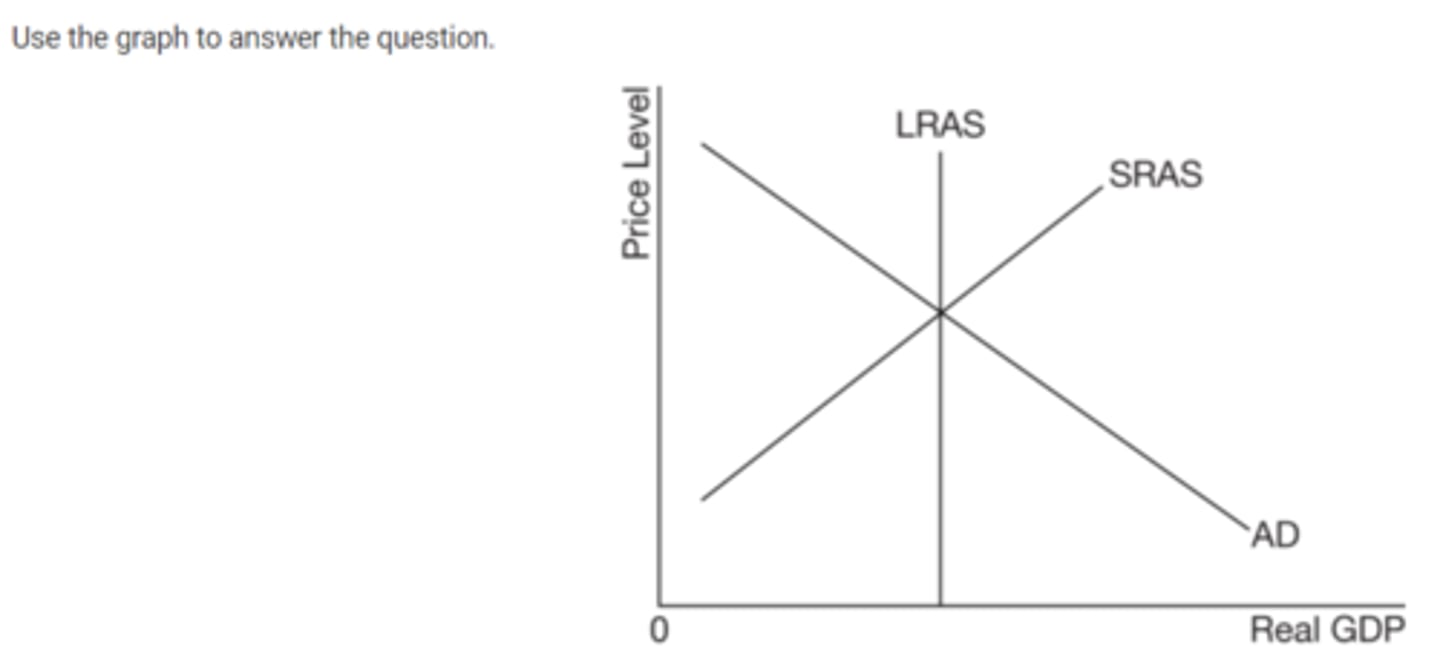
Answer B
Correct. The economy is currently in long-run equilibrium producing the full-employment output. A contractionary monetary policy will cause the AD curve to shift to the left, leading to a decrease in the price level and the real output level. Real output will be lower than full employment and the economy will be in a recessionary gap.
4.6
Assume the banking system in Zenobia has ample reserves. Which of the following reserve market graphs demonstrates the effect of the central bank of Zenobia increasing its administered interest rates?(D E选项见下下页)
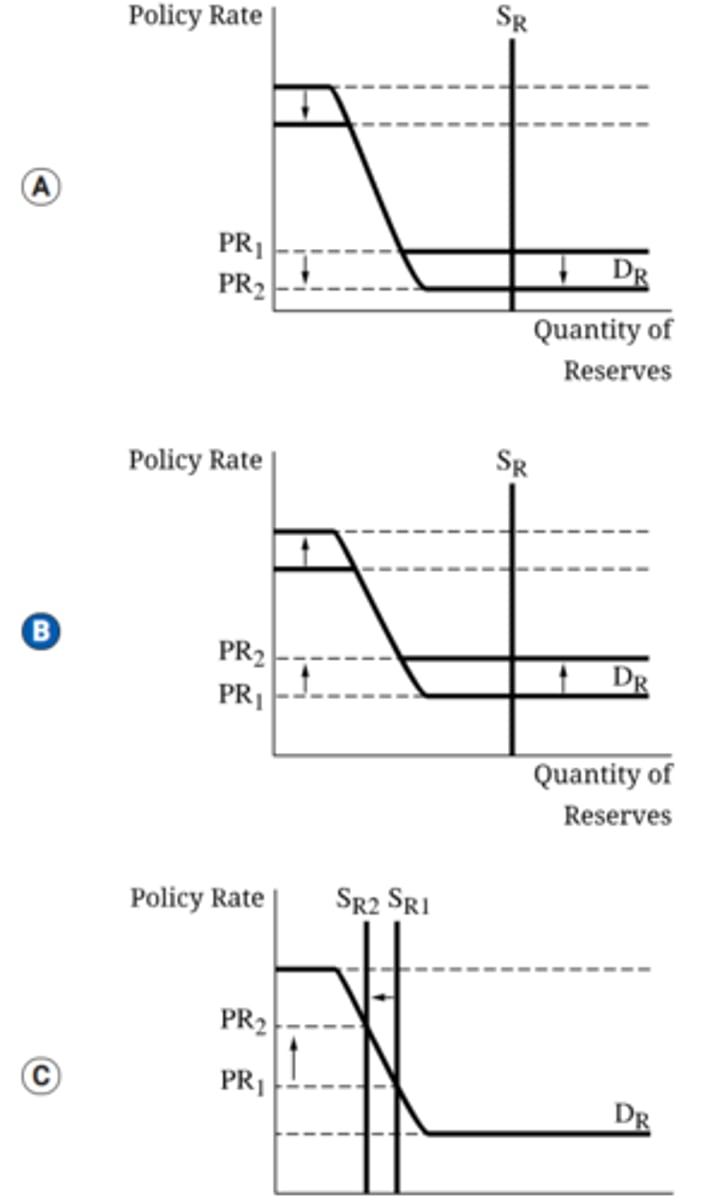
D E选项见后页
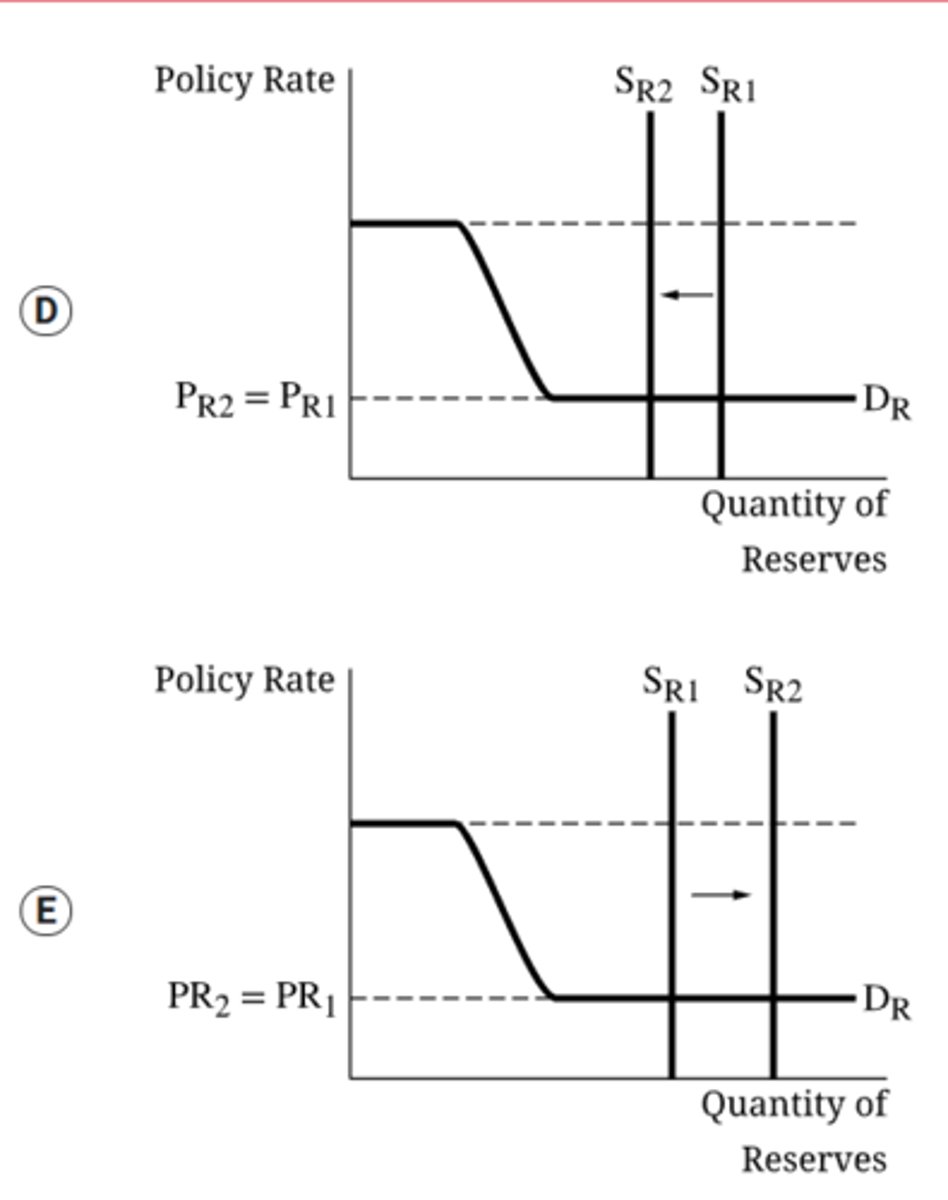
Answer B
Correct. The demand for reserves and the supply of reserves curves intersect where the quantity of reserves is large and the demand curve is horizontal, reflecting a banking system with ample reserves. The graph shows an increase in administered interest rates, which changes the intersection of the demand for reserves curve and the supply of reserves curve, resulting in an increase in the policy rate.
4.7
Which of the following is true about the loanable funds market?
A
The demand for loanable funds shows a positive relationship between real interest rates and the quantity demanded of loanable funds.
B
The supply of loanable funds shows an inverse relationship between real interest rates and the quantity supplied of loanable funds.
C
Investment is financed by national savings in a closed economy.
D
Investment is financed by government borrowing in an open economy.
E
Public savings is the sum of national savings and private savings.
Answer C
Correct. Investment is financed by national savings in a closed economy. In a closed economy, Y = C + I + G, and national savings is S = Y −C − G. Therefore, Y − C − G= I; i.e., S=I.
4.7
The loanable funds market is currently in equilibrium at a real interest rate of r1. An increase in household savings will affect the loanable funds market in which of the following ways?
A
There will be a surplus of funds and the real interest rate will increase.
B
There will be a shortage of funds and the real interest rate will decrease.
C
The demand for loanable funds will increase and the real interest rate will increase.
D
The supply of loanable funds will increase and the real interest rate will increase.
E
The supply of loanable funds will increase and the real interest rate will decrease.
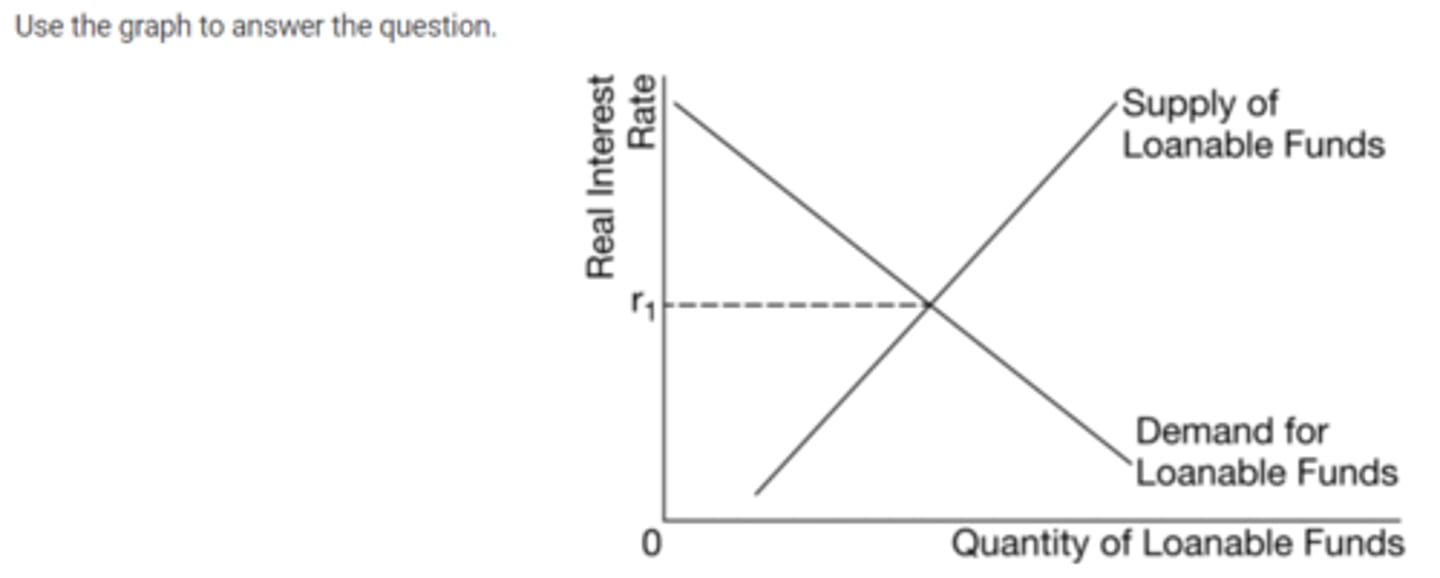
Answer E
Correct. An increase in household savings will shift the supply curve of loanable funds to the right, which results in a lower real interest rate.
4.7
Country X's economy is enjoying political stability and attracting an increase in foreign financial capital. At the same time Country X's government is borrowing to finance spending. How will these changes affect the loanable funds market in Country X?
A
There will be a decrease in the supply of loanable funds.
B
There will be a decrease in the demand for loanable funds.
C
There will be an increase in the equilibrium nominal interest rate.
D
There will be an indeterminate effect on the equilibrium real interest rate.
E
There will be an indeterminate effect on the equilibrium quantity of loanable funds.
Answer D
Correct. The increase in foreign financial capital increases the supply of loanable funds, which lowers the real interest rate. The increase in government borrowing increases the demand for loanable funds, which increases the real interest rate. Thus, the overall impact on the equilibrium real interest rate is indeterminate.