Advanced Molecular Cell Biology - Lecture 3
 Call Kai
 Learn
Learn Practice Test
 Spaced Repetition
 Match
Match Flashcards
 Knowt Play
1/33

There's no tags or description
Looks like no tags are added yet.
Name | Mastery | Learn | Test | Matching | Spaced | Call with Kai | Chat |
|---|
No analytics yet
Send a link to your students to track their progress
34 Terms
describe the concept of intracellular receptors:
a carrier protein carries a small hydrophobic signal molecule to the target cell, then the small hydrophobic signal molecule detaches from the carrier protein and diffuses across the cell membrane, it then travels to the nucleus, where there is an intracellular receptor protein that it binds to causing a confirmational change of the receptor
name an example of a small hydrophobic molecule that can cross the plasma membrane and interact with intracellular receptors:
steroid hormones
how do larger hydrophilic signalling molecules such as proteins interact with the respective receptors of a target cell?
can’t cross the plasma membrane, so they interact with the extracellular portion of transmembrane receptors
molecules can cross plasma membrane via ______ ________ ________ such as calcium ion channels
gated membrane channels
describe the structure of a transmembrane EGF receptor molecule:
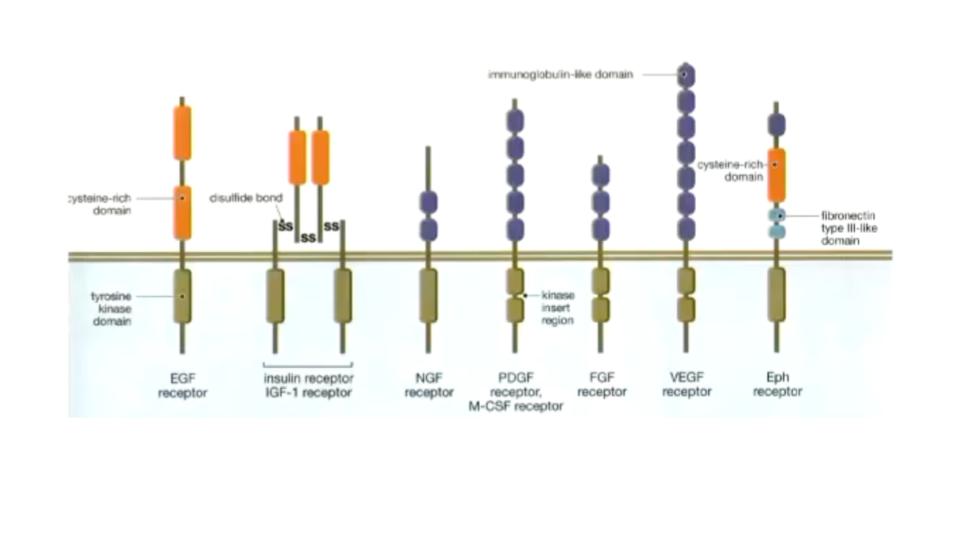
the extracellular cysteine-rich hydrophilic domain, the transmembrane domain and the intracellular tyrosine kinase domain
describe the extracellular cysteine-rich domain of the EGF receptor:
hydrophilic, usually interacts with the ligand, often contains conserved elements including immunoglobulin (Ig)-like, epidermal growth factor (EGF)-like domains, fibronectin type III repeats, or cysteine-rich regions
describe the transmembrane domain of the EGF receptor:
usually 20-25aa of alpha-helical structure made up of hydrophobic amino acids, which is stabilised via interaction with fatty acid chains of the lipid bilayer
inserting a _______ through the plasma membrane is not straightforward. Genes encoding transmembrane proteins contain a _____-peptide which directs the newly synthesised protein to the ___________ _________.
protein, signal, endoplasmic reticulum
describe the tyrosine kinase domain of the EGF receptor
hydrophilic intracellular domain that interacts with downstream signalling machinery. In the case of receptor tyrosine kinases (RTK’s), this includes a tyrosine kinase domain.
true or false: the EGF receptor is a type of RTK?
true
Even though the hydrophobic transmembrane domain is strictly constrained with respect to structure and amino acids, we are able to transmit information from the extracellular ligand-binding region across the plasma membrane to the intracellular ‘effector’ side. Fundamentally, only 2 ways seem to have evolved to solve this; what are they?
confirmational changes to multi-pass trans membrane receptors, which are then often associated with G-proteins
the dimerisation/multimerisation of single-pass transmembrane receptors
give 7 examples of transmembrane RTK’s:
EGF receptor, insulin receptor IGF-1 receptor, NGF receptor, PDGF receptor M-CSF receptor, FGF receptor, VEGF receptor and Eph receptor
describe the responses of the EGF receptor
stimulates cell survival, growth, proliferation, or differentiation of various cell types; acts as an inductive signal in development
describe the response of the insulin receptor
stimulates carbohydrate utilization and protein synthesis
describe the response of the IGF receptor-1
stimulate cell growth and survival in many cell types
describe the response of Trk A
stimulates survival and growth of some neurons
describe the response of PDGF receptors (alpha and beta)
stimulate survival, growth, proliferation, and migration of various cell types
describe the response of the MCSF receptor
stimulates monocyte/macrophage proliferation and differentiation
describe the response of FGF receptors (FGFR1-FGFR4, plus multiple isoforms of each)
stimulate proliferation of various cell types; inhibit differentiation of some precursor cells; act as inductive signals in development
describe the response of VEGF receptors
stimulates angiogenesis
describe the response of Eph receptors (A and B types)
stimulate angiogenesis; guide cell and axon migration
what is the signal protein of EGF receptors?
EGF
what is the signal protein of insulin receptors?
insulin
what is the signal protein of IGF receptor-1?
insulin-like growth factors (IGF1 and IGF2)
what is the signal protein of Trk A receptors?
nerve growth factor (NGF)
what is the signal protein of PDGF receptors (alpha and beta)?
platelet-derived growth factors (PDGF AA, BB, AB)
what is the signal protein of MCSF receptors?
macrophage-colony-stimulating factor (MCSF)
what is the signal protein of FGF receptors (FGFR1-FGFR4, plus multiple isoforms of each)?
Fibroblast growth factors (FGF1 to FGF24)
what is the signal protein of VEGF receptors?
vascular endothelial growth factor (VEGF)
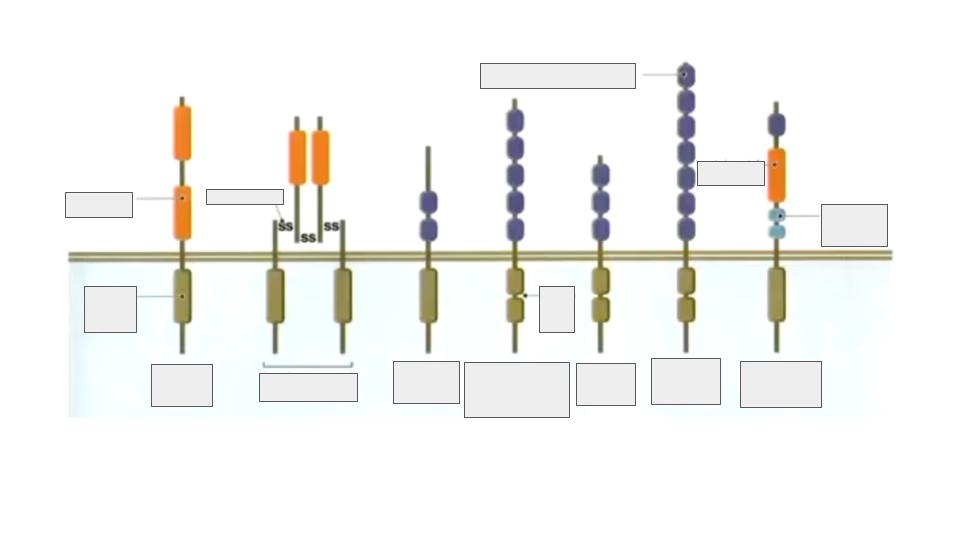
fill in the blanks:
what is the signal protein of Eph receptors (A and B types)?
Ephrins (A and B types)
describe how enzyme-coupled receptors work:
where there is signal molecule in the form of a dimer, each ligand binds to a receptor, receptors are brought together and activate each other (catalytic domain activates)
how do monomeric ligands with 2 receptor binding sites work:
they are ligands that induce changes in the receptor that alter their affinity for one-another eg. Epidermal growth factor (EGF)