Monopolies/ Oligopolies/ Monopolistic Competition
 Call Kai
 Learn
Learn Practice Test
 Spaced Repetition
 Match
Match Flashcards
 Knowt Play
1/18

Earn XP
Description and Tags
Definitions
Name | Mastery | Learn | Test | Matching | Spaced | Call with Kai | Chat |
|---|
No analytics yet
Send a link to your students to track their progress
19 Terms
Oligopoly
A market structure comprised of small number of large firms, which are mutually interdependent and are producing either homogenous or differentiated products. They have high barriers to entry and exit.
Non-price Competition
Firms engaging in product differentiation to make their products less substitutable to their rival firms.
Average Cost Pricing
A pricing strategy to limit a firm’s market power by charging a price that is equal to the average cost.
Marginal Cost Pricing
A price strategy to control a firm’s market power by charging a price equal to its marginal cost.
Mutual Interdependence
When each firm takes into account the possible actions of their rivals, also their reactions to the firms own actions when making business decisions.
Cartel
A formal collusion when two or more firms enter agreements to restrict the quantity of the good produced by each firm or to fix the price of a good in an industry.
Price Discrimination
when a producer sells the same good at different prices to different consumers for reasons that are not associated with differences in the costs of production.
Price Leadership
cooperation that is implicit or understood between the cooperating firms, without any formal agreement.
Abnormal profits
earned when the firm’s total revenue exceeds the firms total economic costs
Productive Efficiency
when a firm uses the minimum amount of resources to produce the maximum possible output.
Long run
time period in which all factor inputs can be changed and there are only variable inputs
Nash Equilibrium
shows that a firm’s decision to maximize self interest resulting in undesirable outcomes for both the firm and their rivals, compared to the situation where both of them cooperate.
Concentration ratio
provides an indication of the percentage of output produced by the number of largest firms in an industry, reflects the degree of competition in an industry
Price/Output Determination of MC Firms (Assumptions), S-RE
All MC firms aim to profit maximize, produces at MC=MR.
in short run, MC firms earn normal/supernormal/subnormal profits
as MC firms earn subnormal profits, its activity is determined by its ability to cover its variable costs > MC firms shut down when Px at Ar is lower than Avc
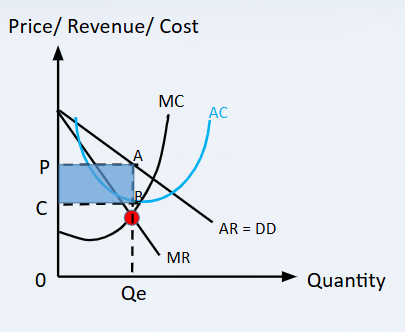
SR Equilibrium: Supernormal Profits
AR > AC
EQ Px: P
EQ output: Qe
Tr: 0PAQe
Tc: 0CBQe
Supernormal profit area: CPAB

LR EQ: Normal Profits
DD curve shifts left to AR2, its more Price Elastic due to the gentle slope
New firms stop entering up until the industry earns normal profits AR2 = AC
Supernormal Profits are eroded by entry of new firms
MC industry earns normal profits in the long run, entry/exit of firms stops
Each MC firm produces at a lower output, has lower market share

MC efficiency at LR EQ
they earn normal profits in the long run
at Q2 the π - maximizing output, charging a price that is greater than the MC. (OVERCHARGING csmrs)
P > MC, MC firms are not AE
and
At Q2 the π - maximizing output, Q2, the firm is not operating at min AC
excess capacity, though firms can still lower AC by expanding its output
Out of Monopolies, Oligopolies and Monopolistic Competition: Monopolistic Competition is the MOST Allocatively inefficient
but.
Out of Monopolies, Oligopolies and Monopolistic Competition: Monopolistic Competition is the LEAST Productively inefficient
Impact on csmr: Consumer Choice
Impact on cmsr: Overcharging