Orbital motion
 Call Kai
 Learn
Learn Practice Test
 Spaced Repetition
 Match
Match Flashcards
 Knowt Play
1/14

There's no tags or description
Looks like no tags are added yet.
Name | Mastery | Learn | Test | Matching | Spaced | Call with Kai | Chat |
|---|
No analytics yet
Send a link to your students to track their progress
15 Terms
satellite
something that orbits something else
less massive objects move around more massive objects due to a force of gravity
What keeps satellites in a circular orbit?
gravity provides the force
natural satellites
moon
earth
halley’s comet (orbits sun)
titan (saturn’s largest moon)
artificial satellites
ISS
Hubble space telescope
Naustar I
Sputnik I
What is the difference between a planet and a natural satellite?
A planet orbits a star, while a natural satellite orbits a planet
What is a similarity between planets and natural satellites?
They both orbit objects in space and do not emit their own light
What is the difference between natural and artificial satellites?
Natural satellites form naturally, while artificial satellites are man-made and placed into orbit
What is a similarity between natural and artificial satellites?
A: They both orbit objects in space
What force keeps an object in orbit?
Gravity provides the centripetal force that keeps an object moving in a circle
What is centripetal force?
A force that acts towards the centre of a circular path
Why does an object in circular orbit accelerate even if its speed stays constant?
Because its direction is constantly changing, so its velocity changes
What happens to speed in a non-circular (elliptical) orbit?
Speed changes—an object speeds up when closer and slows down when further away
if a car is on a semi circular bend what forces provide the centripetal force
friction between tyres and the road
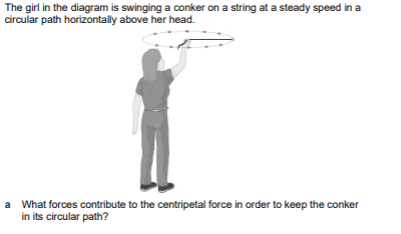
(2)
the tension is a force along the string
so it always points to the centre of the circle when the conker is swung

as it is being swung in the air in a circular motion (3)
the conkers velocity changes direction as it moves in a circular path
the change of velocity is towards the centre of the circle
so the conker is continuously accelerating towards the centre of the circle