Lesson 5 - Dystocia in large animals
 Call Kai
 Learn
Learn Practice Test
 Spaced Repetition
 Match
Match Flashcards
 Knowt Play
1/76

There's no tags or description
Looks like no tags are added yet.
Name | Mastery | Learn | Test | Matching | Spaced | Call with Kai | Chat |
|---|
No analytics yet
Send a link to your students to track their progress
77 Terms
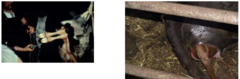
A cow is in prolonged labor. The fetus has not been delivered despite strong abdominal contractions. On vaginal examination, the birth canal appears adequate, but the fetus is presented abnormally. What is the most likely cause of dystocia?
fetal malpresentation
What should you only do if you have no other option for a bovine obstetrical exam?
place the cow in a crush
Where should you place a cow during an obstetrical exam?
the end of the race
What history should be gathered while examining the cow during an obstetrical exam?
1. Dam's age
2. Parity
3. Previous breeding history esp. any dystocia
4. Duration, nature, and intensity of labor
5. Time of appearance and rupture of fetal membranes
6 Any fetal parts emerged from the vulva
7. Any examination or assistance been undertaken
What can information about the time of the appearance and rupture of fetal membranes help to determine?
how long the cow has been in labor
When should a general exam be done in a case of suspected dystocia?
can be postponed until after the delivery of the fetus unless urgent attention is required to save the life of the dam
What characteristics of the external genitalia are examined during an obstetrical exam?
1. degree of vulvar enlargement and relaxation
2. protrusion of membranes and/or fetal body parts
3. nature of vulvar discharge
4. intensity, character and frequency of straining
What can be determined from a vaginal exam?
1. width of the birth canal, cervix, vaginal walls
2. degree of lubrication of the birth canal
3. disposition of the fetus (or fetuses)
4. if the fetus is alive
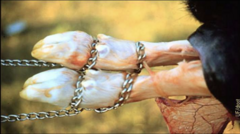
Which limbs of the fetus are coming out of the vulva shown in the picture?
need to palpate in order to diagnose
What can you palpate to determine that you are feeling the forelimbs?
carpus and fetlock bend in the same direction
What can you palpate to determine that you are feeling the hindlimbs?
hock and and fetlock bend in opposite directions
What are the fetal reflexes?
1. Interdigital claw reflex/withdrawal reflex
2. Sucking reflex
3. Corneal reflex
4. Anal reflex
What is the corneal reflex?
fetus will roll eye or withdraw head when cornea is touched
What does the presence of fetal reflexes mean?
the fetus is alive
What does the absence of fetal reflexes mean?
the fetus might be dead
What are the conditions that can cause an absence of fetal reflexes when the fetus is still alive?
1. prolonged hypoxia
2. fetus wedged and has no spave to move or respond
What is the next step of determining fetal viability when fetal reflexes are absent?
find the chest and feel the heart if the fetus is in cranial presentation, or try to palpate the umbilical artery for a pulse if the fetus is in caudal presentation
What is a rectal exam essential for diagnosing?
uterine torsion
On obstetrical examination in a cow with dystocia, you find that withdrawal and suckling reflexes are present. What is the most correct interpretation?
the fetus is definitely alive
On obstetrical examination in a cow with dystocia, you find that withdrawal and suckling reflexes are absent. What is the most correct interpretation?
the fetus may be alive or dead
How can an epidural make delivery go more smoothly?
gets rid of abdominal contractions, and uterine contractions are still present
What supplies should be on standby for the calf in case of emergencies?
1. clean towels
2. respiratory stimulant like naloxone or doxipram
3. speculum with a light source
4. ET-tube with stylet
How much lidocaine should be used for a bovine epidural?
3-6 mL (avg. 5 mL, basically 1 mL/100 kg)
What can happen if too little lidocaine is used for an epidural?
no effect
What can happen if too much lidocaine is used for an epidural?
the cow will go down
What sites can the epidural space be accessed from?
1. between the last sacral and first coccygeal vertebrae
2. between the 1st and 2nd coccygeal vertebrae
What is the technique for finding the epidural space?
manipulate tail while feeling for "gap" between vertebrae
What kind of needle is used for an epidural in a cow?
18G
How is the needle inserted for an epidural?
cranially with the bevel facing up
What can confirm correct placement of the needle into the epidural space?
a small bleb of lidocaine can be placed in the hub and sucked in (may hear a sucking sound)
What is the number one cause of bovine dystocia?
feto-maternal disproportion
What are the potential complications of obstructive dystocia from feto-maternal disproportion?
1. damage to obturator or ischiatic nerves
2. fetal death up to 40-50%
3. maternal death 5-12%
How can obstructive dystocia from feto-maternal disproportion be prevented?
1. selecting sires for lower birth weights
2. selecting well grown heifers
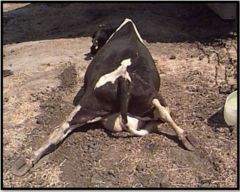
What complication is of feto-maternal disproportion is being shown here?
obturator nerve paralysis
When is an episiotomy indicated?
obstetric cases where the vestibule or the vulvar lips are obstructing passage of the fetus and further traction would lead to fetal distress and tearing of the vulvar lips
What is the technique for performing an episiotomy?
1. Epidural anesthesia
2. incision 5cm from the dorsal commissure of the vulva at a 45°angle from the vertical (10 o'clock or 2 o'clock), avoiding the anal sphincter
1. Three layer closure of the mucosa, subcutaneous tissue and skin

What procedure is being shown?
episiotomy
How is caudal longitudinal presentation corrected?
traction
How is transverse presentation corrected?
converted into caudal longitudinal presentation (version!) followed by traction
How is malposition corrected?
rotation manually by cross traction of limbs
How is malposture corrected?
repulsion (always done first) followed by extension and traction
How are uni- or bilateral carpal, elbow and shoulder flexions correted?
convert elbow and shoulder flexions to carpal flexions to resolve
What are the steps of carpal flexion correction?
1. Repulsion of the part proximal to the bent carpus
2. Outward rotation of the middle part (Carpus joint/metacarpal area) moving the hoof medially
3. Protect vagina from laceration by cupping the hoof in your hand and pulling it towards the vagina

How can this cranial longitudinal presentation, dorso-sacral position, left shoulder flexion be corrected?
convert into carpal flexion and then continue as described for carpal flexion
What can be used to correct malposition of the head and neck?
eye hooks or a war bridle
What is one of the most difficult malpostures to correct?
malposition of the head and neck
You are handling a case of dystocia in a cow. On vaginal examination, you determine that the fetus is in cranial longitudinal presentation with dorsosacral position and right carpal flexion. What would be the best first approach to handle this case?
correct the carpal flexion and then apply traction to deliver the fetus
What are the calving aids?
1. lube
2. calving ropes or chains and handles
3. head snare
4. eye hooks
5. calving jack
Where are calving chains/ropes applied?
above and below the fetlock
What is important to know about using a calving jack?
massive force exerted may damage cow/fetus
How can we determine if the fetus can be delivered vaginally?
trial traction with two strong people for 10 minutes
What is the largest diameter of the pelvis?
oblique
What do you ALWAYS need to do before pulling?
correct malposture
What happens during normal delivery?
one forelimb is always slightly ahead of the other, the fetal body rotating slightly towards the side of the more advanced limb, and one shoulder passes through the pelvis and then the other one passes through
How is alternate traction used to correct dystocia?
traction is applied to the more ventral limb until no further progress, hold the limb in this position, and then apply traction to the other limb
When should you try to pull when correcting dystocia?
when the cow is straining
How should you pull?
continuous and alternating movements
When can traction be applied to both limbs simultaneously?
once the shoulders are delivered
What are the most common parts that get stuck in the birth canal?
head and shoulders
What is the next most common part that can get stuck after the head and shoulders?
hips
Why should hiplock be avoided at all costs?
can cause damage to the obturator nerves
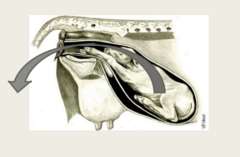
What is being shown here?
the birth arc
What should you do once the calf is born?
clean nose and mouth
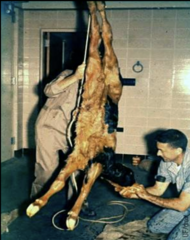
Why is this calf discolored?
meconium passed in uterus
What does it mean when a fetus passed meconium in the uterus?
sign of fetal distress
What is a potential complication of meconium being passed in the uterus?
breathing problems
What should you examine in your postpartum examination of the birth canal?
1. presence of a second fetus
2. vaginal or uterine tears
3. eversion/prolapse
What are possible complications if the cow is unable to stand postpartum?
1. nerve damage
2. pelvic fracture
3. metabolic disorder
What are the indications for a cesarian section?
1. live calf
2. valuable calf
3. vaginal delivery impossible
4. feto-maternal disproportion
5. incomplete dilation of the cervix or caudal tract
6. irreducible fetal maldisposition
7. irreducible uterine torsion
What is a bovine fetotomy?
method of cutting a dead fetus into pieces that can be delivered through the birth canal
What are the requirements for performing a fetotomy?
fetus must be dead and birth canal must be fully dilated
What is the first cut of a fetotomy?
head and one leg ideally underneath the scapula
What is the second cut of a fetotomy?
thorax as far back as possible
What is the third cut of a fetotomy?
depending on how far back you are able to make your 2nd cut, you may need to cut through the lumbar region
What is the fourth cut of a fetotomy?
split the pelvis using the tuber ischii as the guide to keep your wire in place
What is required for aftercare following a fetotomy?
1. antibiotics if needed
2. anti-inflammatories
3. painkillers
4. oxytocin
You are handling a case of dystocia in a cow. On vaginal examination, you determine that the fetus is alive and in a cranial longitudinal presentation and dorsosacral position with lateral deviation of head and neck. Despite your best efforts, you couldn't correct the malposture. What would be the best approach to handle this case?
perform a cesarean section