MCAT Error Log Takeaways
 Call Kai
 Learn
Learn Practice Test
 Spaced Repetition
 Match
Match Flashcards
1/32

There's no tags or description
Looks like no tags are added yet.
Name | Mastery | Learn | Test | Matching | Spaced | Call with Kai | Chat |
|---|
No analytics yet
Send a link to your students to track their progress
33 Terms
boiling points
what to look at to determine
polarity (more polar, higher bp) —> if they have the same polarity then look at branching
branching if the molecules have similar structures (less branching, higher boiling points bc more surface area)
*if pressure dec, bp dec
determining where enantiomers differ
enantiomers differ at their chiral centers—> this leads to different spatial arrangements so look for sp3 hybridized carbon atomsand substituents that vary
avogadro’s number
6.022 × 10²³ molecules per mole
thin layer chromatography
used to separate non-volatile mixtures based on differences in their polarity and adsorption to stationary and mobile phases, more polar travels less distance/ slower (smaller Rf) and vice versa
hydrogen bonding
is an intermolecular force that occurs when a hydrogen atom, covalently bonded to a highly electronegative atom like oxygen or nitrogen, is attracted to another electronegative atom
to participate, a molecule must have a hydrogen atom attached directly to nitrogen, oxygen, or fluorine (acting as a donor), or if it contains an N, O, or F atom with lone pairs (acting as an acceptor)
pH
pH +pOH = 14
pH = -log[H+]
strong acids
are acids that completely dissociate in water
HI, HCl, HBr, HClO3, HClO4, HNO3, H2SO4 (hi cool bro clo clo no so, 3434)
strong bases
are bases that completely dissociate in water
metal cation (Group 1 and 2) and a hydroxide group (OH)
thin line chromatogrpahy
movement along paper, migration of components is based on h-bonding, size of spots is based on solute concentration
converging vs diverging lens
Converging lenses focus light rays to a point, while diverging lenses spread light rays apart.
Converging lenses are typically convex, and diverging lenses are concave.
Nearsightedness = converging eye lens, must have a positive sign of lens strength
catalyst
is a substance that increases the rate of a chemical reaction without being consumed in the process
lowers the activation energy
stabilization of transition state is done by an enzyme to lower the Ea of a reaction. (Stabilizing the SUBSTRATE would inc Ea and slow the reaction)
le chatelier's principle
states that if a system at equilibrium is subjected to a change in concentration, temperature, or pressure, the equilibrium will shift to counteract that change
atmospheric pressure
1 atm, 760 mmHg, 101.3 kPa
gas-liquid chromotography
Least polar, most volatile, first peak to emerge in gas-liquid chomatography
boiling chip
small, porous piece of material added to a liquid to promote smooth boiling and prevent bumping, prevents superheating by providing nucleation sites for bubble formation.
VESPR
remember.
similar properties
elements in the same group with have similar properties
ion responsible for color of solution
the ion responsible for color in a solution is typically a transition metal ion, which can absorb certain wavelengths of visible light, giving the solution a characteristic color
most vs least soluble in water
solubility differences are based on intermolecular forces; substances with stronger hydrogen bonding are generally more soluble —> more polar (less C-H bonds)
inc yield of product or byproduct
increase the reagents
pKa
is a measure of the acidity of a solution, higher pKa means more basic
to determine the highest vs lowest pKa, consider the strength of the acid: less EN atoms and smaller atoms hold electrons more tightly and thus a higher pKa
Keq
is the equilibrium constant for a reaction, representing the ratio of the concentrations of products to reactants at equilibrium
henderson-hasselbalch equation
equation is used to calculate the pH of a buffer solution
pH = pKa + log [A-]/[HA]
leaving groups
weaker bases make the best leaving groups, while strong bases make bad leaving groups
you can make a bad leaving group a good one by protonating it to increase its stability (or reduce its basicity or turn the LG into a neutral molecule)
aliphatic
compounds that consist of carbon and hydrogen arranged in open-chain or branched structures, not including aromatic rings
how can you know if something would be a good nucleophile
a good nucleophile is typically characterized by a strong base, high electron density, and less steric hindrance, allowing it to effectively attack electrophiles
aromatic compounds can be good nucleophile if they possess a negatively charged or electron-rich substituent and are not sterically hindered
number of possible peptides that contain one each of n amino acids
The formula for the number of possible peptides that contain one each of n amino acids is n! (n factorial). For n = 3 (a tripeptide), n! = 3! = 3 × 2 × 1 = 6 = Answer C. Alternatively, for a tripeptide ABC, the following combinations are possible: ABC, ACB, BAC, BCA, CAB, and CBA, or six = Answer C.
ionic character in the periodic table
difference in EN means greater ionic character
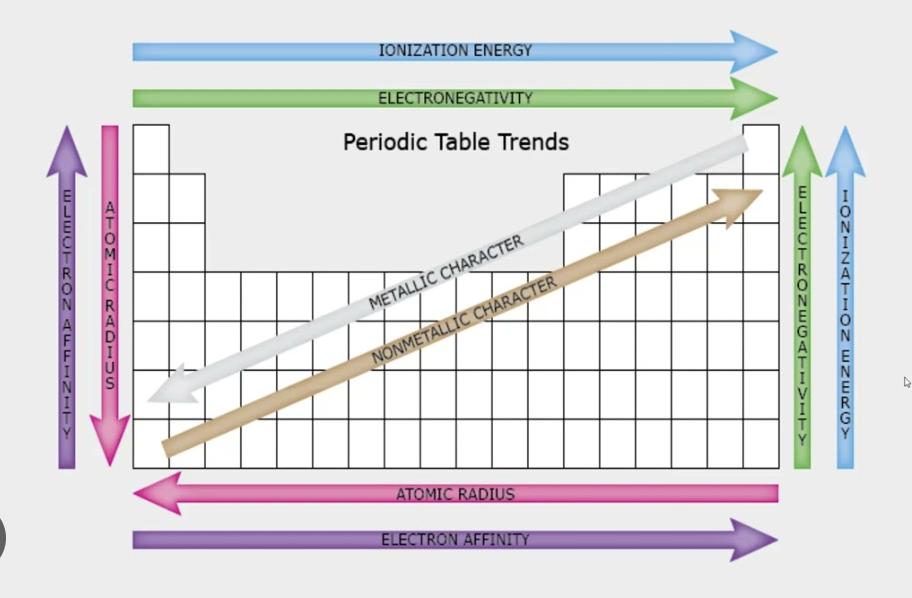
periodic trends
describe the predictable patterns in properties
entropy
entropy = randomness in a system
delta(S) is the change in entropy; if it is positive, the system becomes more disordered and entropy inc BUT if it is negative, less disordered and entropy decreases
one factor that affects entropy is if bonds are made, entropy dec